Passkeys by Happenv sp. z o.o.
CommunityWebAuthn passkeys for Filament panels — Face ID, Touch ID, Windows Hello or a security key as a second factor.
 Author:
Happenv sp. z o.o.
Author:
Happenv sp. z o.o.
Package health
Automated checks of this plugin's Composer package
15 checks
- Passed: GitHub Actions pinned to SHA
- Skipped: GitLab CI includes pinned to SHA
- Passed: Open security advisories
- Passed: Dependabot PR responsiveness — No open Dependabot PRs.
- Skipped: Renovate MR responsiveness
- Passed: Dependabot or Renovate configured
- Passed: Dependency update cooldown configured
- Passed: Provides a security policy
- Passed: Abandoned or archived — No consulted source marks the package abandoned (packagist, github).
- Passed: Commit and release recency — Active: last commit 2 days ago; last release 2 days ago.
-
Passed:
composer.lock not committed by library
—
composer.lockis absent from the released dist archive. - Passed: Dist archive is lean
-
Passed:
Current Laravel version supported
—
Package dependencies resolve together with current Laravel
13.0. -
Passed:
Current PHP version supported
—
Constraint
^8.2supports current PHP8.5. - Skipped: Current Symfony version supported
filament/
namespace. Review the source and install at your own risk. Found
malware or an unresolved security issue the author won't
address?
Report it
.
Documentation
- Key features
- Requirements
- Installation
- Configuration
- Usage
- How it works
- Testing your application
- Translations
- Development
- Upgrading
- Changelog
- Contributing
- Security vulnerabilities
- Credits
- License






Multi-factor authentication for Filament panels using WebAuthn passkeys, powered by laravel/passkeys.
use Happenv\FilamentPasskeys\FilamentPasskeysPlugin;
use Happenv\FilamentPasskeys\PasskeyAuthentication;

$panel
    ->multiFactorAuthentication([
        PasskeyAuthentication::make(),
    ])
    // Optional: a "Sign in with a passkey" button on the login page.
    ->plugin(FilamentPasskeysPlugin::make());
#Key features
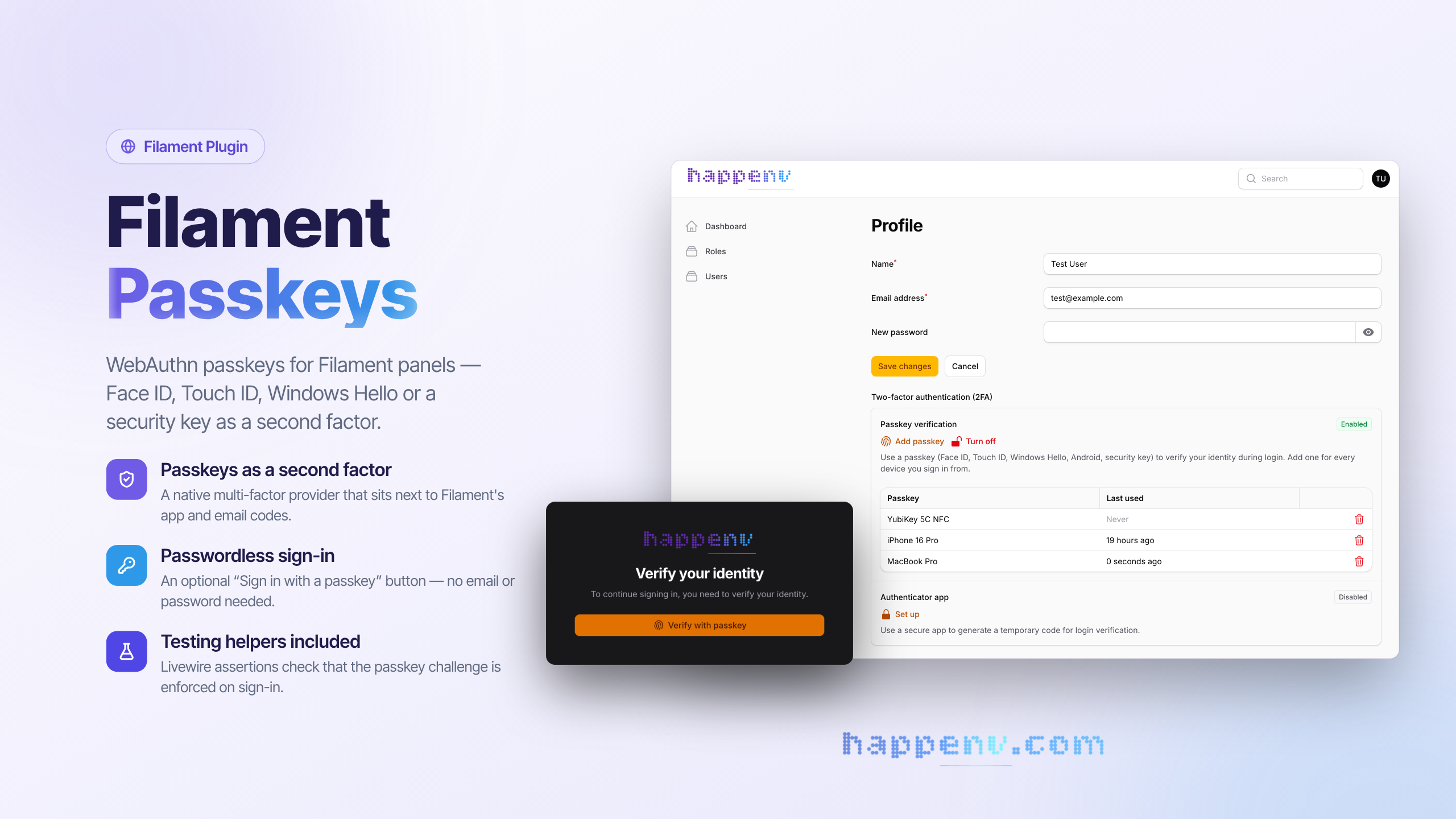
- Passkeys as a second factor. A native Filament multi-factor provider: after the password step, users confirm with one of their passkeys. It sits alongside Filament's app and email code providers, and users choose between the methods they have turned on.
- Passwordless sign-in on the login page. An optional "Sign in with a passkey" button under the login form signs users in with a discoverable credential, no email or password needed.
- A passkey for every device. Users can register as many passkeys as they need (Windows Hello, an Android phone, iCloud Keychain, a security key) and remove any one of them from a table on their Filament profile page. Each row shows which authenticator holds the passkey and when it was last used.
- A streamlined passkey-only challenge. When a passkey is a user's only method, the prompt opens as soon as the challenge appears and Filament's redundant "Confirm sign in" button is hidden. Both are on by default and can be turned off.
- Secure by default. Challenges are single use and bound to the user who passed the password step, so a replayed assertion or someone else's passkey is rejected. Passwordless sign-in honours
laravel/passkeyslogin authorization andFilamentUser::canAccessPanel(). - Built on
laravel/passkeys. Its actions handle challenge generation, verification and storage, and every ceremony runs through Livewire, so no extra routes are exposed. - Testing helpers. Livewire assertions check whether signing in stops at the multi-factor challenge and whether that challenge offers a passkey.
- Upgrade path from
spatie/laravel-passkeys. A migration converts existing passkeys to thelaravel/passkeysschema. - Translated into every language Filament supports (64 locales).
- Tested. A Pest suite runs real WebAuthn ceremonies against a virtual authenticator on every supported PHP, Laravel and Filament combination.
#Requirements
| Package | Versions |
|---|---|
| PHP | ^8.2 (CI runs 8.3 – 8.5) |
| Laravel | 12, 13 |
| Filament | 4 (^4.13.3), 5 (^5.8) |
laravel/passkeys |
^0.2.1 |
#Installation
Install the package via Composer:
composer require happenv-com/filament-passkeys
Publish and run the migrations from laravel/passkeys:
php artisan vendor:publish --tag="passkeys-migrations"
php artisan migrate
Publish the laravel/passkeys config (optional, to tweak the relying party ID, allowed origins, timeout, etc.):
php artisan vendor:publish --tag="passkeys-config"
laravel/passkeysderives the relying party ID and the allowed origins fromAPP_URL. Make sure it matches the URL your panel is served from, or passkey ceremonies will be rejected.
#Upgrading from spatie/laravel-passkeys
Both packages use a passkeys table and a config/passkeys.php file, so they cannot be installed side by side. Existing passkeys keep working after the switch; publish and run this package's upgrade migration instead of the laravel/passkeys one:
composer remove spatie/laravel-passkeys
php artisan vendor:publish --tag="filament-passkeys-migrations"
php artisan migrate
The migration renames authenticatable_id to user_id and data to credential, and rebuilds credential_id from the stored credential record. It does nothing when the table already has the laravel/passkeys schema. Remove the old config/passkeys.php published by Spatie and publish the new one if you need to customise it.
#Configuration
Publish this package's config (optional):
php artisan vendor:publish --tag="filament-passkeys-config"
| Option | Default | What it does |
|---|---|---|
redirect |
null |
Where to send the user after registering a passkey — see Customising the redirect URL. |
register_passkeys_routes |
false |
Keeps the laravel/passkeys HTTP routes — see laravel/passkeys routes. |
hide_challenge_confirm_button |
true |
Hides Filament's "Confirm sign in" button on a passkey-only challenge — see Passkey-only challenge. |
auto_start_challenge |
true |
Opens the passkey prompt as soon as a passkey-only challenge appears — see Passkey-only challenge. |
Optionally, publish the views and translations:
php artisan vendor:publish --tag="filament-passkeys-views"
php artisan vendor:publish --tag="filament-passkeys-translations"
#Usage
#1. Prepare your User model
Implement the HasPasskeysAuthentication contract and use the InteractsWithPasskeysAuthentication trait. They build on the laravel/passkeys PasskeyUser contract and PasskeyAuthenticatable trait:
use Filament\Models\Contracts\FilamentUser;
use Happenv\FilamentPasskeys\Concerns\InteractsWithPasskeysAuthentication;
use Happenv\FilamentPasskeys\Contracts\HasPasskeysAuthentication;
use Illuminate\Foundation\Auth\User as Authenticatable;

class User extends Authenticatable implements FilamentUser, HasPasskeysAuthentication
{
    use InteractsWithPasskeysAuthentication;

    // ...
}
Passkey verification counts as enabled when hasPasskeysEnabled() returns true, which by default means the user has at least one passkey. If your user model is not App\Models\User, tell laravel/passkeys about it in a service provider:
use Laravel\Passkeys\Passkeys;

Passkeys::useUserModel(\App\Models\Admin::class);
#2. Register the MFA provider in your panel
In your PanelProvider, register PasskeyAuthentication in the multiFactorAuthentication() array:
use Filament\Panel;
use Happenv\FilamentPasskeys\FilamentPasskeysPlugin;
use Happenv\FilamentPasskeys\PasskeyAuthentication;

public function panel(Panel $panel): Panel
{
    return $panel
        // ...
        ->multiFactorAuthentication([
            PasskeyAuthentication::make(),
        ])
        // Optional: adds a "Sign in with a passkey" button to the login page.
        ->plugin(FilamentPasskeysPlugin::make());
}
That's it. The MFA section in the user profile page now shows a "Passkey verification" entry with Set up / Turn off buttons. Once a passkey is registered, Set up becomes Add passkey and a table lists every passkey with a Remove button. After a user signs in with their password, Filament asks them to confirm with one of their passkeys.
Registering FilamentPasskeysPlugin is optional. Passkeys work as a second factor without it. The plugin only adds a "Sign in with a passkey" button directly on the login page, below the standard form, so users can sign in with a passkey without typing their email and password. Leave it out if you only want passkeys as a second factor.
#3. Customising the redirect URL
By default, after registering a passkey the set-up modal closes and the user stays on their profile page. To redirect them somewhere instead:
PasskeyAuthentication::make()
    ->redirectUrlUsing(fn () => route('dashboard'));
You can also set a static URL via config/filament-passkeys.php:
return [
    'redirect' => '/dashboard',
];
#4. Blocking passkey sign-in
The passwordless login button honours the laravel/passkeys authorization callback, e.g. to keep suspended accounts out:
use Illuminate\Validation\ValidationException;
use Laravel\Passkeys\Passkeys;

Passkeys::authorizeLoginUsing(function ($request, $user, $passkey): bool {
    if ($user->is_suspended) {
        throw ValidationException::withMessages(['credential' => ['This account is suspended.']]);
    }

    return true;
});
Users who fail FilamentUser::canAccessPanel() are never signed in.
#5. Passkey-only challenge
When a passkey is the only multi-factor method a user has turned on, the challenge needs nothing but the "Verify with passkey" button, since the ceremony submits the form itself. By default, the passkey prompt opens as soon as the challenge appears and Filament's "Confirm sign in" button is hidden. Two options in config/filament-passkeys.php turn this off:
return [
    // Hide Filament's "Confirm sign in" button (default: true).
    'hide_challenge_confirm_button' => true,

    // Open the passkey prompt as soon as the challenge appears (default: true).
    'auto_start_challenge' => true,
];
Users with more than one method enabled always get Filament's usual challenge. Some browsers, notably Safari, only allow WebAuthn right after a user gesture and may refuse the automatic prompt; the button stays available as a fallback.
#6. laravel/passkeys routes
Every ceremony runs through Livewire, so this package does not need the HTTP routes laravel/passkeys registers and turns them off. To keep them, e.g. for the @laravel/passkeys JavaScript client elsewhere in your app, set register_passkeys_routes to true in config/filament-passkeys.php.
#How it works
This package is a Filament adapter on top of laravel/passkeys. Challenge generation, attestation and assertion verification and persistence are handled by its actions; the browser side uses @simplewebauthn/browser.
- Set up / Add passkey is a regular Filament action with an optional name field. Submitting it runs
GenerateRegistrationOptionsand hands the options to the browser, which completes the ceremony and submits the form again so the action can store the passkey withStorePasskey. The options exclude the user's existing passkeys, so the same authenticator cannot be registered twice. A passkey saved without a name is named after its authenticator, looked up by AAGUID (e.g. "Windows Hello", "Google Password Manager"). - Remove deletes a single passkey through
DeletePasskey. Removing the last one turns passkey verification off, and its confirmation says so. - Turn off deletes each of the user's passkeys through
DeletePasskey, so aPasskeyDeletedevent fires for every one. - Login challenge is a regular field of Filament's MFA challenge form. Its button generates options scoped to the user who passed the password step, and the field's validation rule checks the assertion with
VerifyPasskeyfor that same user, so a passkey belonging to anyone else is rejected. - Sign in with a passkey runs a discoverable-credential ceremony and logs the owner in on the panel's guard.
#Testing your application
The package adds assertions to Livewire's Testable for Filament's login page, so your own tests can check that multi-factor authentication is enforced:
use Filament\Auth\Pages\Login;
use Livewire\Livewire;

Livewire::test(Login::class)
    ->fillForm(['email' => $user->email, 'password' => 'password'])
    ->call('authenticate')
    ->assertMultiFactorChallengeRequired()
    ->assertPasskeyChallengeOffered();
| Assertion | Passes when |
|---|---|
assertMultiFactorChallengeRequired() |
Signing in stopped at the multi-factor challenge. |
assertMultiFactorChallengeNotRequired() |
No multi-factor challenge is shown. |
assertPasskeyChallengeOffered() |
The challenge is shown and offers a passkey, alone or next to other methods. |
assertPasskeyChallengeNotOffered() |
No challenge is shown, or the challenge offers no passkey. |
#Translations
#Supported languages
The package ships translations for every locale Filament supports. Publish them with php artisan vendor:publish --tag="filament-passkeys-translations" to adjust any wording.
Amharic (am) |
Persian (fa) |
Lithuanian (lt) |
Slovenian (sl) |
Arabic (ar) |
Finnish (fi) |
Mizo (lus) |
Albanian (sq) |
Azerbaijani (az) |
Filipino (fil) |
Latvian (lv) |
Serbian (Cyrillic) (sr_Cyrl) |
Bulgarian (bg) |
French (fr) |
Macedonian (mk) |
Serbian (Latin) (sr_Latn) |
Bengali (bn) |
Hebrew (he) |
Mongolian (mn) |
Swedish (sv) |
Bosnian (bs) |
Hindi (hi) |
Malay (ms) |
Swahili (sw) |
Catalan (ca) |
Croatian (hr) |
Burmese (my) |
Tajik (tg) |
Central Kurdish (ckb) |
Hungarian (hu) |
Norwegian Bokmål (nb) |
Thai (th) |
Czech (cs) |
Armenian (hy) |
Nepali (ne) |
Turkish (tr) |
Danish (da) |
Indonesian (id) |
Dutch (nl) |
Ukrainian (uk) |
German (de) |
Italian (it) |
Polish (pl) |
Urdu (ur) |
Greek (el) |
Japanese (ja) |
Portuguese (pt) |
Uzbek (uz) |
English (en) |
Georgian (ka) |
Portuguese (Brazil) (pt_BR) |
Vietnamese (vi) |
Spanish (es) |
Khmer (km) |
Romanian (ro) |
Chinese (Simplified) (zh_CN) |
Estonian (et) |
Korean (ko) |
Russian (ru) |
Chinese (Hong Kong) (zh_HK) |
Basque (eu) |
Kurdish (ku) |
Slovak (sk) |
Chinese (Traditional) (zh_TW) |
tests/Unit/TranslationsTest.php checks that every locale has exactly the keys English has.
#Development
composer test          # unit and feature tests
composer phpstan       # static analysis
composer cs            # fix code style: composer normalize, Rector, Pint
composer ci            # everything CI checks, locally
The package's JavaScript and CSS are built by bin/build.js into resources/dist, which is committed. After changing resources/js or resources/css, rebuild and commit the result — CI refuses outdated assets:
npm ci
npm run build   # or `npm run dev` to rebuild on change
npm run lint    # Prettier check, as in CI
#Upgrading
Breaking changes and how to migrate are described in UPGRADING for every major version.
#Changelog
See CHANGELOG and GitHub releases for what has changed recently.
#Contributing
See CONTRIBUTING for details.
#Security vulnerabilities
Please review our security policy on how to report security vulnerabilities.
#Credits
- Happenv sp. z o.o.
- webard
- Jefferson Gonçalves — original author of filament-multifactor-passkeys
- Laravel — for the underlying WebAuthn implementation
- All contributors
#License
The MIT License (MIT). See License File for more information.

The author
Happenv is a software development company specializing in e-commerce solutions, logistics systems, and Order Management Systems (OMS). We design, build, and maintain scalable business applications that help companies streamline operations, automate workflows, and improve customer experiences. Our expertise includes custom development, system integrations, and long-term support of solutions built with Laravel and Filament, delivering reliable and efficient platforms tailored to modern commerce and logistics needs.
From the same author
Translatable Fields
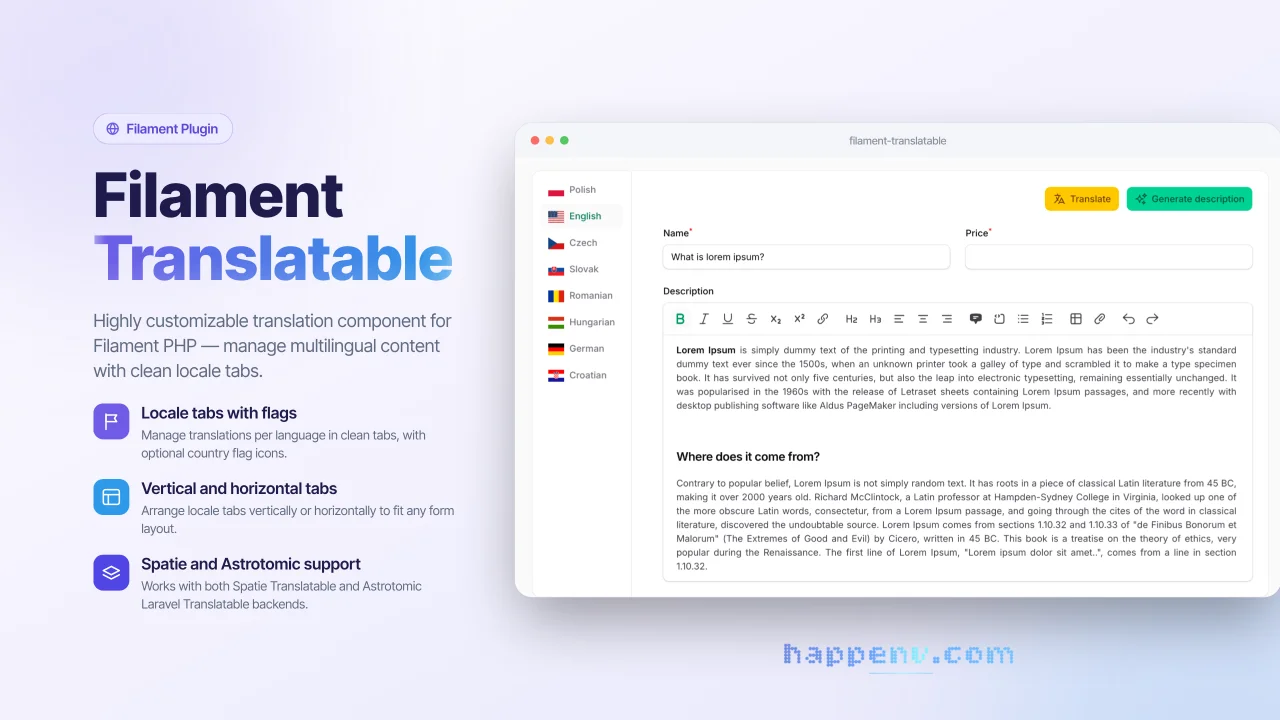
ilament Translatable is a flexible package that provides a complete solution for managing multilingual content in Filament admin panels. It allows you to easily create translatable form fields with an intuitive tabbed interface, supporting multiple locales and translation packages.
Author:
Happenv sp. z o.o.
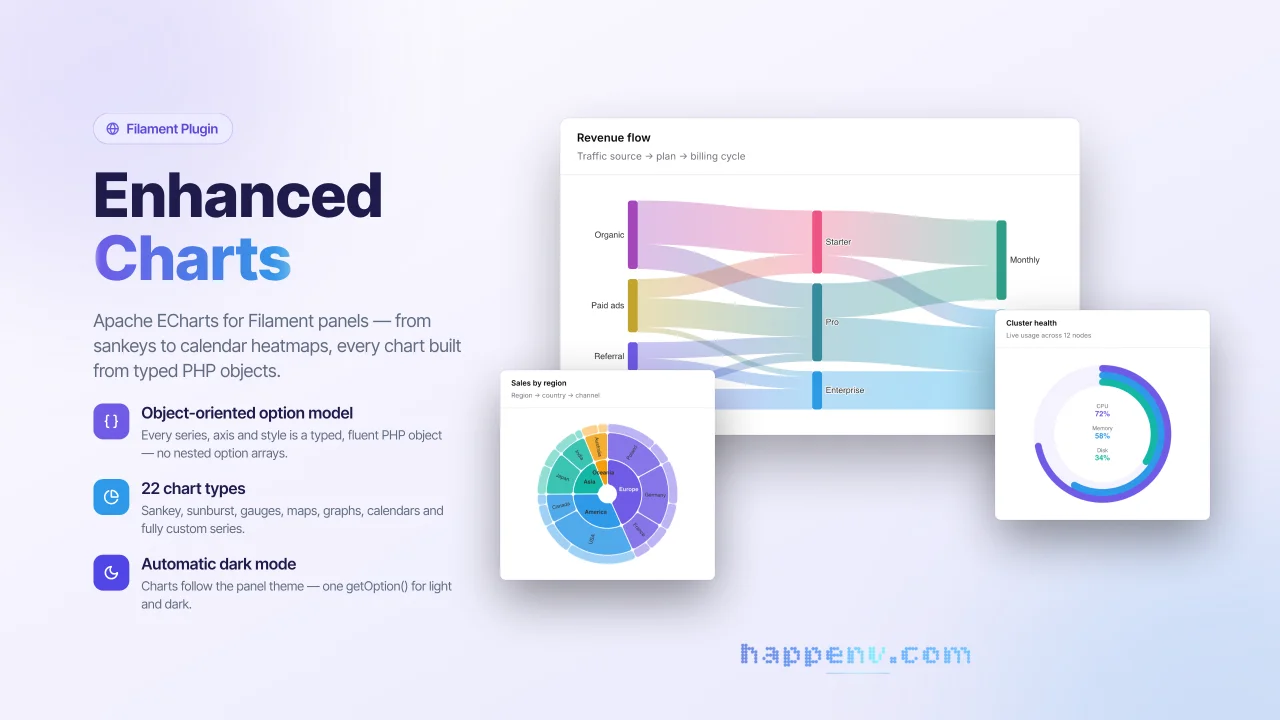
Enhanced Charts
Apache ECharts for Filament panels - from sankeys to calendar heatmaps, every chart built from typed PHP objects.
Author:
Happenv sp. z o.o.
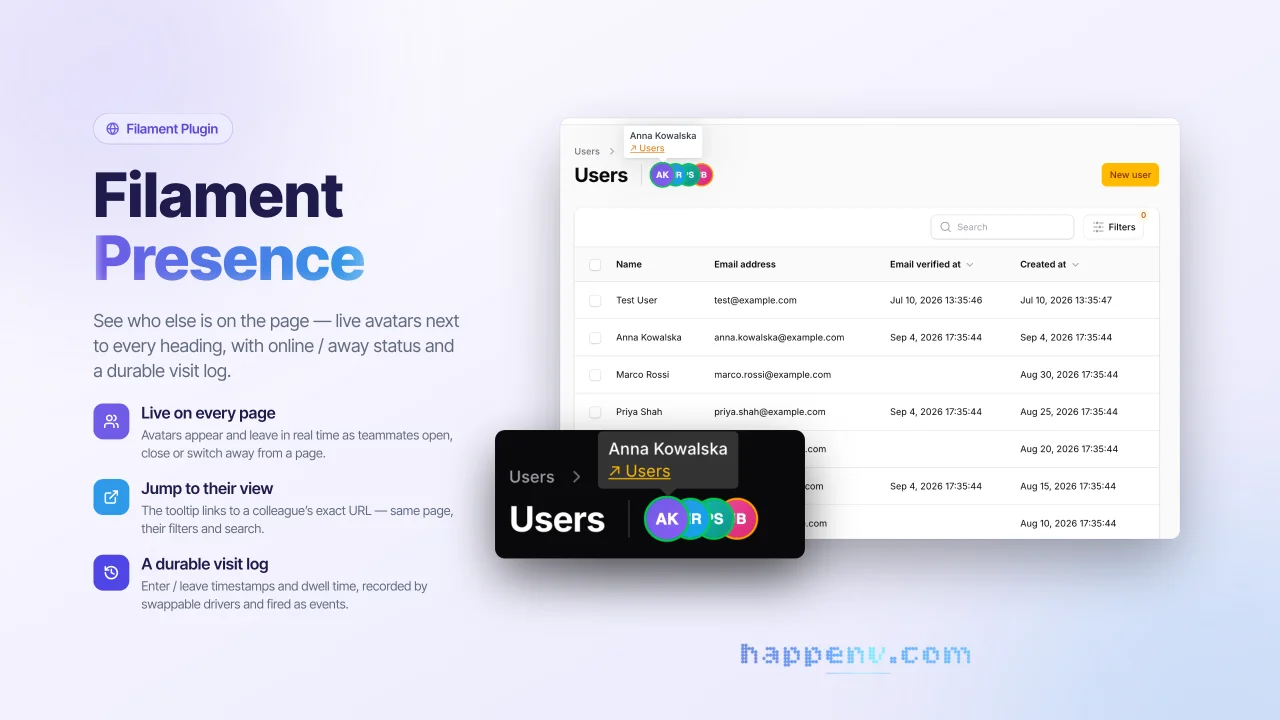
User Presence
See who else is on the page - live avatars next to every heading, with online / away status and a durable visit log.
Author:
Happenv sp. z o.o.
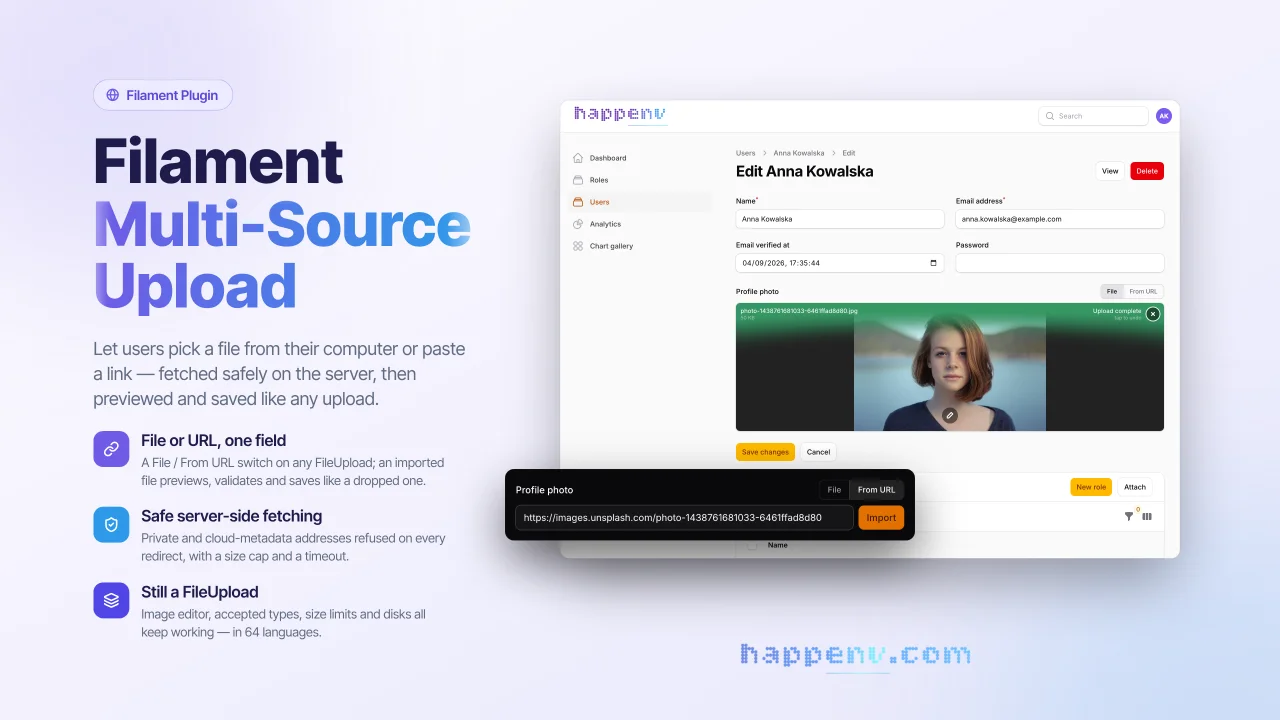
Multi Source Upload
A drop-in replacement for Filament's FileUpload field that lets users add a file from their disk or from a URL.
Author:
Happenv sp. z o.o.
Featured Plugins
A selection of plugins curated by the Filament team
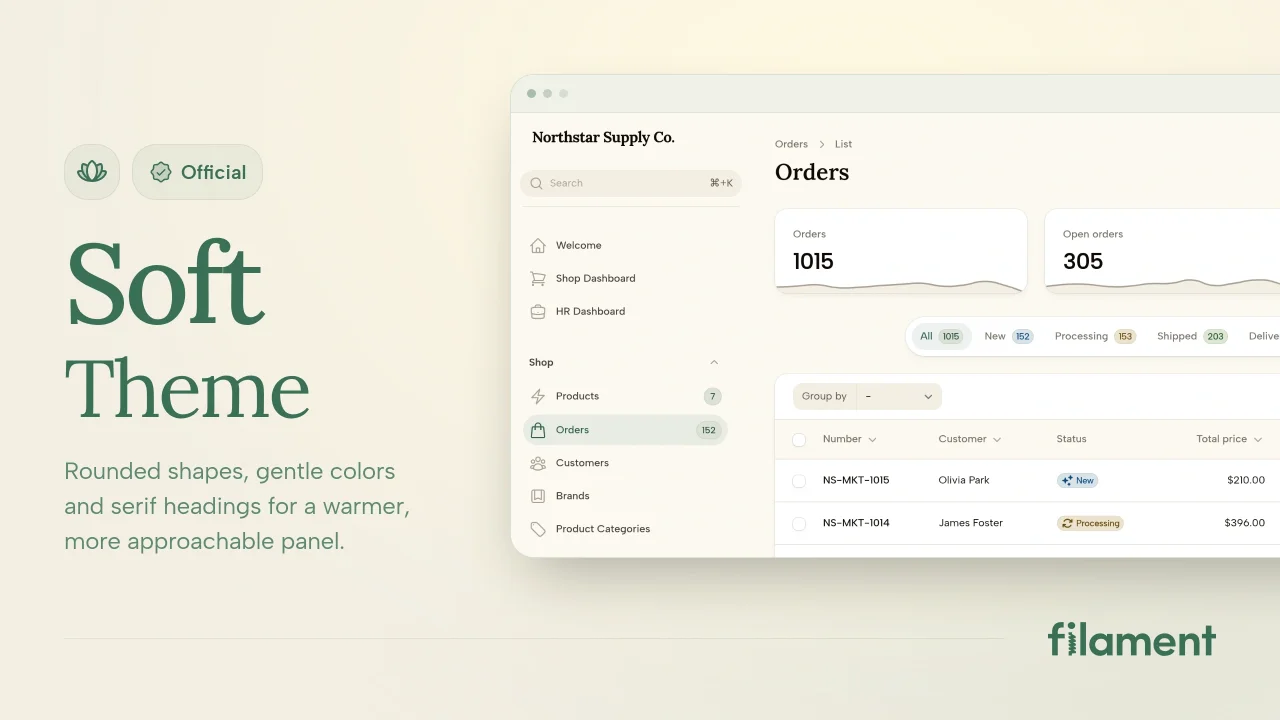
Soft Theme
A theme that gives panels a warm, approachable look with rounded shapes, gentle colors, and serif headings.
 Filament
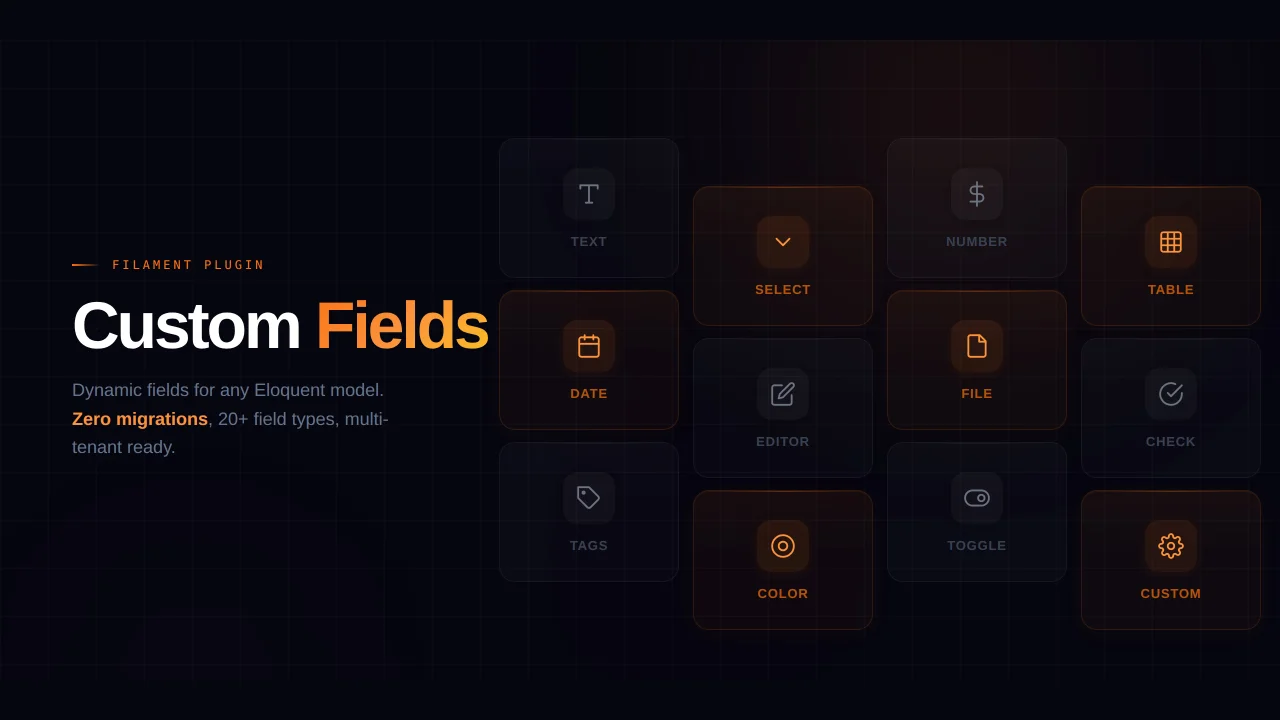
Custom Fields
Eliminate custom field migrations forever. Let your users create and manage form fields directly in Filament admin panels with 20+ built-in field types, validation, and zero database changes.
 Relaticle
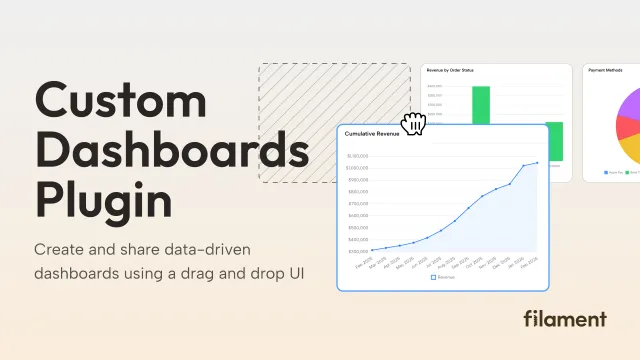
Custom Dashboards
Let your users build and share their own dashboards with a drag-and-drop interface. Define your data sources in PHP and let them do the rest.
Filament