Custom Fields
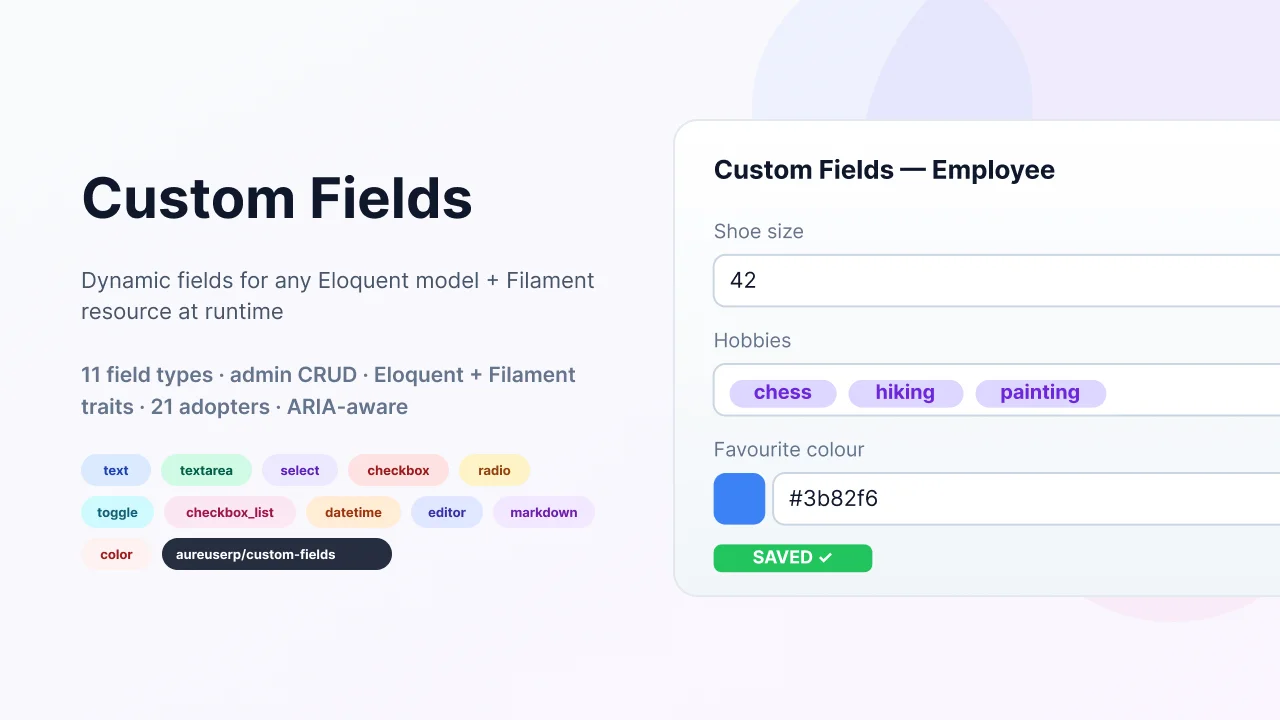
CommunityLet your end-users add dynamic fields to any Eloquent model + Filament resource at runtime, without writing a single migration. Ships an admin CRUD for managing field definitions, an Eloquent trait that auto-merges the new columns into your model's fillable/casts, a Filament resource trait with five merge helpers that inject fields into forms, tables, filters, infolists, and a runtime schema manager that creates the underlying DB columns for you.
 Author:
Aureus ERP
Author:
Aureus ERP
Package health
BetaAutomated checks of this plugin's Composer package
15 checks
- Skipped: GitHub Actions pinned to SHA
- Skipped: GitLab CI includes pinned to SHA
- Passed: Open security advisories
- Passed: Dependabot PR responsiveness — No open Dependabot PRs.
- Skipped: Renovate MR responsiveness
- Failed: Dependabot or Renovate configured — No dependency updater configuration found. View details on Plumb
- Skipped: Dependency update cooldown configured
- Passed: Provides a security policy
- Passed: Abandoned or archived — No consulted source marks the package abandoned (packagist, github).
- Passed: Commit and release recency — Active: last commit 0 days ago; last release 11 days ago.
-
Passed:
composer.lock not committed by library
—
composer.lockis absent from the released dist archive. - Passed: Dist archive is lean
-
Passed:
Current Laravel version supported
—
Package dependencies resolve together with current Laravel
13.0. -
Passed:
Current PHP version supported
—
Constraint
^8.2supports current PHP8.5. - Skipped: Current Symfony version supported
filament/
namespace. Review the source and install at your own risk. Found
malware or an unresolved security issue the author won't
address?
Report it
.
Documentation
- Table of contents
- Features
- Requirements
- Installation
- Quick start
- API reference
- Enums
- Real-world example
- Translations
- Configuration
- Publishing resources
- Testing
- Troubleshooting
- Security
- Contributing
- Credits
- License


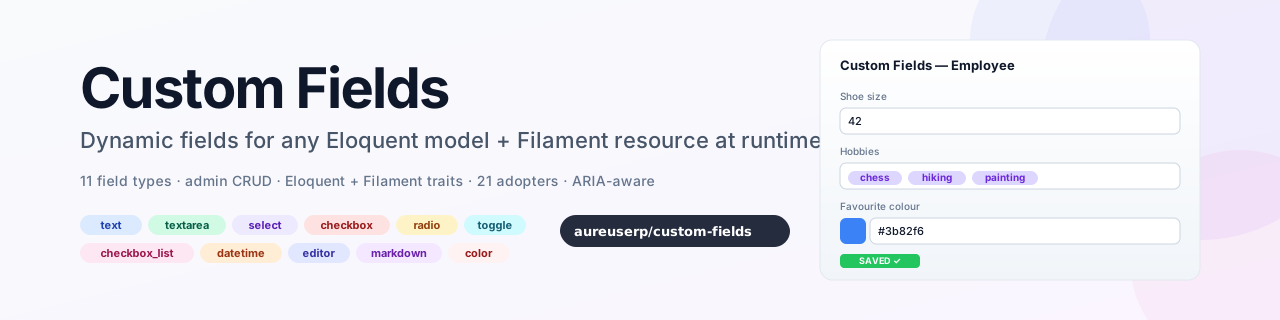
Let your end-users add dynamic fields to any Eloquent model + Filament resource at runtime, without writing a single migration. Ships an admin CRUD for managing field definitions, an Eloquent trait that auto-merges the new columns into your model's fillable/casts, a Filament resource trait with five merge helpers that inject fields into forms, tables, filters, infolists, and a runtime schema manager that creates the underlying DB columns for you.
#Table of contents
- Features
- Requirements
- Installation
- Quick start
- API reference
- Enums
- Real-world example
- Translations
- Publishing resources
- Testing
- Troubleshooting
- Security
- Contributing
- Credits
- License
#Features
- Eloquent trait (
HasCustomFields) — drop onto any model; custom field codes auto-merge into$fillableand$castsat runtime - Filament resource trait — 5 one-line merge helpers:
mergeCustomFormFields,mergeCustomTableColumns,mergeCustomTableFilters,mergeCustomTableQueryBuilderConstraints,mergeCustomInfolistEntries - Admin CRUD (
/admin/custom-fields) — create, edit, sort, soft-delete dynamic fields per resource, with full validation / formatting settings - 11 field types via
FieldTypeenum — Text, Textarea, Select, Checkbox, Radio, Toggle, CheckboxList, DateTime, Editor, Markdown, ColorPicker - 8 text input types via
InputTypeenum — Text, Email, Numeric, Integer, Password, Tel, Url, Color - Schema manager (
CustomFieldsColumnManager) — programmatically add / drop DB columns when fields are created or deleted - Table integration — the defined fields automatically surface as
CustomColumns(ifuse_in_table=true) andCustomFilters - Spatie-sortable — drag-to-reorder fields with
order_column_name=sort - Soft deletes — recover deleted field definitions
- Policy + permissions — Filament Shield compatible, with
view_any_field_field,create_field_fieldetc. - Translations —
enandarshipped (navigation + form labels + validation names + setting names) - Pest test suite — architecture + model + policy + trait + components + enums (31 tests)
#Requirements
- PHP 8.2+
- Laravel 11.28+, 12, or 13
- Filament v5+ — note that Laravel 13 requires Filament v5.4 or later
spatie/eloquent-sortablev4 or v5 (a direct dependency of this package; Laravel 13 resolves v5)
#Installation
composer require aureuserp/custom-fields
The service provider is auto-discovered. The migration is registered via Spatie's package-tools and run on php artisan migrate.
php artisan migrate
[!NOTE] Migrating from
webkul/fields: thecustom_fieldstable migration keeps its original timestamp filename, so existing installations will see it already applied — no duplicate-table errors, no re-run.
#Quick start
#1. Mark your model
use Illuminate\Database\Eloquent\Model;
use Webkul\CustomFields\Concerns\HasCustomFields;

class Employee extends Model
{
    use HasCustomFields;
}
Any custom field code defined against Webkul\Employee\Models\Employee is now mass-assignable and properly cast.
#2. Extend your Filament resource
use Filament\Resources\Resource;
use Filament\Schemas\Schema;
use Webkul\CustomFields\Filament\Concerns\HasCustomFields;

class EmployeeResource extends Resource
{
    use HasCustomFields;

    public static function form(Schema $schema): Schema
    {
        return $schema->components(
            static::mergeCustomFormFields([
                // your base fields
            ])
        );
    }

    public static function table(Table $table): Table
    {
        return $table
            ->columns(static::mergeCustomTableColumns([ /* base */ ]))
            ->filters(static::mergeCustomTableFilters([ /* base */ ]));
    }
}
#3. Define fields in the admin CRUD
Visit /admin/custom-fields → New field → pick a resource → pick a field type → configure options/validations → save.
The field now appears in the resource's form, table, filters, and infolist automatically.
#API reference
#Eloquent trait
Webkul\CustomFields\Concerns\HasCustomFields
Boots three lifecycle listeners (retrieved, creating, updating) that call loadCustomFields():
loadCustomFields()— queriesField::where('customizable_type', get_class($this)), merges every field'scodeinto$fillableand applies type-appropriate casts.mergeFillable(array $attributes)— public helper exposed for ad-hoc merging.mergeCasts($attributes)— public helper; accepts either an array (passes through to parent) or a Collection of Field records.getCustomFields()(protected) — override this if you want to scope the query (e.g. to a specific tenant).
Type-to-cast mapping:
| Field type | Cast |
|---|---|
select (multiselect) |
array |
select (single) |
string |
checkbox, toggle |
boolean |
checkbox_list |
array |
| everything else | string |
#Filament resource trait
Webkul\CustomFields\Filament\Concerns\HasCustomFields
Five static helpers — each accepts a base array + optional include/exclude lists and returns base + custom:
static::mergeCustomFormFields(array $base, array $include = [], array $exclude = []): array
static::mergeCustomTableColumns(array $base, array $include = [], array $exclude = []): array
static::mergeCustomTableFilters(array $base, array $include = [], array $exclude = []): array
static::mergeCustomTableQueryBuilderConstraints(array $base, array $include = [], array $exclude = []): array
static::mergeCustomInfolistEntries(array $base, array $include = [], array $exclude = []): array
include=[] means "all fields"; a non-empty list whitelists field codes. exclude blacklists field codes.
#Components
Each injector is also usable standalone:
use Webkul\CustomFields\Filament\Forms\Components\CustomFields;
use Webkul\CustomFields\Filament\Infolists\Components\CustomEntries;
use Webkul\CustomFields\Filament\Tables\Columns\CustomColumns;
use Webkul\CustomFields\Filament\Tables\Filters\CustomFilters;

CustomFields::make(MyResource::class)
    ->include(['hobbies'])
    ->exclude(['internal_notes'])
    ->getSchema();
#Column manager
Webkul\CustomFields\CustomFieldsColumnManager
Three static methods called on Field model lifecycle (create/update/delete):
createColumn(Field $field)— adds the column to the customisable model's table with the appropriate DB typeupdateColumn(Field $field)— creates the column if missing (for rename/resurrect scenarios)deleteColumn(Field $field)— drops the column
The DB type mapping uses getColumnType() which routes via FieldType::tryFrom($field->type):
| Field type | DB column type |
|---|---|
text |
string / integer / decimal (based on input_type) |
textarea, editor, markdown |
text |
select (multiselect) |
json |
select (single), radio, color |
string |
checkbox, toggle |
boolean |
checkbox_list |
json |
datetime |
datetime |
#Enums
| Enum | Cases → values | Default |
|---|---|---|
FieldType |
Text='text', Textarea='textarea', Select='select', Checkbox='checkbox', Radio='radio', Toggle='toggle', CheckboxList='checkbox_list', DateTime='datetime', Editor='editor', Markdown='markdown', ColorPicker='color' |
FieldType::Text |
InputType |
Text, Email, Numeric, Integer, Password, Tel, Url, Color |
InputType::Text |
Both enums expose a default() static for symbolic-constant fallbacks:
use Webkul\CustomFields\Enums\FieldType;
use Webkul\CustomFields\Enums\InputType;

$type = FieldType::tryFrom($raw) ?? FieldType::default();
#Real-world example
Here's a full Employee resource adopting the trait. End-users can add a "hobbies" multiselect via the admin CRUD; the field flows through form, table, and infolist automatically.
use Filament\Forms\Components\Select;
use Filament\Forms\Components\TextInput;
use Filament\Resources\Resource;
use Filament\Schemas\Schema;
use Filament\Tables\Columns\TextColumn;
use Filament\Tables\Table;
use Webkul\CustomFields\Filament\Concerns\HasCustomFields;
use Webkul\Employee\Models\Employee;

class EmployeeResource extends Resource
{
    use HasCustomFields;

    protected static ?string $model = Employee::class;

    public static function form(Schema $schema): Schema
    {
        return $schema->components(static::mergeCustomFormFields([
            TextInput::make('name')->required(),
            Select::make('department_id')->relationship('department', 'name'),
        ]));
    }

    public static function table(Table $table): Table
    {
        return $table
            ->columns(static::mergeCustomTableColumns([
                TextColumn::make('name'),
            ]))
            ->filters(static::mergeCustomTableFilters([]));
    }
}
And the Eloquent side:
use Webkul\CustomFields\Concerns\HasCustomFields;

class Employee extends Model
{
    use HasCustomFields;

    protected $fillable = ['name', 'department_id'];
}

// After an admin defines a "hobbies" checkbox_list field:
$employee = Employee::create([
    'name' => 'Alice',
    'department_id' => 1,
    'hobbies' => ['chess', 'hiking'],  // ← custom field, automatically fillable + cast to array
]);

$employee->hobbies;  // ['chess', 'hiking']  ← automatically cast from JSON
#Translations
Ships with en and ar under the custom-fields:: namespace. Publish to customise:
php artisan vendor:publish --tag="custom-fields-translations"
The translation file includes 70+ validation rule labels, 200+ Filament setting names, plus navigation and form labels for the admin CRUD.
#Configuration
Every navigation / identity / placement setting is configurable two ways — pick whichever fits your project:
#1. Fluent setters in your panel provider (recommended for per-panel overrides)
// app/Providers/Filament/AdminPanelProvider.php
use Webkul\CustomFields\CustomFieldsPlugin;

->plugins([
    CustomFieldsPlugin::make()
        ->navigationGroup(__('admin.navigation.setting'))
        ->navigationLabel('Custom Fields')
        ->navigationIcon('heroicon-o-puzzle-piece')
        ->navigationSort(50)
        ->navigationBadge(fn () => \Webkul\CustomFields\Models\Field::count())
        ->navigationBadgeColor('primary')
        ->slug('admin/custom-fields')
        ->cluster(\App\Filament\Clusters\AdminTools::class),
])
#2. Publishable config file (recommended for app-wide defaults)
php artisan vendor:publish --tag="custom-fields-config"
That writes config/custom-fields.php to your app. Edit any key:
// config/custom-fields.php
return [
    'navigation' => [
        'label'   => 'Custom Fields',
        'group'   => 'Settings',
        'icon'    => 'heroicon-o-puzzle-piece',
        'sort'    => 50,
        'badge'   => null,
        'register'=> true,
    ],
    'resource' => [
        'register'           => true,
        'slug'               => 'admin/custom-fields',
        'cluster'            => \App\Filament\Clusters\AdminTools::class,
        'model_label'        => null,
        'plural_model_label' => null,
    ],
];
#Resolution order
When the Resource renders, each value is resolved by the first matching rule:
- Fluent setter on
CustomFieldsPlugin::make()->…()— highest priority - Config file
config('custom-fields.*')— if the setter was not called - Hardcoded fallback in
getPluginDefaults()— when both above arenull
#Full setter → config key map
| Fluent setter | Config key |
|---|---|
navigationLabel($v) |
custom-fields.navigation.label |
navigationGroup($v) |
custom-fields.navigation.group |
navigationIcon($v) |
custom-fields.navigation.icon |
activeNavigationIcon($v) |
custom-fields.navigation.active_icon |
navigationSort($v) |
custom-fields.navigation.sort |
navigationBadge($v) |
custom-fields.navigation.badge |
navigationBadgeColor($v) |
custom-fields.navigation.badge_color |
navigationBadgeTooltip($v) |
custom-fields.navigation.badge_tooltip |
navigationParentItem($v) |
custom-fields.navigation.parent_item |
subNavigationPosition($v) |
custom-fields.navigation.sub_position |
registerNavigation($bool) |
custom-fields.navigation.register |
modelLabel($v) |
custom-fields.resource.model_label |
pluralModelLabel($v) |
custom-fields.resource.plural_model_label |
slug($v) |
custom-fields.resource.slug |
cluster($class) |
custom-fields.resource.cluster |
tenantRelationshipName($v) |
custom-fields.resource.tenant_relationship |
registerResource($bool) |
custom-fields.resource.register |
#Disable the admin CRUD entirely
Only want the Eloquent trait + table-injection API, not the admin menu?
CustomFieldsPlugin::make()->registerResource(false),
// or in config/custom-fields.php:
'resource' => ['register' => false],
The FieldResource routes are skipped; everything else still works.
#Publishing resources
php artisan vendor:publish --tag="custom-fields-config"
php artisan vendor:publish --tag="custom-fields-migrations"
php artisan vendor:publish --tag="custom-fields-translations"
#Testing
vendor/bin/pest plugins/aureuserp/custom-fields/tests/Feature
31 tests (114 assertions) across:
| Area | Coverage |
|---|---|
| Architecture | Field model extends Eloquent Model + implements Sortable, Plugin implements Filament\Contracts\Plugin, SP extends Spatie, no debug calls in shipped code |
| Enums | FieldType / InputType — all cases have expected values, default() works, tryFrom returns null for unknown |
| Field model | Table name, fillable, casts, SoftDeletes trait, Sortable config |
| Policy | All 10 CRUD + soft-delete permission methods exist |
| Eloquent trait | Trait exists, applies to host model without error, mergeFillable dedups, declares fill / mergeCasts |
| Filament trait | Trait exists, all 5 merge helpers declared, merge helpers combine base + custom arrays |
| Component API | CustomFields/Entries/Columns/Filters::make()->include()->exclude() chainable and return static |
| Column manager | Exposes createColumn/updateColumn/deleteColumn static methods |
#Troubleshooting
| Symptom | Fix |
|---|---|
Class not found for Webkul\CustomFields\… |
composer dump-autoload && php artisan optimize:clear |
| Trait methods not firing | Confirm the Eloquent trait is on your model (use HasCustomFields;) and that Field::where('customizable_type', …) returns rows |
| Custom column doesn't appear in the DB | Check CustomFieldsColumnManager::createColumn() ran — it's called from CreateField::afterCreate() on save. Verify the host table already exists. |
| Policy denies everything | Generate Shield policies: php artisan shield:generate --resource=FieldResource |
custom_fields table missing |
Run php artisan migrate |
#Security
Email support@webkul.com for security-related reports instead of opening a public issue.
#Contributing
PRs welcome. Before submitting:
vendor/bin/pest plugins/aureuserp/custom-fields/tests/Feature
vendor/bin/pint plugins/aureuserp/custom-fields
#Credits
- Webkul — plugin author
- Filament team — the excellent admin framework
- filamentphp/plugin-skeleton — structural template
#License
MIT. See LICENSE.md.
The author
From the same author
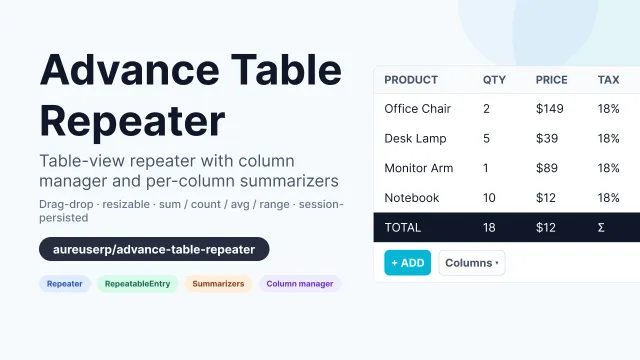
Advance Table Repeater
An advanced Filament v5 Repeater + RepeatableEntry that renders as a table with a column manager, drag-and-drop reorder, resizable columns, and per-column summarizers (sum / count / average / range).
Author:
Aureus ERP
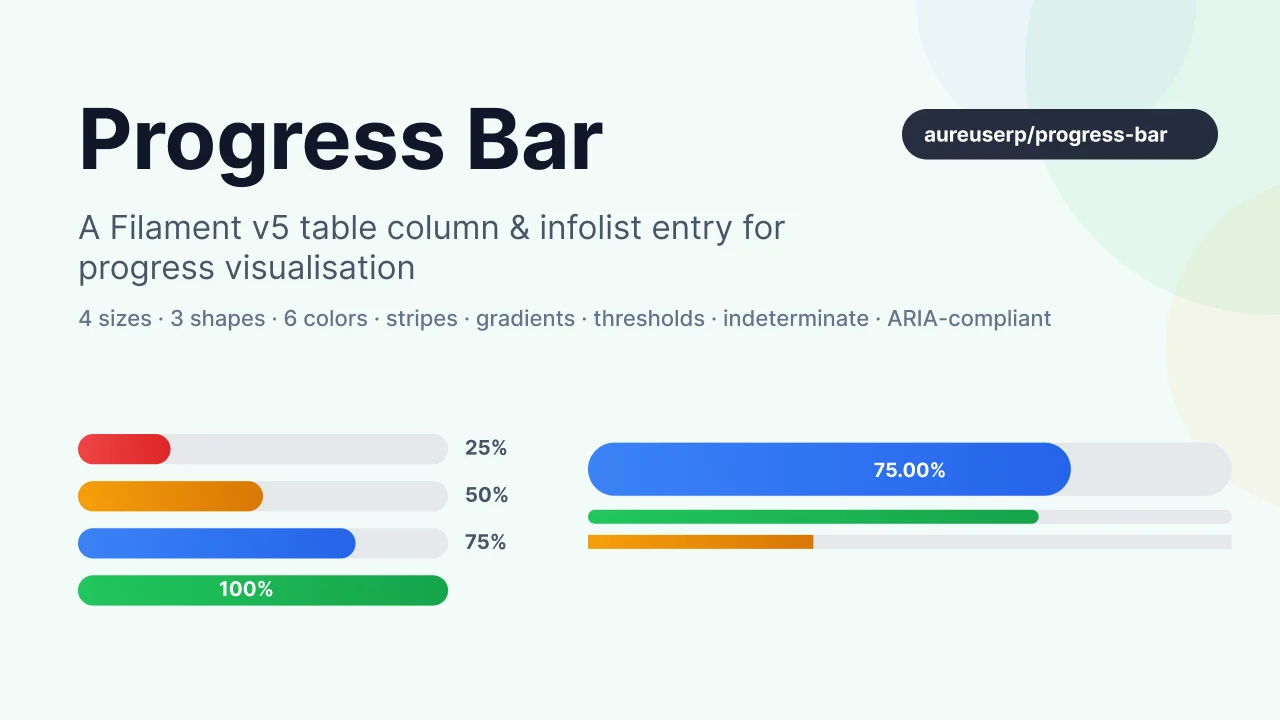
Progress Bar
A feature-rich Filament v5 table column & infolist entry that renders progress as a horizontal bar. Built for dashboards, task progress, capacity gauges, skill levels, and any numeric value that fits on a 0–100% (or custom min–max) scale.
Author:
Aureus ERP
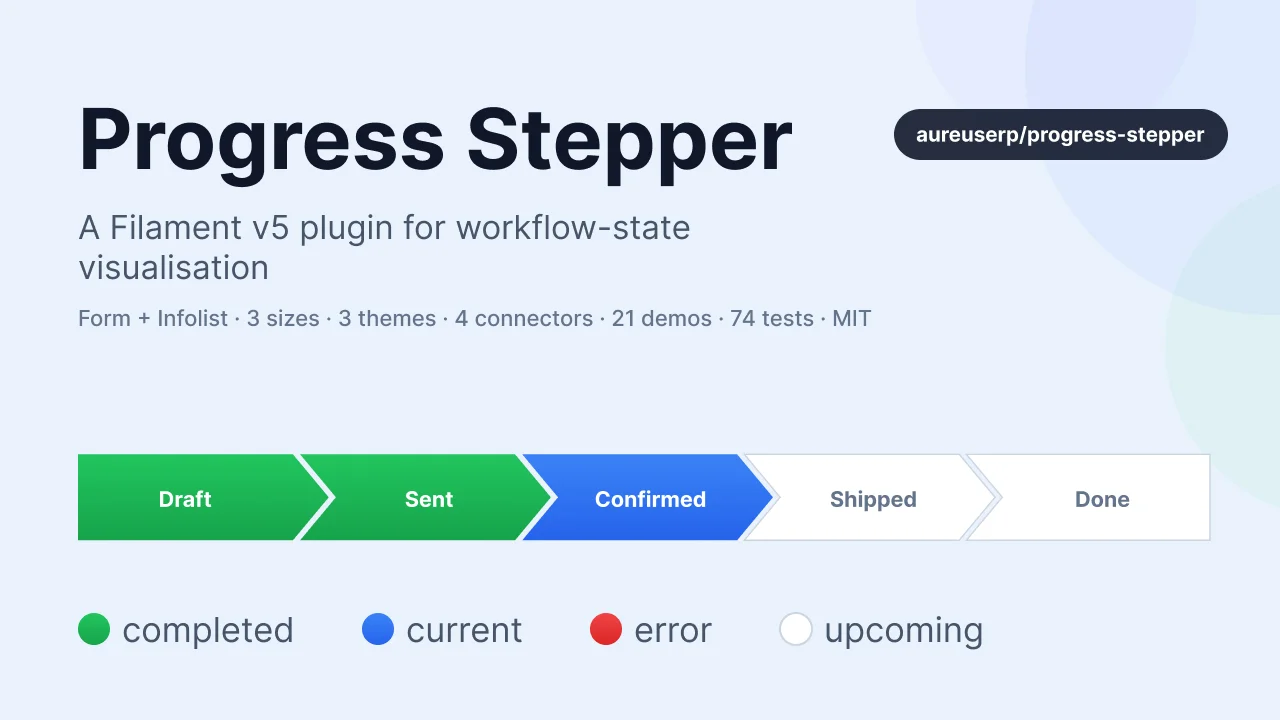
Progress Stepper
A feature-rich Filament v5 plugin that renders workflow state as an interactive arrow-stepper (form) or a read-only status bar (infolist). Built for business apps where orders, applications, or projects move through named states and you want every screen to show that progress visually.
Author:
Aureus ERP
Featured Plugins
A selection of plugins curated by the Filament team
Custom Dashboards
Let your users build and share their own dashboards with a drag-and-drop interface. Define your data sources in PHP and let them do the rest.
 Filament
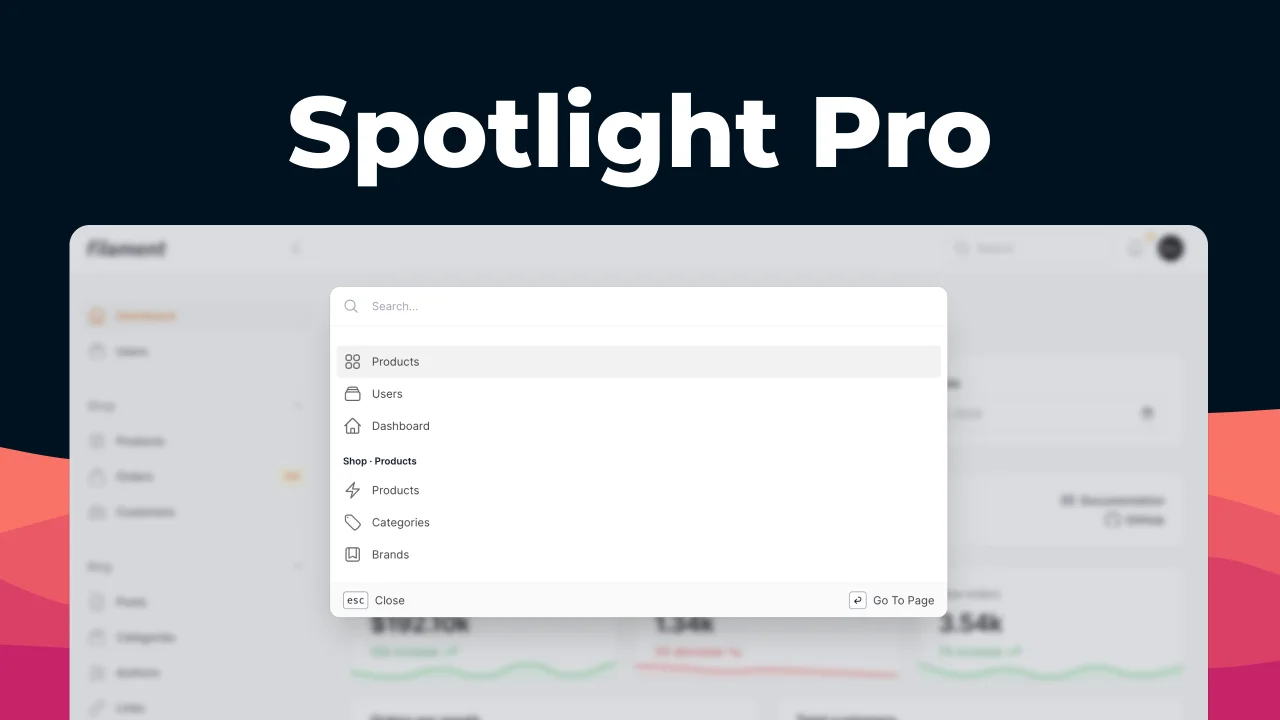
Spotlight Pro
Browse your Filament Panel with ease. Filament Spotlight Pro adds a Spotlight like Command Palette to your Filament Panel.
 Dennis Koch
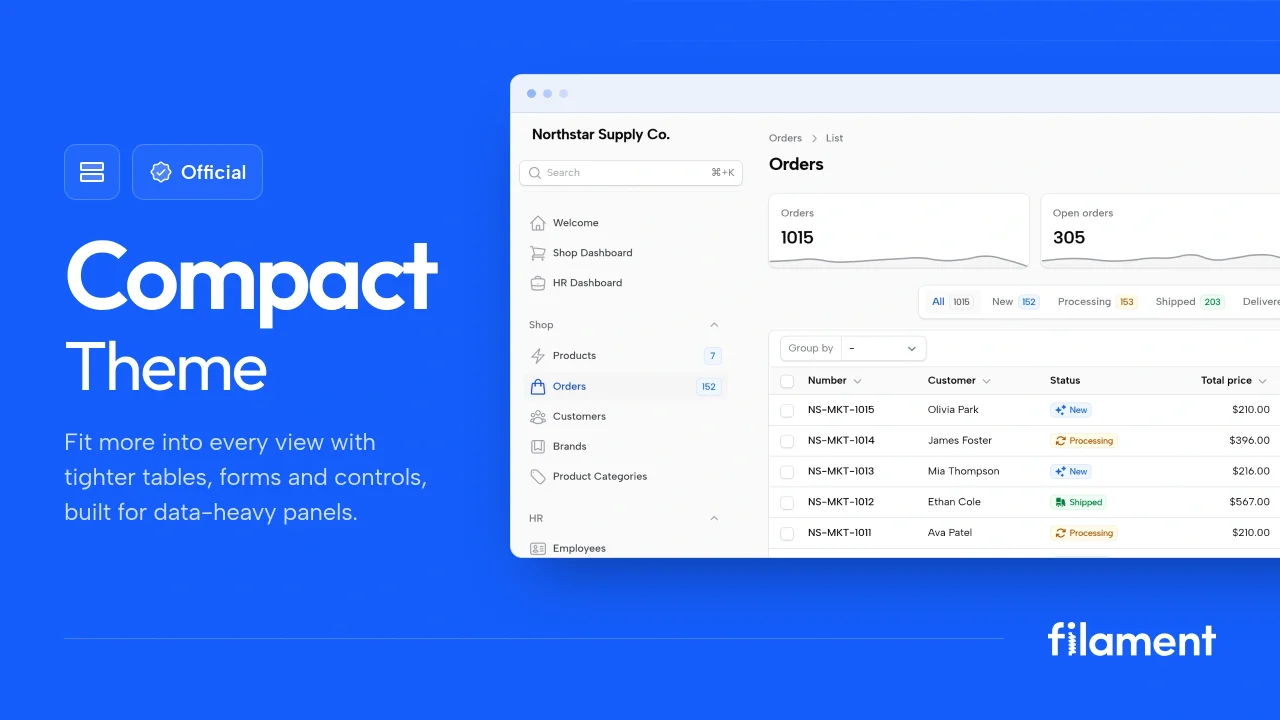
Compact Theme
A theme that makes data-heavy panels easier to scan by fitting more useful information on each screen.
Filament