Progress Stepper
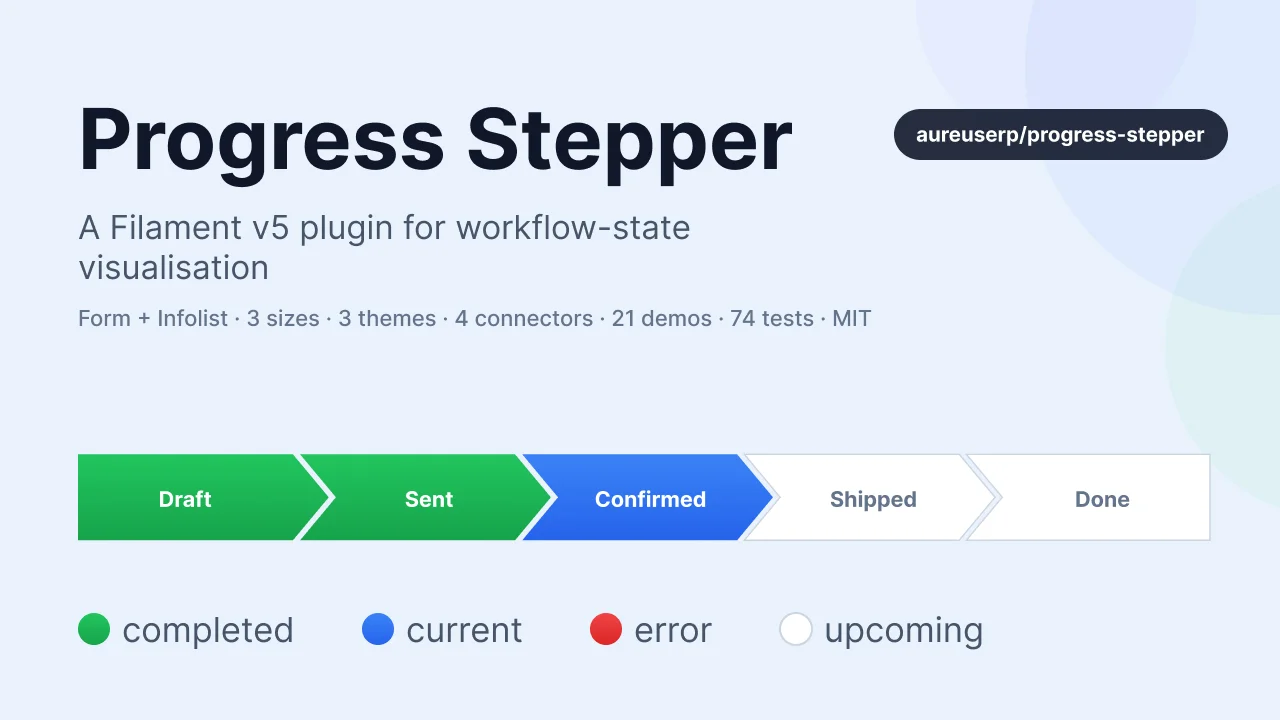
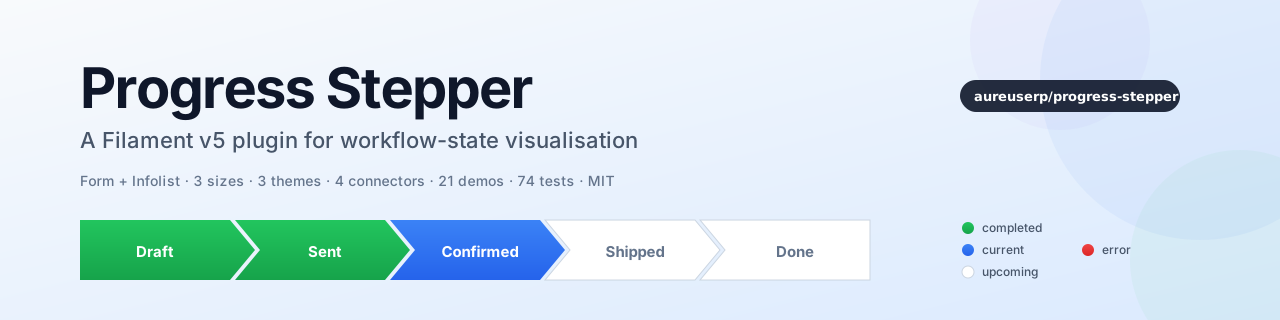
CommunityA feature-rich Filament v5 plugin that renders workflow state as an interactive arrow-stepper (form) or a read-only status bar (infolist). Built for business apps where orders, applications, or projects move through named states and you want every screen to show that progress visually.
 Author:
Aureus ERP
Author:
Aureus ERP
Package health
BetaAutomated checks of this plugin's Composer package
15 checks
- Skipped: GitHub Actions pinned to SHA
- Skipped: GitLab CI includes pinned to SHA
- Passed: Open security advisories
- Passed: Dependabot PR responsiveness — No open Dependabot PRs.
- Skipped: Renovate MR responsiveness
- Failed: Dependabot or Renovate configured — No dependency updater configuration found. View details on Plumb
- Skipped: Dependency update cooldown configured
- Passed: Provides a security policy
- Passed: Abandoned or archived — No consulted source marks the package abandoned (packagist, github).
- Passed: Commit and release recency — Active: last commit 2 days ago; last release 33 days ago.
-
Passed:
composer.lock not committed by library
—
composer.lockis absent from the released dist archive. - Passed: Dist archive is lean
-
Passed:
Current Laravel version supported
—
Package dependencies resolve together with current Laravel
13.0. -
Passed:
Current PHP version supported
—
Constraint
^8.2supports current PHP8.5. - Skipped: Current Symfony version supported
filament/
namespace. Review the source and install at your own risk. Found
malware or an unresolved security issue the author won't
address?
Report it
.
Documentation
- Table of contents
- Features
- Requirements
- Installation
- Quick start
- API reference
- Enums
- Real-world example
- Theming & customisation
- Overridable icons
- Translations
- Publishing resources
- Testing
- Troubleshooting
- Naming notes
- Security
- Contributing
- Credits
- License


A feature-rich Filament v5 plugin that renders workflow state as an interactive arrow-stepper (form) or a read-only status bar (infolist). Built for business apps where orders, applications, or projects move through named states and you want every screen to show that progress visually.
#Table of contents
- Features
- Requirements
- Installation
- Quick start
- API reference
- Enums
- Real-world example
- Theming & customisation
- Overridable icons
- Translations
- Publishing resources
- Testing
- Troubleshooting
- Naming notes
- Security
- Contributing
- Credits
- License
#Features
- Form component (extends
ToggleButtons) — interactive radio/checkbox stepper - Infolist entry — read-only status visualisation
- 4 state colors — completed, current, upcoming, error — each overridable
- Auto-mark completed —
markCompletedUpToCurrent()paints every step before the active one - Error states — flag any states as danger via
errorStates([…]) - Hide states conditionally —
hideStatesFor(fn)based on the current record - BackedEnum integration —
optionsFromEnum(MyStatus::class)auto-derives labels / icons / colors - Type-safe enums —
Size::Large,Direction::Vertical,Theme::Outlined,ConnectorShape::Chevron,StepStatus::Completed— strings still work for backwards compatibility - 3 sizes — sm / md / lg
- 2 directions — horizontal / vertical
- 4 connector shapes — arrow / chevron / dot / line
- 3 themes — filled / outlined / minimal
- Step numbering —
showIndex()prepends 1., 2., 3. - Icon-only (compact) mode for tight navigation bars
- Per-step content — descriptions, tooltips, badges, icons
- Overridable icons via
FilamentIcon::register() - Translations shipped for
enandar - Full Pest test coverage — 74 tests across architecture, API, status resolver, enum input, and component instantiation
#Requirements
- PHP 8.2+
- Laravel 11+
- Filament v5+
- Tailwind CSS (via a custom Filament theme if you use Panels)
#Installation
composer require aureuserp/progress-stepper
The service provider is auto-discovered. The component CSS is registered via FilamentAsset and published automatically during artisan filament:assets.
#Quick start
#Form component
use Webkul\ProgressStepper\Forms\Components\ProgressStepper;

ProgressStepper::make('state')
    ->options([
        'draft'     => 'Draft',
        'sent'      => 'Sent',
        'confirmed' => 'Confirmed',
        'done'      => 'Done',
    ])
    ->default('draft');
#Infolist entry
use Webkul\ProgressStepper\Infolists\Components\ProgressStepper;

ProgressStepper::make('state')
    ->options([
        'draft' => 'Draft',
        'sent'  => 'Sent',
        'done'  => 'Done',
    ]);
Both components extend normal Filament base classes (ToggleButtons and Entry), so all standard Filament methods — ->label(), ->helperText(), ->visible(), ->columnSpanFull(), ->state() — still work.
#API reference
All methods return static so they chain. Each accepts either a scalar value or a Closure where applicable (per Filament's standard pattern).
#Options
->options(array | Closure $options)               // ['value' => 'Label', …]
->optionsFromEnum(string $enumClass)              // derive from a BackedEnum
#BackedEnum integration
Implement HasLabel, HasColor, HasIcon on your enum and every case's label / icon / color is picked up automatically:
enum OrderStatus: string implements HasLabel, HasColor, HasIcon
{
    case Draft = 'draft';
    case Sent = 'sent';
    case Confirmed = 'confirmed';
    case Done = 'done';

    public function getLabel(): ?string
    {
        return match ($this) {
            self::Draft => __('orders.state.draft'),
            self::Sent => __('orders.state.sent'),
            self::Confirmed => __('orders.state.confirmed'),
            self::Done => __('orders.state.done'),
        };
    }

    public function getColor(): string | array | null
    {
        return match ($this) {
            self::Draft => 'gray',
            self::Sent => 'info',
            self::Confirmed => 'primary',
            self::Done => 'success',
        };
    }

    public function getIcon(): ?string
    {
        return match ($this) {
            self::Draft => 'heroicon-m-document',
            self::Sent => 'heroicon-m-paper-airplane',
            self::Confirmed => 'heroicon-m-check-badge',
            self::Done => 'heroicon-m-check-circle',
        };
    }
}

ProgressStepper::make('state')->optionsFromEnum(OrderStatus::class);
#State behaviour
->markCompletedUpToCurrent(bool | Closure $condition = true)
    // Steps ordered before the current one take the completedColor. Default: false.

->errorStates(array | Closure $states)
    // Values that should render with errorColor. e.g. ['cancelled', 'rejected'].

->hideStatesFor(Closure $callback)
    // Callback returns an array of values to hide. Receives ['record' => …] if
    // used inside a resource form/infolist — see the real-world example below.
#State colors
Each slot accepts any Filament color token (primary, success, warning, danger, info, gray, custom) or a Closure.
->completedColor(string | Closure $color)   // default: 'success'
->currentColor(string | Closure $color)     // default: 'primary'
->upcomingColor(string | Closure $color)    // default: 'gray'
->errorColor(string | Closure $color)       // default: 'danger'
#Layout
Each layout setter accepts either the dedicated enum (recommended — IDE autocomplete, compile-time checked) or the raw string (quick one-offs, backward compatible):
use Webkul\ProgressStepper\Enums\{ConnectorShape, Direction, Size, Theme};

->size(Size::Large)                              // or ->size('lg')         — default: Size::Medium
->direction(Direction::Vertical)                  // or ->direction('vertical') — default: Direction::Horizontal
->theme(Theme::Outlined)                          // or ->theme('outlined')  — default: Theme::Filled
->connectorShape(ConnectorShape::Chevron)         // or ->connectorShape('chevron') — default: ConnectorShape::Arrow
->showIndex(bool | Closure $condition = true)     // prepend 1., 2., …
->iconOnly(bool | Closure $condition = true)      // hide labels, keep icons
->inline(bool | Closure $condition = true)        // align to the right of the field label
Unknown values silently fall back to the enum's default() case, so misspellings never crash a page.
#Per-step enrichment
Each accepts an array<value, string|int> OR a Closure($value, $label, $state):
->stepDescription(array | Closure $descriptions)   // subtitle under the label
->stepTooltip(array | Closure $tooltips)           // hover help (title attribute)
->stepBadge(array | Closure $badges)               // small pill with count/text
Example:
->stepDescription([
    'draft' => 'Not yet sent',
    'sent'  => 'Awaiting response',
])
->stepBadge(fn (string $value) => $value === 'review' ? auth()->user()->unreadReviewCount() : null)
->stepTooltip(fn (string $value) => __("orders.stepper.{$value}.tooltip"))
#Icons
->icons([                                   // available on both components
    'draft'     => 'heroicon-m-document',
    'sent'      => 'heroicon-m-paper-airplane',
    'confirmed' => 'heroicon-m-check-badge',
    'done'      => 'heroicon-m-check-circle',
])
The form component inherits icons() from ToggleButtons; the infolist component declares its own.
#Enums
The plugin ships five BackedEnums under Webkul\ProgressStepper\Enums so you can use symbolic constants instead of magic strings. Every string value matches what the CSS data-ps-* attributes expect, so passing an enum produces the same rendered output as the equivalent string.
| Enum | Cases → values | Default |
|---|---|---|
Size |
Small → 'sm', Medium → 'md', Large → 'lg' |
Size::Medium |
Direction |
Horizontal, Vertical |
Direction::Horizontal |
Theme |
Filled, Outlined, Minimal |
Theme::Filled |
ConnectorShape |
Arrow, Chevron, Dot, Line |
ConnectorShape::Arrow |
StepStatus |
Completed, Current, Upcoming, Error |
(internal; returned by getStepStatus()) |
Each of the first four exposes a default() static method that returns the case used when no explicit value is set or when an unknown value falls through — useful for building resilient defaults in custom code.
#Enum usage
use Webkul\ProgressStepper\Enums\ConnectorShape;
use Webkul\ProgressStepper\Enums\Direction;
use Webkul\ProgressStepper\Enums\Size;
use Webkul\ProgressStepper\Enums\Theme;
use Webkul\ProgressStepper\Forms\Components\ProgressStepper;

ProgressStepper::make('state')
    ->options([...])
    ->size(Size::Large)
    ->direction(Direction::Horizontal)
    ->theme(Theme::Outlined)
    ->connectorShape(ConnectorShape::Chevron);
#Interop with getStepStatus()
Need to inspect the classification of a step programmatically? Round-trip through StepStatus::from(...):
use Webkul\ProgressStepper\Enums\StepStatus;

$status = StepStatus::from($component->getStepStatus('confirmed'));

match ($status) {
    StepStatus::Completed => /* … */,
    StepStatus::Current   => /* … */,
    StepStatus::Upcoming  => /* … */,
    StepStatus::Error     => /* … */,
};
#Real-world example
Adapted from a Sales Order Resource — mirrors the aureuserp pattern, mixing the Size / ConnectorShape enums with a domain OrderStatus enum:
use App\Enums\OrderStatus;
use Filament\Schemas\Schema;
use Webkul\ProgressStepper\Enums\ConnectorShape;
use Webkul\ProgressStepper\Enums\Size;
use Webkul\ProgressStepper\Forms\Components\ProgressStepper;

public static function form(Schema $schema): Schema
{
    return $schema->components([
        ProgressStepper::make('state')
            ->optionsFromEnum(OrderStatus::class)
            ->markCompletedUpToCurrent()
            ->errorStates([OrderStatus::Cancelled->value])
            ->hideStatesFor(fn ($record) => $record?->is_refunded
                ? []
                : [OrderStatus::Refunded->value])
            ->size(Size::Large)
            ->connectorShape(ConnectorShape::Chevron)
            ->showIndex()
            ->stepDescription([
                OrderStatus::Draft->value     => 'Not yet sent to the customer',
                OrderStatus::Confirmed->value => 'Customer has confirmed the quote',
            ])
            ->stepBadge(fn (string $value, $record) => match ($value) {
                OrderStatus::Sent->value => $record?->unread_comment_count ?: null,
                default                  => null,
            })
            ->columnSpanFull()
            ->disabled(),
    ]);
}
#Theming & customisation
#Custom colors
Any color registered on your panel flows through automatically. Just reference its key:
// AdminPanelProvider
->colors(['magenta' => '#b72d81'])

// Usage
->currentColor('magenta')
#Extending the CSS
The plugin styles ship at vendor/aureuserp/progress-stepper/resources/dist/progress-stepper.css. Publish it if you want to fork it:
php artisan vendor:publish --tag="progress-stepper-config"
Or override selectors in your own theme CSS — the stable hooks are:
.ps-container— outer wrapper.ps-step— each step wrapper.ps-button— the rendered stepper segment.ps-label,.ps-label-text,.ps-index,.ps-description,.ps-badge— inner label partsdata-ps-direction | data-ps-size | data-ps-theme | data-ps-separator | data-ps-compact | data-ps-inlineon.ps-container— values match theDirection,Size,Theme,ConnectorShapeenum valuesdata-ps-status="completed | current | upcoming | error"— values matchStepStatusenum valuesdata-ps-color="primary | success | warning | danger | info | gray | <custom>"— drives the--ps-color-500/--ps-color-600CSS variables that the filled / outlined / minimal themes consume
#Overridable icons
The plugin registers three aliases you can override globally:
use Filament\Support\Facades\FilamentIcon;

FilamentIcon::register([
    'progress-stepper::step-completed' => 'phosphor-check-bold',
    'progress-stepper::step-current'   => 'phosphor-caret-right-bold',
    'progress-stepper::step-error'     => 'phosphor-x-bold',
]);
| Alias | Default |
|---|---|
progress-stepper::step-completed |
heroicon-m-check |
progress-stepper::step-current |
heroicon-m-arrow-right |
progress-stepper::step-error |
heroicon-m-x-mark |
#Translations
The plugin ships en and ar translations under the progress-stepper:: namespace for status / separator / theme labels used internally.
Publish them to customise:
php artisan vendor:publish --tag="progress-stepper-translations"
Files appear in lang/vendor/progress-stepper/{locale}/progress-stepper.php.
#Publishing resources
# Config file (currently empty — reserved for future tuning knobs)
php artisan vendor:publish --tag="progress-stepper-config"

# Blade views
php artisan vendor:publish --tag="progress-stepper-views"

# Translations
php artisan vendor:publish --tag="progress-stepper-translations"
#Testing
The plugin ships with a full Pest test suite covering every public API surface.
vendor/bin/pest plugins/aureuserp/progress-stepper/tests/Feature
74 tests (148 assertions) across:
| Area | Coverage |
|---|---|
| Architecture | Components extend ToggleButtons / Entry, shared trait used on both, Plugin implements Filament\Contracts\Plugin, ServiceProvider extends Spatie PackageServiceProvider, no debug calls (dd, dump, var_dump, ray, die, exit) in shipped code |
| State colors | Defaults, scalar setters, closure setters, chaining |
| State behaviour | markCompletedUpToCurrent, errorStates, hideStatesFor |
| Layout API | size, direction, theme, connectorShape, showIndex, iconOnly — value acceptance and default-fallback |
| Content enrichment | stepDescription, stepTooltip, stepBadge — arrays, closures, empty-value coercion |
| Status resolver | getStepStatus / getStepColor across completed / current / upcoming / error; errorStates overrides; custom color overrides |
| Enum input | Size::Large, Direction::Vertical etc. produce the same strings as raw equivalents; string inputs still work; closures returning enums work |
optionsFromEnum |
Derives labels from HasLabel, icons from HasIcon, colors from HasColor; safely ignores non-enum classes |
| Component instantiation | Base class assertions, view paths, chainable API, inline(), getColor() delegation |
Fixtures live at tests/Feature/Fixtures/ (only a SampleStatus BackedEnum).
#Troubleshooting
| Symptom | Likely cause | Fix |
|---|---|---|
Target class [Webkul\ProgressStepper\Forms\…] not found |
Autoload cache is stale | composer dump-autoload && php artisan optimize:clear |
View progress-stepper::forms.progress-stepper not found |
Service provider not registered | Check the provider is in bootstrap/providers.php or that package discovery ran (php artisan package:discover) |
| Steps render without arrows / colors | Filament asset cache stale | php artisan filament:assets |
Form component throws Declaration of … must be compatible with Filament\Schemas\Components\Component::… |
You called one of the legacy methods (separator(), compact(), description(), tooltip(), badge()) which collide with Filament base traits |
Use the prefixed names: connectorShape(), iconOnly(), stepDescription(), stepTooltip(), stepBadge() |
#Naming notes
Five method names on this plugin intentionally differ from the natural English word to avoid collisions with Filament's base traits:
| Natural name | Use this instead | Why |
|---|---|---|
separator() |
connectorShape() |
Component::separator() takes string|null = ',' |
compact() |
iconOnly() |
CanBeCompact::compact() exists |
description() |
stepDescription() |
HasDescription::description() exists |
tooltip() |
stepTooltip() |
HasTooltip::tooltip() exists |
badge() |
stepBadge() |
HasBadge::badge() exists |
#Security
If you discover a security vulnerability, email support@webkul.com rather than opening a public issue.
#Contributing
PRs welcome. Please run the test suite before submitting:
vendor/bin/pest plugins/aureuserp/progress-stepper/tests/Feature
vendor/bin/pint plugins/aureuserp/progress-stepper       # code style
When adding a new configuration option, please:
- Define (or extend) a
BackedEnumundersrc/Enums/if the option is one of a fixed set of values. - Accept both the enum and the raw string in the setter signature for backward compatibility.
- Add coverage to the relevant test file under
tests/Feature/Unit/. - Document the option in the API reference and Enums sections as appropriate.
#Credits
- Webkul — plugin author
- Filament team — the excellent admin framework
- filamentphp/plugin-skeleton — structural template
#License
MIT. See LICENSE.md.
The author
From the same author
Advance Table Repeater
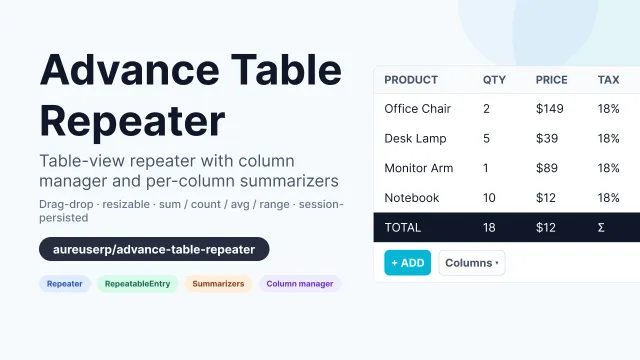
An advanced Filament v5 Repeater + RepeatableEntry that renders as a table with a column manager, drag-and-drop reorder, resizable columns, and per-column summarizers (sum / count / average / range).
Author:
Aureus ERP
Custom Fields
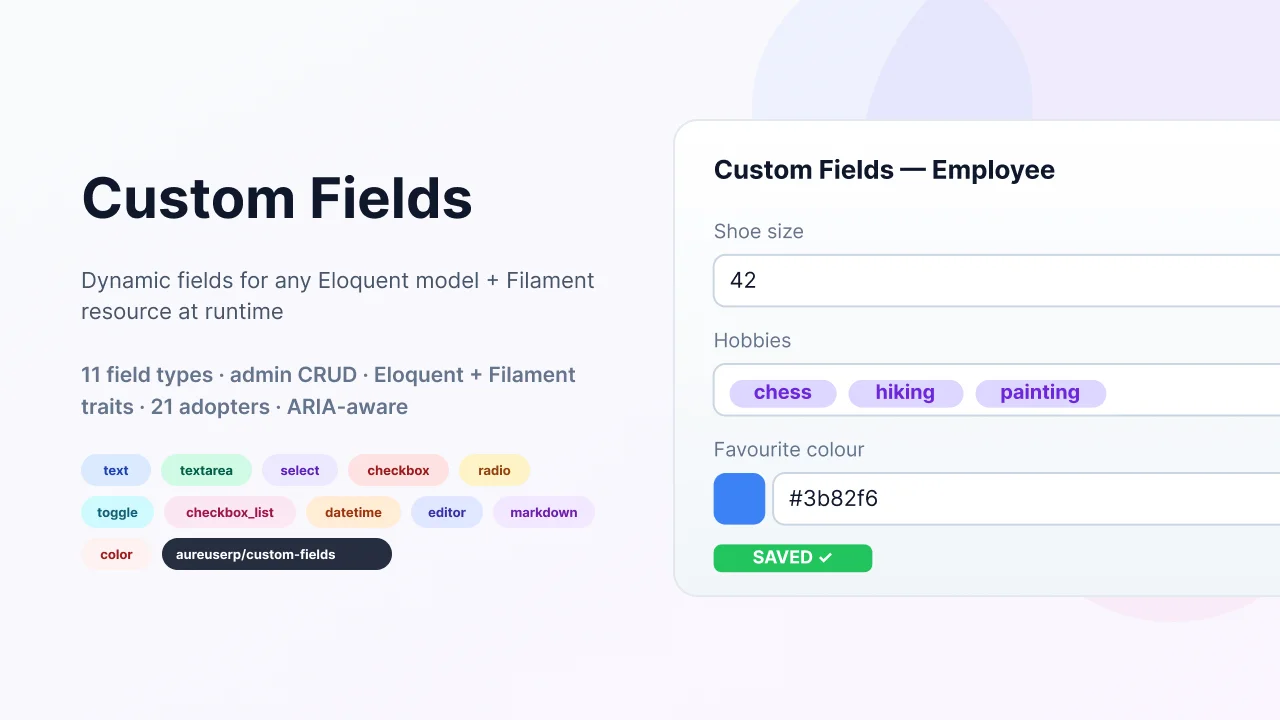
Let your end-users add dynamic fields to any Eloquent model + Filament resource at runtime, without writing a single migration. Ships an admin CRUD for managing field definitions, an Eloquent trait that auto-merges the new columns into your model's fillable/casts, a Filament resource trait with five merge helpers that inject fields into forms, tables, filters, infolists, and a runtime schema manager that creates the underlying DB columns for you.
Author:
Aureus ERP
Progress Bar
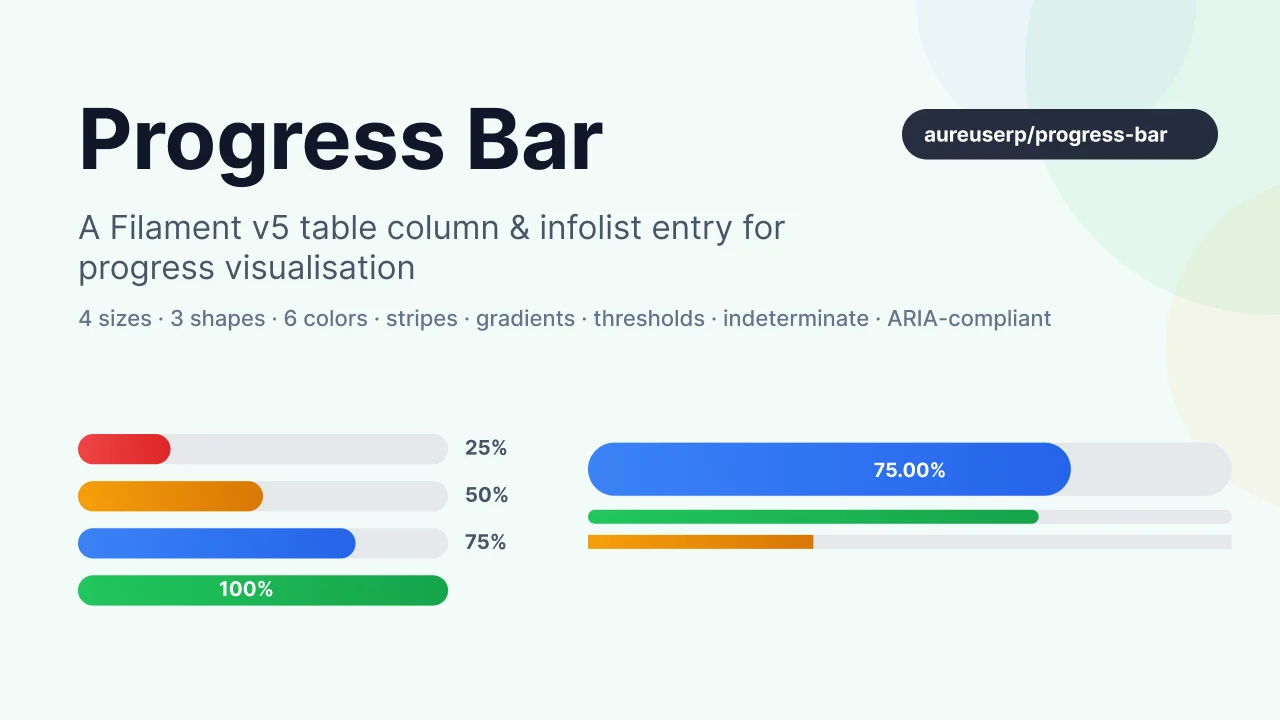
A feature-rich Filament v5 table column & infolist entry that renders progress as a horizontal bar. Built for dashboards, task progress, capacity gauges, skill levels, and any numeric value that fits on a 0–100% (or custom min–max) scale.
Author:
Aureus ERP
Featured Plugins
A selection of plugins curated by the Filament team
Sharp Theme
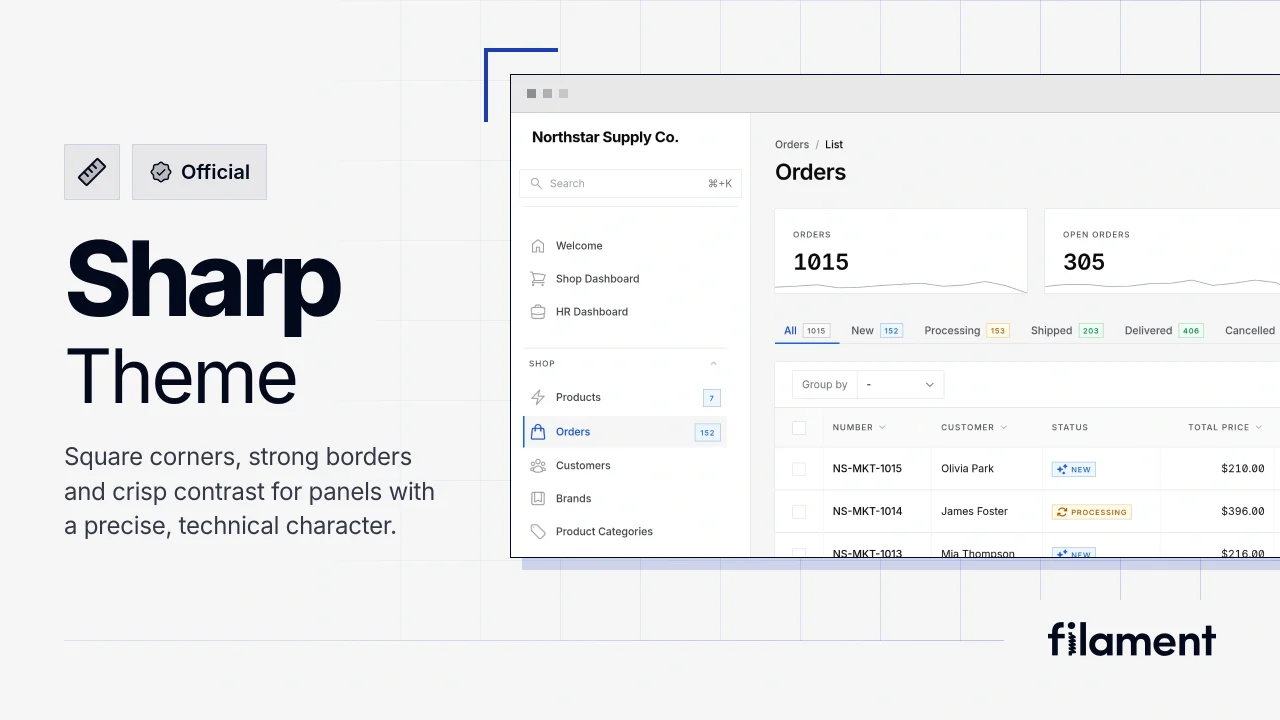
A theme that gives panels a precise, technical look with square corners, strong borders, and clear contrast.
 Filament
Custom Fields
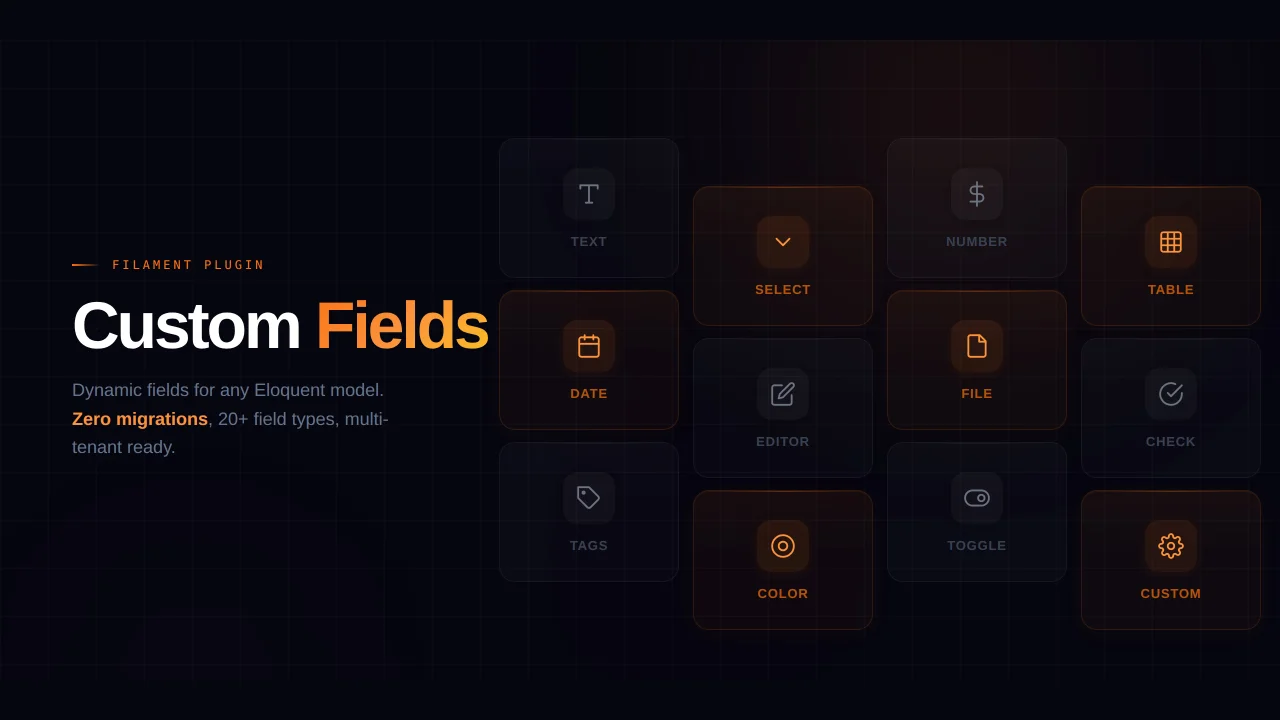
Eliminate custom field migrations forever. Let your users create and manage form fields directly in Filament admin panels with 20+ built-in field types, validation, and zero database changes.
 Relaticle
Advanced Tables (formerly Filter Sets)
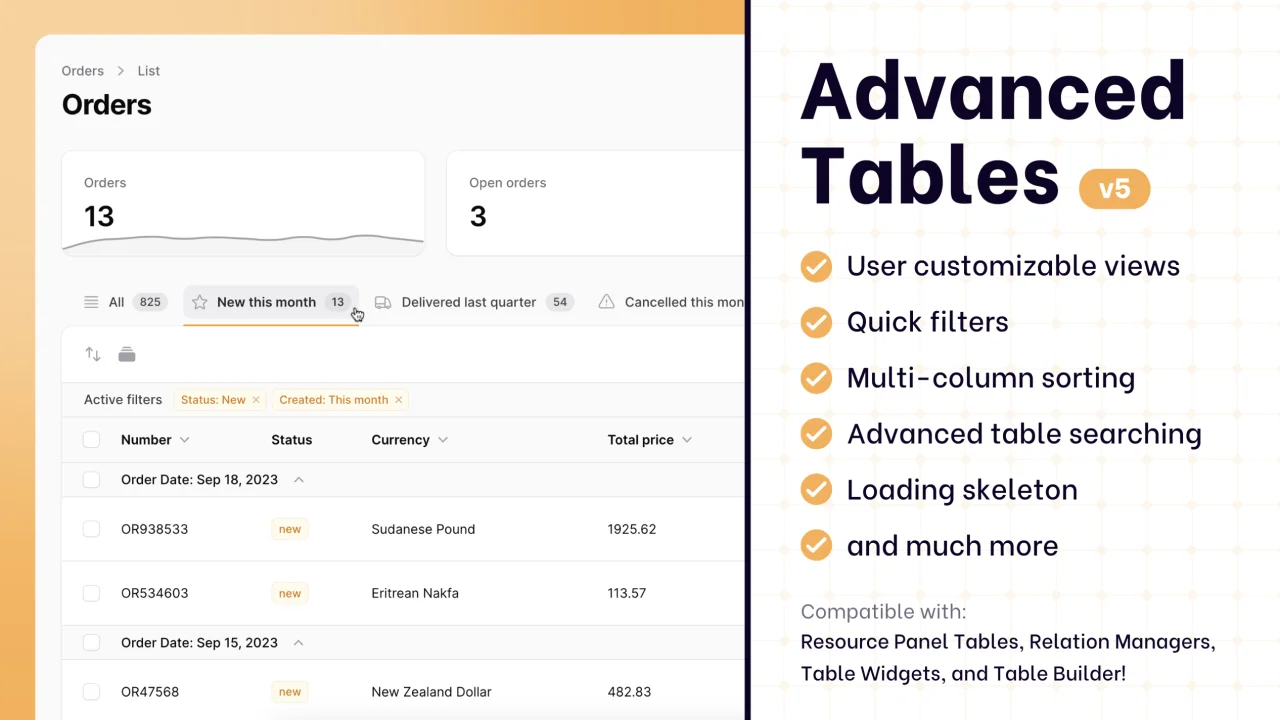
Supercharge your tables with powerful features like user-customizable views, quick filters, multi-column sorting, advanced table searching, convenient view management, and more. Compatible with Resource Panel Tables, Relation Managers, Table Widgets, and Table Builder!
 Kenneth Sese