VoodTutorials
CommunityFilament 5 package for technical tutorials: markdown, table of contents, materials, tools, resources, SEO, translations, comments, learning paths (series), and optional public routes.
filament/
namespace. Review the source and install at your own risk. Found
malware or an unresolved security issue the author won't
address?
Report it
.
 Author:
Voodflow
Author:
Voodflow
Documentation
- Requirements
- Optional dependencies
- Installation
- Admin authorization (with / without Shield)
- Core concepts
- Markdown authoring
- Tutorial series (learning paths)
- Filament admin
- Configuration
- Public routes
- Tutorial page layout
- Multilingual content
- Sitemap
- MCP server (AI authoring)
- Testing
- Features
- License
Public README mirror for Filament / marketing links. Canonical product docs: docs.voodflow.com. Package source remains private/licensed.
Version 0.0.20 · Paid plugin — source-available (not Open Source)
Commercial Filament 5 package for technical tutorials: markdown, table of contents, materials, tools, resources, SEO, translations, comments, learning paths (series), Integration typography with Voodbuilder, and optional public routes.
Production use requires a paid Voodflow license via Anystack. Source is available for audit and local development under the Voodflow Source-Available License — this is not MIT/Apache Open Source. See docs.voodflow.com.
Requires a Filament 5 admin panel in your Laravel 12+ / 13+ app. Pair with voodflow/voodbuilder (Community free) for the public site shell, or keep the bundled standalone theme when you are not using Voodbuilder.
#Requirements
- PHP 8.4+
- Laravel 12 or 13
- Filament 5
- voodflow/vmedia — Media Vault (featured images, galleries, markdown uploads)
- ralphjsmit/laravel-seo
- ralphjsmit/laravel-filament-seo
- spatie/laravel-markdown
- relaticle/comments
- spatie/laravel-medialibrary
#Optional dependencies
| Package | Purpose |
|---|---|
| voodflow/voodbuilder | Site shell (nav, footer, theme) + Integration typography — recommended for production sites |
| bezhansalleh/filament-shield | Role-based admin permissions + Users resource in the panel |
| spatie/laravel-permission | Required by Filament Shield |
| laravel/mcp | MCP tools for AI-assisted authoring |
| spatie/laravel-sitemap | XML sitemap integration |
#Installation
#Anystack (private Composer repository)
Licensed customers install from the Anystack private registry (see Anystack: private PHP packages). Add the repository to your Laravel app composer.json:
{
    "repositories": [
        {
            "type": "composer",
            "url": "https://vtuts.composer.sh"
        }
    ]
}
Then require the package:
composer require voodflow/vtuts
php artisan vtuts:install
Composer will prompt for HTTP Basic auth against vtuts.composer.sh:
Loading composer repositories with package information
Authentication required (vtuts.composer.sh):
Username: [licensee-email]
Password: [license-key]
Credentials
- Username: the email address on your Anystack license, or
unlockif the license is not assigned to a specific licensee. - Password: your license key from Anystack.
If your license policy requires a fingerprint, append it to the license key with a colon:
Password: 8c21df8f-6273-4932-b4ba-8bcc723ef500:your-fingerprint.example
If no fingerprint is required, use only the license key (no colon).
You can store the same credentials in auth.json or the COMPOSER_AUTH environment variable so composer update does not prompt every time.
#From GitHub (Composer)
{
    "repositories": [
        {
            "type": "vcs",
            "url": "https://github.com/voodflow/vtuts.git"
        }
    ],
    "require": {
        "voodflow/vtuts": "^0.0.19"
    }
}
Then run:
composer update voodflow/vtuts
php artisan vtuts:install
#Local path (development)
{
    "repositories": [
        { "type": "path", "url": "packages/voodflow/vtuts" }
    ],
    "require": {
        "voodflow/vtuts": "*"
    },
    "autoload": {
        "psr-4": {
            "Voodflow\\Vtuts\\": "packages/voodflow/vtuts/src/"
        }
    }
}
When using a path repository inside Docker, add the explicit PSR-4 autoload entry above and run composer dump-autoload -o so classes resolve from packages/ instead of a broken vendor/ symlink.
#vtuts:install
The install command publishes configs and migrations for tutorials and its dependencies, patches known relaticle/comments migration issues for MySQL, publishes Filament Shield assets when installed, seeds the default Style guide markdown template, then runs migrate.
php artisan vtuts:install
Options:
| Option | Description |
|---|---|
--force |
Overwrite already published files |
--skip-migrate |
Publish only, without running migrations |
When Filament Shield is installed, vtuts:install publishes Shield/permission assets, runs migrations, then offers to create the tutorials role matrix.
You can also run the role setup manually:
php artisan vtuts:shield-roles --generate --super-admin=1
Add HasRoles to your User model when using Shield:
use Spatie\Permission\Traits\HasRoles;

class User extends Authenticatable
{
    use HasFactory, HasRoles, Notifiable;
}
#Sample content
Seed demo tutorials, categories, tags, and three learning series (with ordered lessons):
php artisan vtuts:seed-samples
php artisan vtuts:seed-samples --fresh   # wipe previous sample slugs first
The seeder also creates Tutorial sample covers / Tutorial sample series galleries under the Tutorials vault root (voodflow/vmedia) and attaches SVG featured images.
#Admin authorization (with / without Shield)
Tutorial Filament resources (Tutorials, Series, Categories, Tags, Templates) use Laravel policies. Settings has no model policy, so it stays visible even when other items are denied.
#Without Filament Shield (stock Filament)
You do not need Shield to use vtuts. When the Shield package is not installed, the default authorization driver (auto) allows any user who can access the Filament panel to manage all tutorial resources.
Driver (vtuts.authorization.driver / VTUTS_AUTHORIZATION) |
Behaviour |
|---|---|
auto (default) |
Shield present → named abilities (ViewAny:Vtut, …). Shield absent → any Filament panel user |
permissions |
Always require Shield-style abilities (custom Gate / Shield) |
panel |
Always allow Filament panel users (ignore named abilities) |
If Shield is installed as a Composer dependency but you are not using it for vtuts:
VTUTS_AUTHORIZATION=panel
Or disable Shield wiring on the plugin / config:
VtutsPlugin::make()->shield(false);
// config/vtuts.php
'shield' => [
    'enabled' => env('VTUTS_SHIELD_ENABLED', true),
],
#With Filament Shield
When bezhansalleh/filament-shield is installed and shield.enabled is true:
- Run
php artisan vtuts:shield-roles --generate --super-admin=1(or accept the prompt duringvtuts:install). - Assign
super_admin/editor(and public roles as needed) to users. - Without those permissions, the Tutorials nav shows only Settings — that is expected, not a broken install.
VtutsPlugin then also registers FilamentShieldPlugin and the package UserResource.
#Core concepts
Vtuts separates what you teach (content) from how it is organised (taxonomy and paths).
| Concept | Purpose | Example |
|---|---|---|
| Tutorial | A single article with markdown body, intro, excerpt, SEO, materials/tools/resources | “CosmoBlink — your first C++ example” |
| Category | Broad topic for filtering and sidebar grouping | C++, Getting started |
| Series | Ordered learning path (lessons in sequence) | C++ Basics → lesson 1, lesson 2, … |
| Template | Reusable markdown skeleton for new tutorials | style-guide (seeded on install) |
| Tag | Optional cross-cutting labels (feature flag) | embedded, audio |
A tutorial can belong to one category, appear in one or more series, and link to next steps (other tutorial IDs shown at the end of the article).
Category vs series
- Category = “what kind of tutorial is this?” (used on the listing page and category archives).
- Series = “what order should I read these in?” (course bar, prev/next, progress tracking).
Example: category C++, series C++ Basics containing lessons mapped to examples/cpp/01_basics/* in your project docs.
#Markdown authoring
Tutorial bodies are written in GitHub Flavored Markdown. The renderer (VtutMarkdown) adds VitePress-style callouts and enhanced code blocks.
#Document structure
| Field | Role |
|---|---|
| Introduction | Short summary above the article (also rendered as markdown) |
| Content | Main body — use ## / ### headings for the table of contents |
| Excerpt | ~160 characters for listing cards |
Use ## for main sections (they appear in the right-hand On this page outline). Use ### for subsections.
#Headings and table of contents
## Overview

## What you need

## Build and flash

### Compile

### Upload to the board
Headings ## and ### receive stable anchor IDs and appear in the doc aside TOC.
#Inline code and code blocks
Wrap commands, filenames, and identifiers in backticks:
Install `arm-none-eabi-gcc`, then run `make program-dfu`.
Fenced blocks with a language tag get syntax highlighting (Shiki), a language label, line numbers, and a copy button (when voodflow/voodbuilder is installed):
```bash
cd examples/cpp/01_basics/CosmoBlink
make clean && make
```

```cpp
#include "daisy_cosmolab.h"

DaisyCosmolab hw;
```
Supported languages follow Spatie Markdown / Shiki (e.g. bash, cpp, ini, python, json).
#Callouts (alerts)
GitHub-style alerts render as coloured boxes with icons:
> [!NOTE]
> Install the toolchain before continuing.

> [!TIP]
> Compare with the next example in the same folder.

> [!IMPORTANT]
> Run `install.bat` on Windows instead of `install.sh`.
Also supported: > [!WARNING].
Legacy blockquote syntax still works:
> **Important note:** Your safety message here.
#Tables, lists, and GFM extras
- Tables — standard pipe tables
- Task lists —
- [x] Done/- [ ] Todo - Strikethrough —
~~removed~~ - Links and images — standard markdown
#Introduction deduplication
If the introduction paragraph is repeated at the start of the content body, it is automatically removed from the displayed body so it does not appear twice on the public page.
#Default template
vtuts:install seeds a Style guide template (slug: style-guide) with all common patterns. In Filament, pick From template when creating a tutorial, or fetch it via MCP (get_vtut_template).
#Tutorial series (learning paths)
Series group tutorials into ordered lessons — like a course or a chapter sequence.
#Admin workflow
- Create tutorials (draft or published).
- Tutorials → Series — create a series (title, slug, description, locale).
- Attach lessons and drag to reorder (or use MCP
sync_vtut_series_lessons).
#Public URLs
When features.series is true (default):
| URL | Route name | Purpose |
|---|---|---|
/tutorials/series |
vtuts.series.index |
All published series |
/tutorials/series/{slug} |
vtuts.series.show |
Series landing page + lesson list |
/tutorials/series/{series}/{lesson} |
vtuts.series.lesson |
Lesson inside series context |
Series lesson pages show a course bar: progress, previous/next lesson, and the full lesson list. Authenticated users can persist progress (POST …/progress).
Visibility gates (registered / subscriber) apply to series lesson routes the same way as standalone tutorials.
#MCP: sync_vtut_series_lessons
Replaces the entire ordered lesson list for a series (not incremental append):
{
  "series_slug": "cpp-basics",
  "locale": "en",
  "lesson_slugs": ["cosmoblink", "cosmo-display"]
}
Lesson 1 → cosmoblink, lesson 2 → cosmo-display. Call again with the full ordered list when you add or reorder lessons.
#Filament admin
Register the plugin in your panel provider:
use Voodflow\Vtuts\VtutsPlugin;

$panel->plugins([
    VtutsPlugin::make(),
]);
See Admin authorization (with / without Shield) for how resources appear in the panel.
Admin resources: Tutorials, Templates, Categories, Series, Tags, Settings, and optionally Users + Shield Roles.
Settings includes listing page copy, pagination, sidebar, read tracking, access-gate URLs, and MCP defaults (author email, draft vs publish, optional server code roots).
#Shield roles and tutorial visibility
| Role | Filament panel | Public tutorials |
|---|---|---|
super_admin |
Full access (Shield) | All visibility levels |
editor |
Create, edit, publish tutorials, categories, tags, templates, series | Same as any logged-in user |
registered |
No admin permissions | Can read Registered tutorials (must be logged in) |
subscriber |
No admin permissions | Can read Subscriber tutorials (access subscriber content permission) |
Tutorial visibility (per article):
| Visibility | Who can read |
|---|---|
| Public | Everyone |
| Registered users | Any authenticated user |
| Subscribers | Users with the access subscriber content permission |
Typical assignments:
- Staff who write tutorials →
editor - Users who sign up on the site →
registered - Paying members →
subscriber - Project owner →
super_admin
Customize role names and permission subjects in config/vtuts.php under shield.roles.
#SubKit + Stripe (optional paid access)
When SubKit and Laravel Cashier are installed:
| What you get | Details |
|---|---|
| Pricing page | /vtuts.pricing with <x-subkit::pricing-table> |
| Account page | /vtuts.subscription with <x-subkit::manage-subscriptions> |
| Gate CTA | Subscriber-only tutorials link to pricing automatically |
| Admin | SubKit Filament plugin registered by VtutsPlugin |
| Access sync | Stripe webhooks + login keep the subscriber Shield role in sync |
composer require karpovigorok/subkit laravel/cashier
php artisan vtuts:install
Disable SubKit integration:
VtutsPlugin::make()->subkit(false);
#Configuration
Publish and edit config/vtuts.php:
| Key | Purpose |
|---|---|
prefix |
URL prefix (default: tutorials) |
force_standalone |
Keep native vtuts layouts even when Voodbuilder is installed (see below) |
layout / doc_layout |
Blade layouts (auto-switched when integrated with Voodbuilder) |
authorization.driver |
auto / permissions / panel (see Admin authorization) |
author_model |
Author Eloquent model |
locales / default_locale |
Content languages |
features.* |
Routes, feed, sitemap, tags, comments, localization, series |
visibility.* |
Content visibility gate |
shield.enabled |
Filament Shield + Users resource |
subkit.* |
Optional SubKit + Cashier |
mcp.* |
MCP defaults (overridable in Admin → Settings → MCP) |
#Public frontend layouts (standalone vs Voodbuilder)
Vtuts ships its own Blade layouts (vtuts::layouts.*). When voodflow/voodbuilder is installed, the package integrates into Voodbuilder chrome by default (nav, footer, Theme Map, Integration typography preview).
| Mode | Config | Result |
|---|---|---|
| Integrated (recommended with Voodbuilder) | force_standalone = false (default) |
Uses vtuts::layouts.voodbuilder / vtuts::layouts.voodbuilder-page inside Voodbuilder chrome; reserves the tutorials URL prefix |
| Standalone | force_standalone = true or VTUTS_FORCE_STANDALONE=true |
Keeps original vtuts::layouts.* shell (does not pick up Voodbuilder theme/nav) |
# Keep package-native layouts (no Voodbuilder shell)
VTUTS_FORCE_STANDALONE=true

# Use Voodbuilder layouts when the package is present (default)
VTUTS_FORCE_STANDALONE=false
// config/vtuts.php
'force_standalone' => env('VTUTS_FORCE_STANDALONE', false),
After changing this, run php artisan config:clear.
Optional: php artisan voodbuilder:install can also patch a published config/vtuts.php and wire the language switcher. With integration you get shared nav/footer, theme.css via Vite, and enhanced code blocks (vp-code-block with copy button).
#Standalone layout views
| Layout | Purpose |
|---|---|
vtuts::layouts.page |
Index, category, tag, series listings |
vtuts::layouts.doc |
Single tutorial (sidebar, TOC, materials, comments) |
vtuts::layouts.app |
Base shell (nav, footer, theme toggle) |
php artisan vendor:publish --tag=vtuts-assets
Public comments use Relaticle. Add the commenter trait to your user model:
use Voodflow\Vtuts\Concerns\CanComment;

class User extends Authenticatable
{
    use CanComment, HasFactory, Notifiable;
}
#Public routes
Registered when features.public_routes is true:
| URL | Route name |
|---|---|
/tutorials |
vtuts.index |
/tutorials/{slug} |
vtuts.show |
/tutorials/series |
vtuts.series.index |
/tutorials/series/{slug} |
vtuts.series.show |
/tutorials/series/{series}/{lesson} |
vtuts.series.lesson |
/{locale}/tutorials/... |
vtuts.localized.* |
/tutorials/category/{slug} |
vtuts.category |
/tutorials/tag/{slug} |
vtuts.tag |
/tutorials/preview/{vtut} |
signed preview |
/tutorials/feed |
RSS feed |
Set prefix in config/vtuts.php (or VTUTS_PREFIX in .env). Route names stay vtuts.*.
Middleware:
vtuts.locale— setsapp()->getLocale()from the URLvtuts.visible— visibility gate for registered/subscriber content
#Tutorial page layout
Doc-style pages include:
- Left sidebar — latest tutorials from the same category, or series lesson list on series URLs
- Main column — title, meta, video, markdown, materials/tools/resources, comments
- Right aside — table of contents, section anchors, comments link, deduplicated external links from materials/tools/resources
#Multilingual content
- Configure
localesanddefault_locale - Enable
features.localization - Create translations in Filament (Translate action)
- Default locale:
/tutorials/...; others:/{locale}/tutorials/... - SEO
hreflangalternates per tutorial
Admin UI strings: resources/lang/{locale}/admin.php (English and Italian included).
#Sitemap
use Spatie\Sitemap\Sitemap;
use Voodflow\Vtuts\Support\VtutSitemapGenerator;

Sitemap::create()
    ->pipe(fn ($sitemap) => VtutSitemapGenerator::addToSitemap($sitemap))
    ->writeToFile(public_path('sitemap.xml'));
#MCP server (AI authoring)
Install the optional dependency:
composer require laravel/mcp
Vtuts registers VtutsServer automatically:
- HTTP —
{APP_URL}/mcp/vtuts(default route) - Stdio —
php artisan mcp:start vtuts(local process transport)
#How it works
MCP is the publish button for your AI agent — not a code editor.
- You work on source material in your AI tool (open files, pasted code, conversation).
- The agent composes tutorial markdown (headings, code blocks, callouts).
- MCP tools save the result to this site's database (
create_vtut, series tools, etc.).
The AI agent already sees your workspace. You do not need to mount external repositories or configure code roots for the typical workflow.
#Setup (out of the box)
- Admin → Tutorials → Settings → MCP
- Default author email (staff user that owns AI-created tutorials)
- Publish immediately vs save as draft (draft recommended)
- Optional: enable server-side code roots (off by default)
- Run
php artisan vtuts:mcp-infoand copy the configuration snippet into your MCP client. - Reconnect the MCP client in your AI tool.
{
  "mcpServers": {
    "vtuts": {
      "url": "https://your-site.test/mcp/vtuts"
    }
  }
}
For local development, use your local APP_URL (e.g. http://localhost:8002/mcp/vtuts). The site must be running and reachable.
#MCP tools
| Tool | Purpose |
|---|---|
list_vtut_templates |
List markdown templates |
get_vtut_template |
Fetch template body (e.g. style-guide) |
list_vtuts |
List existing tutorials (avoid duplicates) |
create_vtut |
Create or update a tutorial (slug + locale upsert) |
list_vtut_series |
List learning paths |
create_vtut_series |
Create or update a series |
sync_vtut_series_lessons |
Set ordered lesson list for a series |
search_project_code |
Optional — search files on the server |
read_project_file |
Optional — read a file from server code roots |
create_vtut saves drafts by default unless publish: true or Settings → MCP → Publish tutorials immediately is enabled.
#Optional server code roots
Enable only when the AI agent runs without workspace context and must read files on the server (e.g. a cloned repo at /var/www/myproject).
- Admin → Settings → MCP → Enable server-side code roots
- One absolute path per line
- Activates
search_project_codeandread_project_file
Leave disabled for normal use: the agent reads from the conversation instead.
#Environment variables
| Variable | Default | Purpose |
|---|---|---|
VTUTS_FORCE_STANDALONE |
false |
Keep native vtuts layouts instead of Voodbuilder |
VTUTS_AUTHORIZATION |
auto |
Admin policy driver (auto / permissions / panel) |
VTUTS_MCP_ENABLED |
true |
Master switch |
VTUTS_MCP_HTTP_ROUTE |
mcp/vtuts |
HTTP endpoint path |
VTUTS_MCP_DEFAULT_AUTHOR_EMAIL |
— | Fallback author (Settings overrides) |
VTUTS_MCP_DEFAULT_PUBLISH |
false |
Fallback publish flag |
VTUTS_MCP_ENABLE_PROJECT_ROOTS |
false |
Env fallback for code roots toggle |
VTUTS_MCP_PROJECT_ROOTS |
— | Comma-separated server paths |
#Testing
composer install
./vendor/bin/phpunit
#Features
- Filament CRUD with drafts, scheduling, bulk publish/unpublish
- Translation groups with per-locale slugs
- Markdown TOC, GitHub alerts, GFM tables, Shiki code blocks
- Materials, tools, resources sidebars with deduplicated aside links
- Tutorial series with ordered lessons and progress tracking
- SEO (Filament + schema.org TechArticle)
- Public comments via Relaticle
- Optional Filament Shield + Users resource
- Standalone dark/light theme with bundled CSS
- MCP tools for AI-assisted authoring
- voodbuilder dynamic block: Latest tutorials
#License
Voodflow Source-Available License — the source is visible for audit and local development, but this is not Open Source. Production use requires a paid license from Voodflow. See LICENSE and docs.voodflow.com.
The site shell voodflow/voodbuilder is Community free (source-available; not OSI Open Source).
The author
We are a development team focused on building modern, efficient management applications using FilamentPHP. We’ve been working with FilamentPHP since version 3 for several years, leveraging its flexibility to create solid, scalable, and productivity-oriented admin interfaces.
Over time, we developed an internal management system for one of our businesses, tackling real-world challenges and delivering practical, field-tested solutions. From that experience, we also built a range of plugins designed to extend Filament’s capabilities in a focused and meaningful way.
This natural evolution led to the creation of Voodflow: not just a plugin, but a full workflow engine that lives inside FilamentPHP. Voodflow is designed to orchestrate complex processes in an intuitive way, while preserving the consistency and elegance of the Filament ecosystem—while pushing it beyond its traditional limits.
From the same author
VoodDocs
Filament 5 package for documentation sites: markdown pages, VitePress-style sidebar navigation, import 1:1 from vite-press, table of contents, locales, and optional integration with voodflow/vpress.
Author:
Voodflow
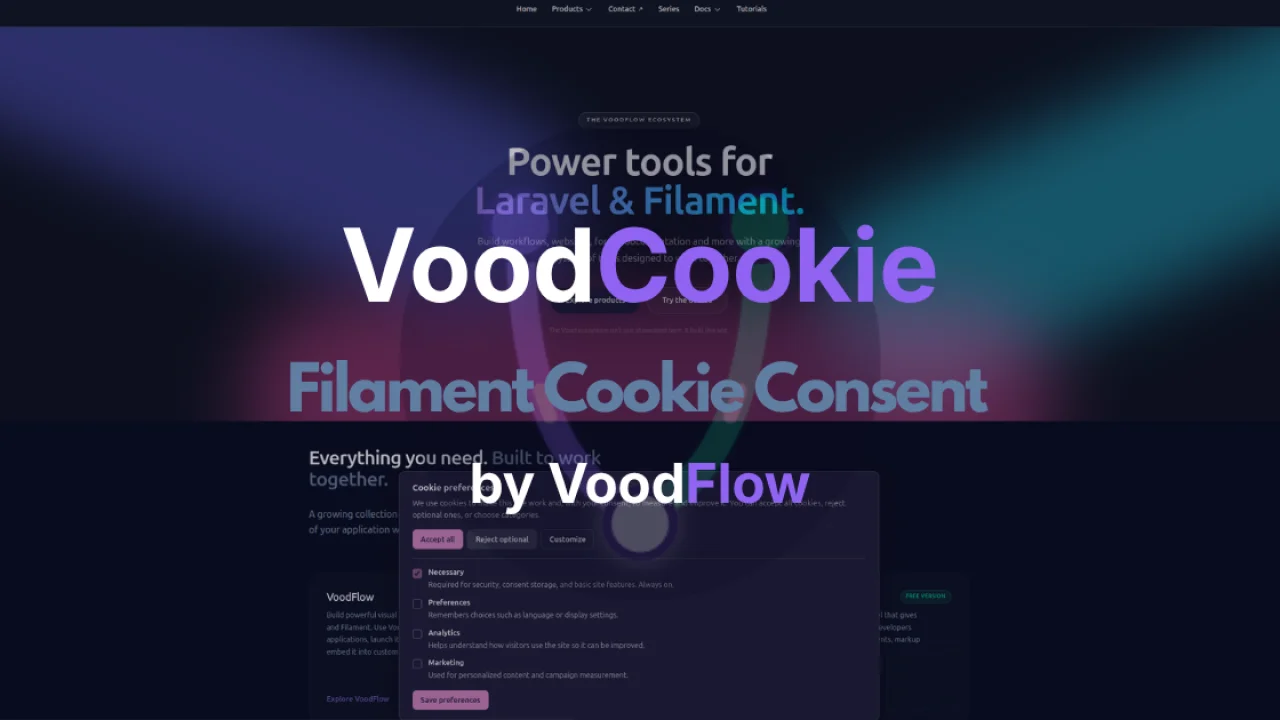
VoodCookiebar
Cookie consent for Laravel + Filament 5: opt-in preferences UI, real script gating, and a Filament settings page. Works standalone in any Filament app
Author:
Voodflow
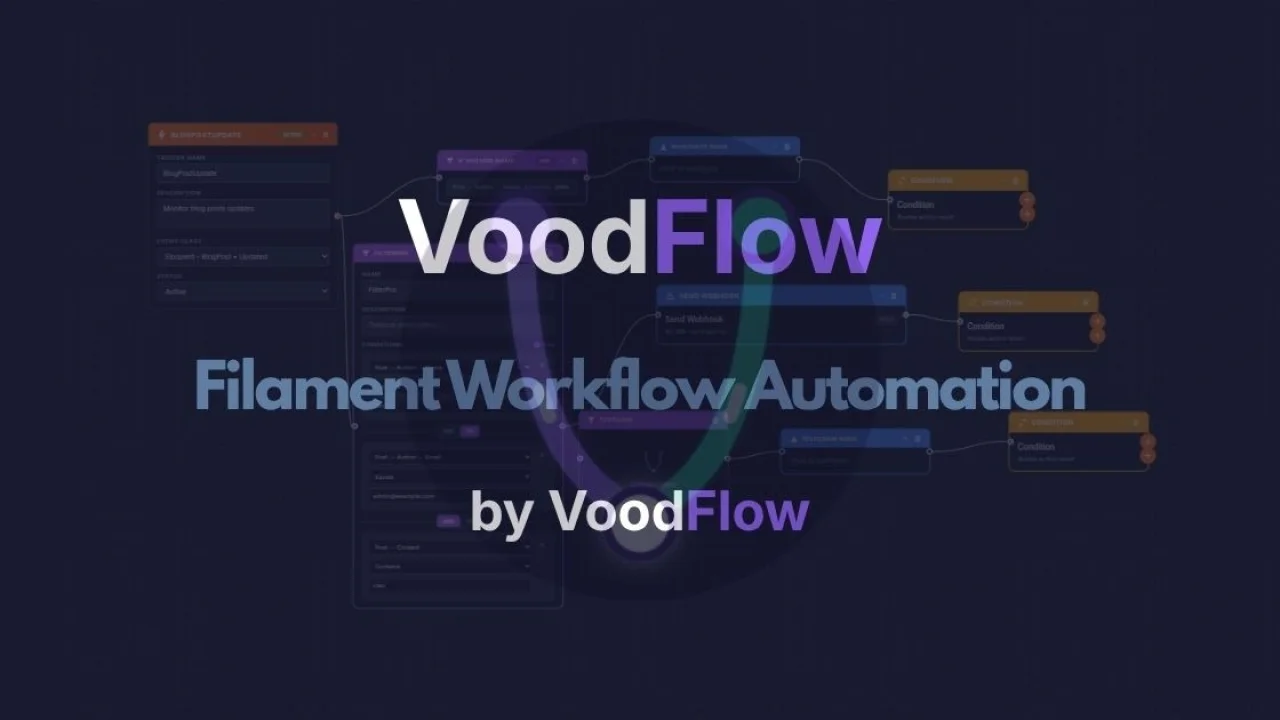
Voodflow
Self-hosted visual workflow automation for Filament and Laravel: design and run automations in your own admin while your workflows, credentials, and data stay entirely on your infrastructure.
Author:
Voodflow
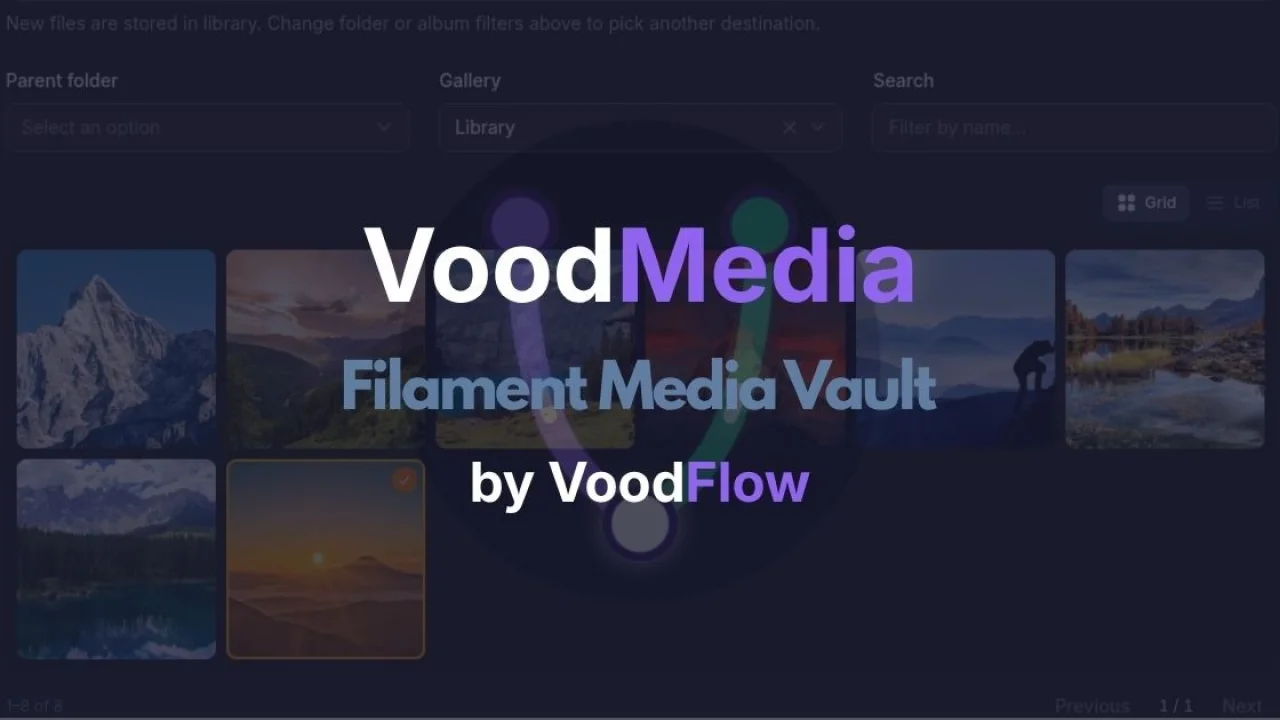
VoodMedia
Media vault and galleries for Laravel + Filament — reusable assets, galleries, and form pickers. MIT by Voodflow.
Author:
Voodflow
Featured Plugins
A selection of plugins curated by the Filament team
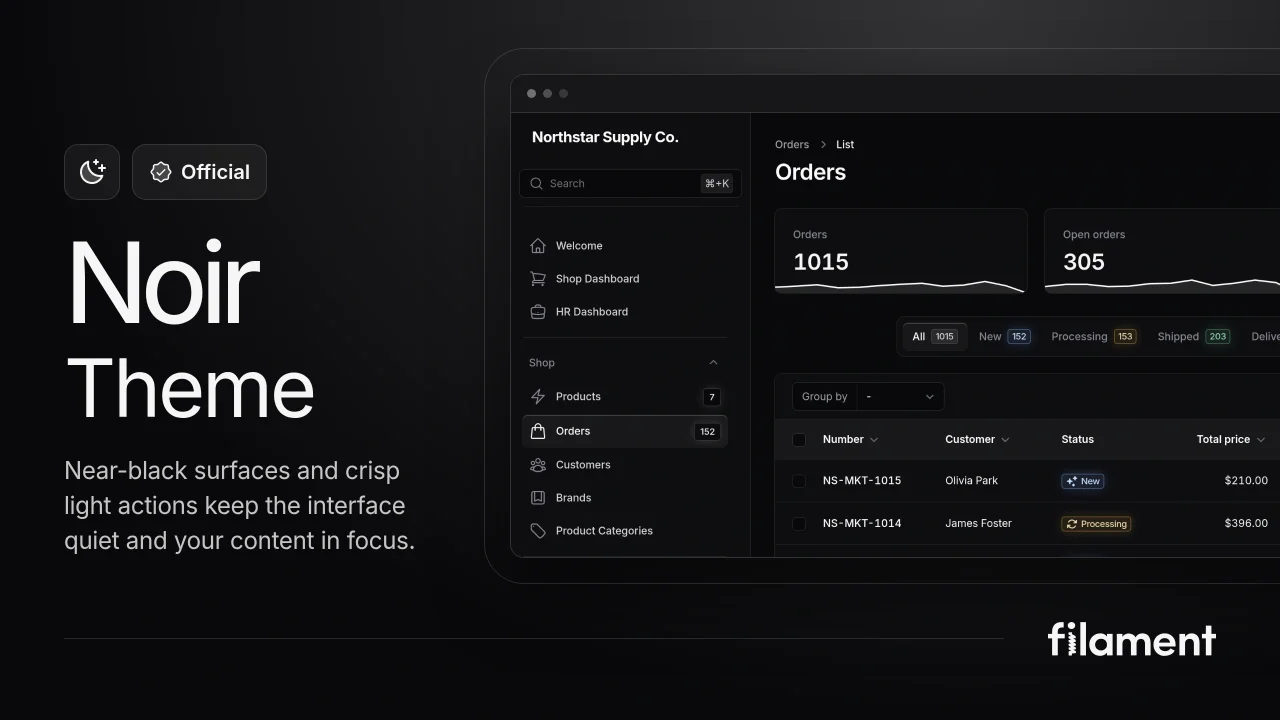
Noir Theme
A theme that gives panels a focused, refined look with near-black surfaces, crisp actions, and restrained color.
 Filament
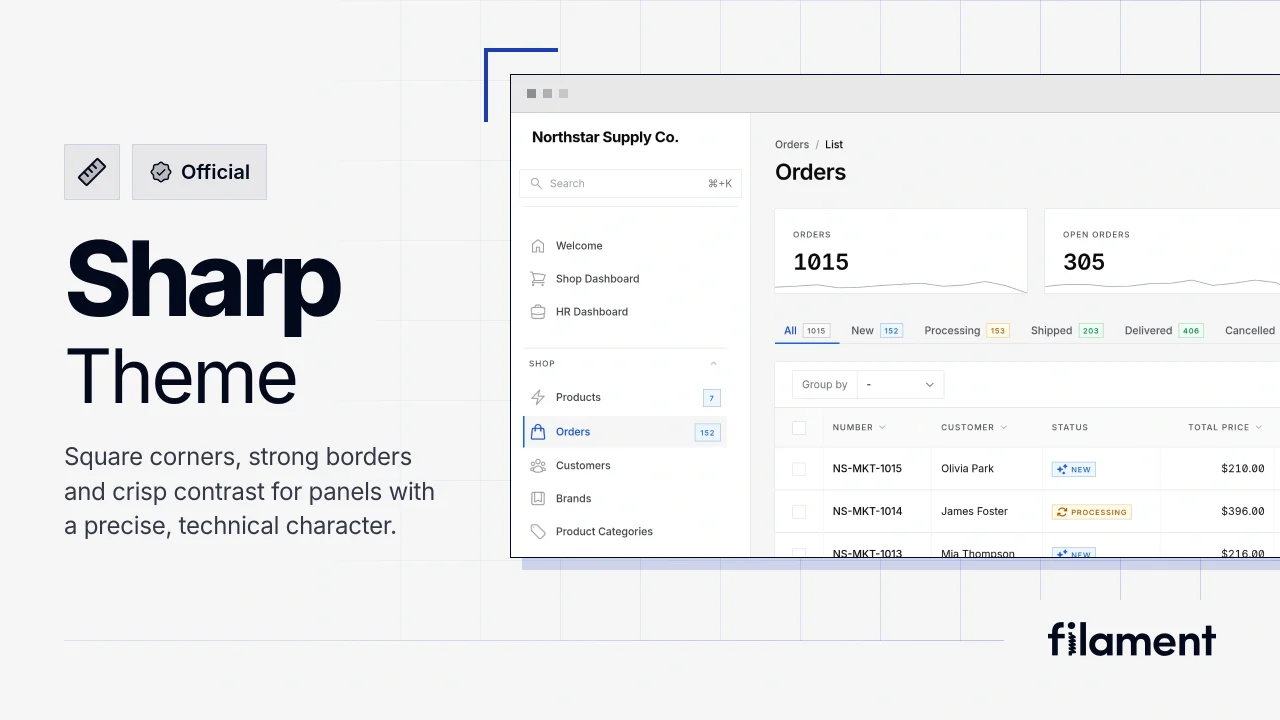
Sharp Theme
A theme that gives panels a precise, technical look with square corners, strong borders, and clear contrast.
Filament
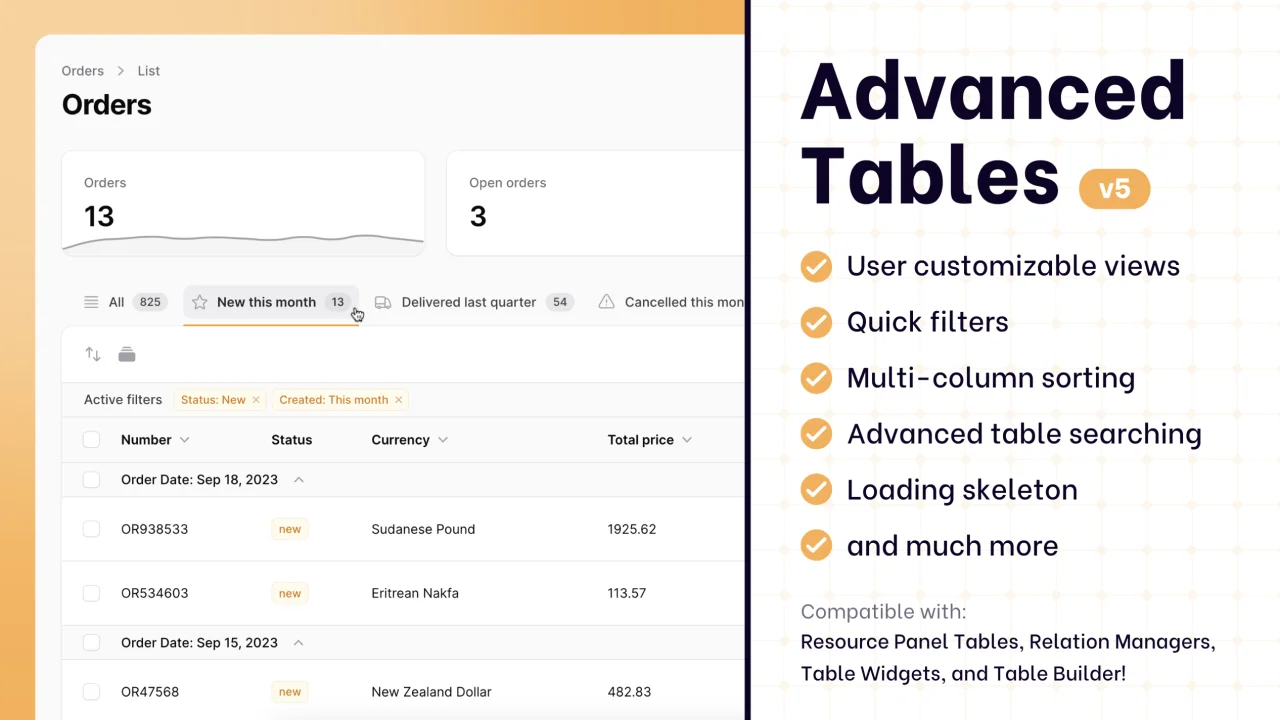
Advanced Tables (formerly Filter Sets)
Supercharge your tables with powerful features like user-customizable views, quick filters, multi-column sorting, advanced table searching, convenient view management, and more. Compatible with Resource Panel Tables, Relation Managers, Table Widgets, and Table Builder!
 Kenneth Sese