VoodDocs
CommunityFilament 5 package for documentation sites: markdown pages, VitePress-style sidebar navigation, import 1:1 from vite-press, table of contents, locales, and optional integration with voodflow/vpress.
filament/
namespace. Review the source and install at your own risk. Found
malware or an unresolved security issue the author won't
address?
Report it
.
 Author:
Voodflow
Author:
Voodflow
Documentation
Public README mirror for Filament / marketing links. Canonical product docs: docs.voodflow.com. Package source remains private/licensed.
Version 0.0.16 · Paid — source-available (not Open Source)
Filament 5 package for documentation sites: markdown pages, VitePress-style sidebar navigation, table of contents, locales, doc templates, section versioning, and optional integration with voodflow/voodbuilder. Requires a Filament 5 admin panel — it does not run as a plain Laravel package without Filament.
Production use requires a paid Voodflow license via Anystack. Source is available for audit and local development under the Voodflow Source-Available License — this is not MIT/Apache Open Source. See docs.voodflow.com.
#Requirements
- PHP 8.4+
- Laravel 12 or 13
- Filament 5
- voodflow/vmedia — Media Vault (markdown editor uploads / vault roots)
- ralphjsmit/laravel-filament-seo
- spatie/laravel-markdown
Optional
- voodflow/voodbuilder — site shell (header nav, footer, theme) + Integration typography preview
#Installation
#Anystack (private Composer repository)
Licensed customers install from the Anystack private registry (see Anystack: private PHP packages). Add the repository to your Laravel app composer.json:
{
    "repositories": [
        {
            "type": "composer",
            "url": "https://vdocs.composer.sh"
        }
    ]
}
Then require the package:
composer require voodflow/vdocs
php artisan vdocs:install
Composer will prompt for HTTP Basic auth against vdocs.composer.sh:
Loading composer repositories with package information
Authentication required (vdocs.composer.sh):
Username: [licensee-email]
Password: [license-key]
Credentials
- Username: the email address on your Anystack license, or
unlockif the license is not assigned to a specific licensee. - Password: your license key from Anystack.
If your license policy requires a fingerprint, append it to the license key with a colon:
Password: 8c21df8f-6273-4932-b4ba-8bcc723ef500:your-fingerprint.example
If no fingerprint is required, use only the license key (no colon).
You can store the same credentials in auth.json or the COMPOSER_AUTH environment variable so composer update does not prompt every time.
vdocs:install publishes configs and migrations for vdocs and its dependencies, runs migrations, and — when voodflow/voodbuilder is installed — updates config/vdocs.php to use voodbuilder layouts.
Options:
php artisan vdocs:install --force          # overwrite published config files
php artisan vdocs:install --skip-migrate   # publish only, run migrate yourself
#From GitHub (Composer)
{
    "repositories": [
        {
            "type": "vcs",
            "url": "https://github.com/voodflow/vdocs.git"
        }
    ],
    "require": {
        "voodflow/vdocs": "^0.0.15"
    }
}
Then run:
composer update voodflow/vdocs
php artisan vdocs:install
#Local path (development)
{
    "repositories": [
        { "type": "path", "url": "packages/voodflow/vdocs" }
    ],
    "require": {
        "voodflow/vdocs": "*"
    }
}
#Filament setup
Register the plugin in your panel provider:
use Voodflow\Vdocs\VdocsPlugin;

$panel->plugins([
    VdocsPlugin::make(),
]);
After installation, open your Filament panel. The Vdocs navigation group contains:
| Resource / page | Purpose |
|---|---|
| Sections | Top-level documentation areas (guide, api, …) |
| Pages | Markdown pages, assigned to a section or standalone |
| Settings | Site title, docs home, sidebar behaviour |
#Using the plugin
#Content model
vdocs stores documentation in three database tables:
- Sections — logical groups with a URL slug and sort order.
- Pages — markdown content with layout, locale, publication status, and sidebar metadata.
- Settings — global documentation options (cached).
#Creating content manually
-
Create a section (e.g. slug
guide, titleGuide). -
Create pages inside that section:
slug: URL segment (getting-started, orindexfor the section landing page)layout:doc(default article),home(hero landing), orpage(root-level article without section)status: must be Published to appear on the public sitesidebar_group: optional group label in the left sidebar (e.g.Getting Started)sidebar_order/sort_order: control navigation order
-
Write markdown in the Content field. Headings (
##,###, …) automatically feed the on-page table of contents.
#Page layouts
| Layout | Use for | Public URL |
|---|---|---|
home |
Documentation landing with hero + feature grid | /docs (when selected as home) |
doc |
Standard documentation article inside a section | /docs/{section}/{slug} |
page |
Standalone page at the docs root (no section) | /docs/{slug} |
The home layout reads structured data from home_data (hero name/text/tagline, image, action buttons, feature cards). This is populated automatically when importing VitePress layout: home frontmatter, or can be edited in the database.
#Documentation settings
Open Vdocs → Settings:
| Setting | Description |
|---|---|
| Site title / description | Used in SEO metadata |
| Show table of contents on docs home | Right-hand outline on /docs when using a doc home page |
| Docs home source | Documentation page or Site page (requires voodbuilder) |
| Documentation home page | Which published home layout page is served at /docs |
| Site page | A voodbuilder site page served at /docs instead of the doc home |
| Show section sidebar on doc pages | Toggle the left navigation column |
Home resolution order for /docs:
- If Site page mode is enabled and a valid published voodbuilder page is selected → render that page.
- Otherwise → render the selected (or first available) home layout doc page.
- If no home page exists → redirect to the first section.
- If there are no sections either → 404.
#Public routes
All routes use the vdocs.locale middleware. Default prefix is docs (configurable).
| URL | Description |
|---|---|
/docs |
Documentation home (see settings above) |
/docs/{section} |
Section landing page (index slug) |
/docs/{section}/{slug} |
Documentation article |
/docs/{slug} |
Root-level page (layout: page, no section) |
When voodbuilder is present, a Docs dropdown can appear in the site header and mobile menu:
- Preferred: menu item type Documentation (Admin → VoodBuilder → Menus). Children are resolved live from navigable topics (product docs with a published home page and/or sections). Empty topics like legacy
defaultare skipped. Add a topic → it appears in the dropdown without editing the menu. - With multiple products: Overview (
/docs) + one link per product home (/docs/{topic}). - With a single product: only that product home (no duplicate Overview).
- Legacy sites with no navigable topics still list Overview + sections.
Legacy auto-inject: when nav_show_in_header is enabled and no Documentation menu item exists in main, the package still injects <x-voodbuilder::docs-menu /> after the Admin menu (same topic/section rules). Auto-inject is skipped when a Documentation item is already present (avoids duplicates).
By default vdocs.nav.show_in_header is false. To enable auto-inject:
- Set
'show_in_header' => trueinconfig/vdocs.php(host override of the package default), or - Use Admin → Vdocs settings and enable the
nav_show_in_headertoggle (persisted inDocSettings; overrides the config default).
Precedence: once a DocSettings row exists, nav_show_in_header in the DB wins over config/vdocs.php. Changing config to false alone will not hide the menu if Admin (or a previous save) left nav_show_in_header: true. Disable the toggle in Admin, or:
php artisan tinker --execute 'Voodflow\Vdocs\Models\DocSettings::saveData(["nav_show_in_header" => false]);'
Hiding the dropdown does not disable documentation routes — only the automatic nav injection.
#Configuration
Publish and edit config/vdocs.php:
| Key | Purpose |
|---|---|
prefix |
URL prefix (default: docs) |
force_standalone / VDOCS_FORCE_STANDALONE |
Keep package shell instead of voodbuilder (default: false) |
doc_layout / home_layout |
Blade layouts for doc and home pages |
layouts |
Named layout map (doc, home, page) |
features.public_routes |
Enable public /docs routes |
features.localization |
Enable locale-prefixed URLs |
locales / default_locale |
Supported languages |
sidebar.show_on_doc_pages |
Default for left sidebar visibility |
home.show_toc |
Default for home page outline |
home.mode |
Default home source (doc_page or site_page) |
nav.show_in_header |
Docs dropdown in voodbuilder site nav (default: false) |
When voodflow/voodbuilder is installed and force_standalone is false, Vdocs uses its own reading layouts inside Voodbuilder chrome (vdocs::layouts.voodbuilder) and registers the docs URL prefix plus an Integration-tab reading preview. Set VDOCS_FORCE_STANDALONE=true to keep the package standalone shell (vdocs::layouts.doc).
#Morph map (required with HasSEO)
If your application uses Relation::enforceMorphMap(), register the doc page model:
'doc_page' => \Voodflow\Vdocs\Models\DocPage::class,
#Blade components
| Component | Purpose |
|---|---|
<x-vdocs::outline /> |
On-page table of contents |
<x-vdocs::doc-sidebar-nav /> |
Multi-group section sidebar |
<x-vdocs::language-switcher /> |
Locale switcher (when localization is enabled) |
#Importing from VitePress
vdocs includes an Artisan command to migrate an existing VitePress content folder (the directory that contains index.md and section subfolders) into the database.
#Command
php artisan vdocs:import-vitepress /path/to/docs [--locale=en|it] [--topic=voodbuilder] [--docs-version=1.x] [--force]
| Argument / option | Description |
|---|---|
path |
Root folder with .md files (e.g. cosmolab-docs/ or docs/) |
--locale |
Import into this locale (defaults to default_locale; prompts when omitted in interactive mode) |
--topic |
Product topic slug (one plugin = one topic). Create with --create-topic when missing |
--docs-version |
Tag imported sections with this version (1.x). Omit / latest = current tree (docs_version null) |
--force |
Delete existing pages for the selected topic/locale (and version when --docs-version is set) before importing |
Without --force, the command aborts if conflicting pages already exist.
Version folders: paths like 1.x/guide/foo.md, v1/guide/foo.md, or frontmatter version: 1.x / docs_version: 1.x map into parallel section trees under the same topic. Do not invent a second topic (voodbuilder-v1) for older releases.
Locale-aware paths: if markdown files live under a locale prefix (it/guide/foo.md), they are imported only when --locale=it matches that prefix. Files without a prefix use the selected --locale.
#Seed section translations (one-shot)
After importing English content (or when upgrading an existing single-locale site), create linked section rows for another locale and fix pages that still point at the source sections:
# Preview
php artisan vdocs:seed-section-translations --dry-run

# Create IT sections from EN (default source/target from config/vdocs.php)
php artisan vdocs:seed-section-translations --source=en --target=it
| Option | Description |
|---|---|
--source |
Source locale (default: default_locale, usually en) |
--target |
Target locale (default: first non-default locale, e.g. it) |
--dry-run |
Print planned creates/remaps without writing |
The command:
- Creates missing section translations in the target locale (same slug, localized title from
SectionCatalog). - Remaps target-locale pages whose
section_idstill points at a source-locale section.
Typical Cosmolab workflow:
php artisan vdocs:import-vitepress ../cosmolab-docs --locale=en --force
php artisan vdocs:seed-section-translations --source=en --target=it
# later, when Italian markdown exists:
php artisan vdocs:import-vitepress ../cosmolab-docs/it --locale=it --force
Known section titles (guide → Guida, api → Riferimento API, …) live in src/Support/SectionCatalog.php — update that file for custom projects (also used by the VitePress importer).
#What the importer does
- Scans markdown files recursively, skipping
.vitepress/andnode_modules/. - Parses YAML frontmatter (
---blocks at the top of each file). - Creates or updates sections and pages in the database, all marked as published.
- Rewrites internal links in markdown from VitePress paths (
/guide/foo) to vdocs paths (/docs/guide/foo). - Rewrites hero action links in home frontmatter the same way.
- Optionally copies images from
.vitepress/dist/assets/intopublic/images/(see below).
#Expected folder structure
A typical VitePress docs tree:
docs/
├── index.md              → home page (layout: home)
├── guide/
│   ├── index.md          → /docs/guide
│   ├── getting-started.md
│   └── first-project.md
├── api/
│   ├── index.md
│   └── daisy-cosmolab.md
└── resources.md          → root-level page (layout: page)
Path → URL mapping:
| File | Section | Slug | Result URL |
|---|---|---|---|
index.md |
— | index |
/docs (home layout) |
guide/index.md |
guide |
index |
/docs/guide |
guide/getting-started.md |
guide |
getting-started |
/docs/guide/getting-started |
resources.md |
— | resources |
/docs/resources |
#Frontmatter support
The importer recognises VitePress frontmatter keys:
---
title: Custom Page Title
layout: home        # home | page (default: doc)
hero:
  name: Product Name
  text: Tagline
  tagline: Subtitle
  image:
    src: /images/logo.png
    alt: Logo
  actions:
    - theme: brand
      text: Get Started
      link: /guide/getting-started
features:
  - icon: 🎛️
    title: Feature title
    details: Feature description
---
layout value |
vdocs layout | Notes |
|---|---|---|
home |
home |
Hero and features stored in home_data |
page |
page |
Root-level article, no section |
| (absent) | doc |
Standard section article |
If title is omitted, the importer derives it from the VitePress sidebar label or the section/file name.
#Sidebar groups and order
During import, each page receives sidebar_group, sidebar_order, and sort_order from a sidebar index built at import time.
The default sidebar definitions in ImportVitePressCommand mirror the Cosmolab VitePress project (guide, api, examples, hardware, ai). Page titles and sidebar groups match the original VitePress config.mjs sidebar.
For a different VitePress site, update sidebarDefinitions() in ImportVitePressCommand.php and section titles in SectionCatalog.php.
Copy the sidebar object from your .vitepress/config.mjs into the same structure, then re-run the import with --force. Alternatively, import once and adjust sidebar groups manually in Filament.
#Link rewriting
Markdown links are rewritten on import:
| Original (VitePress) | After import |
|---|---|
/guide/getting-started |
/docs/guide/getting-started |
./other-page |
/docs/{section}/other-page |
../api/foo |
/docs/api/foo |
https://…, #anchor, mailto: |
unchanged |
The prefix follows config('vdocs.prefix') (default docs).
#Images and assets
If you have already built the VitePress site (npm run docs:build), the importer copies matching files from:
{path}/.vitepress/dist/assets/
into public/images/. By default this applies to files whose names start with cosmolab_ or lasercut_.
For other projects, either:
- place images in
public/images/before import and reference them as/images/...in markdown, or - extend
copyDistAssets()inImportVitePressCommand.php.
Hero images referenced in frontmatter (hero.image.src) are kept as absolute paths (e.g. /images/logo.png).
#Example: Cosmolab
# From the Laravel app container or project root
php artisan vdocs:import-vitepress /path/to/cosmolab-docs --force
Then open /docs in the browser. With voodbuilder installed you should see the hero landing; section pages appear under /docs/{section}/{slug}.
#After import
- Visit Filament → Vdocs → Settings and confirm the Documentation home page points to the imported
index.mdhome page. - Review Pages for any missing sidebar groups or titles.
- Run
npm run buildin your Laravel app if voodbuilder frontend assets changed. - Clear rendered content cache if you edit pages programmatically: each page clears its own cache on save.
#Re-importing
--force deletes pages (and orphan sections) for the selected locale only before importing. Other locales and global settings are preserved. Use this when refreshing content from an updated VitePress tree for one language at a time.
#Testing
cd packages/voodflow/vdocs
composer install
vendor/bin/phpunit
#License
Voodflow Source-Available License — the source is visible for audit and local development, but this is not Open Source. Production use requires a paid license from Voodflow. See LICENSE and docs.voodflow.com.
The site shell voodflow/voodbuilder is Community free (source-available; not OSI Open Source).
The author
We are a development team focused on building modern, efficient management applications using FilamentPHP. We’ve been working with FilamentPHP since version 3 for several years, leveraging its flexibility to create solid, scalable, and productivity-oriented admin interfaces.
Over time, we developed an internal management system for one of our businesses, tackling real-world challenges and delivering practical, field-tested solutions. From that experience, we also built a range of plugins designed to extend Filament’s capabilities in a focused and meaningful way.
This natural evolution led to the creation of Voodflow: not just a plugin, but a full workflow engine that lives inside FilamentPHP. Voodflow is designed to orchestrate complex processes in an intuitive way, while preserving the consistency and elegance of the Filament ecosystem—while pushing it beyond its traditional limits.
From the same author
VoodTutorials
Filament 5 package for technical tutorials: markdown, table of contents, materials, tools, resources, SEO, translations, comments, learning paths (series), and optional public routes.
Author:
Voodflow
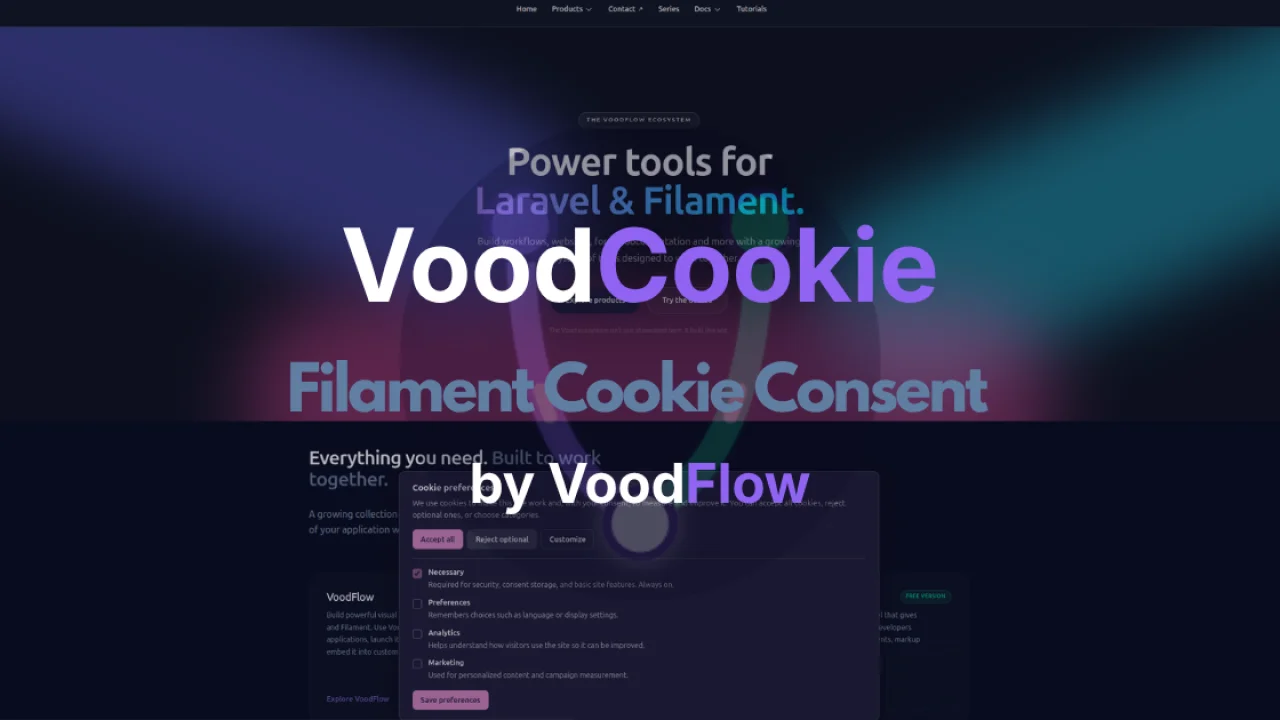
VoodCookiebar
Cookie consent for Laravel + Filament 5: opt-in preferences UI, real script gating, and a Filament settings page. Works standalone in any Filament app
Author:
Voodflow
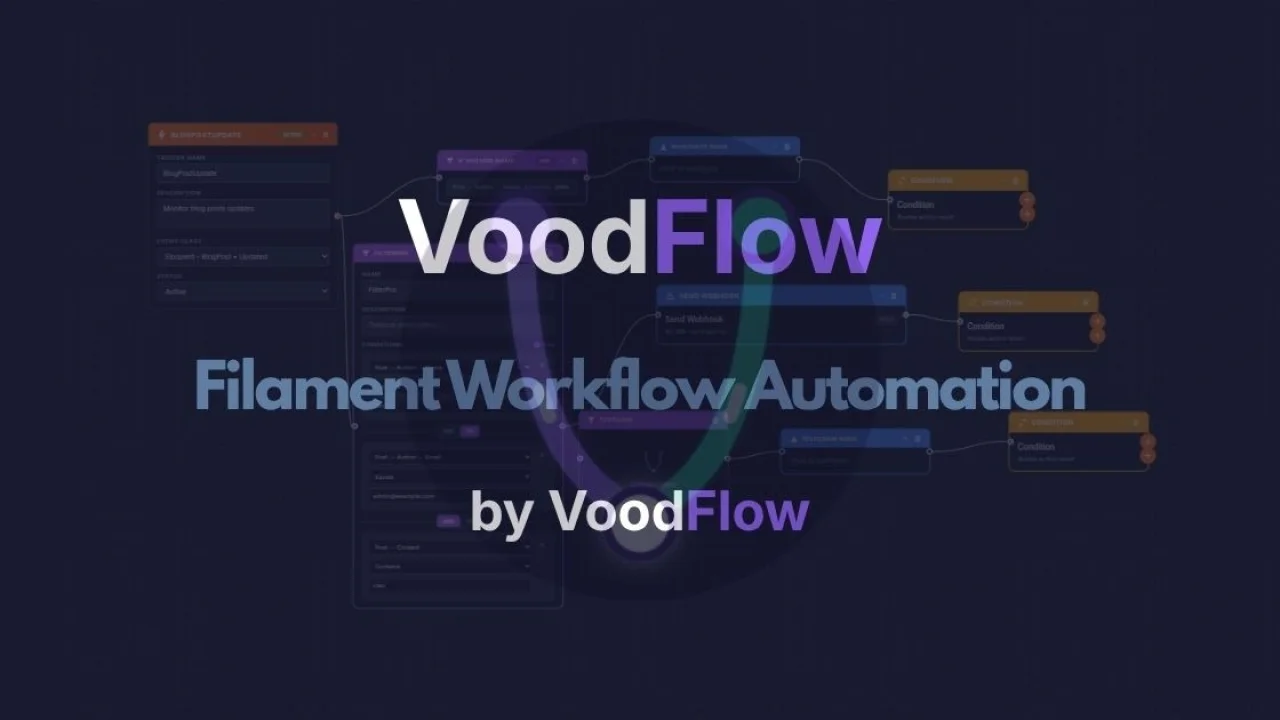
Voodflow
Self-hosted visual workflow automation for Filament and Laravel: design and run automations in your own admin while your workflows, credentials, and data stay entirely on your infrastructure.
Author:
Voodflow
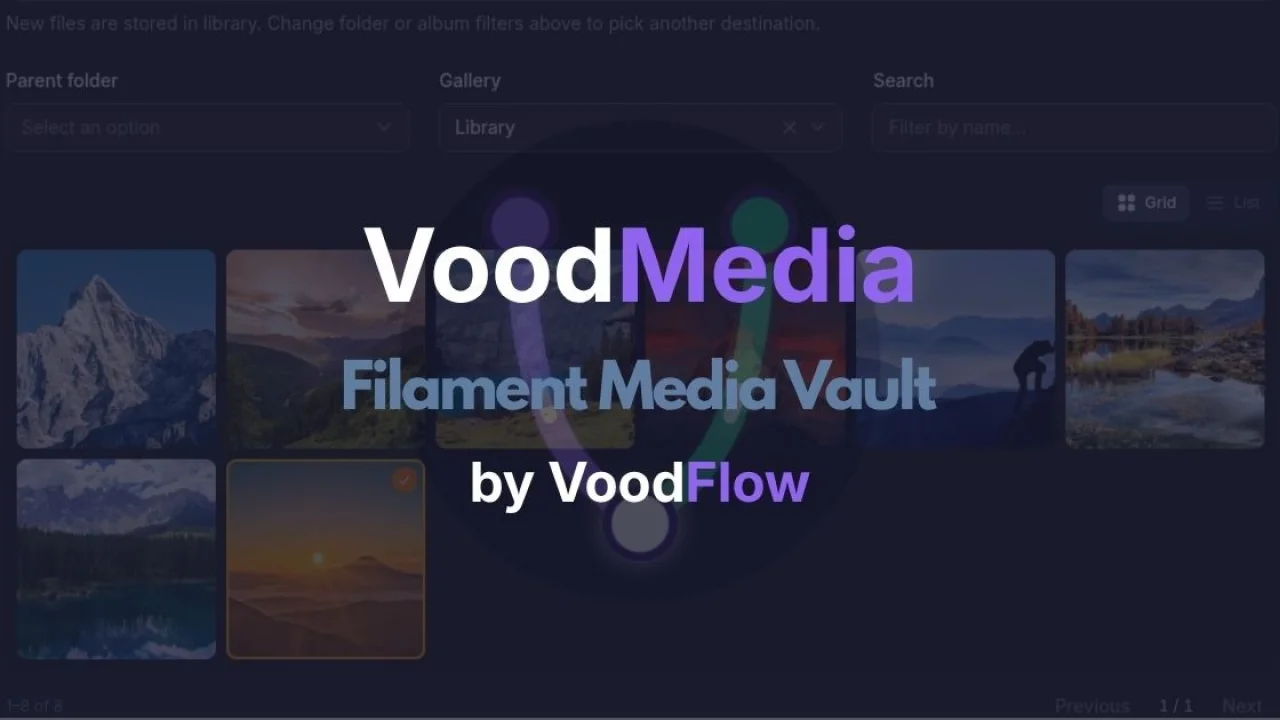
VoodMedia
Media vault and galleries for Laravel + Filament — reusable assets, galleries, and form pickers. MIT by Voodflow.
Author:
Voodflow
Featured Plugins
A selection of plugins curated by the Filament team
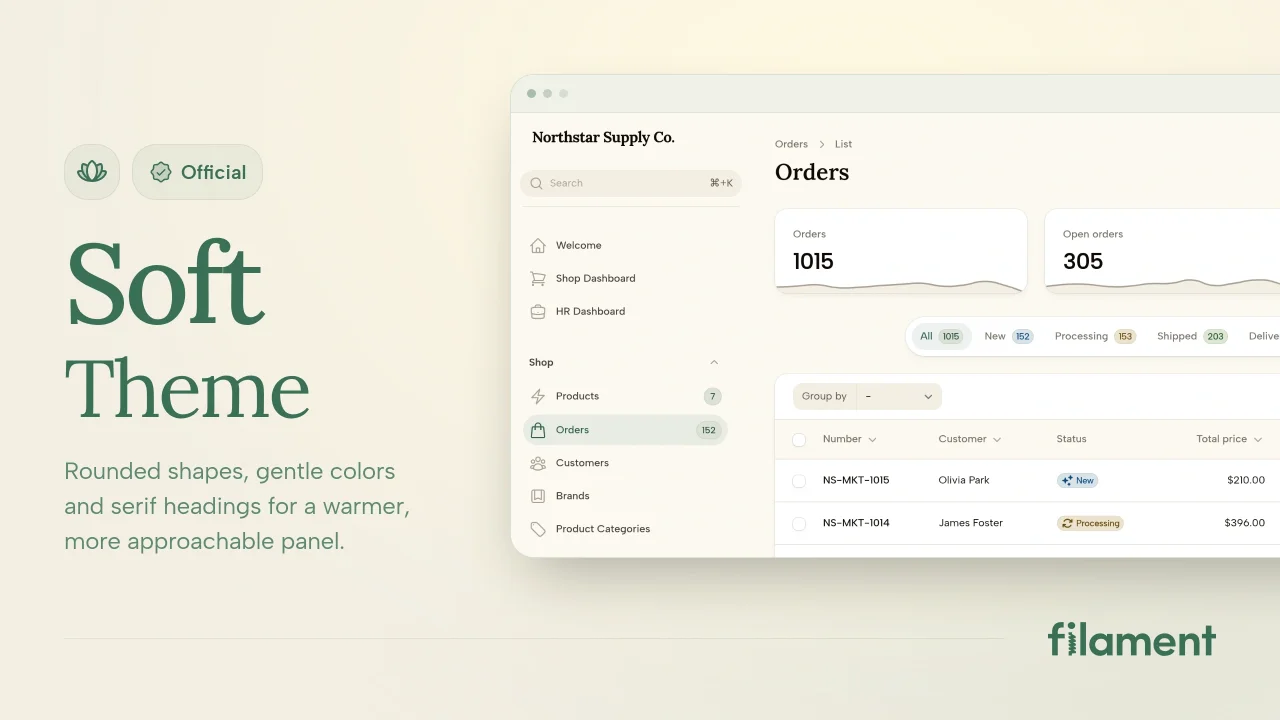
Soft Theme
A theme that gives panels a warm, approachable look with rounded shapes, gentle colors, and serif headings.
 Filament
Spotlight Pro
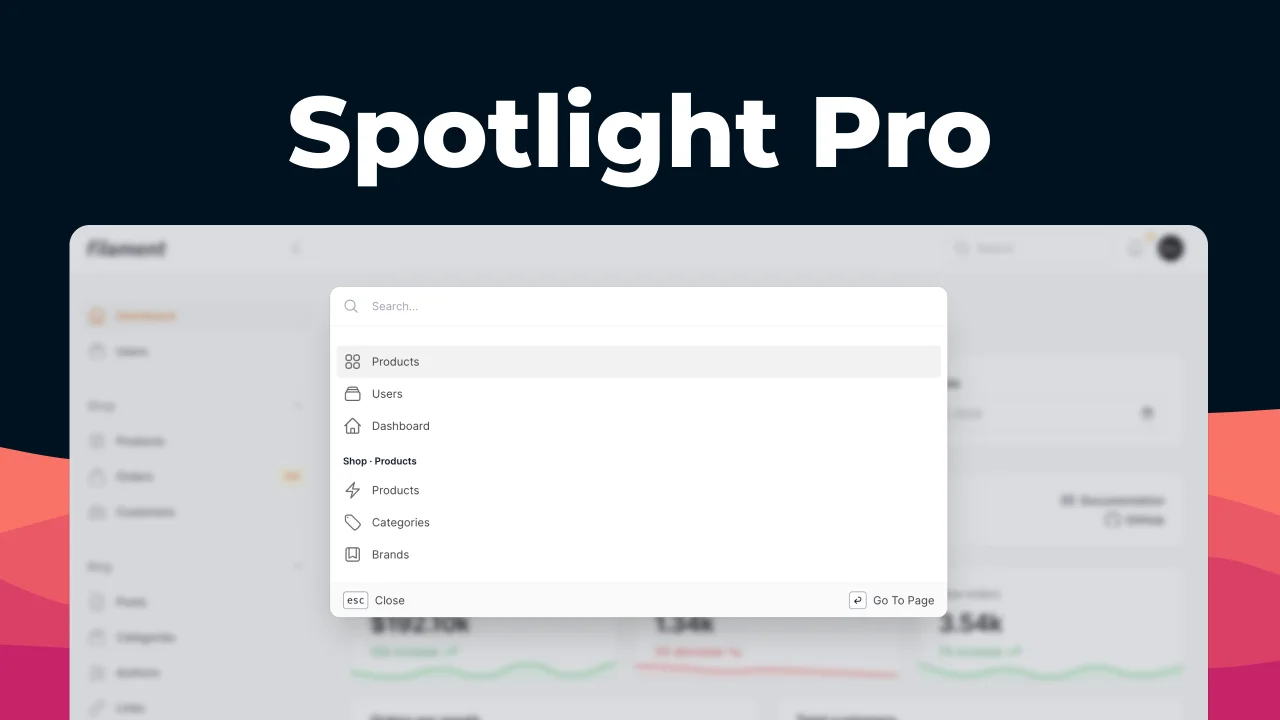
Browse your Filament Panel with ease. Filament Spotlight Pro adds a Spotlight like Command Palette to your Filament Panel.
 Dennis Koch
Custom Fields
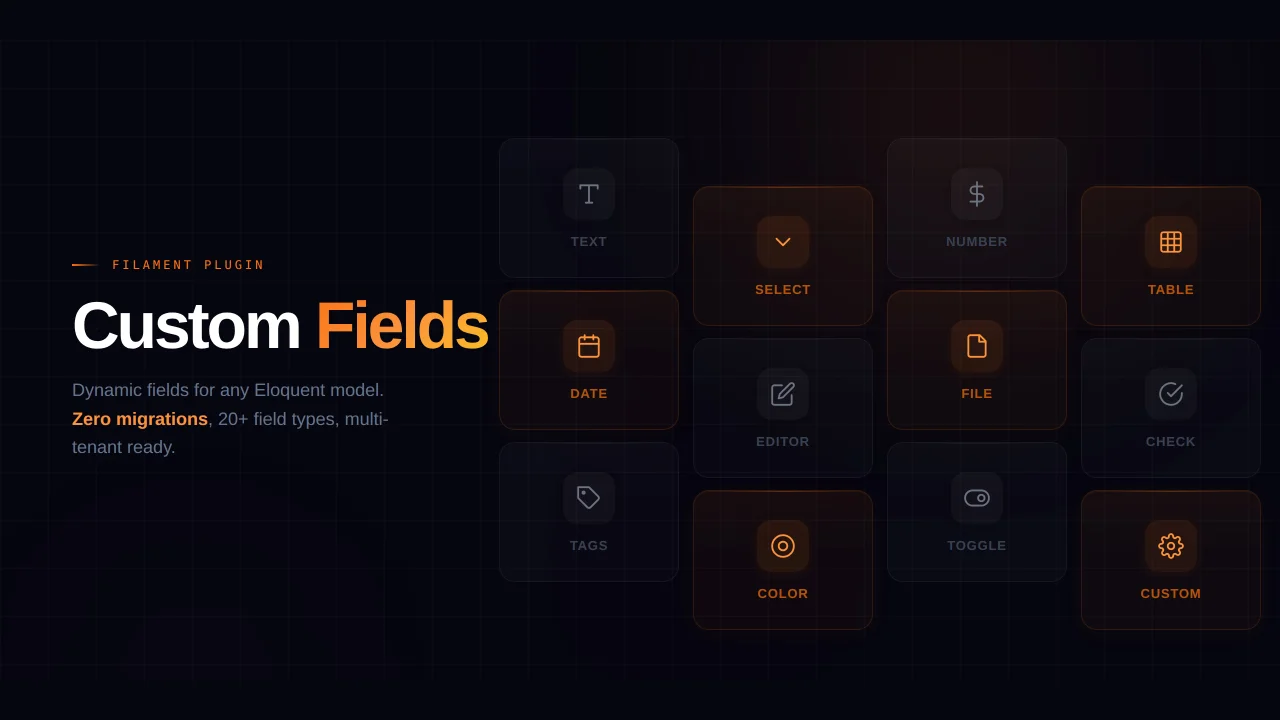
Eliminate custom field migrations forever. Let your users create and manage form fields directly in Filament admin panels with 20+ built-in field types, validation, and zero database changes.
 Relaticle