Forge Monitor
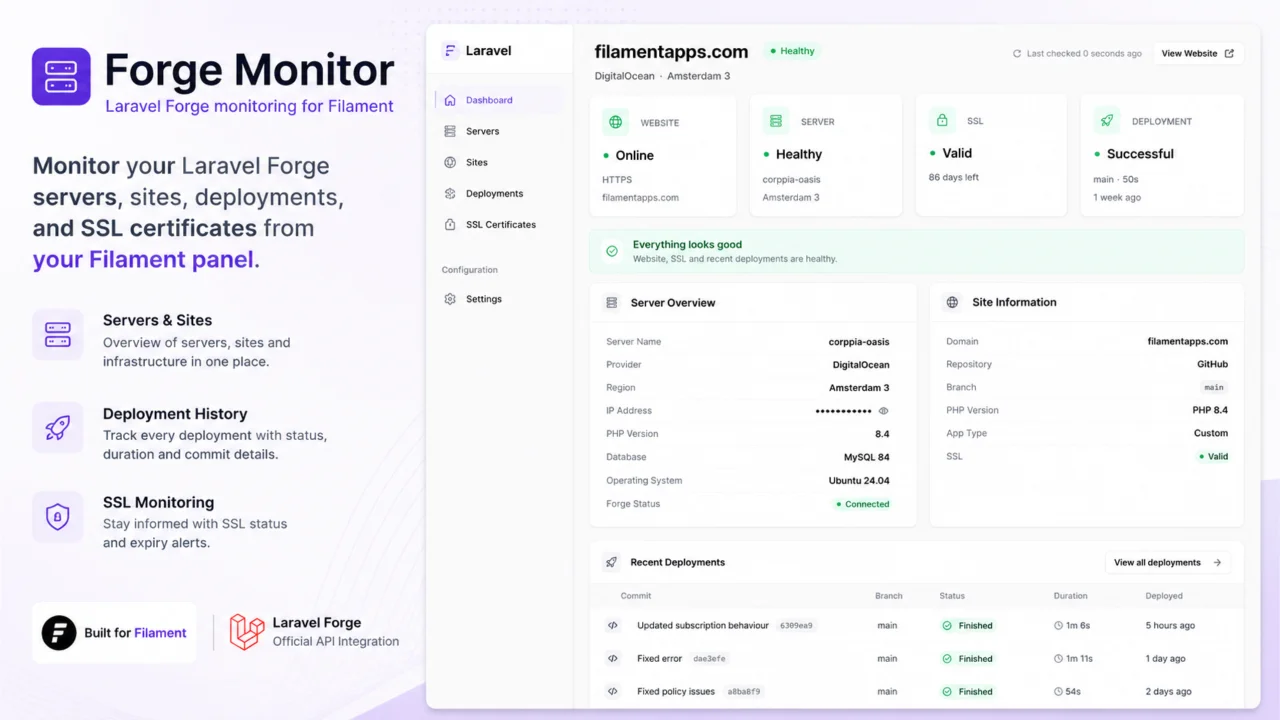
CommunityMonitor your Laravel Forge servers, sites, deployments, and SSL certificates directly from your Filament panel with a secure, read-only dashboard.
 Author:
Stanley Ojadovwa
Author:
Stanley Ojadovwa
Package health
BetaAutomated checks of this plugin's Composer package
15 checks
- Passed: GitHub Actions pinned to SHA
- Skipped: GitLab CI includes pinned to SHA
- Passed: Open security advisories
- Passed: Dependabot PR responsiveness — No stale Dependabot PRs.
- Skipped: Renovate MR responsiveness
- Passed: Dependabot or Renovate configured
- Passed: Dependency update cooldown configured
- Passed: Provides a security policy
- Passed: Abandoned or archived — No consulted source marks the package abandoned (packagist, github).
- Passed: Commit and release recency — Active: last commit 0 days ago; last release 0 days ago.
-
Failed:
composer.lock not committed by library
—
composer.lockis present in the released dist archive. View details on Plumb - Passed: Dist archive is lean
-
Passed:
Current Laravel version supported
—
Package dependencies resolve together with current Laravel
13.0. -
Passed:
Current PHP version supported
—
Constraint
^8.3supports current PHP8.5. - Skipped: Current Symfony version supported
filament/
namespace. Review the source and install at your own risk. Found
malware or an unresolved security issue the author won't
address?
Report it
.
Documentation
- Requirements
- Installation
- Configuration
- Styling
- Testing
- Changelog
- Contributing
- Security Vulnerabilities
- Credits
- License




A read-only Laravel Forge integration for Filament. Give agencies, freelancers, and internal teams a client-safe infrastructure dashboard — servers, sites, deployments, SSL, scheduled jobs, queue workers, and databases — without ever handing out real Forge access.
Connect a Forge API token once, and everything renders from live (cached) Forge data through a Saloon-based API layer. There are no write endpoints anywhere in the plugin — it cannot deploy, restart, or reconfigure anything on your servers.
#Requirements
- PHP 8.3+
- Laravel 11, 12, or 13
- Filament 5
#Installation
Install the package via Composer:
composer require prodstarter/filament-forge-insights
The plugin ships its own settings table and registers its migration automatically — just run your normal migration command after installing:
php artisan migrate
Register the plugin on a panel, in your panel provider's panel() method:
use Prodstarter\FilamentForgeInsights\FilamentForgeInsightsPlugin;

public function panel(Panel $panel): Panel
{
    return $panel
        // ...
        ->plugins([
            FilamentForgeInsightsPlugin::make(),
        ]);
}
Publish the plugin's compiled CSS so the dashboard renders styled out of the box:
php artisan filament:assets
That's it — a new Infrastructure navigation group appears in the panel with a Settings page for connecting a Forge account.
#Connecting a Forge account
- Generate an API token from your Forge account settings.
- In the panel, go to Infrastructure → Settings.
- Paste the token, pick an Organization, then click Test Connection and Save.
Everything else under the Infrastructure nav group (Overview, Deployments, Databases, Jobs, Workers) populates automatically once connected. Server, site, and SSL details live on the Overview page itself rather than as separate pages — see below.
#The Overview page
The Overview page is built to answer four questions at a glance — for the agency and for a client who doesn't know what a PHP version or a deployment is:
- Is my site healthy? — status cards for Website, Server, SSL, and the last Deployment, each colored using one consistent green / amber / red / gray health language.
- Where is it hosted? — a Server Overview and Site Information panel with provider, region, PHP/database versions, and an IP address that's masked by default (click to reveal).
- Has anything changed recently? — a 30-day deployment success/failure summary plus the 5 most recent deployments, with a link through to the full, paginated deployment history.
- Is there anything I need to worry about? — an Attention Required banner that only appears when something needs it (SSL expiring, a failed deployment, a server not responding). When everything's fine, it just says so.
The layout adapts to how the panel is scoped: the full client-facing layout above shows when scoped to a single site; scoping to a server or leaving it unscoped (whole organization) shows an equivalent, appropriately simplified view.
SSL certificate expiry isn't exposed directly by Forge's API — only issuance/renewal status and the last renewal timestamp. The plugin estimates an expiry date from that (Let's Encrypt certificates are issued for 90 days and Forge renews them well before then), rather than hiding the information or fabricating a source Forge doesn't provide.
#Scoping to a server or site
Agencies often run several clients' sites on one shared Forge server. The Settings page lets you narrow what a panel shows, in addition to the Organization:
- Server (optional) — show only this one server instead of the whole organization.
- Site (optional, requires a Server) — show only this one site on that server.
When scoped down to a single site, the Overview and Deployments pages narrow to match. Scheduled Jobs, Workers, and Databases are server-wide resources in Forge's API (they can't be attributed to a single site), so those pages are hidden entirely when a portal is scoped to one site among several on a shared server — this avoids surfacing another client's cron commands or database names.
#Configuration
Publish the config file if you want to set connection defaults via environment variables (useful for CI or non-interactive deploys) instead of the Settings page:
php artisan vendor:publish --tag="filament-forge-insights-config"
return [
    'token' => env('FORGE_API_TOKEN'),
    'organization' => env('FORGE_ORGANIZATION_ID'),
    'server' => env('FORGE_SERVER_ID'),
    'site' => env('FORGE_SITE_ID'),
    'base_url' => env('FORGE_API_BASE_URL', 'https://forge.laravel.com/api'),
    'navigation_group' => 'Infrastructure',
    'cache' => [
        'servers' => 600,
        'sites' => 600,
        'deployments' => 120,
        'ssl' => 1800,
        'jobs' => 600,
        'workers' => 600,
        'databases' => 600,
    ],
];
Anything saved on the Settings page takes precedence over these values at runtime — the config file is a fallback, not the primary way most users will connect an account.
The plugin can also be configured fluently, which is handy for setting an agency-wide default that the Settings page can still override:
FilamentForgeInsightsPlugin::make()
    ->token(env('FORGE_API_TOKEN'))
    ->organization('my-organization-slug')
    ->navigationGroup('Client Infrastructure')
    ->cacheFor(now()->addMinutes(5));
#Styling
The Overview page's cards and layout use Tailwind utility classes that Filament's own default stylesheet doesn't ship (it's purged down to only what Filament's core components use). To make this work without requiring every consumer to set up a custom panel theme, the plugin compiles and ships its own small CSS bundle, registered automatically through Filament's asset system — nothing to configure, it just needs publishing once via php artisan filament:assets (see Installation).
If your panel already has a custom Filament theme, you can have your own build compile the plugin's classes too, so everything comes from one unified stylesheet instead of two separate ones. Add both of the plugin's directories to your theme's @source list (views for the Blade markup, src for a couple of classes generated dynamically in PHP):
/* resources/css/filament/admin/theme.css */
@source '../../../../vendor/prodstarter/filament-forge-insights/resources/views/**/*';
@source '../../../../vendor/prodstarter/filament-forge-insights/src/**/*';
Then rebuild your theme (npm run build). The plugin's own bundle stays registered regardless — having both loaded isn't a problem, since a custom theme's build and the plugin's bundle compile from the same source classes.
#Testing
composer test
#Changelog
Please see CHANGELOG for more information on what has changed recently.
#Contributing
Please see CONTRIBUTING for details.
#Security Vulnerabilities
Please review our security policy on how to report security vulnerabilities.
#Credits
#License
The MIT License (MIT). Please see License File for more information.
The author
I am the founder of FilamentApps, an independent software studio dedicated to building premium apps/plugins for the Laravel and Filament ecosystem. I build production-ready Filament plugins that solve real business challenges through clean architecture, intuitive user experiences, and exceptional developer experience. My goal is to help developers build powerful internal systems for their businesses faster and with confidence.
From the same author
Featured Plugins
A selection of plugins curated by the Filament team

Blueprint
Filament Blueprint is a premium Laravel Boost extension that helps AI agents produce accurate, detailed implementation plans and security reports for Filament apps.
 Filament
Spotlight Pro
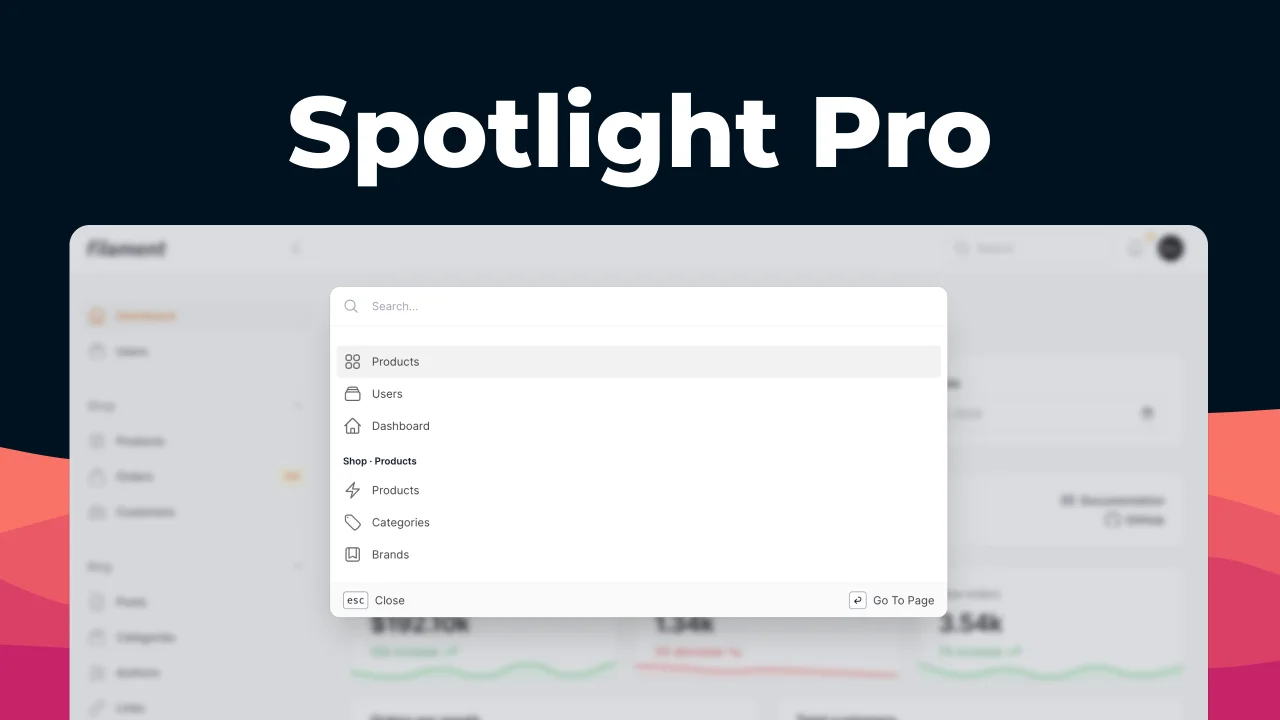
Browse your Filament Panel with ease. Filament Spotlight Pro adds a Spotlight like Command Palette to your Filament Panel.
 Dennis Koch
Data Lens
Advanced Data Visualization for Laravel Filament - a premium reporting solution enabling custom column creation, sophisticated filtering, and enterprise-grade data insights within admin panels.
 Padmission