Record Watcher by Mustafa Khaled
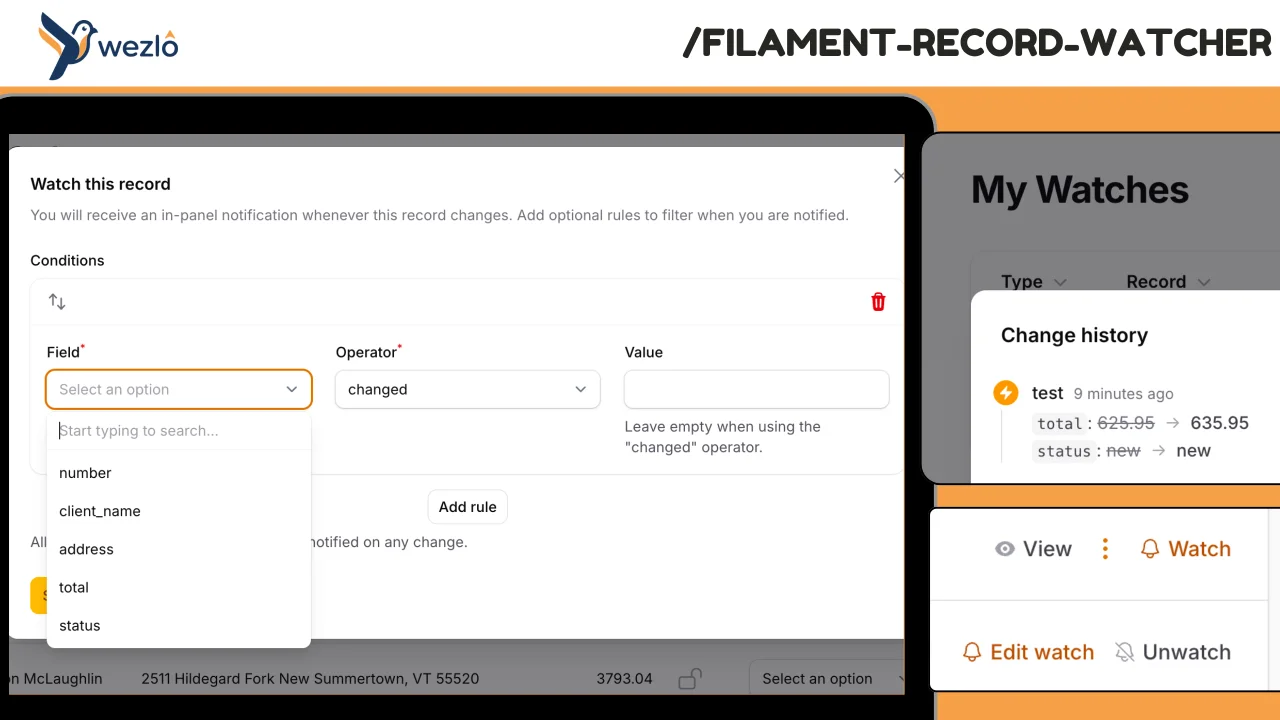
CommunitySubscribe to individual Eloquent records and receive in-panel Filament notifications whenever they change — with the actor (who) and a field-level diff (what). Watches can carry conditions ("only if status changes", "only if amount > 10K"), can be paused, and live on a personal **My Watches** page scoped to the authenticated user. Every fan-out is also persisted to a permanent event log, so users can review the full change history even after dismissing notifications.
 Author:
Mustafa Khaled
Author:
Mustafa Khaled
Package health
Automated checks of this plugin's Composer package
15 checks
- Skipped: GitHub Actions pinned to SHA
- Skipped: GitLab CI includes pinned to SHA
- Passed: Open security advisories
- Passed: Dependabot PR responsiveness — No open Dependabot PRs.
- Skipped: Renovate MR responsiveness
- Skipped: Dependabot or Renovate configured
- Skipped: Dependency update cooldown configured
- Failed: Provides a security policy — View details on Plumb
- Passed: Abandoned or archived — No consulted source marks the package abandoned (packagist, github).
- Warning: Commit and release recency — Low activity: last commit 181 days ago; last release 181 days ago.
-
Passed:
composer.lock not committed by library
—
composer.lockis absent from the released dist archive. - Passed: Dist archive is lean
-
Passed:
Current Laravel version supported
—
Package dependencies resolve together with current Laravel
13.0. -
Passed:
Current PHP version supported
—
Constraint
^8.2supports current PHP8.5. - Skipped: Current Symfony version supported
filament/
namespace. Review the source and install at your own risk. Found
malware or an unresolved security issue the author won't
address?
Report it
.
Documentation
- Highlights
- Requirements
- Installation
- Make a model watchable
- Filament integration — WatchAction / UnwatchAction
- Conditions DSL
- "My Watches" page
- Persistent event history
- Actor capture (queues, jobs, commands)
- Events
- How change detection works
- Database schema
- Configuration reference
- Low-level service API
- Translations
- Testing
- License
Subscribe to individual Eloquent records and receive in-panel Filament notifications whenever they change — with the actor (who) and a field-level diff (what). Watches can carry conditions ("only if status changes", "only if amount > 10K"), can be paused, and live on a personal My Watches page scoped to the authenticated user. Every fan-out is also persisted to a permanent event log, so users can review the full change history even after dismissing notifications.
#Highlights
- One-click Watch / Unwatch actions for any Filament Resource record.
- Conditions DSL — JSON rules with
changed,=,!=,>,<,>=,<=,contains. ANDed. Empty = notify on any change. - In-panel notifications delivered through Filament's built-in
databaseNotifications()channel — they appear in the bell dropdown. - Persistent event history — every fan-out writes a
WatchEventrow keeping the actor + diff, so users can see what they missed even after clearing notifications. - My Watches page — auth-scoped, shows event count, supports pause / resume / unwatch / history.
- Per-action permission gates via
->can()(boolean or closure). - Curated field selector — the condition modal renders a
Selectpopulated from agetWatchableFields()hook (auto-introspected by default). - Actor capture for queues / commands through
WatchEngine::actingAs($user, fn () => …). - Extensible via the
RecordWatchedChangeLaravel event for email / Slack / audit pipelines.
#Requirements
- PHP 8.2+
- Laravel 11+ / Laravel 13
- Filament v4+
- A panel with
->databaseNotifications()enabled (the package writes to Filament's database notifications channel)
#Installation
The package is path-linked inside this monorepo. From the project root:
composer require wezlo/filament-record-watcher
php artisan migrate
The migrate step creates two tables: watches and watch_events.
#Tailwind v4 — register the package's views
The package ships a Blade view (the History modal) that uses Tailwind utility classes. Tailwind v4 only scans paths it has been told about, so you must add an @source directive to your panel's theme CSS file (typically resources/css/filament/admin/theme.css):
@source '../../../../vendor/wezlo/filament-record-watcher/resources/views/**/*';
After editing the theme, rebuild your assets (npm run build or npm run dev). Without this line the History modal will render unstyled.
Register the plugin on each panel where you want the My Watches page:
use Wezlo\FilamentRecordWatcher\FilamentRecordWatcherPlugin;

public function panel(Panel $panel): Panel
{
    return $panel
        ->databaseNotifications() // required — watchers receive db notifications
        ->plugins([
            FilamentRecordWatcherPlugin::make(),
        ]);
}
#Make a model watchable
Add the HasWatchers trait to any Eloquent model:
use Wezlo\FilamentRecordWatcher\Concerns\HasWatchers;

class Order extends Model
{
    use HasWatchers;
}
You can now:
$order->watchFor($user);                                  // subscribe with no conditions
$order->watchFor($user, [                                 // subscribe with rules
    ['field' => 'status', 'operator' => 'changed', 'value' => null],
    ['field' => 'amount', 'operator' => '>',       'value' => 10_000],
]);

$order->isWatchedBy($user);    // bool
$order->watches;               // MorphMany of Watch rows
$order->watchers();            // collection of distinct subscribed users

$order->unwatchFor($user);     // delete the user's subscription (cascades to events)

$order->update(['status' => 'paid']);   // → fans out notifications + events to all matching watchers
watchFor() is idempotent — calling it twice for the same (record, user) pair updates the existing row instead of creating a duplicate (enforced by a unique index).
#Curating which fields users can build conditions on
The Field input in the condition modal is rendered as a searchable Select, populated from getWatchableFields(). The trait's default introspects the model's table and returns every column minus the primary key, deleted_at, and any plugin-level ignored columns (default updated_at, created_at).
Override the method on your model to expose a curated list with friendlier semantics:
class Order extends Model
{
    use HasWatchers;

    public function getWatchableFields(): array
    {
        return ['status', 'total', 'client_name', 'address'];
    }
}
#Filament integration — WatchAction / UnwatchAction
Drop the actions into any Resource that uses a watchable model. They are two separate actions:
WatchAction— always visible. Label flips between "Watch" and "Edit watch" depending on whether the current user is already subscribed. Opens a modal with aRepeaterof condition rows.UnwatchAction— visible only when the current user is already subscribed. One-click confirmation modal.
use Filament\Actions\EditAction;
use Filament\Actions\ViewAction;
use Wezlo\FilamentRecordWatcher\Actions\UnwatchAction;
use Wezlo\FilamentRecordWatcher\Actions\WatchAction;

public static function table(Table $table): Table
{
    return $table
        ->columns([
            TextColumn::make('reference'),
            TextColumn::make('status')->badge(),
        ])
        ->recordActions([
            ViewAction::make(),
            EditAction::make(),
            WatchAction::make(),
            UnwatchAction::make(),
        ]);
}
Both actions also work in page header arrays (headerActions()) on view / edit pages.
#Permissions
Both actions expose a ->can() method that accepts a boolean or a closure receiving (Model $record, ?Authenticatable $user) and returning bool. Returning false hides the action for that user / row. The check is ANDed with the action's built-in visibility rules.
WatchAction::make()
    ->can(fn (Order $record, ?Authenticatable $user) => $user?->can('view', $record) ?? false),

UnwatchAction::make()
    ->can(fn (Order $record) => auth()->user()->hasPermissionTo('manage-watches')),
#Conditions DSL
Conditions are stored as a JSON array of rules. Empty / null conditions are fail-open — every non-ignored change notifies. Multiple rules are ANDed together.
[
  {"field": "status", "operator": "changed", "value": null},
  {"field": "amount", "operator": ">",       "value": 10000}
]
| Operator | Semantics |
|---|---|
changed |
Passes if the field appears in the diff for this update. |
= / != |
Loose comparison against the new attribute value. |
> / < |
Numeric / lexical comparison against the new attribute value. |
>= / <= |
Numeric / lexical comparison against the new attribute value. |
contains |
True if the new attribute value is a string and contains the rule's value. |
The Repeater in WatchAction's modal builds this JSON for end users — they pick a field, an operator, and (optionally) a value, then save.
#"My Watches" page
The plugin registers a custom Filament Page at /{panel}/my-watches. It's auth-scoped at the query level — users only ever see their own watches.
Columns: model type, record id, conditions ("Any change" or "N rule(s)"), event count badge, paused indicator, watching since.
Row actions:
- History — opens a modal listing every recorded change event for this watch (timestamp, actor name, per-field
old → newdiff). Survives notification cleanup. Limited to the latest 100 events per click. - Pause — sets
paused_at. Paused watches stop receiving notifications without losing their conditions. - Resume — clears
paused_at. - Unwatch — deletes the row (and its event history via cascade).
Disable the page from a specific panel:
FilamentRecordWatcherPlugin::make()->registerMyWatchesPage(false)
Or change its navigation:
FilamentRecordWatcherPlugin::make()
    ->navigationGroup('Notifications')
    ->navigationIcon('heroicon-o-bell-alert')
#Persistent event history
Notifications can be dismissed, cleared, or simply missed. To make sure users never lose track of changes, every successful fan-out also persists a row in the watch_events table. The history retains the actor and the full field-level diff and is exposed on the My Watches page through the History action.
$watch->events;                                     // HasMany WatchEvent, latest first
$watch->events()->latest()->limit(50)->get();
$watch->events->first()->actor;                     // morphTo — the user who made the change
$watch->events->first()->diff;                      // ['status' => ['old' => 'pending', 'new' => 'paid'], ...]
$watch->events->first()->created_at;
Schema:
| Column | Purpose |
|---|---|
id |
Primary key |
watch_id |
FK to watches (cascade on delete) |
actor_type, actor_id |
Polymorphic actor (nullable for unattributed writes) |
diff |
JSON {field: {old, new}} for the changed columns |
created_at |
When the event was recorded |
Indexed (watch_id, created_at) for fast per-watch history queries. Unwatching cascades — deleting a watch removes its event log automatically.
#Actor capture (queues, jobs, commands)
By default, WatchEngine reads auth()->user() to attribute the change. In a queued job, scheduled command, or any context where there is no authenticated user, wrap the write with actingAs():
use Wezlo\FilamentRecordWatcher\Services\WatchEngine;

WatchEngine::actingAs($user, function () use ($order): void {
    $order->update(['status' => 'paid']);
});
The actor is included in the notification body (By {name}), persisted on the WatchEvent row, and dispatched on the event payload.
#Self-notify is suppressed
By design, the engine does not notify the actor on their own changes. If user A is watching an order and user A edits it, no notification is delivered (otherwise watching anything you ever touched would spam your bell). The event is also not recorded for the actor's own watches. To verify the system end-to-end, log in as a second user and edit a record the first user is watching.
#Events
Every notification fan-out also dispatches a plain Laravel event:
Wezlo\FilamentRecordWatcher\Events\RecordWatchedChange
The event carries the Watch model, the changed Model, the diff array, and the ?Authenticatable $actor. Subscribe to it for email / Slack delivery, audit logging, analytics, or anything else you need beyond the in-panel notification.
use Illuminate\Support\Facades\Event;
use Wezlo\FilamentRecordWatcher\Events\RecordWatchedChange;

Event::listen(function (RecordWatchedChange $event): void {
    // $event->watch, $event->record, $event->diff, $event->actor
});
#How change detection works
HasWatchers::bootHasWatchers() registers a static updated model hook that:
- Builds a field-level diff with
DiffBuilder::build($model, $ignored)using the model'sgetOriginal()+getChanges(). - Skips ignored columns (
updated_at,created_atby default — configurable). - If the filtered diff is non-empty, calls
WatchEngine::fanOut($model, $diff).
WatchEngine::fanOut():
- Eager-loads
$model->watches()->active()->with('user')(active =paused_at IS NULL). - Skips the actor's own watch.
- For each remaining watch, evaluates conditions via
ConditionEvaluator::passes(). - For each passing watch: persists a
WatchEvent, sends a Filament database notification, dispatchesRecordWatchedChange.
#Database schema
#watches
| Column | Purpose |
|---|---|
id |
Primary key |
watchable_type, watchable_id |
Polymorphic target |
user_id |
Subscriber (FK to users, cascade on delete) |
conditions |
JSON rules array (nullable = notify on any change) |
paused_at |
When the watch was paused (nullable) |
created_at, updated_at |
Timestamps |
Indexes:
- Unique
(watchable_type, watchable_id, user_id)— one watch per user per record. (user_id, paused_at)— fast lookup for the My Watches page.
#watch_events
See the Persistent event history section above.
#Configuration reference
Publish with php artisan vendor:publish --tag="filament-record-watcher-config".
| Key | Default | Description |
|---|---|---|
user_model |
App\Models\User |
Model used for the user_id relationship. |
table_name |
watches |
Name of the polymorphic subscriptions table. |
events_table_name |
watch_events |
Name of the persistent event history table. |
ignored_columns |
['updated_at', 'created_at'] |
Column changes that should NOT trigger watcher notifications. |
max_diff_lines |
8 |
Max diff lines included in a notification body. |
my_watches.enabled |
true |
Whether the My Watches page registers itself. |
my_watches.navigation_group |
null |
Navigation group for the page. |
my_watches.navigation_icon |
heroicon-o-bell |
Navigation icon. |
my_watches.navigation_sort |
95 |
Navigation sort order. |
You can also configure most of these fluently on the plugin (->ignoredColumns([...]), ->navigationGroup(...), ->navigationIcon(...), ->userModel(...), ->registerMyWatchesPage(false)) — the plugin values win over config values when both are set.
#Low-level service API
use Wezlo\FilamentRecordWatcher\Services\WatchEngine;
use Wezlo\FilamentRecordWatcher\Services\ConditionEvaluator;

// Manually fan out (rarely needed — the observer handles this for you)
app(WatchEngine::class)->fanOut($order, [
    'status' => ['old' => 'pending', 'new' => 'paid'],
]);

// Evaluate a rule set against a model + diff
$passes = app(ConditionEvaluator::class)->passes($order, $diff, $watch->conditions);

// Run a write under an explicit actor (queues, console, system jobs)
WatchEngine::actingAs($systemUser, fn () => $order->update(['status' => 'paid']));
The engine performs no authorization of its own — it's a low-level primitive. Enforce permissions at the caller (action, job, command) before invoking it.
#Translations
The package ships English translations under filament-record-watcher::watcher.*. Every user-visible string — action labels, modal headings, notifications, table columns, page title, history modal — is routed through __(). Add additional locales by publishing:
php artisan vendor:publish --tag="filament-record-watcher-translations"
#Testing
The package is exercised by 20 Pest tests covering the condition evaluator, the trait surface (watchFor / unwatchFor / getWatchableFields), the observer + engine notification path, the persistent event log (survives notification deletion), the diff builder's ignored-columns behaviour, and the auth-scoped My Watches page. Run them from the host app:
php artisan test --compact tests/Feature/FilamentRecordWatcher
#License
MIT.
The author
From the same author
Modal Notifications
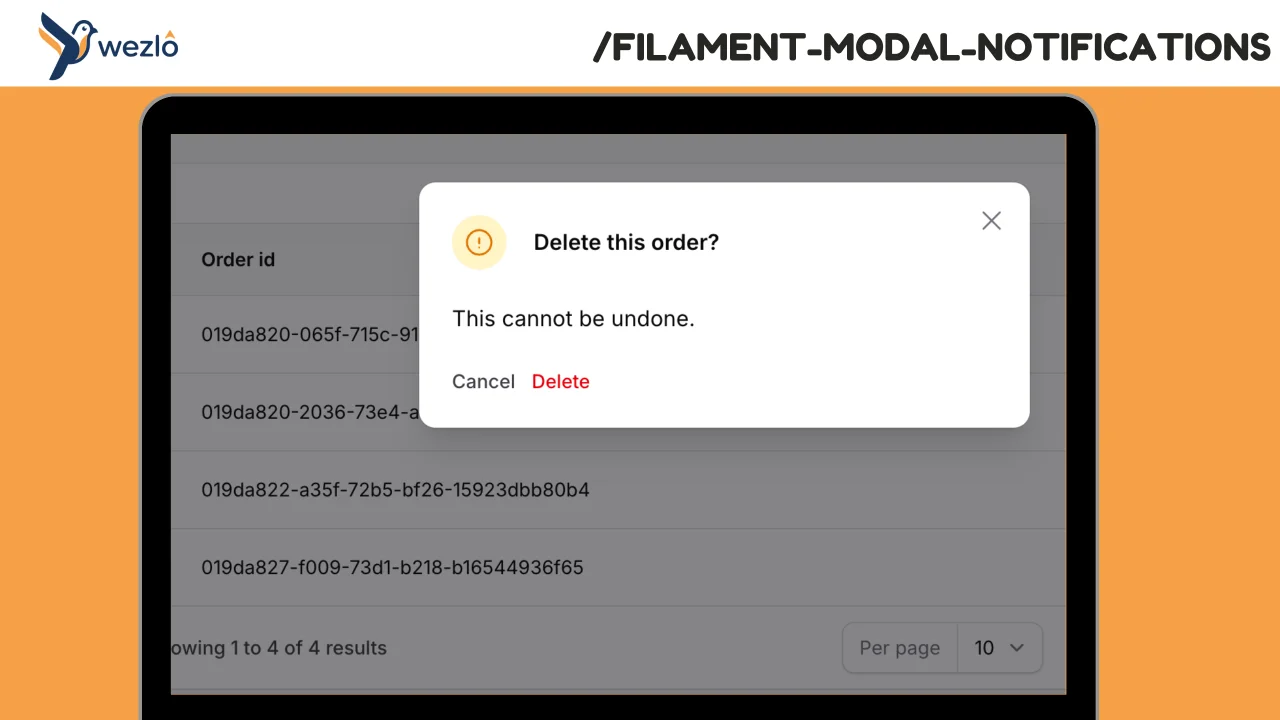
Render any Filament notification as a blocking modal by chaining one method: ->asModal(). Multiple modal notifications fired in the same request are queued one at a time — the user dismisses one and the next slides in, no stacking.
Author:
Mustafa Khaled
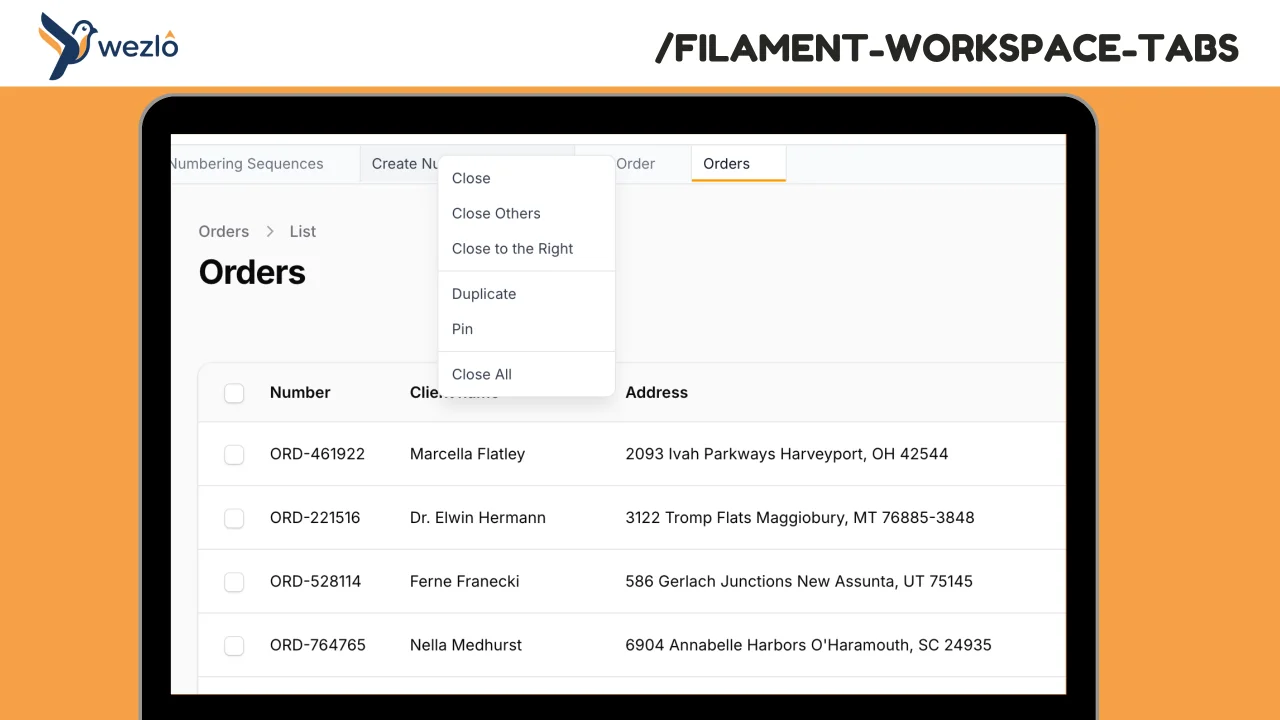
Workspace Tabs
Browser-like tabs for Filament panels. Open multiple pages in tabs without losing context, drag to reorder, pin frequently accessed pages, and right-click for quick actions.
Author:
Mustafa Khaled
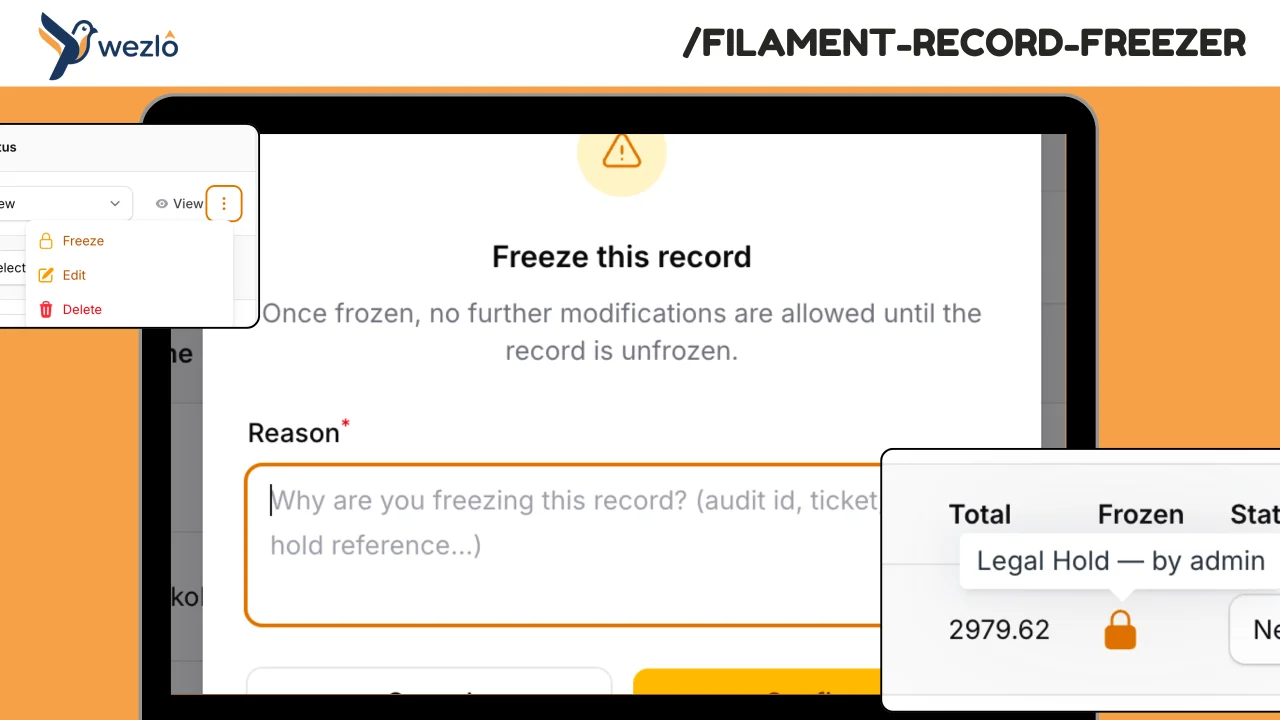
Record Freezer
Freeze individual Eloquent records against modification — finalised contracts, audited financial periods, legal holds
Author:
Mustafa Khaled
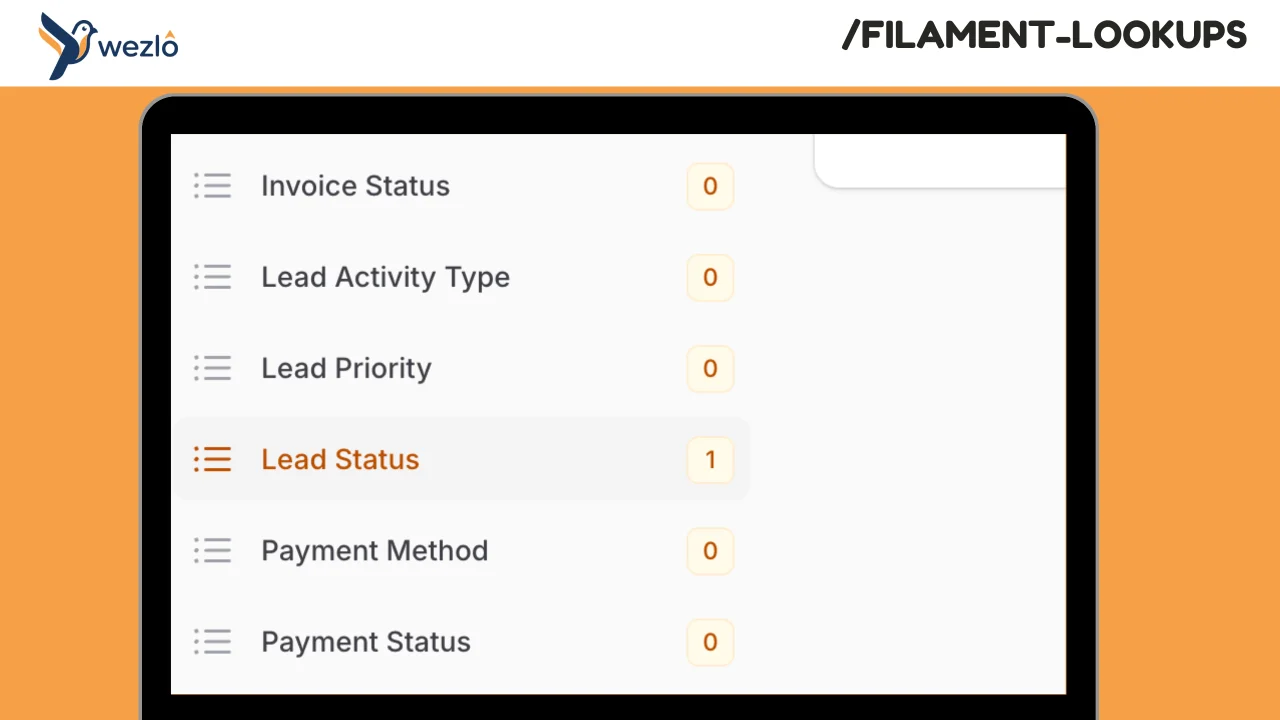
Lookups
Hierarchical lookup management for Filament with configurable multi-tenant support. Manage lookup tables (countries, categories, regions, statuses, etc.) with optional parent-child hierarchies. Each lookup type is defined as a PHP class with full control over permissions and behavior.
Author:
Mustafa Khaled
Featured Plugins
A selection of plugins curated by the Filament team
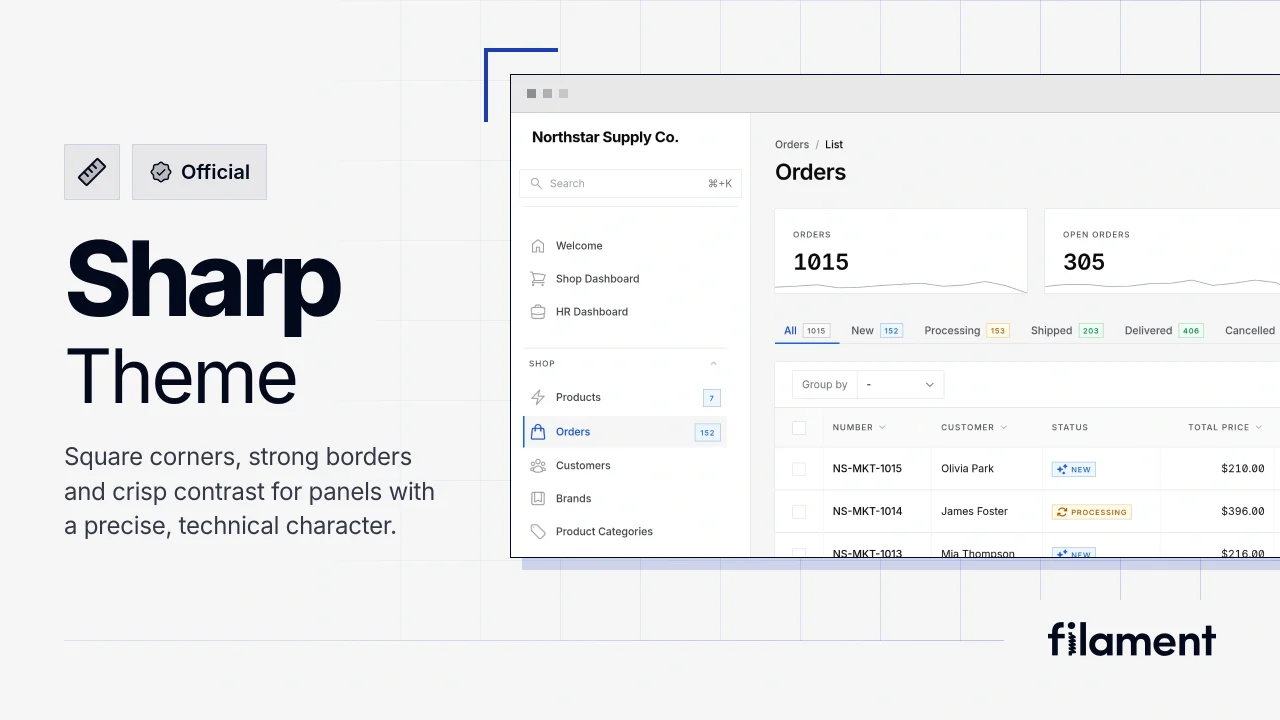
Sharp Theme
A theme that gives panels a precise, technical look with square corners, strong borders, and clear contrast.
 Filament
Advanced Tables (formerly Filter Sets)
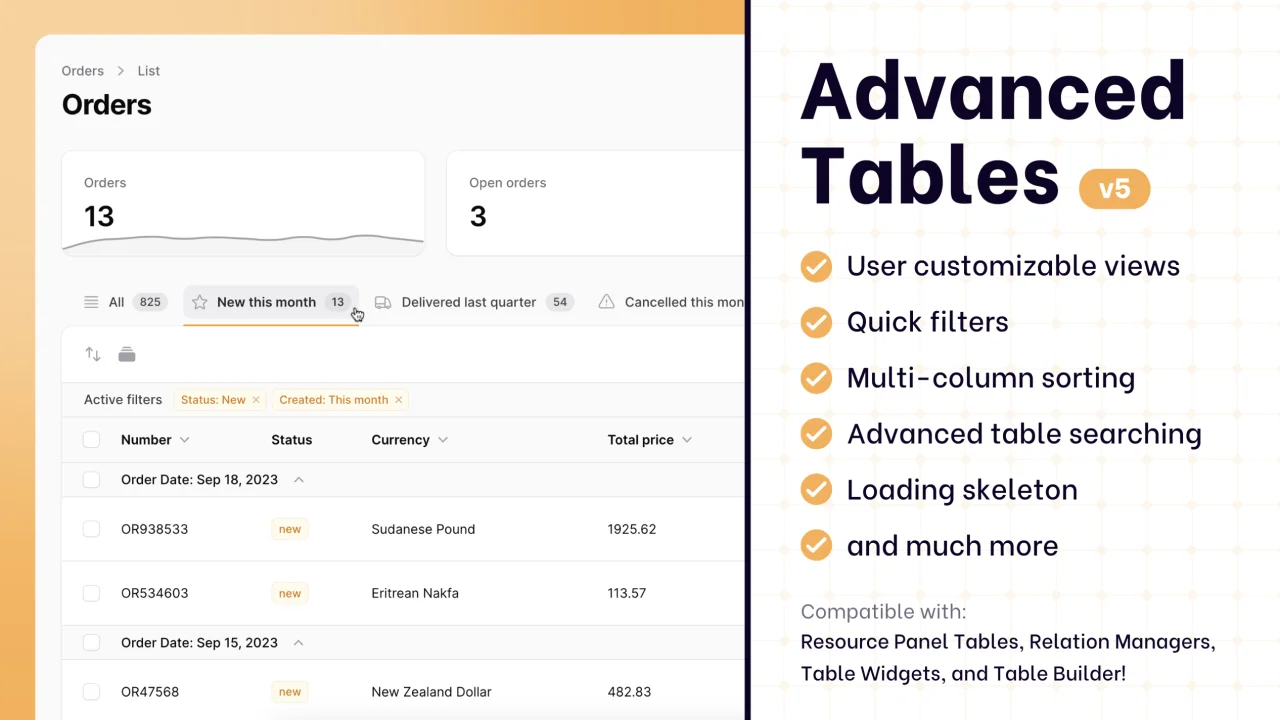
Supercharge your tables with powerful features like user-customizable views, quick filters, multi-column sorting, advanced table searching, convenient view management, and more. Compatible with Resource Panel Tables, Relation Managers, Table Widgets, and Table Builder!
 Kenneth Sese
Noir Theme
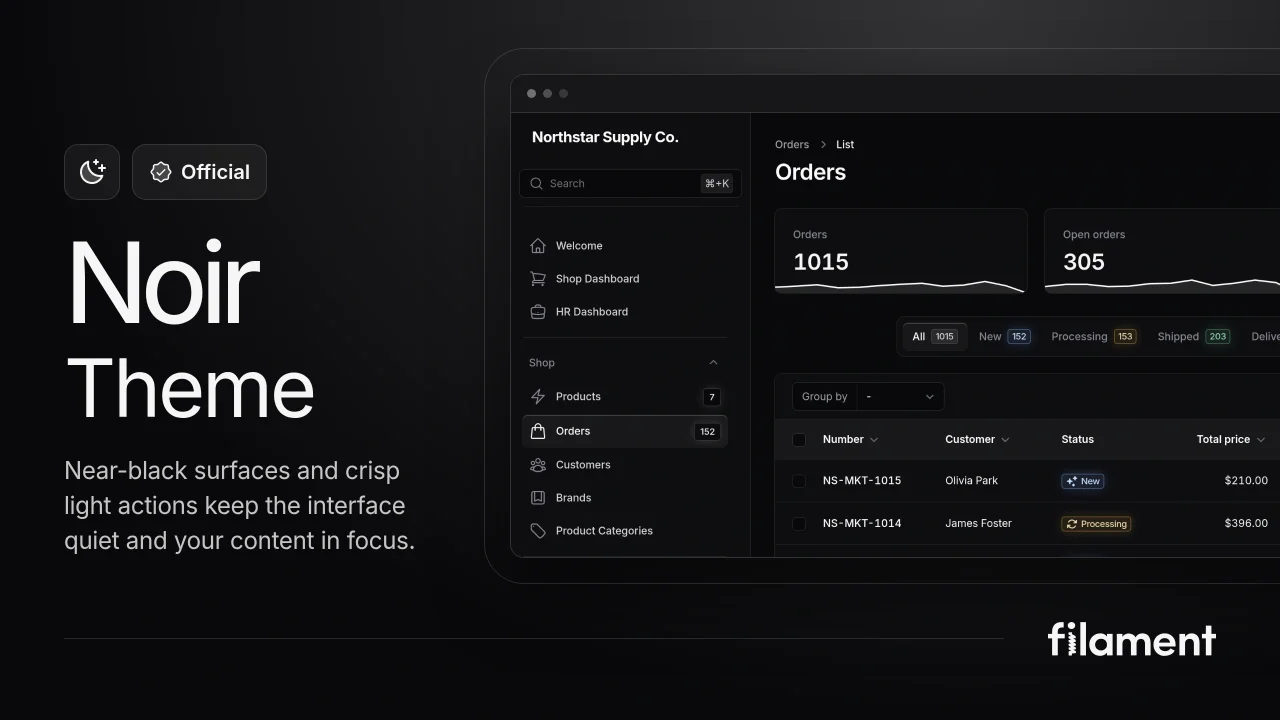
A theme that gives panels a focused, refined look with near-black surfaces, crisp actions, and restrained color.
Filament