Tenancy Suite
CommunityDatabase-per-tenant multi-tenancy on stancl/tenancy: one identity across every workspace, invitations, custom domains verified by DNS, backups and restore, health checks with per-check repairs, async provisioning, and a pool of database servers.
filament/
namespace. Review the source and install at your own risk. Found
malware or an unresolved security issue the author won't
address?
Report it
.
 Author:
Komma SoftHouse
Author:
Komma SoftHouse
Documentation
- Requirements
- Installation
- How it works
- Diagnosing a setup
- Testing a host
- Members and invitations
- Rows that live on both sides
- Several workspaces, one account
- More than one database server
- Provisioning
- Subdomains or paths
- Running under Octane
- Custom domains
- Operations
- Configuration
- Replacing the pages
- Commands
- Hooks
- Services
- Database
- Translations
- License
Database-per-tenant multi-tenancy for Filament v5, built on stancl/tenancy and validated in production.
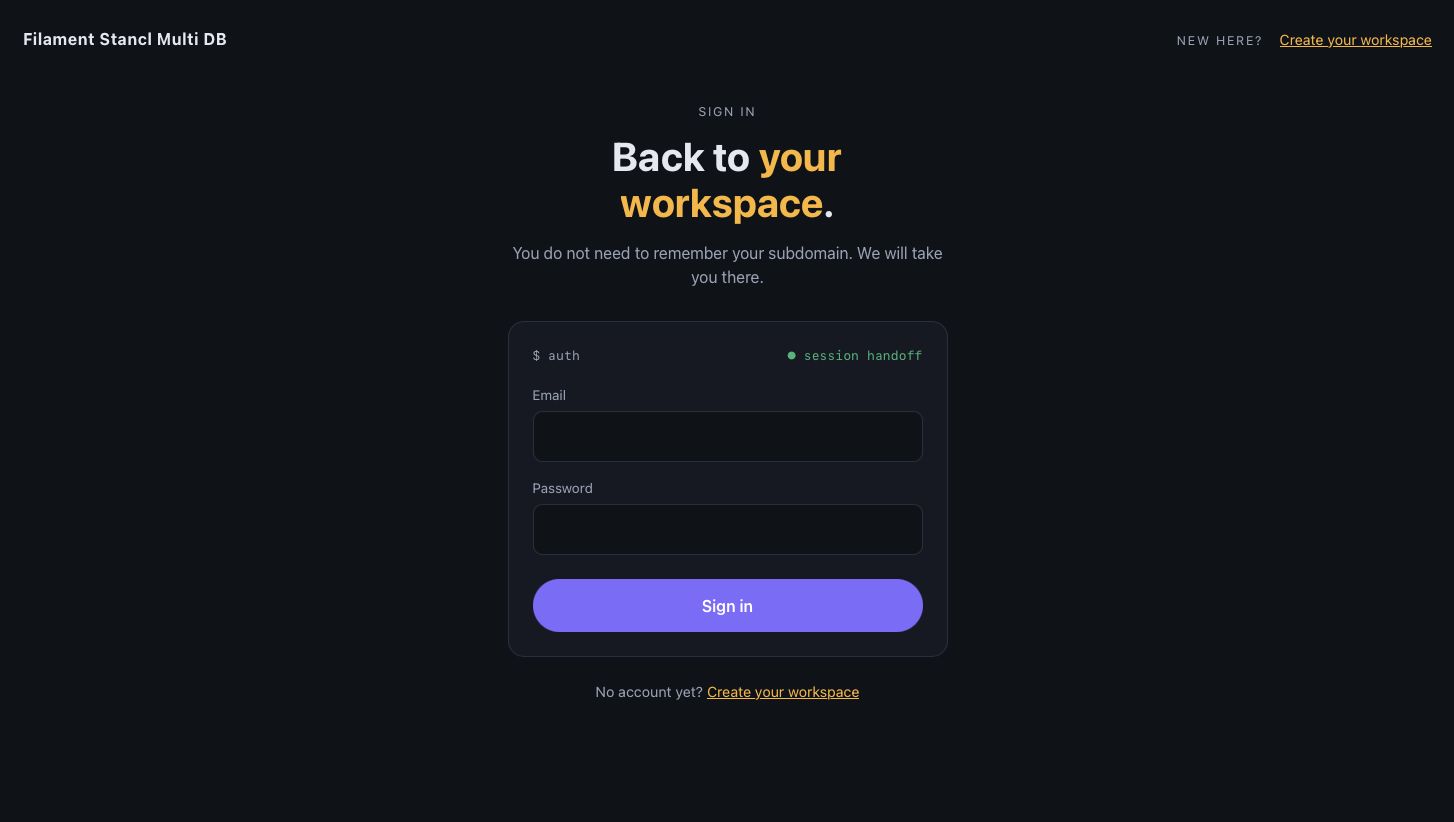
One central identity, one database per tenant, one subdomain per tenant. The plugin brings the whole thing: the connections, the auth guard, the stancl configuration, a login that validates against the central identity, public self-registration, a central "front door" that finds your workspace for you, a signed single-use handoff into the tenant panel, staff impersonation with an audit trail, and the middleware stack that keeps the session on the subdomain.
You register two plugins and keep credentials in .env. Nothing else in the host is edited.
#Requirements
- PHP 8.4+
- Laravel 13+
- Filament 5.x, Livewire 4.x
- stancl/tenancy 3.8+
- PostgreSQL, MySQL/MariaDB or SQLite for the central and tenant databases
- spatie/laravel-permission (optional, recommended): per-tenant roles and staff-role access to the Tenants resource
#Installation
composer require komma-softhouse/filament-tenancy
php artisan filament-tenancy:install
The installer publishes the config file and the migrations and offers to run them.
#1. Credentials
APP_URL=https://demo.test
APP_DOMAIN=demo.test

DB_CENTRAL_DRIVER=pgsql
DB_CENTRAL_HOST=127.0.0.1
DB_CENTRAL_PORT=5432
DB_CENTRAL_DATABASE=central
DB_CENTRAL_USERNAME=postgres
DB_CENTRAL_PASSWORD=secret
The plugin registers the central and tenant_template connections from these values at boot and makes central the default connection. DB_CENTRAL_* fall back to DB_*, so a single-database .env also works. On PostgreSQL the central user needs CREATEDB; on MySQL, CREATE on *.*.
#2. Your central User model
Every tenant member also owns a row on the host's users table (the global identity). Add the trait:
use Komma\Tenancy\Concerns\IsCentralIdentity;
use Spatie\Permission\Traits\HasRoles;

class User extends Authenticatable
{
    use HasRoles;
    use IsCentralIdentity;
}
It adds tenants() and canAccessPanel(): only identities holding a staff role may enter the central panel.
#3. The central panel
use Komma\Tenancy\TenancyPlugin;

$panel
    ->id('admin')
    ->plugin(TenancyPlugin::make());
This adds the Tenants resource (create, edit, view, delete, Enter as tenant) and carries the whole fluent configuration.
#4. Each tenant panel
use Komma\Tenancy\TenantPanelPlugin;

$panel
    ->id('app')
    ->path('app')
    ->plugin(TenantPanelPlugin::make());
Declare no middleware on a tenant panel: the plugin applies the complete stack in the order that works. Do not call ->authGuard() or ->login() either — both are set by the plugin.
#5. DNS and web server
*.demo.test must reach the application. Locally, dnsmasq with address=/demo.test/127.0.0.1; in production a wildcard A record and a wildcard certificate (or a router rule such as Traefik's HostRegexp). The plugin does not route traffic; it identifies the tenant from the host it receives.
#6. Migrate and create the first tenant
php artisan migrate
php artisan tenancy:create acme --name="Acme SL" --owner-name="María Couto" --owner-email=maria@acme.es --owner-password=secret
https://acme.demo.test/app now serves the tenant panel; https://demo.test/login finds it for you; https://demo.test/register creates new ones.
#How it works
- Central identity. Credentials live once, in the host's
userstable on the central connection. Each tenant database has its ownuserstable with a local row per member (global_user_id), which is what Filament authenticates and what roles and tenant data relate to. The local row is provisioned just-in-time on first login. - Tenant login.
Komma\Tenancy\Filament\Pages\Auth\Loginvalidates email and password against the central identity, checks membership in the current tenant on the centraltenant_userpivot, provisions the local user if needed and logs it into the tenant guard. - Central door.
/loginon the central domain checks the credentials against central and hands the session to the tenant panel with a signed, single-use ticket. One workspace: straight in. Several: a picker. - Handoff. A
handoff_ticketsrow (central) plus a temporary signed URL. Both checks must pass on arrival: the signature proves the URL was issued, the ticket proves it has not been spent. Tickets live 60 seconds and are pruned daily. - Impersonation. Staff open a tenant panel as its owner through the same handoff. The visit is recorded in
impersonations; a banner marks the session; Leave ends it. - Session on the subdomain. On tenant hosts the session cookie is renamed and its domain widened to the base domain, so the login POST and the following GET share one session; the central panel keeps the application cookie.
- Livewire. Form submits go to
/livewire/update, outside the panel middleware. The plugin registers that route with theuniversalgroup so tenancy initializes on tenant hosts and central keeps working.
#Diagnosing a setup
php artisan tenancy:doctor
Tenancy fails in ways that look like something else: a login that loops because the session cookie is scoped wrong, assets that 404 because they are served from a tenant, a panel that 500s because a config published months ago still names a class that has since changed. None of those errors say "tenancy".
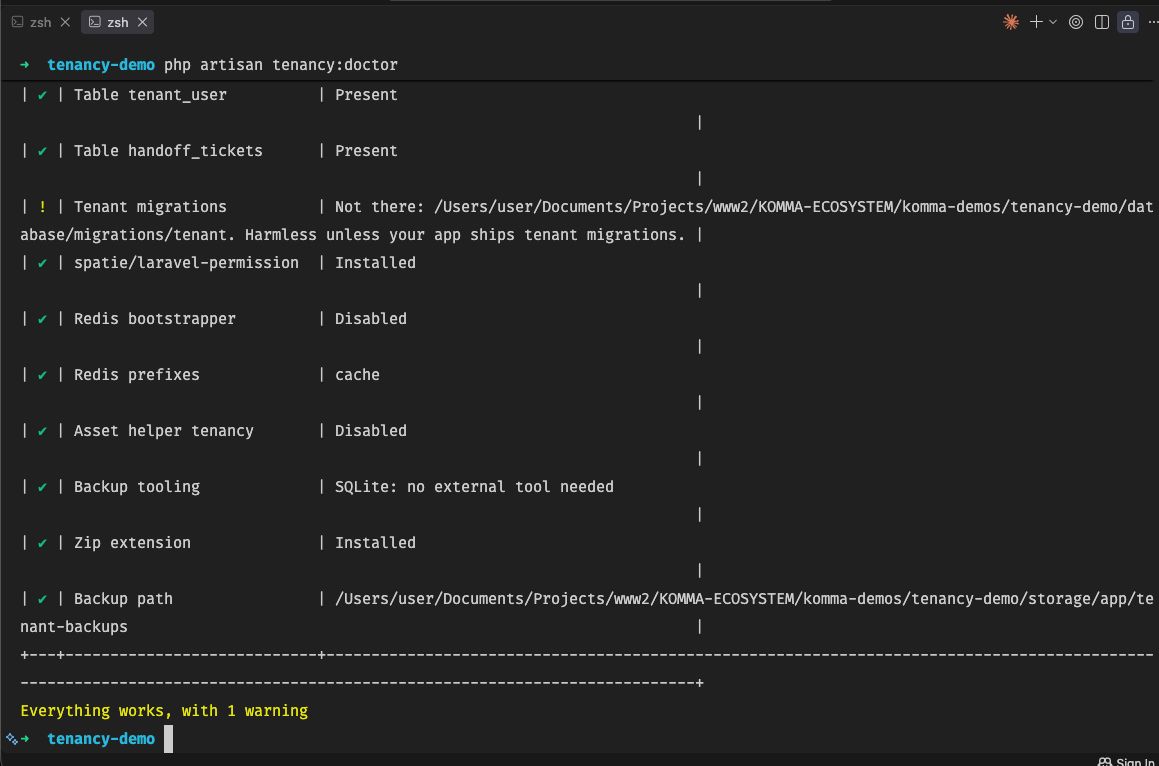
tenancy:doctor asks all of it out loud — both connections and whether the central user can actually create databases, APP_URL against the base domain, whether *.base resolves, the route and config caches, the universal group and the Livewire update route, every panel and its guard (including the provider-order trap), the central tables and columns, spatie, the Redis client, the queue prefix, asset_helper_tenancy, and the backup tooling. --tenants adds a health check per tenant. It exits non-zero when something fails, so it can gate a deploy.
#Testing a host
use Komma\Tenancy\Testing\InteractsWithTenancy;

class TestCase extends BaseTestCase
{
    use InteractsWithTenancy;
}
$tenant = $this->createTenant('acme');                  // database, domain, founder, membership, roles
$this->actingAsTenantUser($tenant)->get($this->tenantUrl($tenant, '/app'));
$this->runInTenant($tenant, fn () => Order::factory()->count(3)->create());
$this->endTenancy();
Point the central connection at an in-memory SQLite database and let tenant databases be files; the plugin's own suite does exactly that and is worth reading as a working example.
#Members and invitations
A workspace is born with its founder. Everybody else arrives through an invitation.
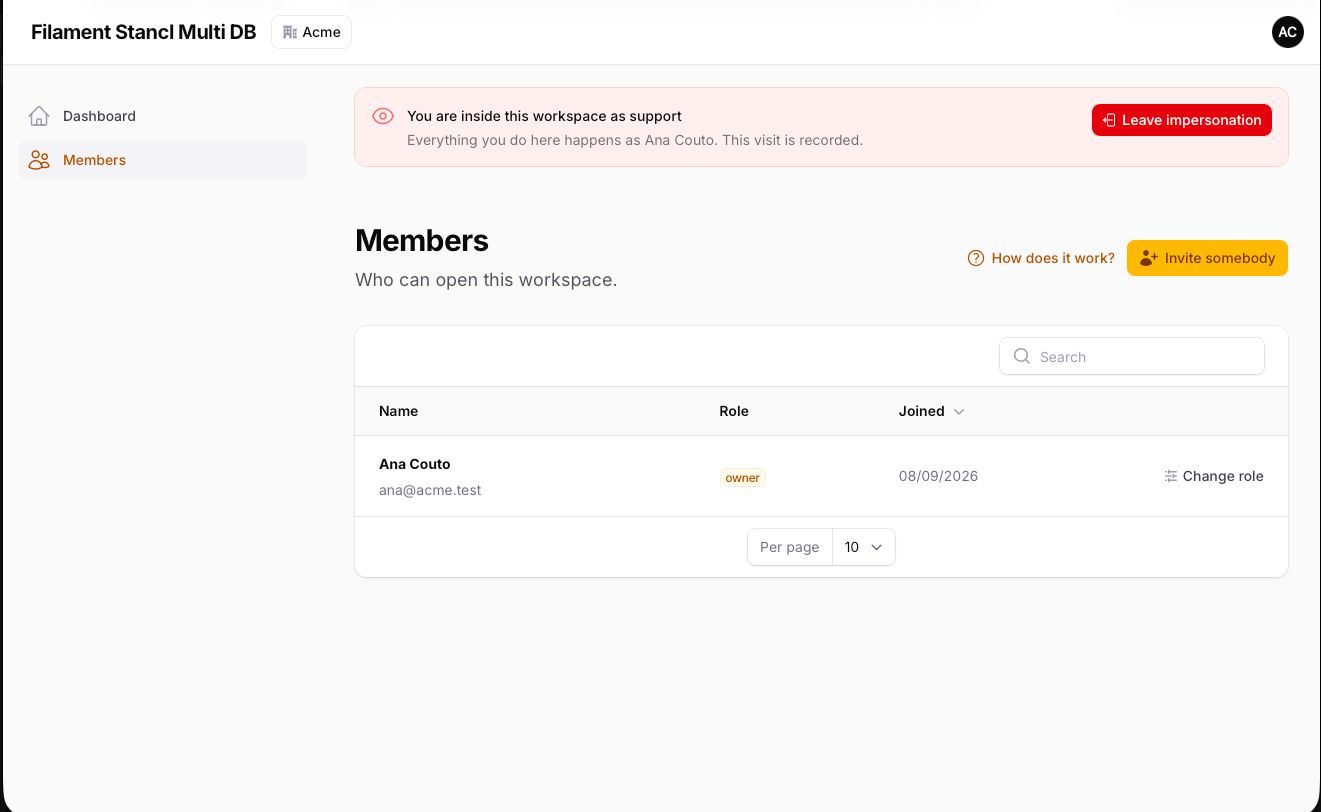
The tenant panel gets a Members page: who is in, with the coarse membership role, and the invitations still pending. Owners and admins (configurable) invite by email, change roles, remove people, resend and revoke. The central panel gets the same as a relation manager on the Tenants resource, so support can fix a workspace without asking its owner to log in.
An invitation is a row in central and a link that works once. Only the hash is stored: the clear token lives in the link and nowhere else. Acceptance happens on the central domain, because the person may have no session and no account yet:
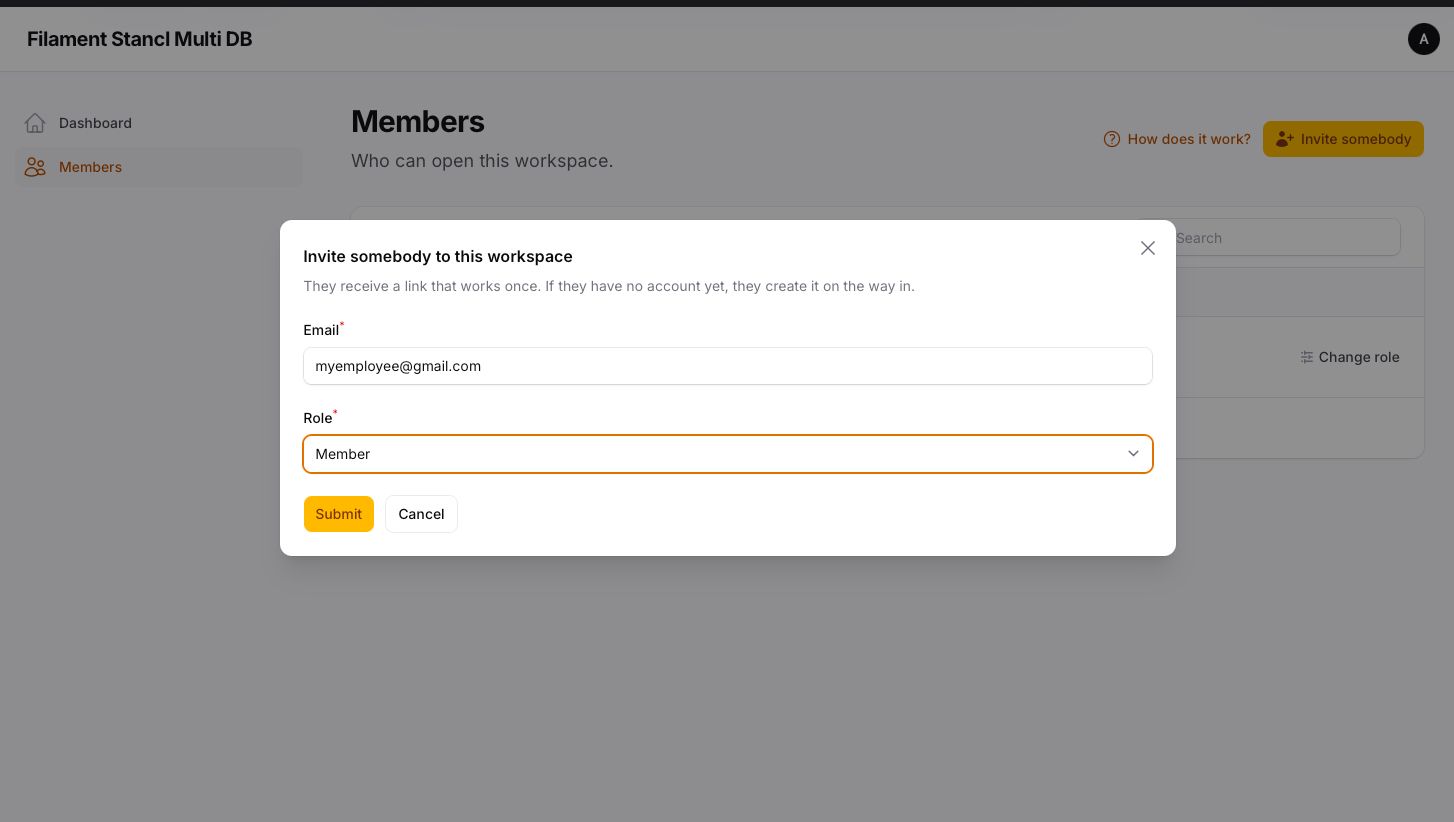
- No account — they choose a name and password, the identity is created, the membership and the tenant-local user with it, and they land inside the panel through a signed handoff.
- Account already — they confirm with their existing password, and the same thing happens minus the identity.
Nobody gets a session out of a URL: the link identifies the invitation, never the person. Links expire (7 days by default), can be revoked, and are pruned on a schedule.
Removing somebody deletes their membership and their tenant-local user. Their central identity is left alone — that only goes when its last workspace dies. The last owner can be neither removed nor demoted.
#Rows that live on both sides
A person is one identity in central and one local user inside every tenant they belong to. Without syncing, a name changed in one place quietly disagrees with the other two.
The plugin wires stancl's resource syncing for those users: a change made inside a workspace reaches central and every other workspace, and a change made in central reaches all of them. Only what is listed travels — never the password, which lives in central and is checked there, and never the roles, which are the tenant's own business.
For the central-to-tenant direction the host's identity model has to declare the contract:
use Stancl\Tenancy\Contracts\SyncMaster;

class User extends Authenticatable implements SyncMaster
{
    use HasRoles;
    use IsCentralIdentity;
}
Without it, the tenant-to-central direction still works and nothing throws; the plugin simply does not start the walk. Anything else you keep on both sides — catalogues, licences, price lists — follows the same contracts: Syncable on the tenant model, SyncMaster on the central one, and stancl's listener does the carrying.
#Several workspaces, one account
An identity can belong to any number of tenants, and the central door already picks between them — but only before you are inside. Once in a panel, the plugin adds two things.
A workspace picker in the topbar, listing the other tenants this identity belongs to. Crossing goes through the same signed single-use handoff as every other door, so the target panel authenticates the arrival on its own terms instead of trusting a session that belongs to a different database. Tenants still being provisioned are left out: their panel has nowhere to land.
A New workspace page, reached from that same picker. If the subdomain they pick is taken, the form says so as soon as they leave the field and offers four free alternatives to choose from — every one of them checked before it is shown, because a suggestion that turns out to be taken is worse than no suggestion at all. The public sign-up creates an account and a tenant, which is exactly wrong for somebody already signed in — they would end up with two identities for the same face. Here only the workspace is created, owned by the identity already authenticated, and they land inside it. Restrict it with onboarding.roles if not everybody should be able to.
#More than one database server
One server holds a lot of tenants until the day it does not, and by then moving them is a migration nobody wants to run.
TenancyPlugin::make()->databasePool(['tenant-db-1', 'tenant-db-2', 'tenant-db-3'])
Each name is an ordinary Laravel connection. A new tenant is placed on one of them at birth — the only moment the question is cheap — and the choice is written on the tenant itself, so provisioning, runtime connections, migrations, backups and deletion all follow it. Adding capacity is adding a name to the list; nothing already placed is ever moved, because a tenant that changed servers behind everyone's back is a tenant whose backups point at the wrong machine.
Three strategies: least-tenants (the default), round-robin, and weighted, where the weight is relative capacity — a server with 2 takes twice as many as one with 1.
To keep a particular tenant somewhere — data residency, dedicated hardware — pin it and it is never rebalanced:
$tenant->setInternal('db_connection', 'residency-eu-1')->save();
In the panel, a widget shows how full each server is and which one takes the next tenant, and Move to another server does the move properly: dump, restore on the target, drop the original, with the workspace suspended in between so nothing is written to a database that is about to disappear. The dump is kept either way.
tenancy:pool shows the distribution, which server is next, and whether each one answers. tenancy:doctor fails on a name that no connection backs, and health reports a tenant placed on a server the application no longer defines — the one failure every other check would report as a driver error.
#Provisioning
By default a tenant is built inside the signup request: database created, migrated, roles seeded, founder provisioned, all before the response. Simple, and fine while migrations are quick.
TenancyPlugin::make()->asyncProvisioning()
With that, the tenant row is written immediately and the rest happens on a queue. The founder lands on a waiting page — signed and short-lived, on the central domain, because their own subdomain has no database yet — and is handed into their panel the moment it is ready, already signed in.
That brings one new fact the whole application has to respect: a tenant can exist before its database does. So:
EnsureTenantIsReadysits at the front of every tenant panel and answers with a page that refreshes itself, instead of a driver error.- Health reports an unfinished tenant as provisioning, not as broken — nobody should be sent to repair what a worker is about to build.
- A failure is recorded on the tenant with its reason, and the job lands in
failed_jobswith the stack trace. - Finish setup / Retry setup appears on the row while there is something to finish, and
tenancy:provision --faileddoes the same for all of them at once.
Both modes run the same list of steps, so a tenant built on a queue is indistinguishable from one built in the request. It needs a queue worker; without one, tenants stay pending forever.
#Subdomains or paths
By default a tenant is identified by the host it is reached at: acme.demo.test. That is what makes the session isolation here work by construction — each tenant is its own origin — and what custom domains are built on.
TenancyPlugin::make()->identification('path')
With that, every tenant lives under the central host instead: demo.test/acme/app. No wildcard DNS, no wildcard certificate, which is why it is often the right choice for an internal tool or a staging box. What it costs:
- One cookie jar. Central and tenant panels share a host, so their session cookies must have different names — they do by default, and
tenancy:doctorfails if they ever match. - Requests with no tenant in the URL. Livewire posts to
/livewire/update, one fixed path for every panel. With subdomains the host still says who this is; with paths it says nothing, so the tenant is remembered in the session while the panel is served and read back from there, falling back to the referer. Two tabs on two tenants in the same browser is the case this cannot serve honestly. - No custom domains. They contradict the mode: the whole point there is to be reached somewhere else.
Everything that hands somebody over to a tenant — the login, the handoff, the switcher, the commands — asks how tenants are reached rather than assuming.
#Running under Octane
Octane keeps the application alive between requests, which is a problem for exactly the things this plugin changes per request: the default database connection, the session cookie, the tenant itself. A tenant left initialized is one workspace answering with another's rows.
The plugin listens to Octane's request events and puts all three back. It registers itself only when Octane is installed, and tenancy:doctor fails if Octane is there and the reset has been turned off.
#Custom domains
Every tenant is born at {slug}.base, and that subdomain is never taken away: it is the service door when anything else breaks. On top of it, a tenant can be reached at a domain of its own.
A custom domain is a claim until DNS proves it. Anybody can type a hostname into a form, so an unverified domain serves nothing: EnsureDomainIsVerified turns those requests away with the record that is still missing. Two ways to prove it, chosen per domain:
- TXT —
_tenancy-verify.example.commust answertenancy-verify={token}. Proves ownership without touching where the domain points, so it can be created before the cutover. - CNAME — the hostname must point here. Proves ownership and routing at once, but cannot be used on a zone apex like
example.com.
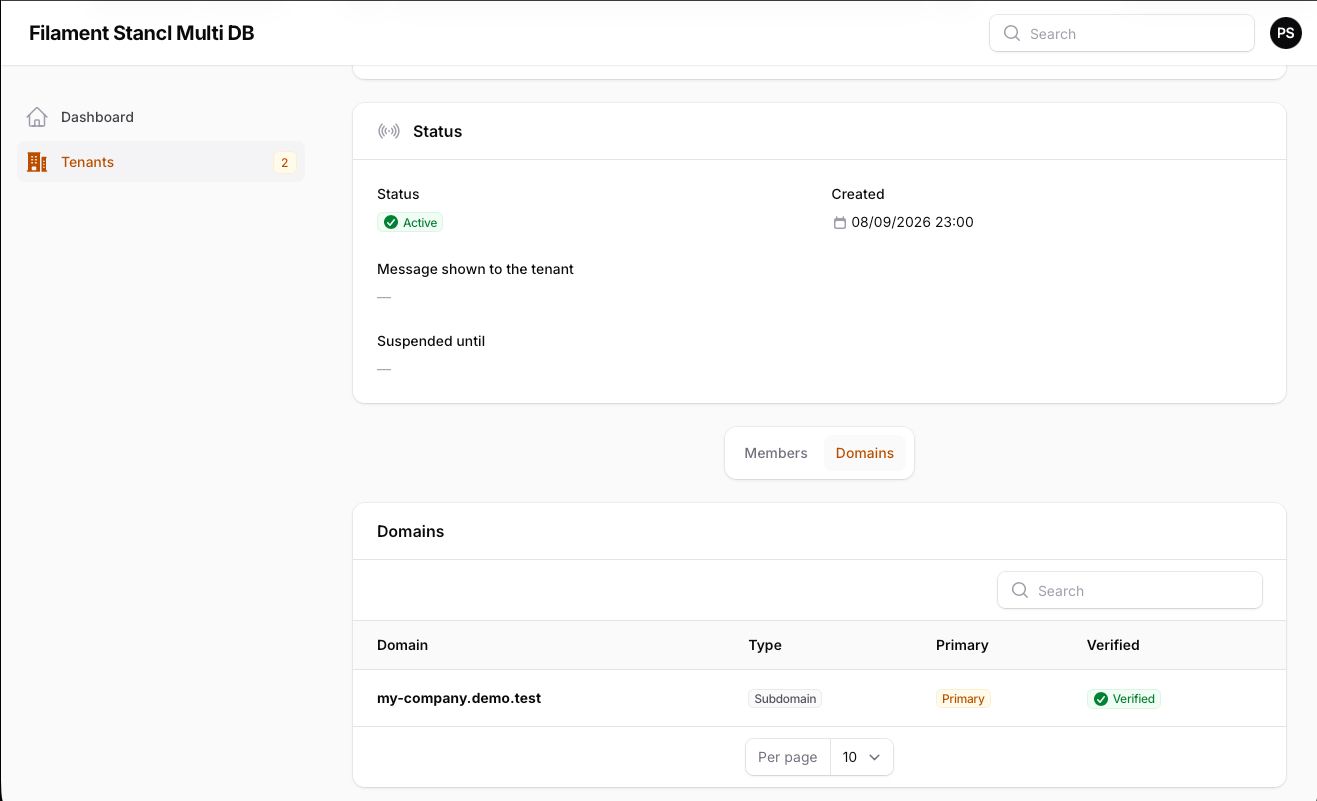
Manage them from the Domains relation manager on the Tenants resource: add, see the pending record, Verify now, make one the primary (every URL the platform builds then uses it), remove. tenancy:domains:verify re-checks the pending ones and is scheduled hourly, because DNS spreads on its own schedule.
What the plugin does not do: route the traffic or issue the certificate. The wildcard that covers *.base does not cover example.com. Pointing the domain at this server and getting it a certificate belongs to the infrastructure — Traefik or Caddy with on-demand certificates, or one the customer brings. The plugin identifies the tenant from the host it receives, and refuses to serve one whose owner never asked for it.
#Operations
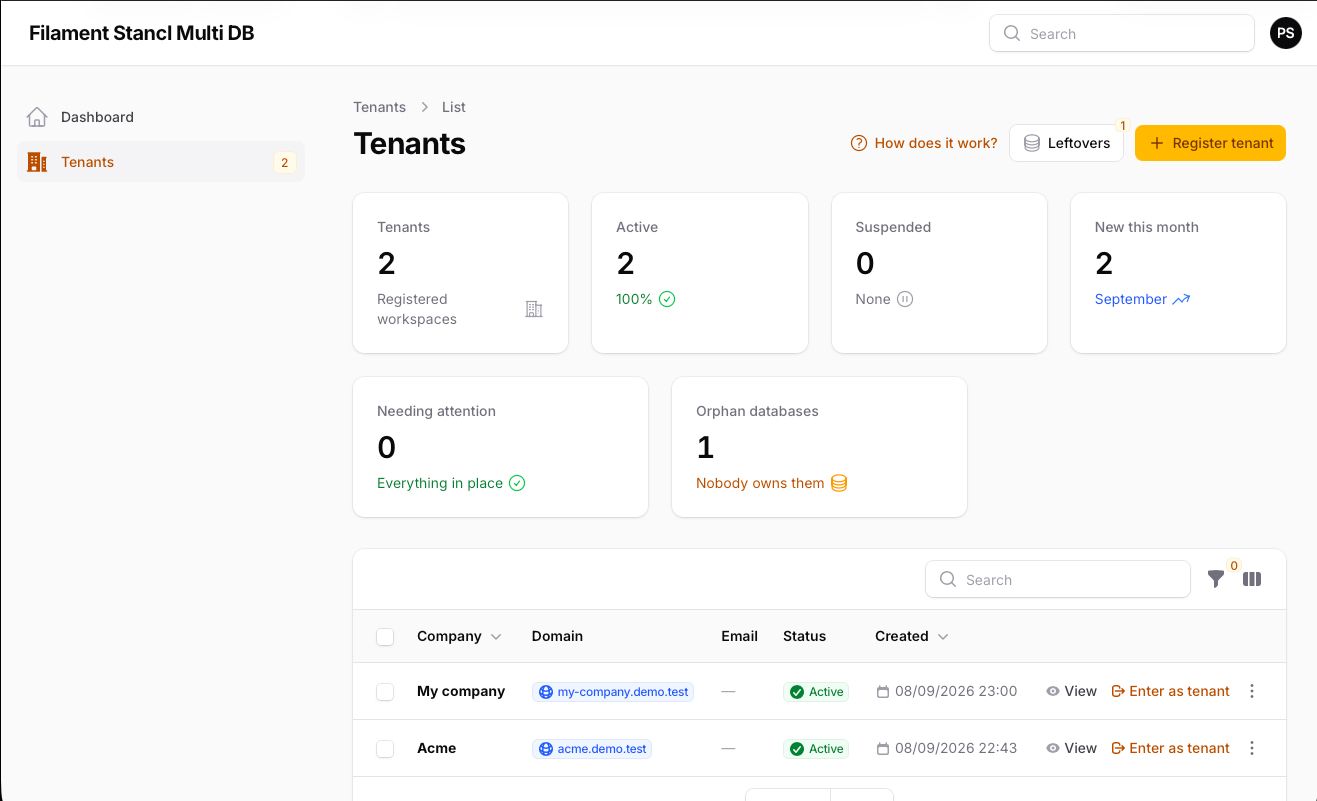
The Tenants resource is where a workspace is run, not just listed.
-
Health. Six checks per tenant — database, schema (pending migrations), domain, owner, tenant users, roles — behind a short cache. A
Healthcolumn, an infolist section listing exactly what is missing, a widget counting the tenants that need attention, and a filter to see only those. -
Repairs. Each failing check gets its own action under Maintenance: create the missing database (and migrate it), run pending migrations, re-seed the roles, assign an owner, provision the tenant users that are missing. Never one button that silently does six things.
-
Leftovers. Databases and storage directories with the tenant naming pattern that no tenant row claims — what a half-finished creation or a hand-deleted row leaves behind. Listed on demand from the server itself, dropped one by one and only when you ask.
-
Storage. stancl gives each tenant a directory of its own and never removes it; the plugin deletes it along with the tenant, reports its size in the list and the infolist, and lists the orphans.
-
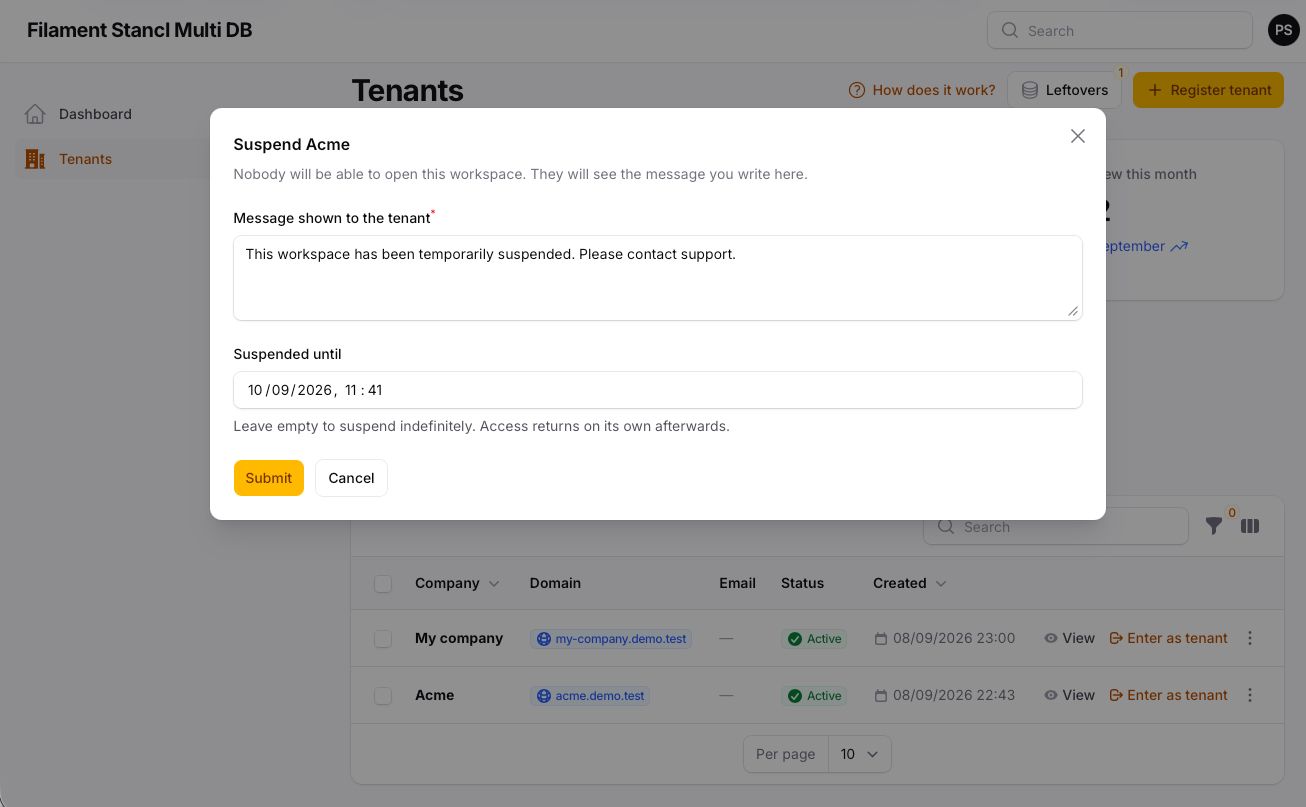
Suspension. Block a tenant with the reason you write and, optionally, a date it comes back on its own.
EnsureTenantIsActiveturns every request away with that message; support keeps access while impersonating. -
Notices. Publish a banner into a tenant's panel (info, warning or urgent, with an optional expiry), and optionally email the same text to its members.
-
Backups. A tenant in a box: the database dump, the files and a
manifest.jsonwith the tenant row, its domains and its members.tenancy:backupfor one tenant or all of them, a Back up now action in the panel, and a back it up first toggle on the destroy action — if that backup fails, nothing is deleted. The dump is delegated topg_dump/mysqldump(a straight file copy on SQLite); when the tool is not on the server, the plugin says so up front instead of writing half a backup. -
Restore.
tenancy:restore backup.zip [--id=]rebuilds the tenant from the manifest, loads the dump and copies the files back. It refuses to write over a live tenant — restoring on top of one is a merge nobody asked for. Identities are referenced by email and never recreated: members whose account no longer exists are reported so you can invite them again. -
Destruction. Type the subdomain to confirm, then the tenant, its database, its files, its domains, its memberships and any identity left without another workspace are gone.
Every page the plugin adds to a panel carries a How does it work? modal in its header, and every visual element is a Filament component, so the plugin inherits the panel's theme instead of bringing its own.
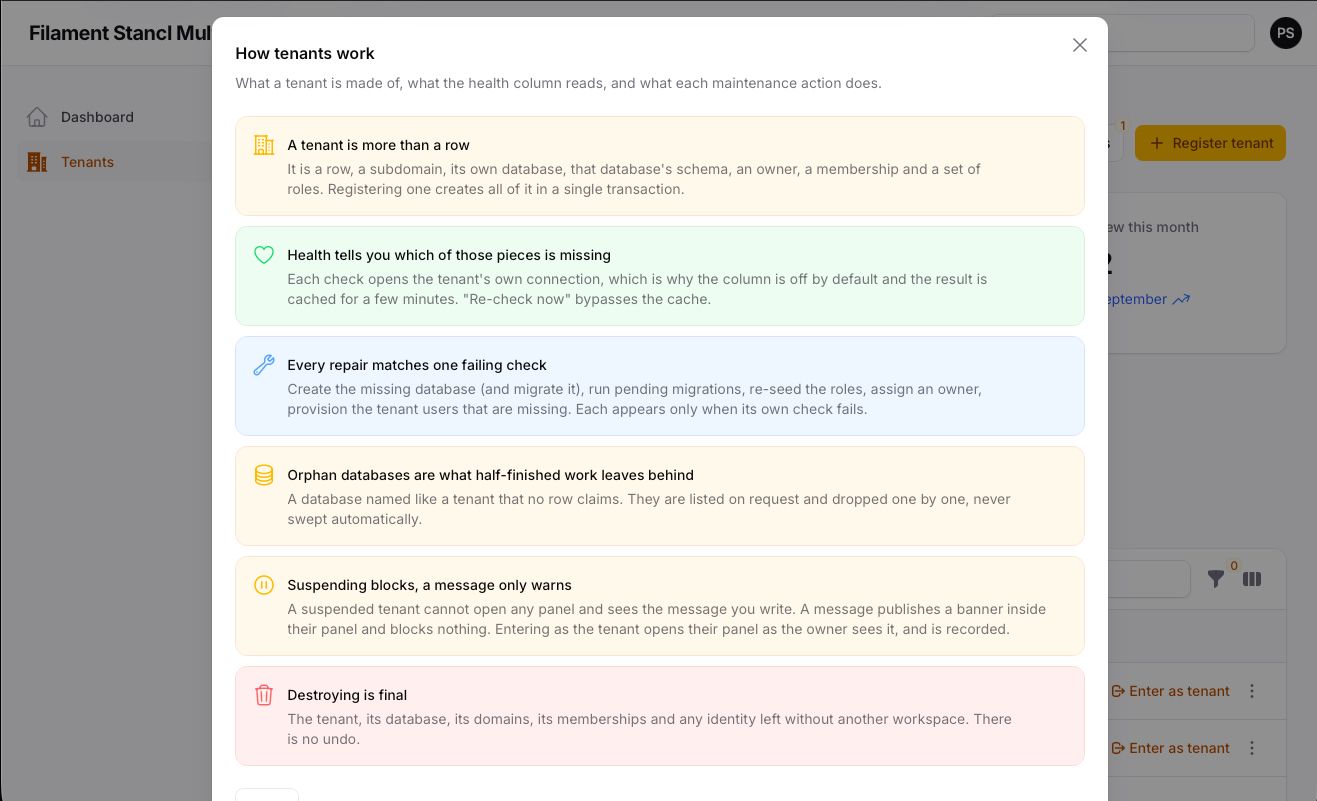
Read docs/ARCHITECTURE.md for the full picture.
#Configuration
Every option lives in config/filament-tenancy.php and every one of them has a fluent counterpart. Fluent calls win over the file. Closures (redirects, hooks) exist only fluently.
#TenancyPlugin (central panel)
| Method | Config key | Default | What it does |
|---|---|---|---|
baseDomain(string) |
domain.base |
APP_DOMAIN, else the host of APP_URL |
Root under which tenants live as {slug}.base |
identification(string $driver, ?string $pathParameter) |
identification.driver, identification.path_parameter |
domain, tenant |
Whether a tenant is identified by host or by the first path segment |
octaneReset(bool) |
octane.reset |
true |
Put the application back between Octane requests |
centralDomains(array) |
domain.central_domains |
127.0.0.1, localhost, the base domain, TENANCY_CENTRAL_DOMAINS (comma list) |
Hosts served without tenancy |
centralConnection(string, bool $register = true) |
database.central_connection, database.register_connections |
central, true |
Name of the central connection; false to reuse one the host defines |
tenantConnectionTemplate(string) |
database.template_connection |
tenant_template |
Connection stancl copies for each tenant database |
databaseDriver(string) |
database.driver |
DB_CENTRAL_DRIVER, else DB_CONNECTION, else pgsql |
pgsql, mysql, mariadb, sqlite |
setDefaultConnection(bool) |
database.set_default_connection |
true |
Switch database.default to the central connection |
databaseNaming(string $prefix, string $suffix) |
database.prefix, database.suffix |
tenant, '' |
Tenant database name = prefix + id + suffix |
databasePool(array $connections, string $strategy, array $weights) |
pool.connections, pool.strategy, pool.weights |
[], least-tenants, [] |
Spread tenants across several database servers |
databaseManagers(array) |
database.managers |
stancl's sqlite/mysql/mariadb/pgsql managers | driver ⇒ TenantDatabaseManager |
tenantModel(string) |
models.tenant |
Komma\Tenancy\Models\Tenant |
Extend it in the host |
centralUserModel(string) |
models.central_user |
App\Models\User |
The host's identity model (uses IsCentralIdentity) |
tenantUserModel(string) |
models.tenant_user |
Komma\Tenancy\Models\TenantUser |
The user model inside tenant databases |
tenantColumns(array) |
models.tenant_columns |
[] |
Extra real columns on tenants |
centralGuard(string) |
auth.central_guard |
web |
|
tenantGuard(string, string $provider, bool $register) |
auth.tenant_guard, auth.tenant_provider, auth.register_guard |
tenant, tenant_users, true |
Guard and provider registered for tenant users |
| — | auth.pin_central_password_broker, auth.central_password_broker |
true, users |
Pin the central password broker to the central connection |
centralPanel(string) |
panels.central |
admin (set automatically from the panel this plugin is registered on) |
|
tenantPanels(array $map, ?string $defaultKind) |
panels.tenant, panels.default_kind |
['business' => 'app'], business |
Tenant kind ⇒ panel id (panels with TenantPanelPlugin add themselves) |
staffRoles(array) |
roles.staff |
super-admin, support, finance, staff |
Central roles allowed into the central panel and the Tenants resource |
manageRoles(array) |
roles.manage |
super-admin |
Roles that may create, edit, delete tenants |
tenantRoles(array, ?string $owner) |
roles.tenant, roles.owner |
owner, admin, member, owner |
Seeded in every new tenant database; the founder gets $owner |
seedTenantRoles(bool) |
roles.seed_tenant_roles |
true |
|
spatiePermissionScoping(bool) |
roles.scope_permission_cache |
true |
Per-tenant spatie permission cache key |
session(string $tenantCookie, bool $wildcardDomain) |
session.tenant_cookie, session.wildcard_domain |
tenant_session, true |
Session cookie on tenant hosts |
centralLogin(bool, ?string $path, ?string $name, ?string $throttle) |
central_login.* |
true, login, login / login.store, 10,1 |
The central door |
registration(bool, ?string $path, ?string $name, ?string $component) |
registration.* |
true, register, register, RegisterTenant::class |
Public self-registration |
centralLoginView(string) |
central_login.view |
filament-tenancy::auth.login |
The Blade view rendered on GET /login |
centralLoginController(string) |
central_login.controller |
Komma\Tenancy\Http\Controllers\EntryController |
The controller behind both verbs of /login |
authLayout(string) |
views.auth_layout |
filament-tenancy::components.layouts.auth |
Layout of the central login, the registration page and the suspension page |
registrationKinds(array) |
registration.kinds |
['business'] |
Kinds accepted through ?kind= |
captcha(?string $rule, ?string $view) |
registration.captcha_rule, registration.captcha_view |
null, null |
A validation rule class for the token and the Blade view of the widget (bound to wire:model="captchaResponse") |
honeypot(bool) |
registration.honeypot |
true |
|
registrationRateLimit(int $attempts, int $decay) |
registration.rate_limit |
3, 60 |
Per IP |
passwordMinLength(int) |
registration.password_min |
8 |
|
| — | registration.email_rule |
email:rfc,dns |
|
reservedSubdomains(array, bool $merge = true) |
reserved_subdomains |
www, admin, api, app, mail, … (see the file) |
Never registrable |
registrationRedirect(Closure) |
— | the tenant panel URL | fn (Tenant $tenant): string |
onTenantRegistered(Closure) |
— | — | fn (Tenant $tenant, Model $owner): void, inside the birth transaction |
afterLoginRedirect(Closure) |
— | the panel home | fn (Tenant $tenant, Model $globalUser, ?string $intent): ?string, after a handoff is claimed |
handoff(int $ttl, int $pruneAfterDays, bool $schedulePrune) |
handoff.* |
60, 7, true |
|
impersonation(bool, ?array $roles, ?array $protectedRoles) |
impersonation.* |
true, super-admin, support, super-admin |
Who may impersonate; identities that never can be |
| — | impersonation.leave_path, impersonation.leave_name, impersonation.banner |
impersonation/leave, impersonation.leave, true |
|
resourceSyncing(bool, ?array $userAttributes) |
syncing.enabled, syncing.user_attributes |
true, name, email |
Keep the same person's row in step on both sides |
invitations(bool, ?int $ttlDays, ?array $roles, ?bool $email) |
invitations.enabled, invitations.ttl_days, invitations.roles, invitations.email |
true, 7, owner, admin, true |
How somebody who is not the founder joins a workspace |
invitationRole(string) |
invitations.default_role |
member |
Role an invitation carries by default |
invitationPage(?string $view, ?string $controller, ?string $path) |
invitations.view, invitations.controller, invitations.path |
the plugin's own, invitations/{token} |
The acceptance page |
customDomains(bool, ?string $verification, ?string $cnameTarget, ?bool $scheduleVerify) |
domains.custom, domains.default_verification, domains.cname_target, domains.schedule_verify |
true, txt, null (the base domain), true |
Domains of a tenant's own, and how they are proved |
domainVerificationRecord(string $name, ?string $prefix) |
domains.txt_record, domains.txt_prefix |
_tenancy-verify, tenancy-verify= |
The TXT record a domain must answer |
storage(bool $deleteOnDestroy, ?bool $orphans, ?string $root) |
storage.delete_on_destroy, storage.orphans, storage.root |
true, true, null |
The per-tenant storage directory |
backups(bool, ?string $path, ?bool $withStorage, ?bool $beforeDestroy, ?bool $zip) |
backups.* |
true, storage/app/tenant-backups, true, true, true |
Database dump, files and manifest |
backupBinaries(array) |
backups.binaries |
all null (found on the PATH) |
Absolute paths to pg_dump, psql, mysqldump, mysql |
asyncProvisioning(bool, ?string $queue, ?int $pollSeconds) |
provisioning.async, provisioning.queue, provisioning.poll_seconds |
false, default queue, 3 |
Build tenant databases on a queue instead of in the signup request |
healthChecks(bool, ?int $cacheTtl, ?bool $orphanDatabases) |
health.enabled, health.cache_ttl, health.orphan_databases |
true, 300, true |
Completeness checks, the repairs they enable, and the orphan-database list |
widgets(bool $stats, ?bool $health, ?bool $pool) |
widgets.stats, widgets.health, widgets.pool |
true, true, true |
Widgets on the Tenants list page (the pool one appears only with a pool) |
suspension(bool) |
suspension.enabled |
true |
Block a tenant's panels with the operator's message |
notices(bool, bool $email) |
notices.enabled, notices.email |
true, false |
Publish a banner into a tenant's panel; optionally email its members |
centralRoutes(bool) |
routes.central |
true |
/register, /login, /impersonation/leave |
tenantRoutes(bool, bool $loadHostFile) |
routes.tenant, routes.host_tenant_routes |
true, true |
/whoami on tenant hosts and the host's routes/tenant.php |
afterTenantCreated(array $jobs, bool $queued) |
pipeline.after_created, pipeline.queued |
[], false |
Jobs after database, migrations and roles; each receives the tenant |
tenantMigrationPaths(array, bool $merge = true) |
migrations.tenant_paths |
database/migrations/tenant (the plugin's own are always included) |
|
tenantSeeders(string) |
migrations.tenant_seeder |
DatabaseSeeder |
Root seeder for tenants:seed |
bootstrappers(array) |
bootstrappers |
Database, Cache, Filesystem, Queue, Redis | stancl bootstrappers |
cacheTag(string) |
cache.tag_base |
tenant |
|
filesystemDisks(array, ?array $rootOverride, ?bool $suffixStoragePath) |
filesystem.* |
local, public; storage-path overrides; true |
|
redis(?bool $enabled, ?array $prefixedConnections, ?string $prefixBase) |
redis.enabled, redis.prefixed_connections, redis.prefix_base |
null (autodetect: on only when phpredis or predis is installed), ['cache'], tenant |
The per-tenant Redis bootstrapper |
redisPrefixedConnections(array) |
redis.prefixed_connections |
['cache'] |
Never the queue: a job already carries its tenant |
| — | id_generator |
Stancl\Tenancy\UUIDGenerator |
|
| — | tenant_panel_middleware |
[] |
Appended to every tenant panel after tenancy is initialized |
tenantResource(bool) |
— | true |
Register the Tenants resource on the central panel |
tenantResourceRelationManagers(array) |
— | [] |
Relation managers shown on the Tenants resource |
configure(string $key, mixed $value) |
any | — | Escape hatch for any key |
#TenantPanelPlugin (each tenant panel)
| Method | Config key | Default | What it does |
|---|---|---|---|
kind(string) |
— | panels.default_kind |
The tenant kind this panel serves |
login(string $page) |
— | Komma\Tenancy\Filament\Pages\Auth\Login |
Extend to customise |
profile(bool, ?string $page) |
profile.enabled |
true, Komma\Tenancy\Filament\Pages\Auth\EditProfile |
Profile page that writes to the central identity |
passwordReset(bool) |
profile.password_reset |
true |
|
passwordReminder(bool) |
profile.password_reminder |
true |
Banner for invited members without a password |
impersonationBanner(bool) |
impersonation.banner |
true |
|
switcher(bool) |
switcher.enabled |
true |
The workspace picker in the topbar |
onboarding(bool, ?string $page) |
onboarding.enabled |
true, Komma\Tenancy\Filament\Pages\NewWorkspace |
Creating another workspace without leaving this one |
members(bool, ?string $page) |
invitations.enabled |
true, Komma\Tenancy\Filament\Pages\Members |
The workspace's own people page |
suspension(bool) |
suspension.enabled |
true |
Apply EnsureTenantIsActive on this panel |
notices(bool) |
notices.enabled |
true |
Show the operator's banner on this panel |
middleware(array) |
tenant_panel_middleware |
[] |
After tenancy is initialized, before PreventAccessFromCentralDomains |
afterLoginRedirect(Closure) |
— | — | Same as on TenancyPlugin |
sessionCookie(string, bool $wildcardDomain) |
session.* |
tenant_session, true |
Same as session() on TenancyPlugin |
A tenant panel gets: authGuard(tenant), the plugin's Login, EditProfile, password reset, the middleware stack (SetSubdomainUrlDefault, cookies, session, errors, CSRF, bindings, Filament, InitializeTenancyByDomain, your extras, PreventAccessFromCentralDomains), Authenticate as auth middleware, and the two banners.
#Every option at a glance
Nothing below is required: each line is the default, written out so the whole surface is visible in one place. Delete what you do not need.
// Central panel
->plugin(
    TenancyPlugin::make()
        // ── Domain ─────────────────────────────────────────────────────
        ->baseDomain(env('APP_DOMAIN', 'demo.test'))
        ->centralDomains(['demo.test', '127.0.0.1', 'localhost'])
        ->identification('domain')                      // domain | path
        // ── Database ───────────────────────────────────────────────────
        ->centralConnection('central', register: true)
        ->tenantConnectionTemplate('tenant_template')
        ->databaseDriver('pgsql')                       // pgsql | mysql | mariadb | sqlite
        ->setDefaultConnection(true)
        ->databaseNaming(prefix: 'tenant', suffix: '')
        ->databaseManagers([
            'sqlite' => SQLiteDatabaseManager::class,
            'mysql' => MySQLDatabaseManager::class,
            'mariadb' => MySQLDatabaseManager::class,
            'pgsql' => PostgreSQLDatabaseManager::class,
        ])
        ->databasePool([], strategy: 'least-tenants')   // several servers; empty means one
        // ── Models ─────────────────────────────────────────────────────
        ->tenantModel(Tenant::class)
        ->domainModel(Domain::class)
        ->centralUserModel(User::class)
        ->tenantUserModel(TenantUser::class)
        ->tenantColumns([])                             // additional physical columns in `tenants`
        // ── Auth ───────────────────────────────────────────────────────
        ->centralGuard('web')
        ->tenantGuard('tenant', provider: 'tenant_users', register: true)
        // ── Panels ─────────────────────────────────────────────────────
        ->centralPanel('admin')                         // set automatically when the plugin is registered
        ->tenantPanels(['business' => 'app'], defaultKind: 'business')
        // ── Roles ──────────────────────────────────────────────────────
        ->staffRoles(['super-admin', 'support', 'finance', 'staff'])
        ->manageRoles(['super-admin'])
        ->tenantRoles(['owner', 'admin', 'member'], owner: 'owner')
        ->seedTenantRoles(true)
        ->spatiePermissionScoping(true)
        // ── Session ────────────────────────────────────────────────────
        ->session(tenantCookie: 'tenant_session', wildcardDomain: true)
        // ── Central login gateway /login ───────────────────────────────
        ->centralLogin(true, path: 'login', name: 'login', throttle: '10,1')
        ->centralLoginView('filament-tenancy::auth.login')
        ->centralLoginController(EntryController::class)
        ->authLayout('filament-tenancy::components.layouts.auth')
        // ── Public registration /register ──────────────────────────────
        ->registration(true, path: 'register', name: 'register', component: RegisterTenant::class)
        ->registrationKinds(['business'])
        ->captcha(rule: null, view: null)               // e.g. Turnstile::class, 'components.turnstile'
        ->honeypot(true)
        ->registrationRateLimit(attempts: 3, decaySeconds: 60)
        ->passwordMinLength(8)
        ->reservedSubdomains(['billing', 'support'], merge: true)
        ->registrationRedirect(fn ($tenant) => null)
        ->onTenantRegistered(fn ($tenant, $owner) => null)
        ->afterLoginRedirect(fn ($tenant, $globalUser, ?string $intent) => null)
        // ── Invitations ────────────────────────────────────────────────
        ->invitations(true, ttlDays: 7, roles: ['owner', 'admin'], email: true)
        ->invitationRole('member')
        ->invitationPage(view: null, controller: null, path: 'invitations/{token}')
        // ── Syncing ────────────────────────────────────────────────────
        ->resourceSyncing(true, userAttributes: ['name', 'email'])
        // ── Custom domains ─────────────────────────────────────────────
        ->customDomains(true, verification: 'txt', cnameTarget: null, scheduleVerify: true)
        ->domainVerificationRecord('_tenancy-verify', 'tenancy-verify=')
        // ── Handoff and impersonation ──────────────────────────────────
        ->handoff(ttlSeconds: 60, pruneAfterDays: 7, schedulePrune: true)
        ->impersonation(true, roles: ['super-admin', 'support'], protectedRoles: ['super-admin'])
        // ── Provisioning ───────────────────────────────────────────────
        ->asyncProvisioning(false, queue: null, pollSeconds: 3)
        // ── Operations ─────────────────────────────────────────────────
        ->healthChecks(true, cacheTtl: 300, orphanDatabases: true)
        ->widgets(stats: true, health: true, pool: true)
        ->suspension(true)
        ->notices(true, email: false)
        // ── Storage and backups ────────────────────────────────────────
        ->storage(deleteOnDestroy: true, orphans: true, root: null)
        ->backups(true, path: null, withStorage: true, beforeDestroy: true, zip: true)
        ->backupBinaries(['pg_dump' => null, 'psql' => null, 'mysqldump' => null, 'mysql' => null])
        // ── Routes ─────────────────────────────────────────────────────
        ->centralRoutes(true)
        ->tenantRoutes(true, loadHostFile: true)
        // ── Pipeline, migrations, seeders ──────────────────────────────
        ->afterTenantCreated([], queued: false)         // jobs that receive the tenant
        ->tenantMigrationPaths([database_path('migrations/tenant')], merge: true)
        ->tenantSeeders('DatabaseSeeder')
        // ── stancl bootstrappers ───────────────────────────────────────
        ->bootstrappers([
            DatabaseTenancyBootstrapper::class,
            CacheTenancyBootstrapper::class,
            FilesystemTenancyBootstrapper::class,
            QueueTenancyBootstrapper::class,
            RedisTenancyBootstrapper::class,
        ])
        ->cacheTag('tenant')
        ->filesystemDisks(['local', 'public'], rootOverride: [
            'local' => '%storage_path%/app/',
            'public' => '%storage_path%/app/public/',
        ], suffixStoragePath: true)
        ->redis(null, prefixedConnections: ['cache'])   // true requires a client · null auto-detects
        ->octaneReset(true)
        // ── Central panel interface ────────────────────────────────────
        ->tenantResource(true)
        ->tenantResourceRelationManagers([])
        // ── Escape hatch ───────────────────────────────────────────────
        ->configure('registration.email_rule', 'email:rfc')
);
// Tenant panel
->plugin(
    TenantPanelPlugin::make()
        ->kind('business')
        ->login(Login::class)
        ->profile(true, page: EditProfile::class)
        ->passwordReset(true)
        ->passwordReminder(true)
        ->members(true, page: Members::class)
        ->switcher(true)
        ->onboarding(true, page: NewWorkspace::class)
        ->impersonationBanner(true)
        ->suspension(true)
        ->notices(true)
        ->middleware([])                                // after tenancy is initialized
        ->afterLoginRedirect(fn ($tenant, $globalUser, ?string $intent) => null)
        ->sessionCookie('tenant_session', wildcardDomain: true)
);
#Several tenant panels
// Central
TenancyPlugin::make()->tenantPanels(['business' => 'app', 'developer' => 'dev'])->registrationKinds(['business', 'developer']);

// Panels
TenantPanelPlugin::make()->kind('business');   // on the 'app' panel
TenantPanelPlugin::make()->kind('developer');  // on the 'dev' panel
A tenant's kind decides the panel it is sent to and the only panel its users may access. /register?kind=developer creates developer tenants.
#Order of registration
TenantPanelPlugin::register() reads the guard name and the profile switches when the tenant panel registers. If you change them fluently on TenancyPlugin, register the central panel provider before the tenant panel providers, or set them in the config file.
#Replacing the pages
Every page the plugin renders can be swapped without publishing a view.
// Central panel
TenancyPlugin::make()
    ->authLayout('layouts.brand')                      // login, register and suspended
    ->centralLoginView('auth.login')                   // just the body of /login
    ->centralLoginController(MyEntryController::class) // or the logic behind it
    ->registration(component: MyRegisterTenant::class);

// Tenant panel
TenantPanelPlugin::make()
    ->login(MyLogin::class)
    ->profile(true, MyEditProfile::class);
Extend the plugin's classes rather than starting from scratch: Login carries the central-identity check and the handoff claim, EntryController the credential check and the signed handoff, RegisterTenant the guards and the birth transaction. A layout receives the body as $slot and the page title as $title. To edit the shipped views instead, publish them with php artisan vendor:publish --tag=filament-tenancy-views.
#Commands
| Command | What it does |
|---|---|
filament-tenancy:install |
Publish config and migrations, offer to migrate |
tenancy:create {subdomain} --name= --owner-name= --owner-email= --owner-password= --kind= --id= --force |
Create a tenant with database, domain, founder, membership and roles |
tenancy:destroy {tenant} --force |
Delete a tenant, its database, files, memberships and orphaned identities |
tenancy:backup {tenant?} --path= --no-zip --without-storage |
Back up one tenant or every tenant |
tenancy:restore {backup} --id= --force |
Rebuild a tenant from a backup |
tenancy:domains:verify --tenant= |
Re-check the DNS of every custom domain still pending |
tenancy:provision {tenant?} --failed --sync |
Provision or re-provision tenants whose database was never finished |
tenancy:pool |
Show the spread across database servers and where the next tenant lands |
tenancy:doctor --tenants |
Diagnose the whole setup: connections, DNS, routes, caches, panels, tooling |
tenants:migrate, tenants:seed, tenants:run |
stancl's own, already configured with the plugin's paths |
#Hooks
Komma\Tenancy\Events\TenantRegistered($tenant, $owner)— fired inside the birth transaction byTenantRegistrationService.- stancl's own events (
TenantCreated,TenancyInitialized, …) keep working; the plugin registers the pipeline and the bootstrap listeners. afterTenantCreated([...])for jobs that seed a new tenant database.onTenantRegistered(),registrationRedirect(),afterLoginRedirect()for the doors.
#Services
| Class | Purpose |
|---|---|
Komma\Tenancy\Services\TenantRegistrationService |
The only way a tenant is born |
Komma\Tenancy\Services\Membership |
The central tenant_user pivot |
Komma\Tenancy\Services\Handoff |
Mint a signed single-use URL into a tenant panel |
Komma\Tenancy\Services\Impersonate |
Staff entry as the tenant owner, recorded |
Komma\Tenancy\Services\Invitations |
Invite, resend, accept, change role, remove |
Komma\Tenancy\Services\TenantHealth |
Per-tenant completeness checks, cached |
Komma\Tenancy\Services\TenantRepair |
Create the missing database, migrate, seed roles, assign owner, provision users |
Komma\Tenancy\Services\Domains |
Add, verify, promote and remove the domains of a tenant |
Komma\Tenancy\Services\TenantStorage |
Where a tenant's files are, how big they are, and which directories are orphaned |
Komma\Tenancy\Services\TenantBackup |
Create, inspect and restore a backup |
Komma\Tenancy\Services\DatabasePool |
Where a new tenant is placed, and what sits where |
Komma\Tenancy\Services\TenantRelocator |
Move a tenant to another server: dump, restore, drop |
Komma\Tenancy\Services\DatabaseInventory |
What is physically on the server, and which of it is orphaned |
Komma\Tenancy\Tenancy |
Runtime configuration (app(Tenancy::class)) |
Komma\Tenancy\Filament\RelationManagers\TenantsRelationManager can be added to the host's User resource to manage memberships.
#Database
Central (host migrations, published): tenants (with status_message, status_until and notice for operations), domains (with type, is_primary, verified_at and the verification token), tenant_user, tenant_invitations, handoff_tickets, impersonations, plus ulid, status and password_set_at on users. Tenant (run by tenants:migrate, shipped by the plugin): users, sessions, password_reset_tokens, and spatie's permission tables when the package is installed. Sessions on tenant hosts live in the tenant database when SESSION_DRIVER=database.
#Translations
English keys, resolved as JSON translations; Spanish, Galician and Portuguese included. They apply when the application locale matches (APP_LOCALE=es), with English as the fallback. Publish and edit them with php artisan vendor:publish --tag=filament-tenancy-translations, which writes to lang/vendor/filament-tenancy/.
#License
Proprietary. See LICENSE.md.
The author
Komma SoftHouse builds Laravel and Filament software — point-of-sale, ERPs, and the multi-tenant SaaS platform behind them. The plugins it publishes are pieces of that work, released once they have proven themselves in production: Spanish fiscal compliance, tenancy infrastructure, and whatever the next product turns out to need.
From the same author
Featured Plugins
A selection of plugins curated by the Filament team
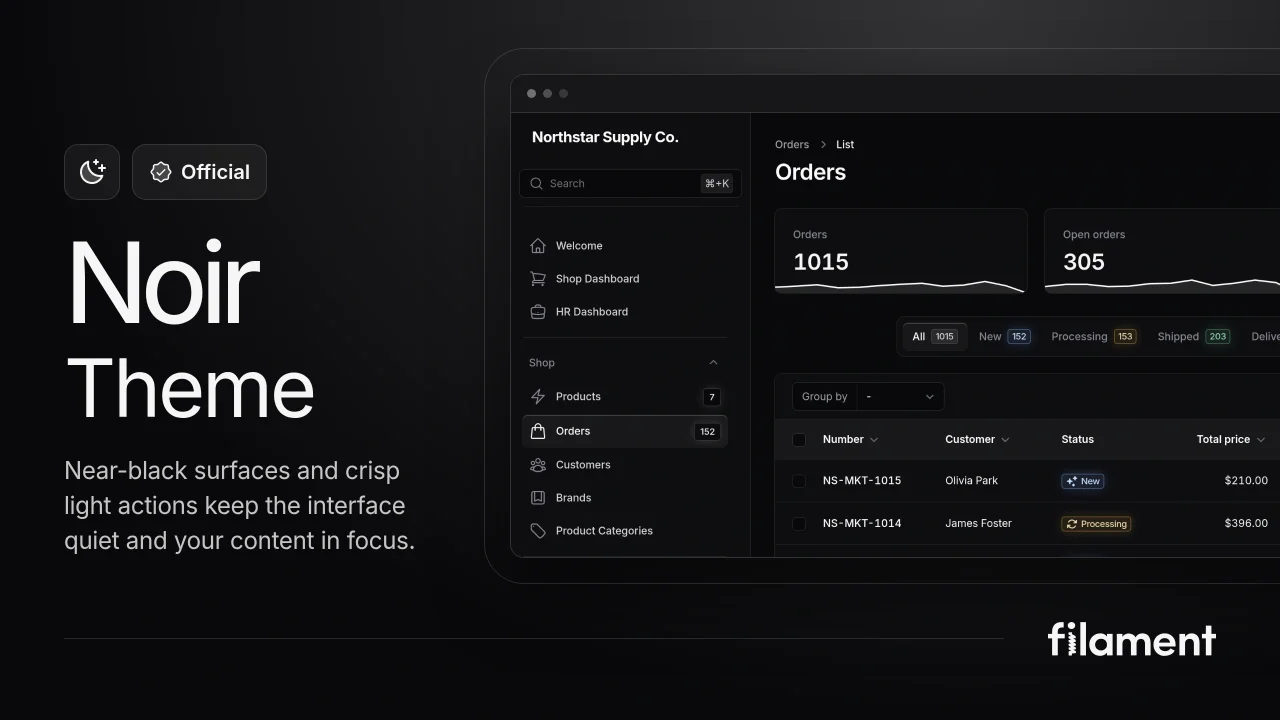
Noir Theme
A theme that gives panels a focused, refined look with near-black surfaces, crisp actions, and restrained color.
 Filament
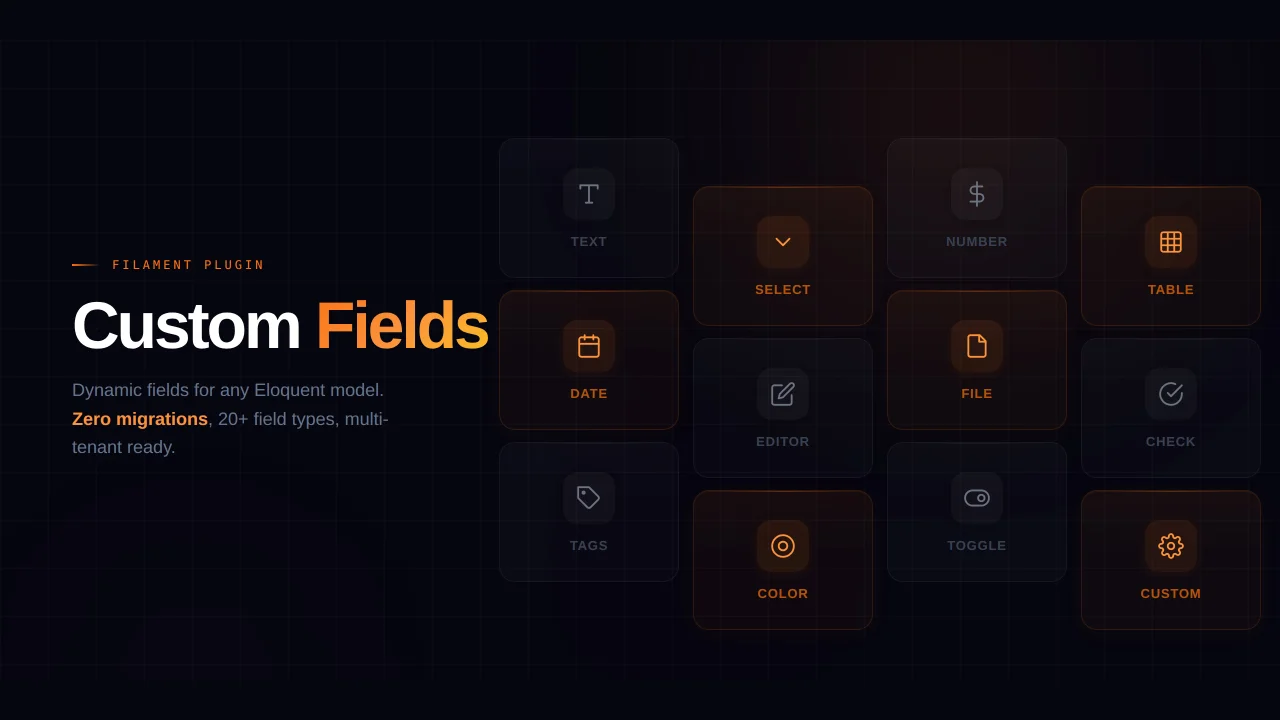
Custom Fields
Eliminate custom field migrations forever. Let your users create and manage form fields directly in Filament admin panels with 20+ built-in field types, validation, and zero database changes.
 Relaticle
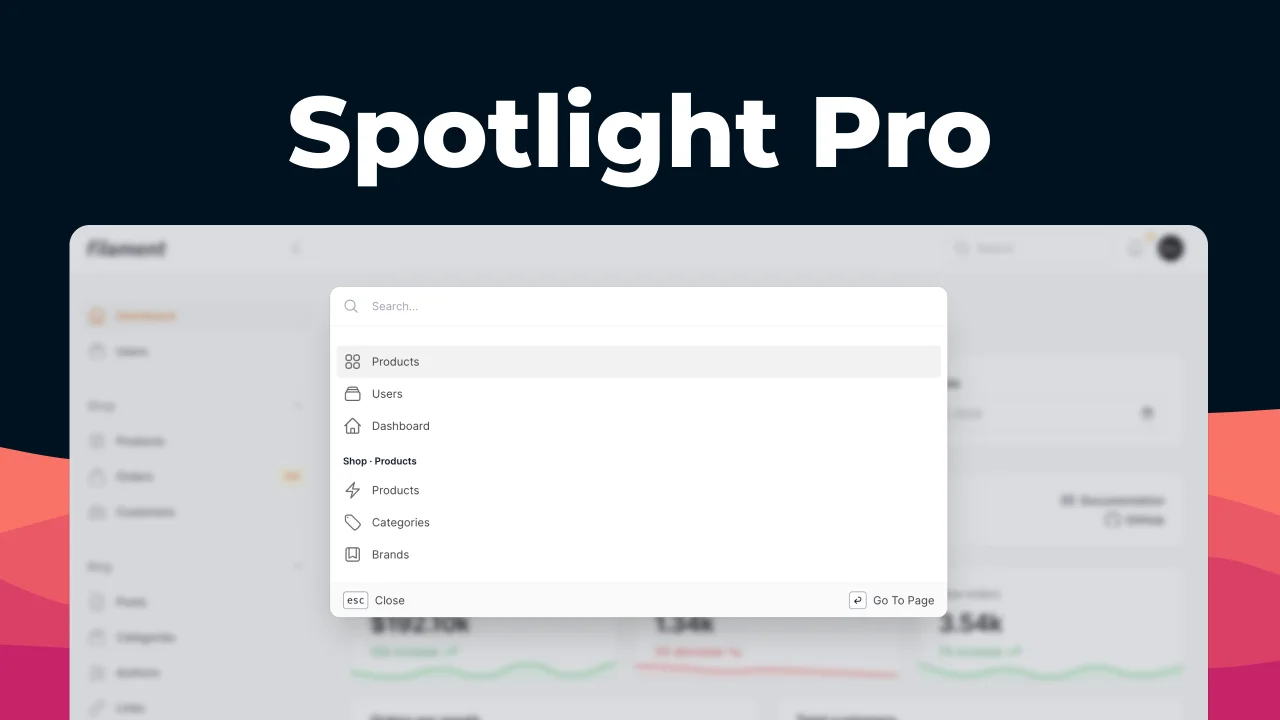
Spotlight Pro
Browse your Filament Panel with ease. Filament Spotlight Pro adds a Spotlight like Command Palette to your Filament Panel.
 Dennis Koch