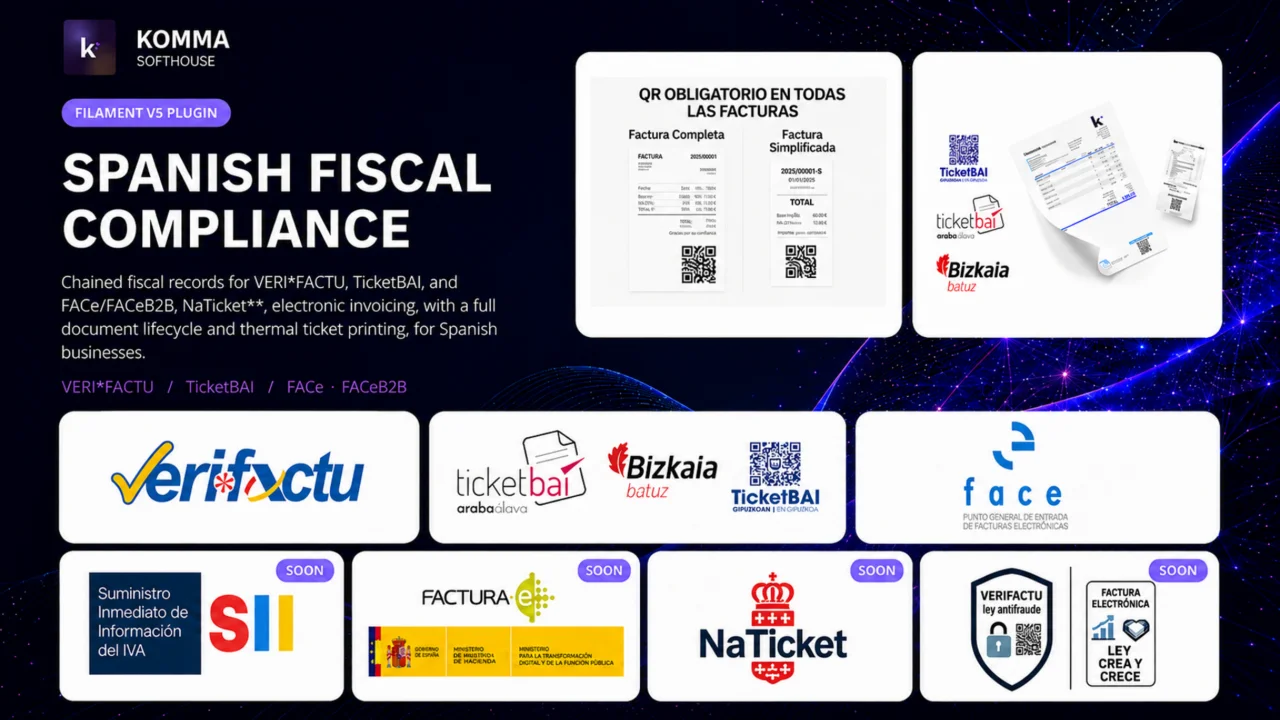
Verifactu
CommunityVERI*FACTU / RRSIF and TicketBAI compliant fiscal engine for Filament 5, covering all four Spanish fiscal regimes: chained fiscal records, AEAT and foral submission, XAdES signing, the full document lifecycle, the received side of the ledger, FACe/FACeB2B, and state and foral tax report drafts.
filament/
namespace. Review the source and install at your own risk. Found
malware or an unresolved security issue the author won't
address?
Report it
.
 Author:
Komma SoftHouse
Author:
Komma SoftHouse
Documentation
- What this plugin does
- Screenshots
- Requirements
- Installation
- Configuration
- Licensing at runtime
- Authorization
- Architecture notes
- Legal references
- Dark mode and translations
- Usage
- Minimal integration: bolting compliance onto existing host software
- Recurring documents, catalog, aging
- Hooks for a host that meters or bills
- Printed papers and templates
- OCR: drafting from a photo or PDF
- Print Agent (thermal printing from the cloud)
- FACe and FACeB2B lifecycle
- Notifying customers on repair status changes
- Navarra: the fourth regime
- Fiscal calendar, collections and the chart of accounts
- Roadmap
- Scope
- Architecture and add-on pricing
- Going to production
- Testing
- Changelog
- Support and community
- Security Vulnerabilities
- Credits
- License
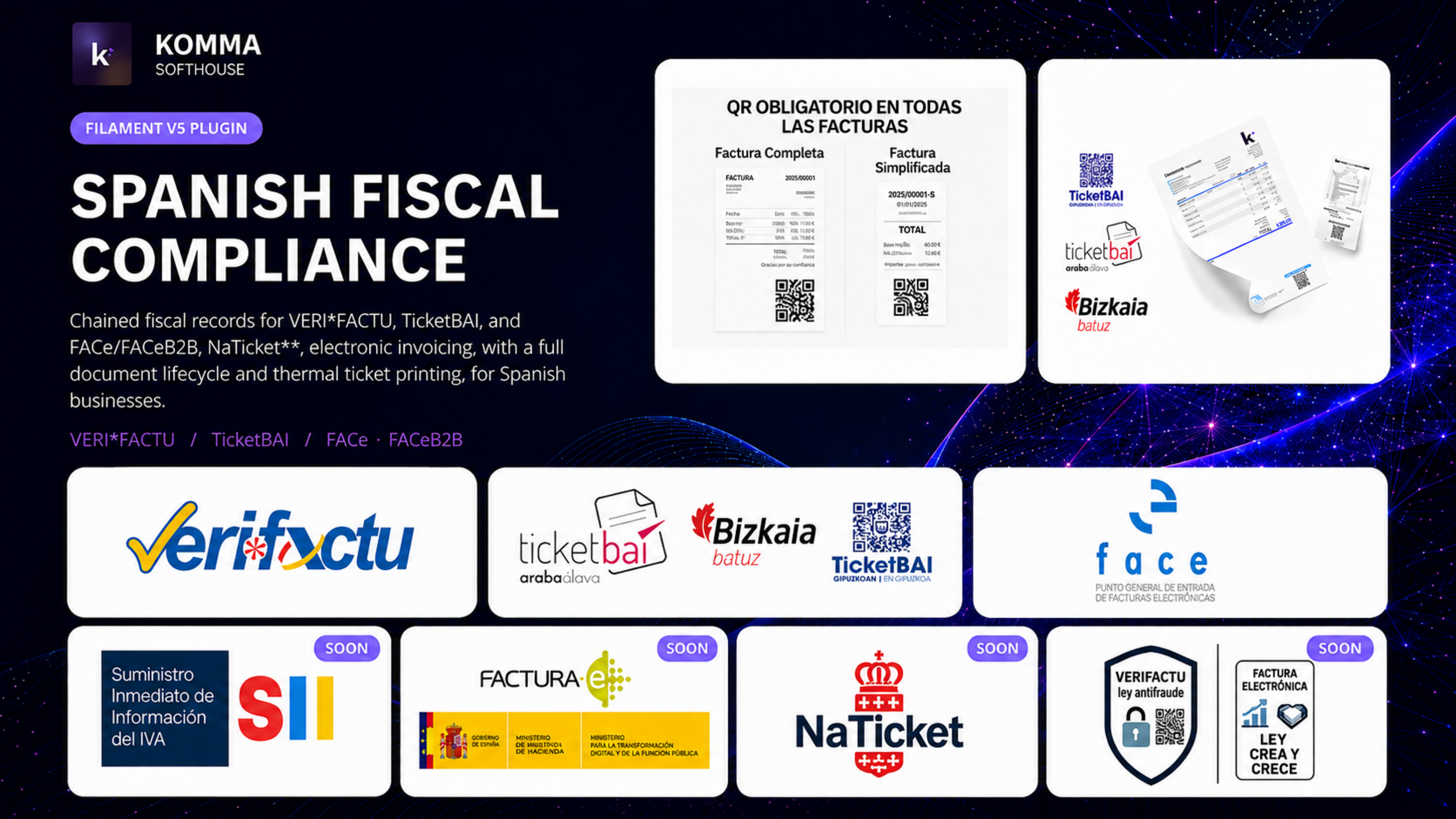
Official documentation for Filament Verifactu, a Filament v5 fiscal compliance engine for VERI*FACTU, TicketBAI, FACe and FACeB2B, covering all four Spanish fiscal regimes — AEAT, the three TicketBAI territories, and Navarra (foral tax models today, NaTicket-ready for when its specification is published).
VERI*FACTU / RRSIF and TicketBAI compliant fiscal engine for Filament 5.x: chained fiscal records, AEAT and foral (Araba/Bizkaia/Gipuzkoa) submission, XAdES signing, a full document lifecycle, FACe/FACeB2B electronic invoicing, and fiscal reporting drafts under both the state numbers (303, 347, 349, 111, 115) and the Navarra foral ones (F-69, F-50, 349, 715, 759) — for Spanish businesses that need their invoicing to comply with Real Decreto 1007/2023, Orden HAC/1177/2024, (for the three Basque territories) their own TicketBAI regulation, or (for Navarra) the Convenio Económico's own treasury, whose antifraud system NaTicket joins as the fourth engine the day its specification is published.



#What this plugin does
- Chains and hashes fiscal records exactly as RRSIF requires, with a
single gate (
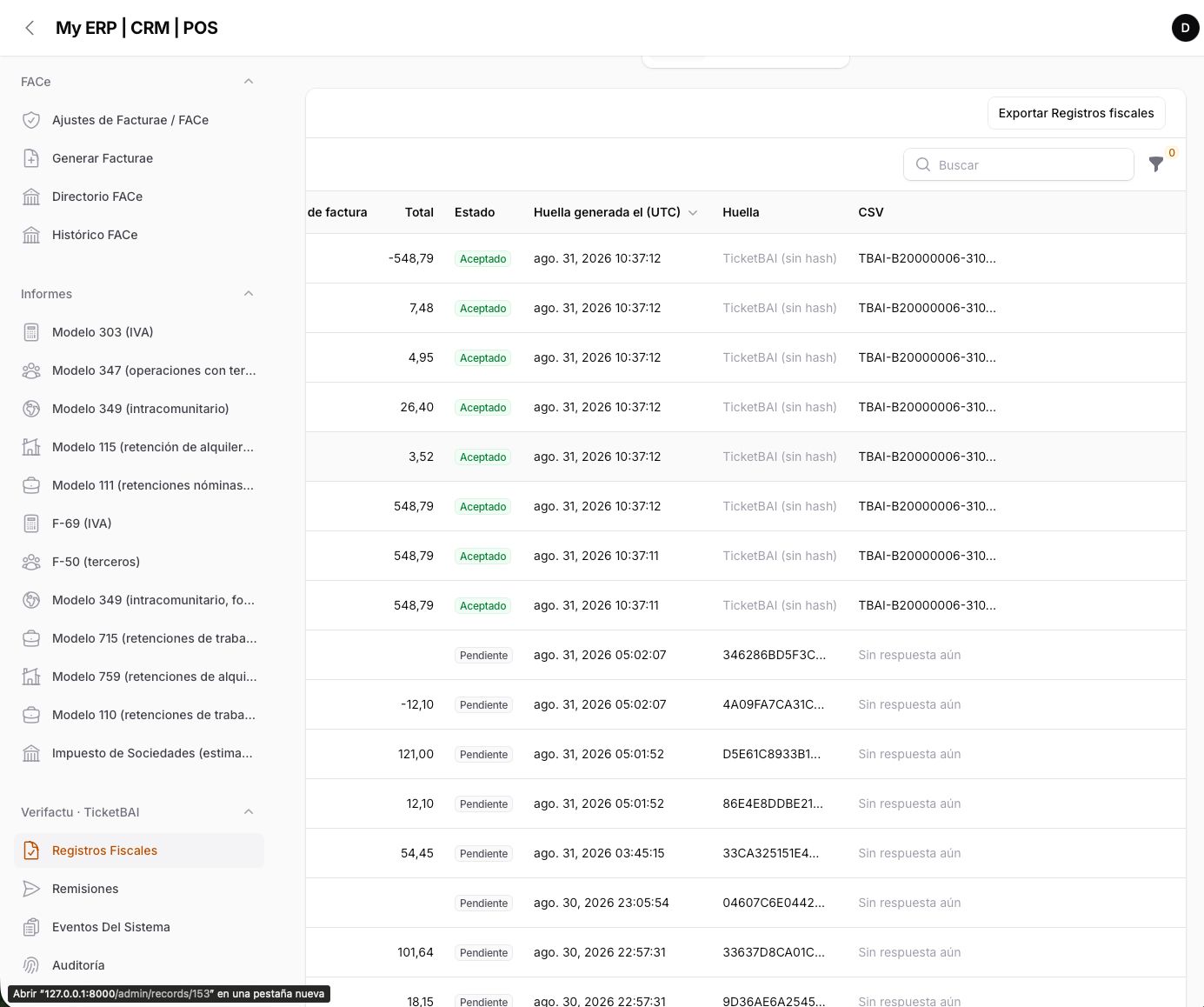
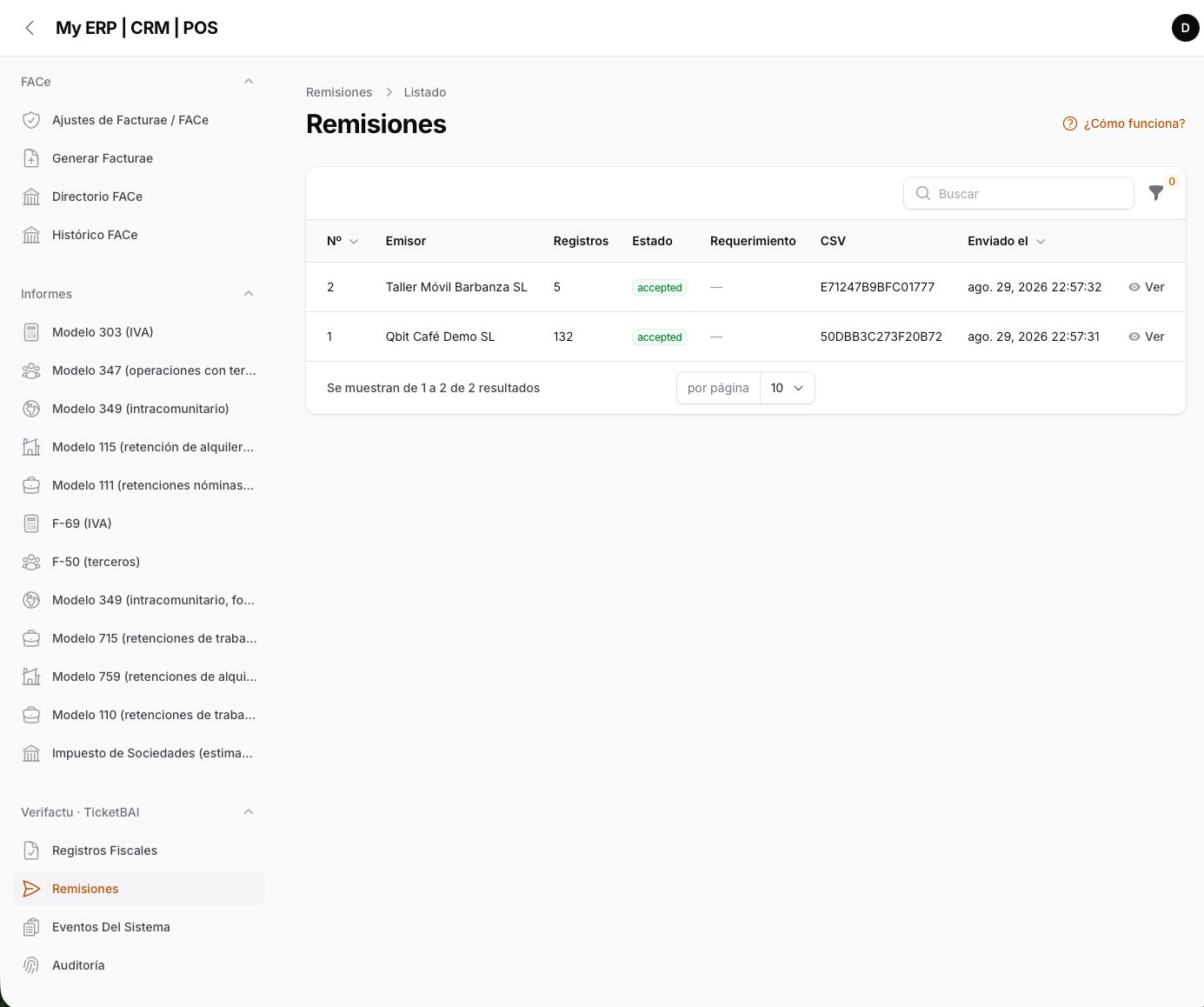
RecordService) that locks the issuer, links the new record to the previous hash, validates it against the AEAT engine, and persists it — impossible to fork, impossible to edit afterwards. - Submits to the AEAT in both remission modes: continuous (VERI*FACTU) and on-demand (signed XML batches, answering a requirement or opened as a voluntary remission whenever the issuer decides — a dedicated panel action carries the legal context), respecting the AEAT's flow-control window. The continuous pipeline refuses non-Verifactu issuers by design: their records only ever leave on demand.
- Reads back from the AEAT (
ConsultaFactuSistemaFacturacion): asks the office what IT holds for a record — state, presentation data, and the hash it stores, cross-checked against our own chain — and translates every rejection through the official 239-code error catalog, with its severity (whole-submission / this-record / accepted-but-fix). - Submits to TicketBAI (Araba, Bizkaia, Gipuzkoa) through the exact same
RecordServicegate — a completely separate engine under the hood, with its own signature-value chaining, registration, cancellation, corrective (rectificativa) invoices, and Zuzendu subsanación (Araba/Gipuzkoa; Bizkaia does not implement it). Bizkaia submissions are automatically wrapped in the correct Batuz/LROE envelope (Modelo 140 autónomo or 240 sociedad). - Models Navarra as a first-class regime: neither VERI*FACTU nor TicketBAI apply in the Comunidad Foral, and its own antifraud system (NaTicket) has no published specification yet — so a Navarrese issuer runs the entire document lifecycle with gapless numbering, prints, reports under the foral model numbers, and simply has no antifraud chain to activate until the NaTicket driver exists. The activation stays locked for this regime by design: nothing is faked, nothing is chained against an unpublished spec.
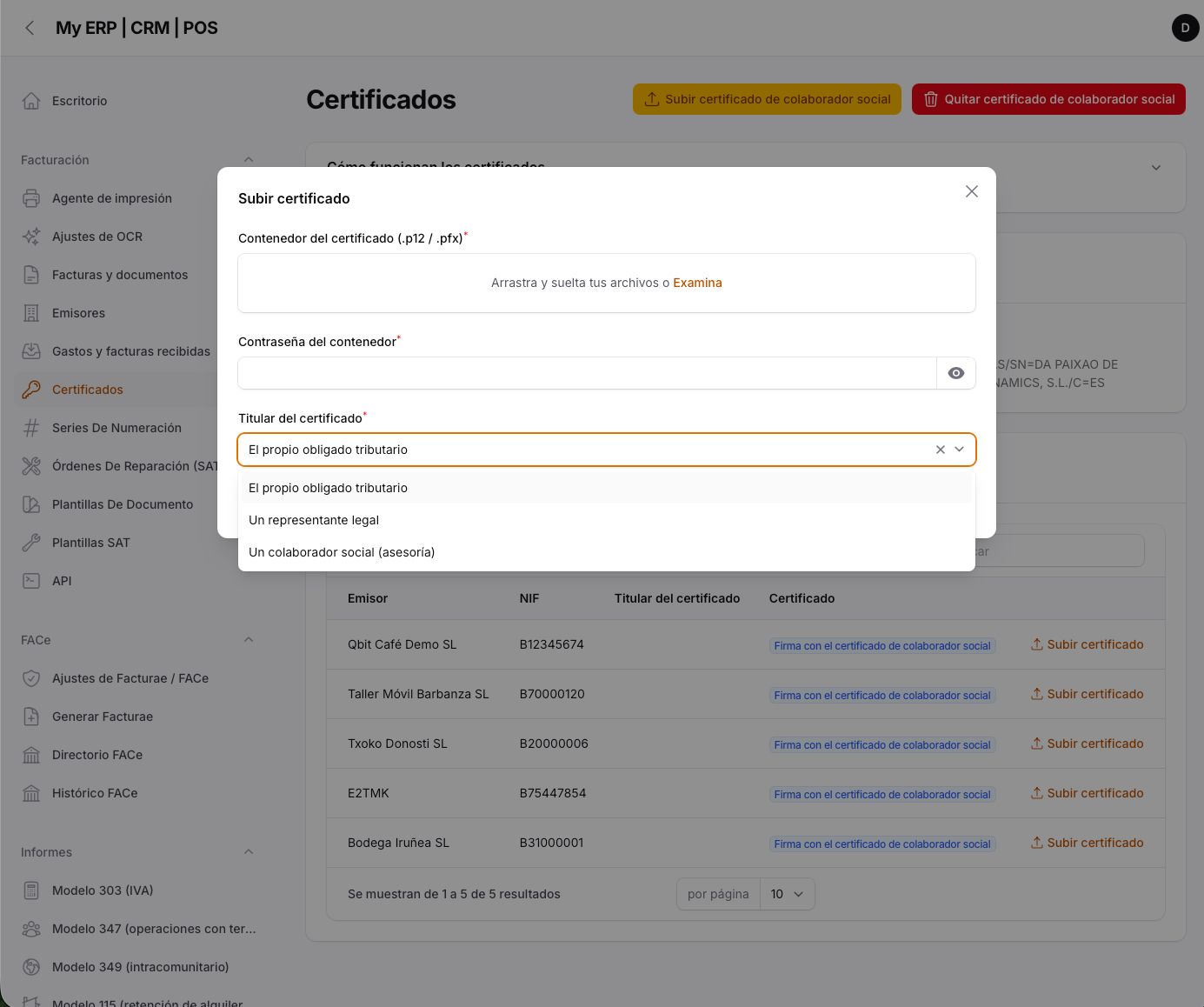
- Signs with XAdES-BES when an AEAT issuer operates in non-Verifactu mode (VERI*FACTU systems are exempt from signing per art. 16.3 — hash only); TicketBAI records are always signed, per its own regulation. Certificates live per issuer, with a global social-collaborator certificate (the advisory-firm scenario: one gestoría certificate signing for every client issuer that has none of its own) as automatic fallback across all four signers.
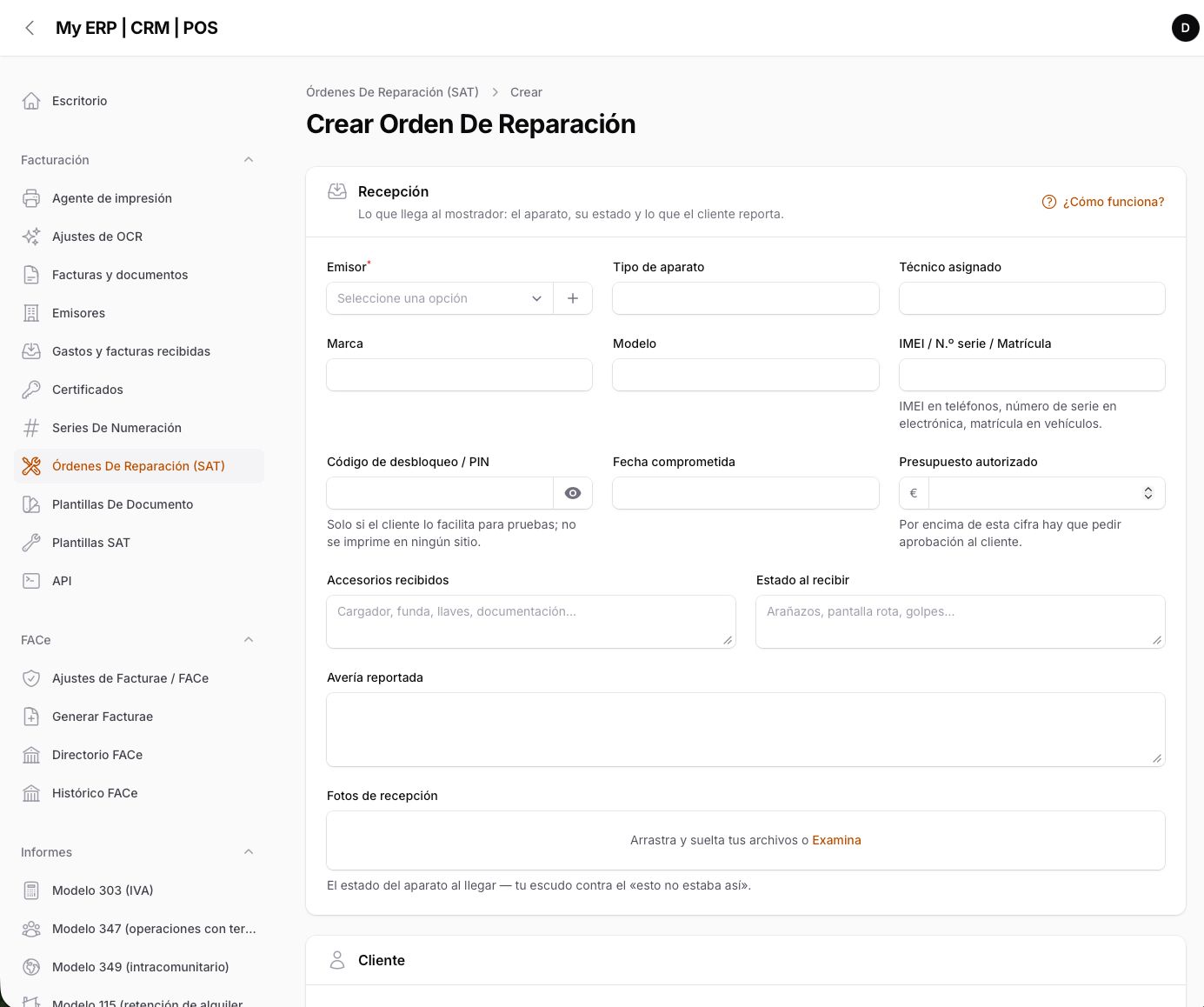
- Runs the whole document lifecycle: quotes → orders → delivery notes → proformas → invoices/tickets, a forward-only conversion graph (including merging several delivery notes into one invoice), credit notes with per-line returns, per-line and general discounts, IRPF withholding, hospitality pre-bills and kitchen routing, and SAT repair orders (with a customer-facing tracking QR) that fiscalize on delivery.
- Prints: A4 sheets and 80/58 mm roll tickets that are the exact
layout designed in the template designer — every template field (logo,
colours, texts, labels, watermark text or image with its geometry, legal
legend, QR) reaches the paper, on screen and on PDF alike — through the
PDF engine you choose (
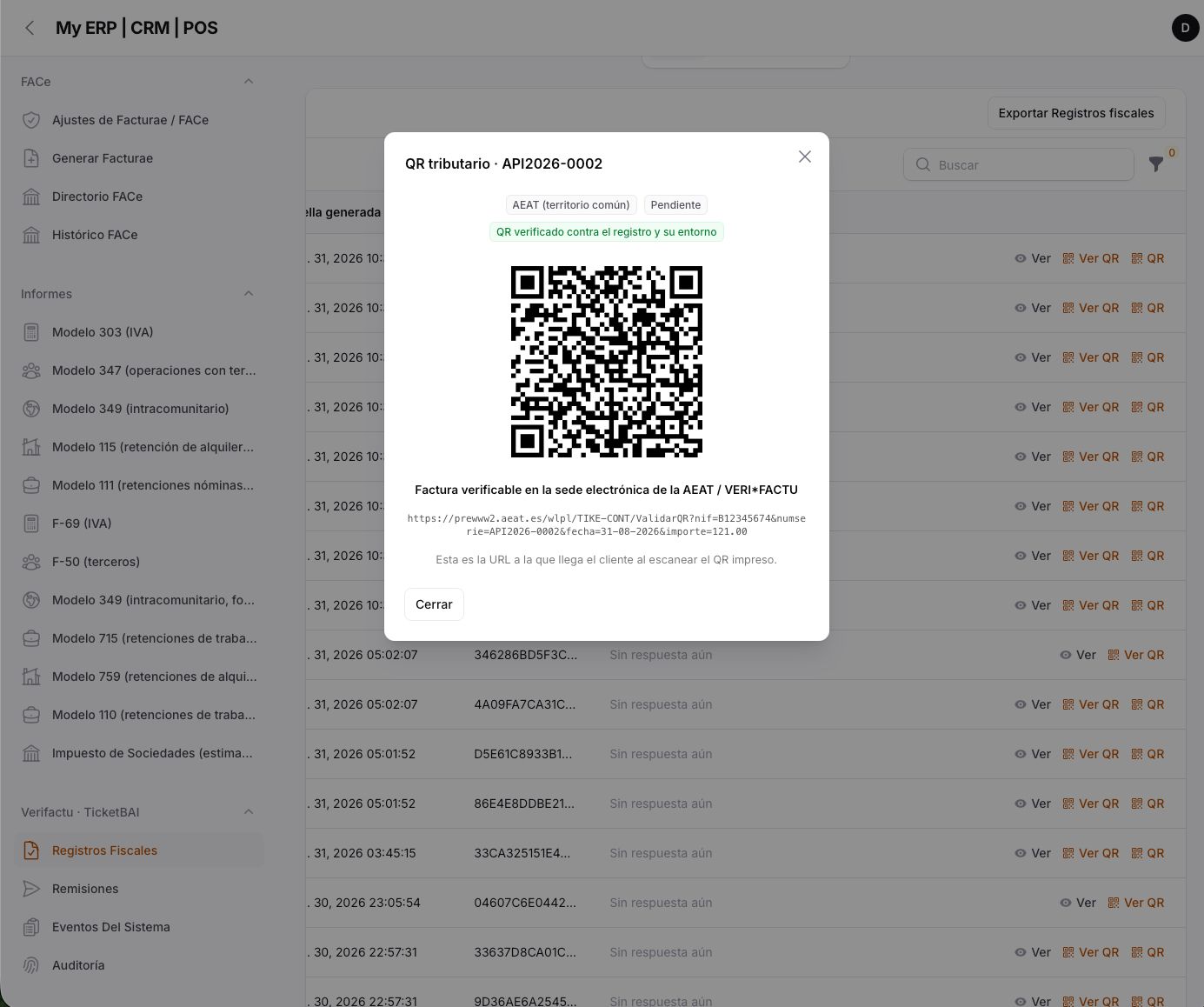
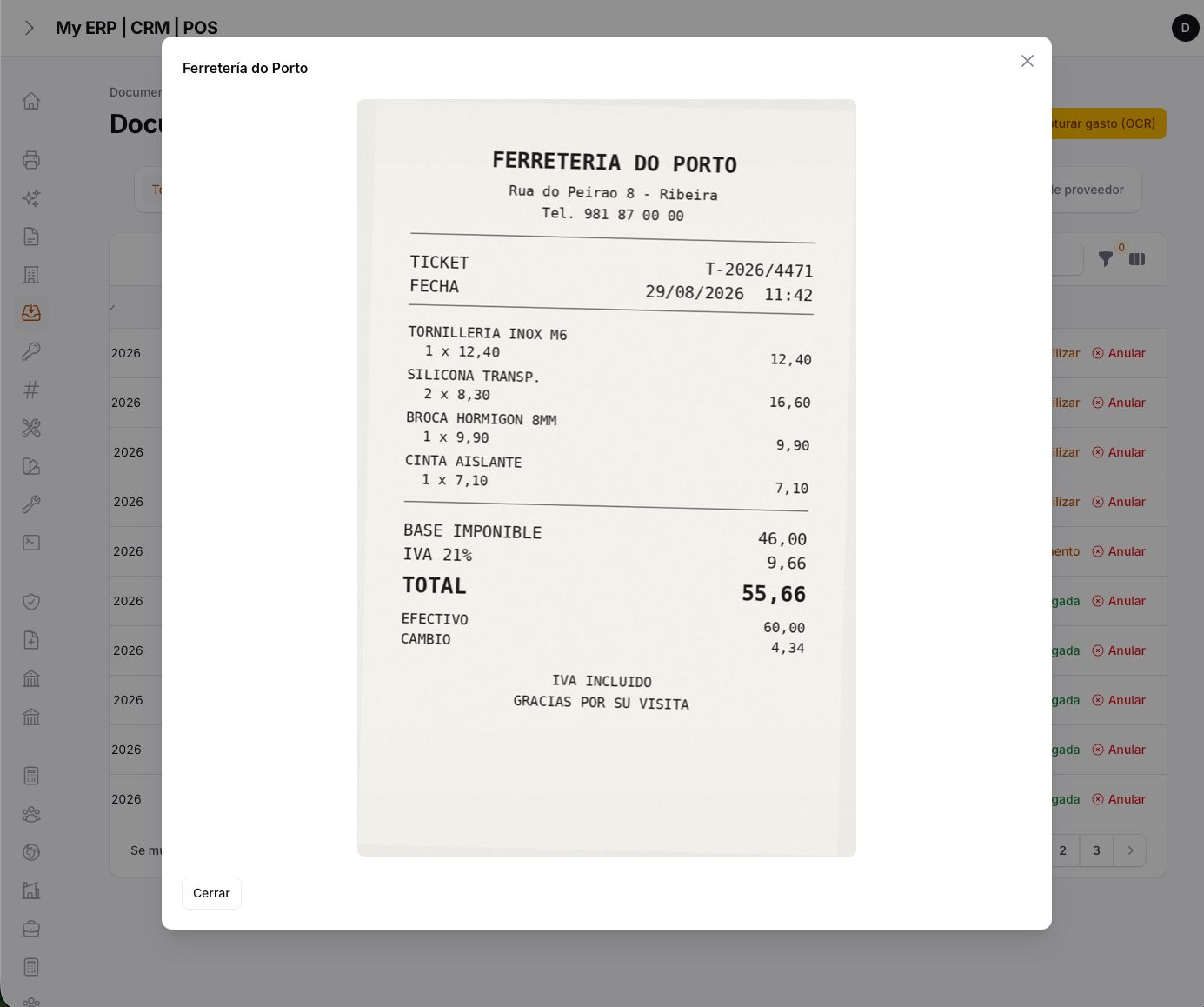
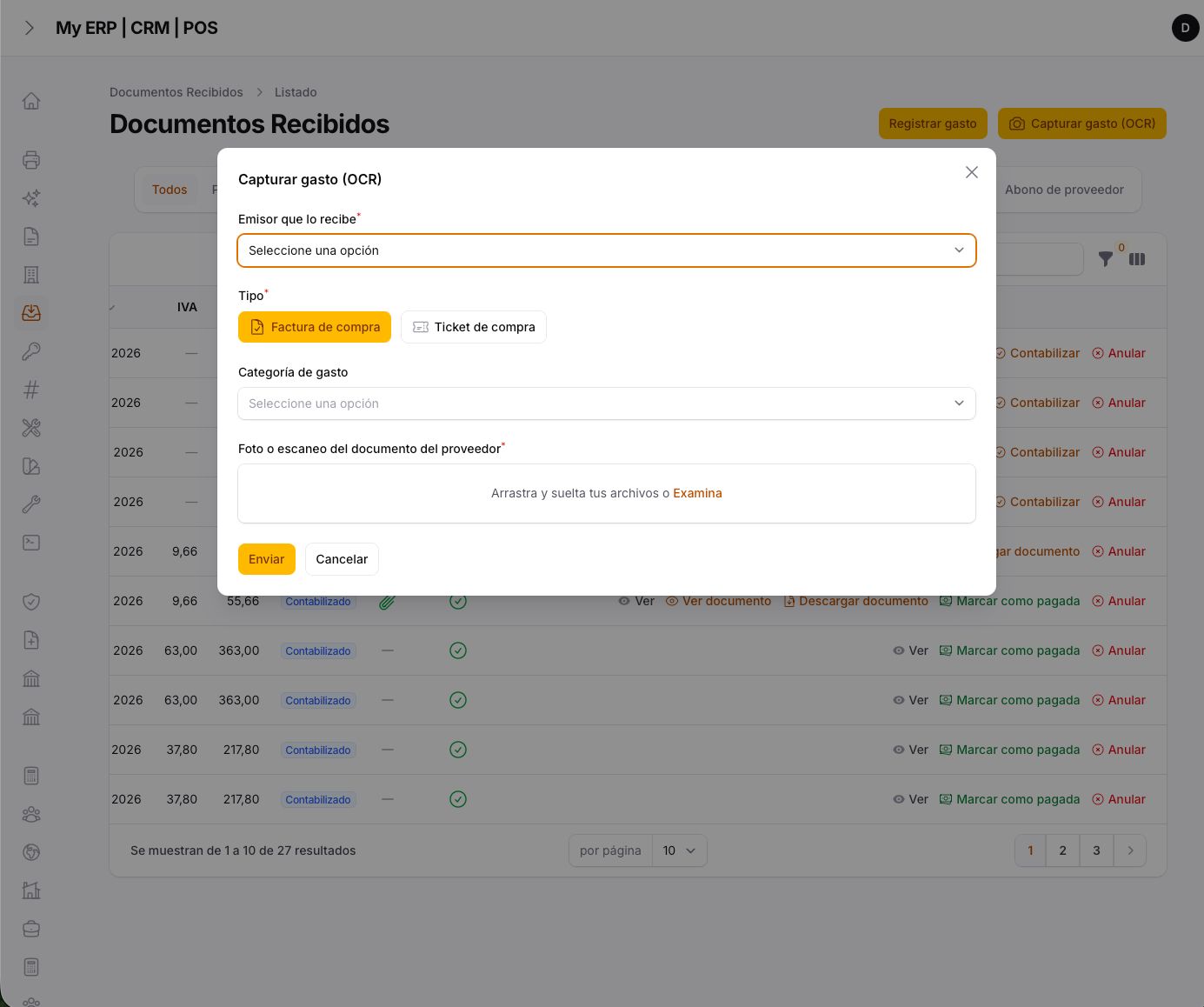
->mpdf(), a bundled pure-PHP engine with nothing to install, or->gotenbergPdf()for hosts with Docker; nothing is assumed), with automatic draft/copy watermarking, an in-panel preview of the printed document, and 14 kinds of ESC/POS thermal ticket — including a paired Print Agent add-on (Windows service installer generated from the panel) for hosts that can't talk to a receipt printer directly from the browser. Each ticket variant carries its own template message — the gift receipt's "no purchase value" line (printed bold, so a price-less print never passes for a sale), the return receipt's note and the gift voucher's terms — with sensible defaults when left blank. The tributary QR can also be inspected on screen, with a live self-check of its URL against the record and the issuer environment (sandbox/production drift is flagged before it ever reaches paper). - Sends to FACe (public-sector electronic invoicing) and FACeB2B (Ley 25/2013's separate, already-active extension to large private subcontractors of public administrations — full lifecycle, both as sender and as receiver: send, cancel, download, reject, mark as paid, resolve cancellations, validate signatures), with the full compliance pack a real town hall validated: three DIR3 centres, Ref. Receptor contract reference, issuer IBAN as transfer account, due date, optional embedded invoice PDF, TSA timestamping, and a pre-flight validator. Facturae can also be generated signed or unsigned for external inspection, an existing paper/PDF invoice can be transcribed by OCR into a standalone Facturae (amounts copied literally, never recomputed), and every Facturae stays inspectable pretty-printed in the panel — the delivered signed XML from the history, or an unsigned build right from the invoice. It also offers OCR-assisted drafting from a photo via Laravel AI — the host picks any provider they already hold a key for, never locked to one.
- Exposes an on-prem API sidecar so external ERPs/POS terminals can register records and fetch a QR synchronously, authenticated per issuer, with signed webhooks on every accepted/rejected submission — and an API panel page listing every endpoint, managing per-issuer bearer keys and showing a truthful first call.
- Ships advisory-firm bulk flows: select a period's documents and download one ZIP of PDFs or one ZIP of signed Facturae, and requeue rejected records in bulk.
- Gates every panel action behind a configurable authorization system (see Authorization) — everything enabled by default, each of the 42 abilities switchable globally or per user.
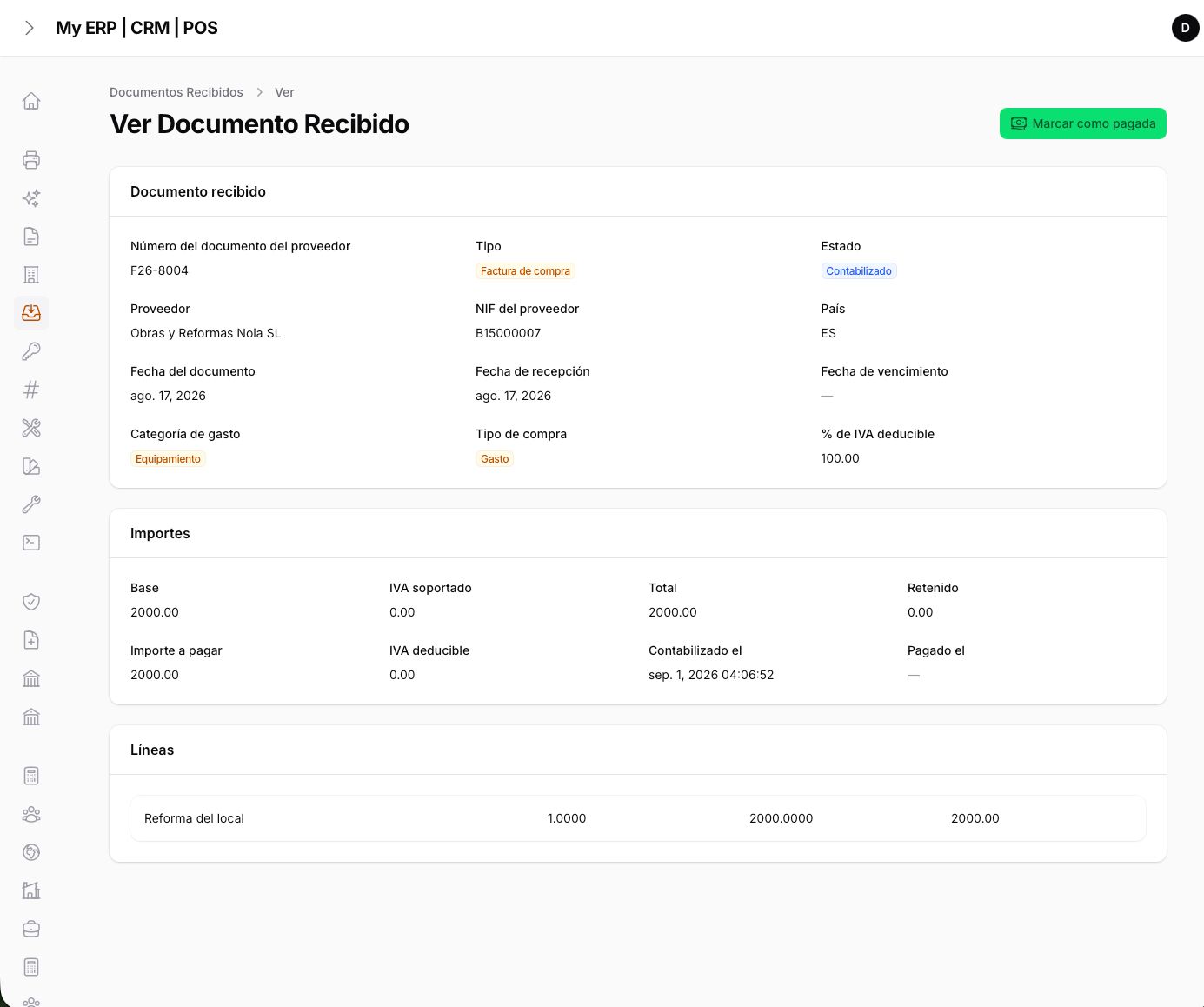
- Keeps the received side of the ledger too (
->expenses()): purchase invoices, purchase tickets and supplier credit notes, drafted by hand or captured with the same OCR, with the deductible VAT share, the expense category and the IRPF withheld. Booking freezes a purchase exactly as completing freezes a sale — and from that moment the tax drafts read it. - Submits both LROE chapters in Bizkaia: TicketBAI sends what the business issues, and the expenses book (Modelo 140 for a self-employed issuer, 240 for a company) sends what it receives — which is what makes the Batuz obligation complete, and why a Bizkaia issuer files no 347.
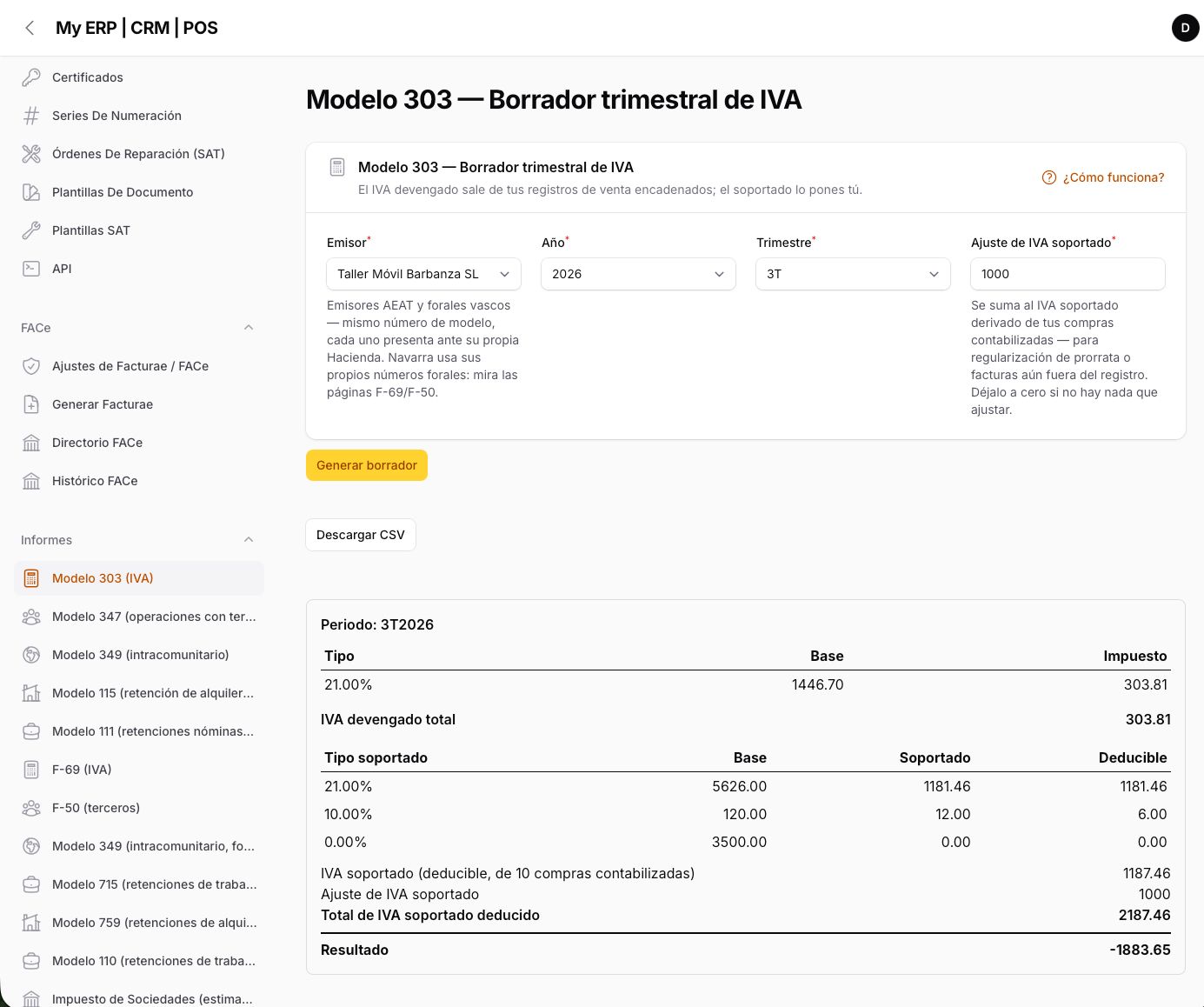
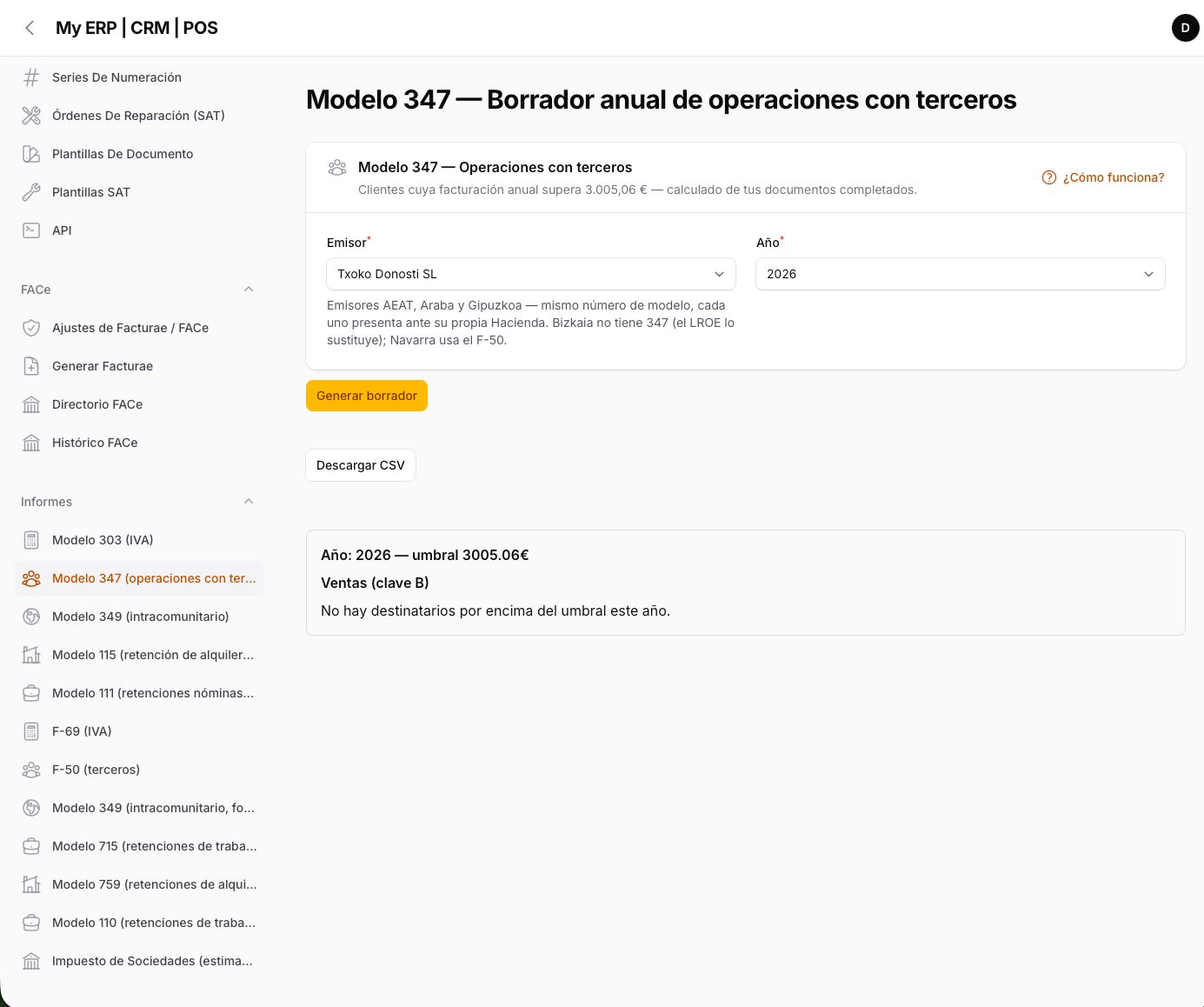
- Drafts Modelos 303, 347, 349 (real E/S classification from each record's own data), 111 and 115 for the accountant, each exportable as CSV — with input VAT, the purchase side of the 347, intra-EU acquisitions and the withholding payees all derived from those booked purchases instead of typed in.
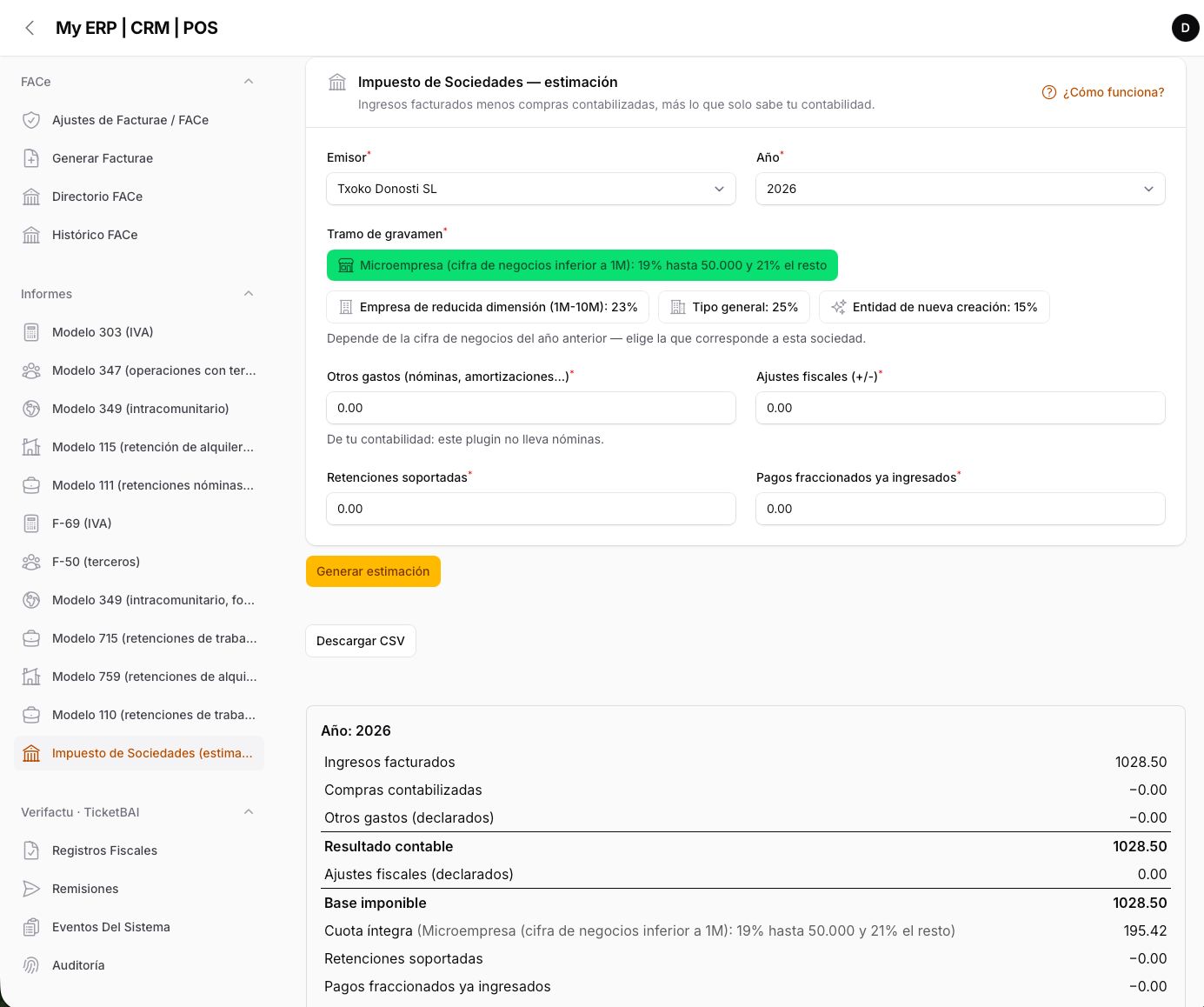
- Estimates the corporate income tax and its instalment from invoiced income less booked purchases, on the 2026 rate scale, with payroll, depreciation and fiscal adjustments declared — a provisioning tool, not a filing.
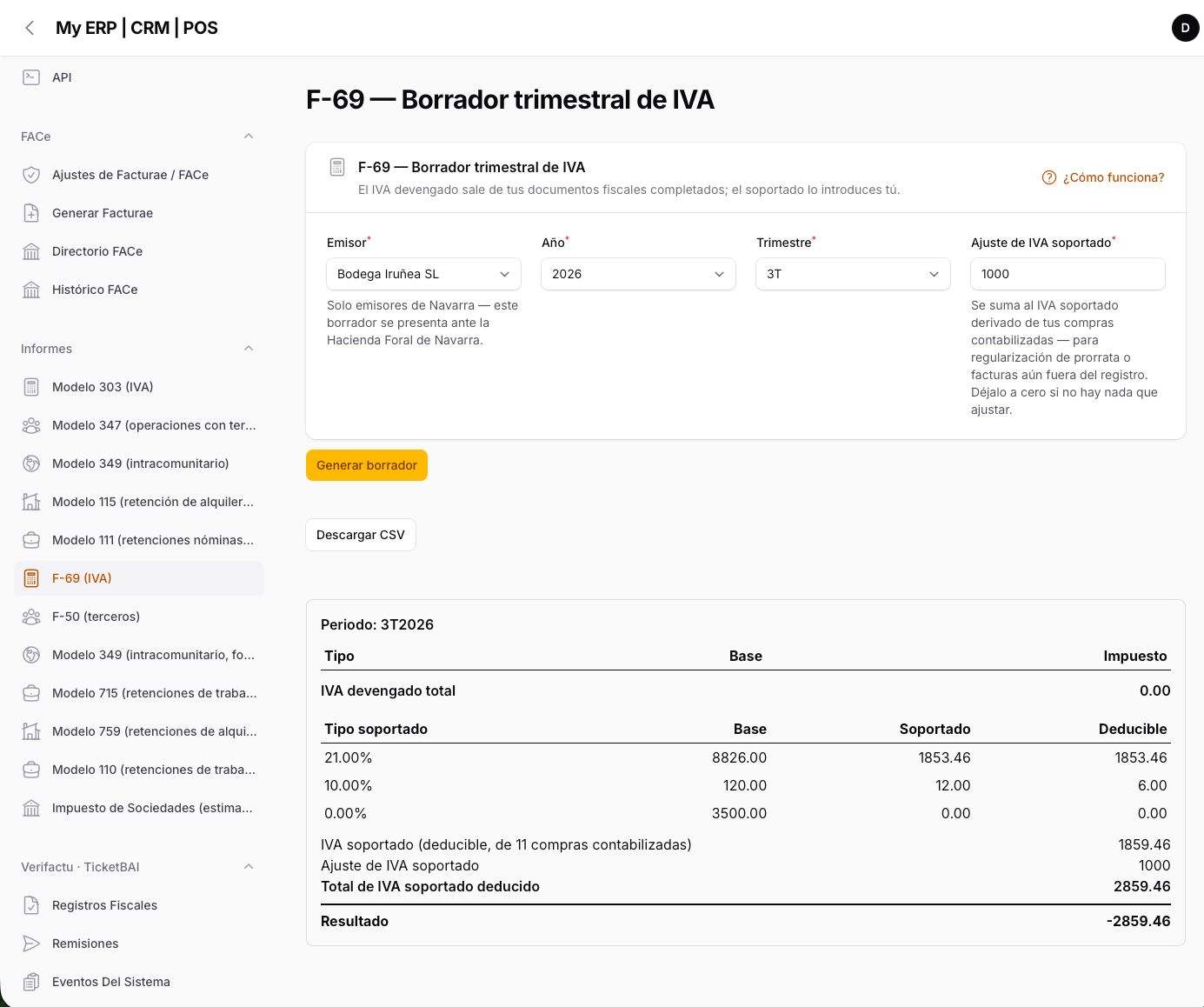
- Serves every treasury under its own numbers. The Basque treasuries keep the state numbering, so a TicketBAI issuer's 303/347/349 drafts read its own chained foral records — with the quarterly 110 as their general payroll model (their 111 is the monthly large-company one) and no 347 in Bizkaia, where the LROE replaces it and both of its chapters ship. Navarra issuers get the same drafts under the foral numbers — F-69, F-50, the foral 349, 715 and 759 — read from the completed fiscal documents.
- Keeps a fiscal calendar. Every issuer's obligations — its treasury's quarterly and annual models since its activation — with deadlines, overdue count in the menu, "Fill in" opening the exact draft, the treasury's portal one click away, and filed / omitted with the receipt reference.
- Knows who is under the SII. An AEAT issuer registered in the Suministro Inmediato de Información is sealed as outside the RRSIF (art. 3.2 RD 1007/2023): numbered invoices, no chain, no tributary QR, drafts read from the completed documents.
- Tracks collection and payment. Every completed sale is collected, pending or overdue against its due date, with the payment method; the documents list opens on Collected / Pending / Overdue; purchases carry their due date and how they were paid. Bookkeeping, never fiscal content: it stays editable after completion.
- Speaks the accountant's language. A chart of accounts seeded from the PGC Pymes, an income account on every sale and an expense account on every purchase (proposed from the category, remembered per NIF), and a yearly accounting export the gestoría imports instead of retyping.
- Sums the year on the dashboard: income, booked purchases, result, VAT to settle and IRPF to settle, from the same sources the drafts use.
Every surface beyond the core fiscal resources ships disabled by default — a host that registers only the plugin object gets the fiscal chain and nothing else; every other module is a fluent opt-in.
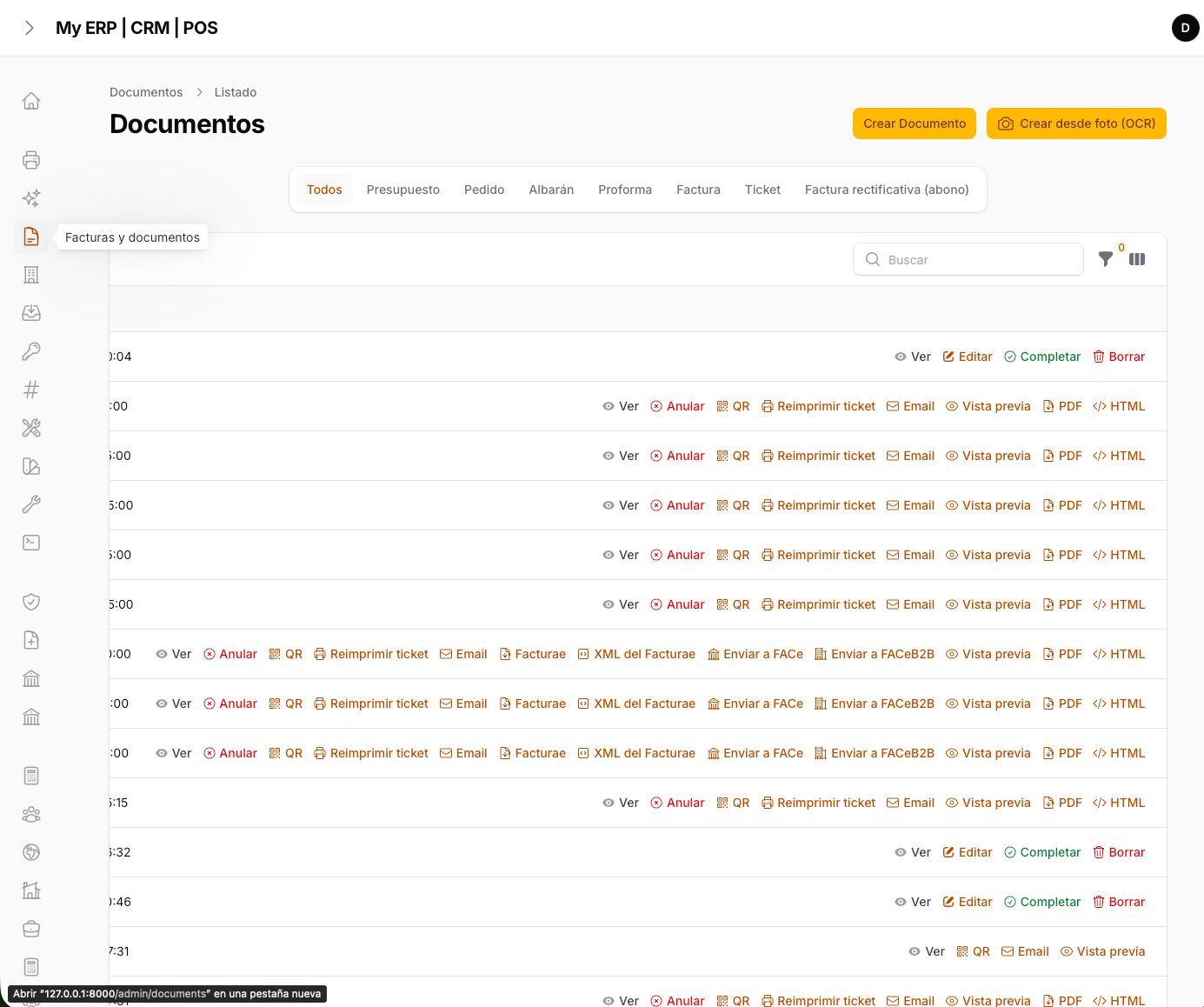
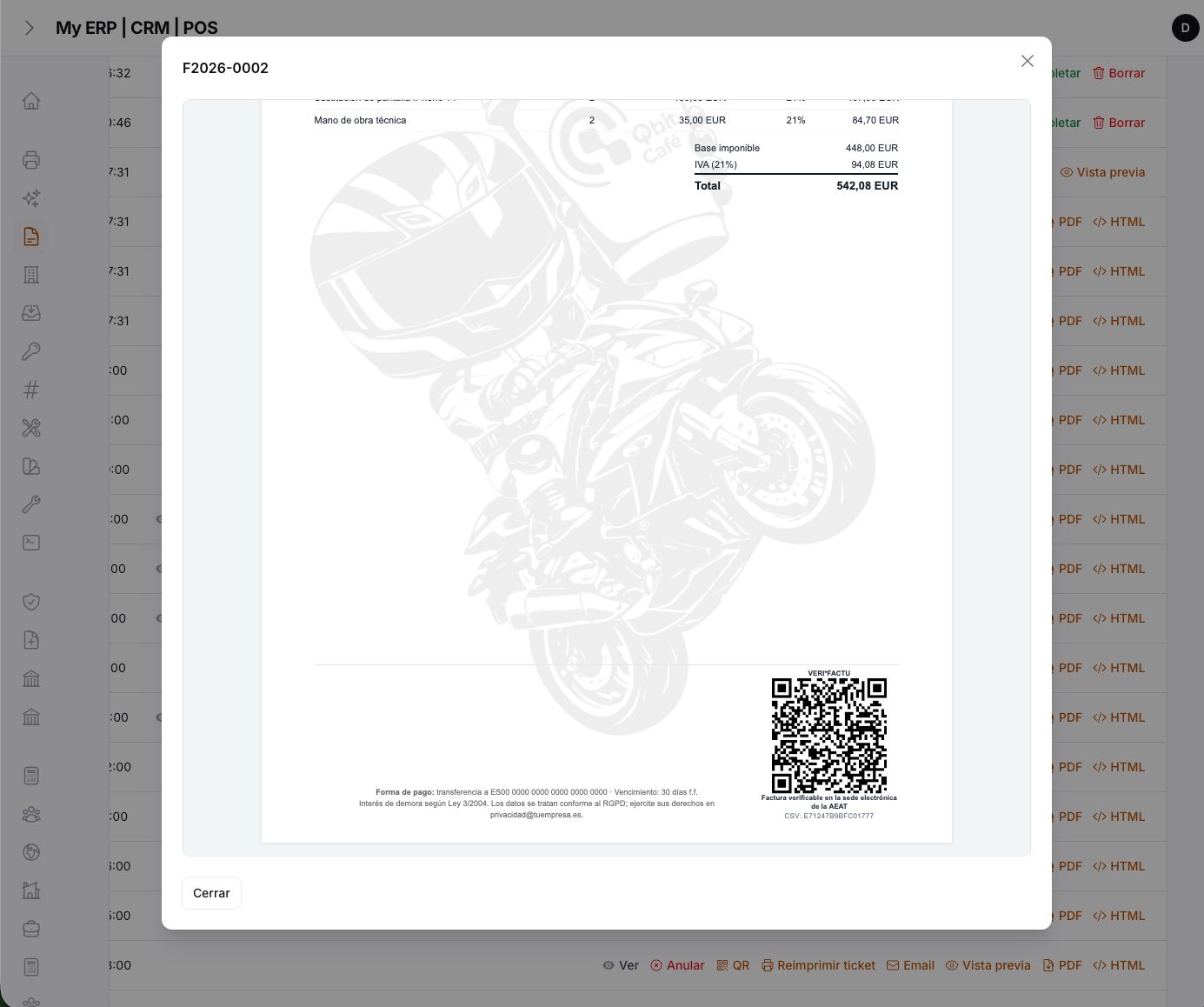
#Screenshots
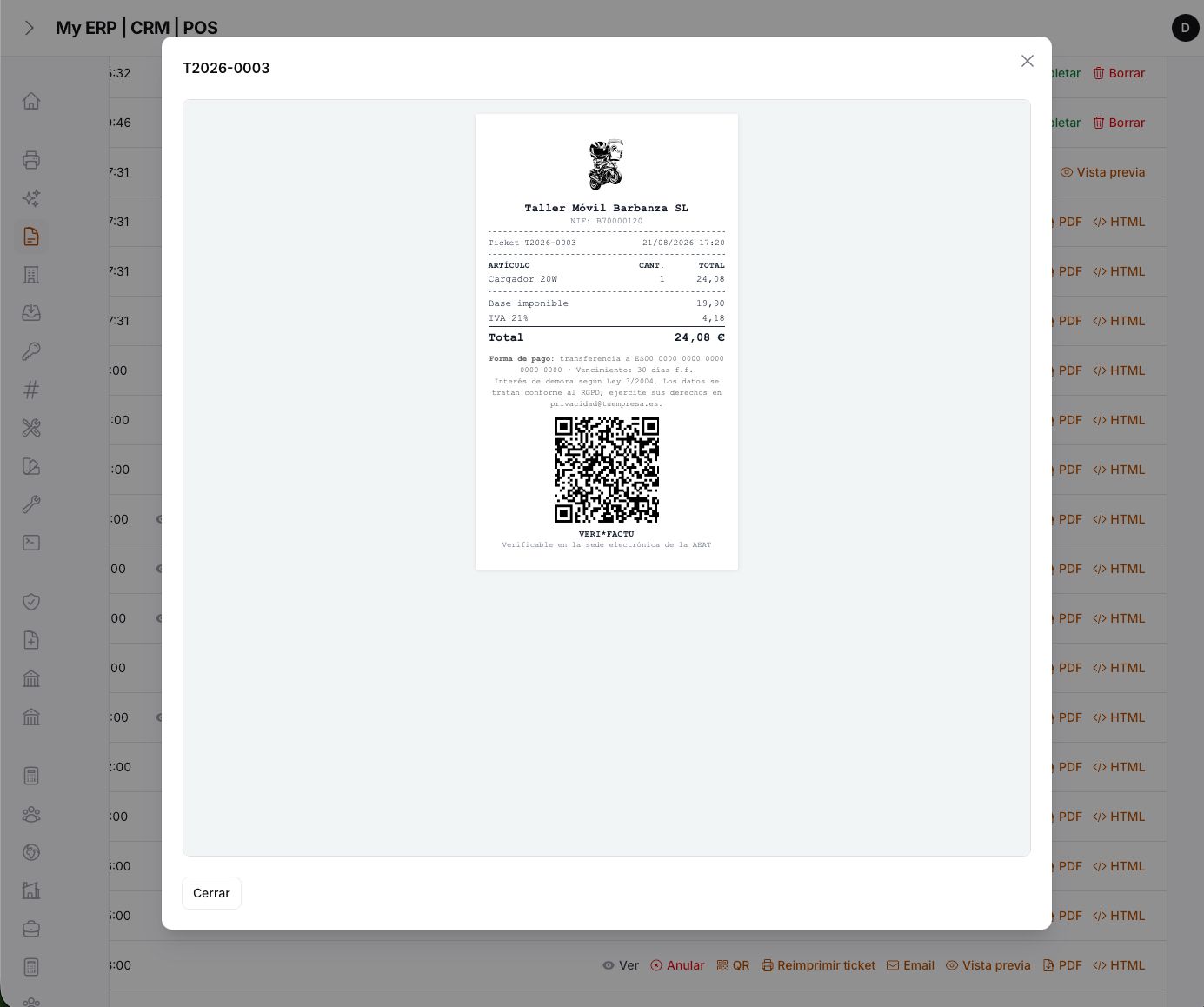
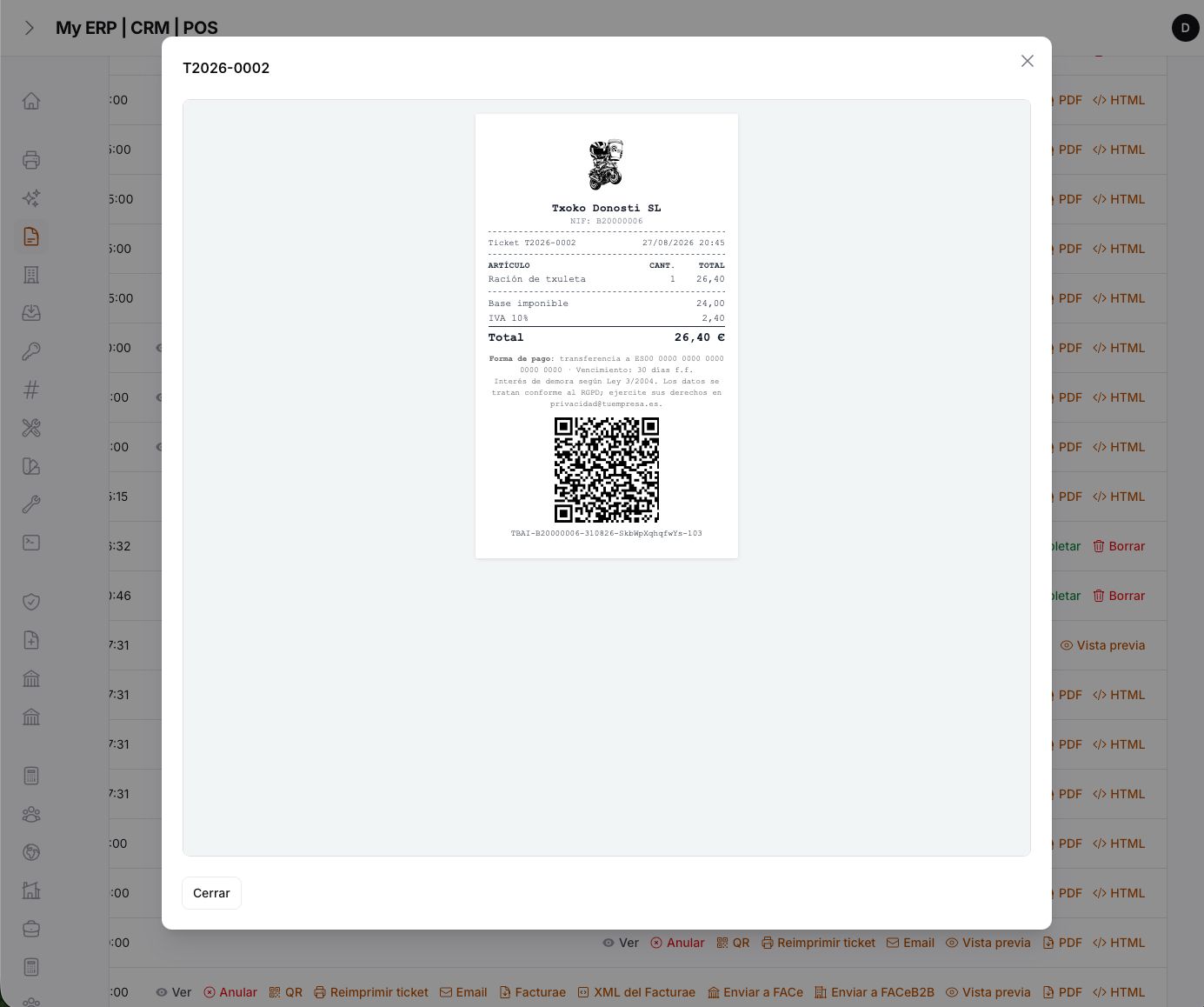
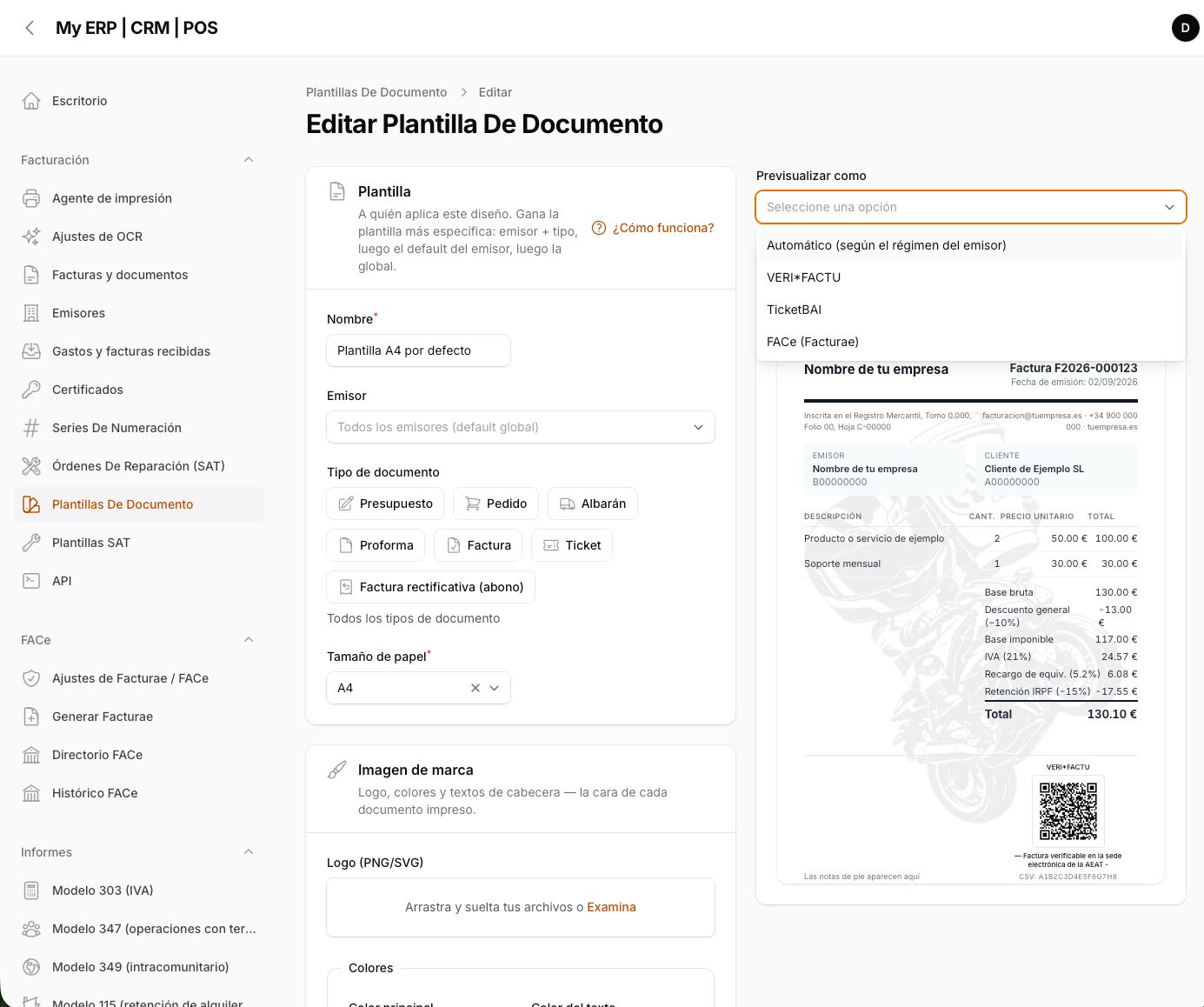
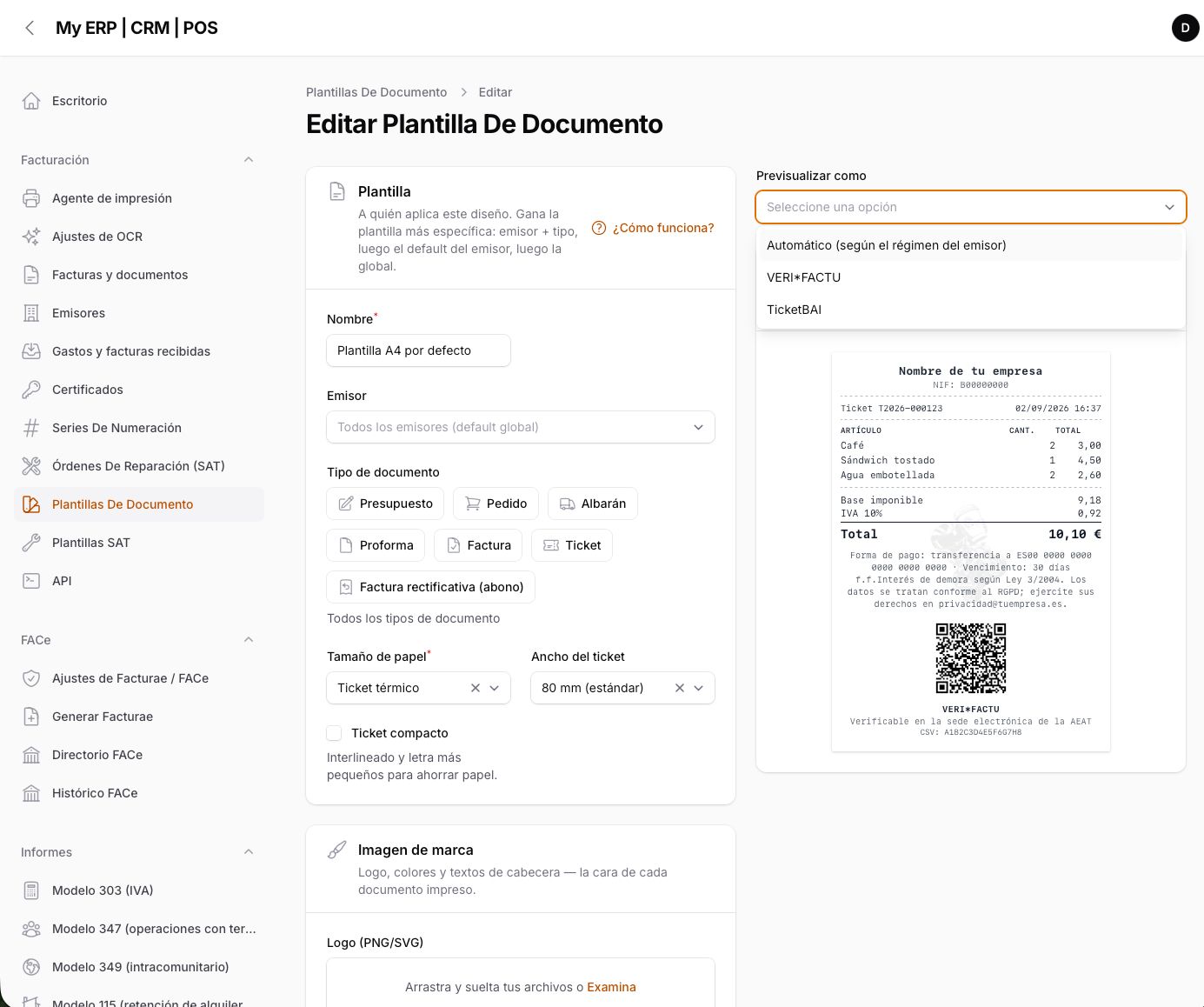
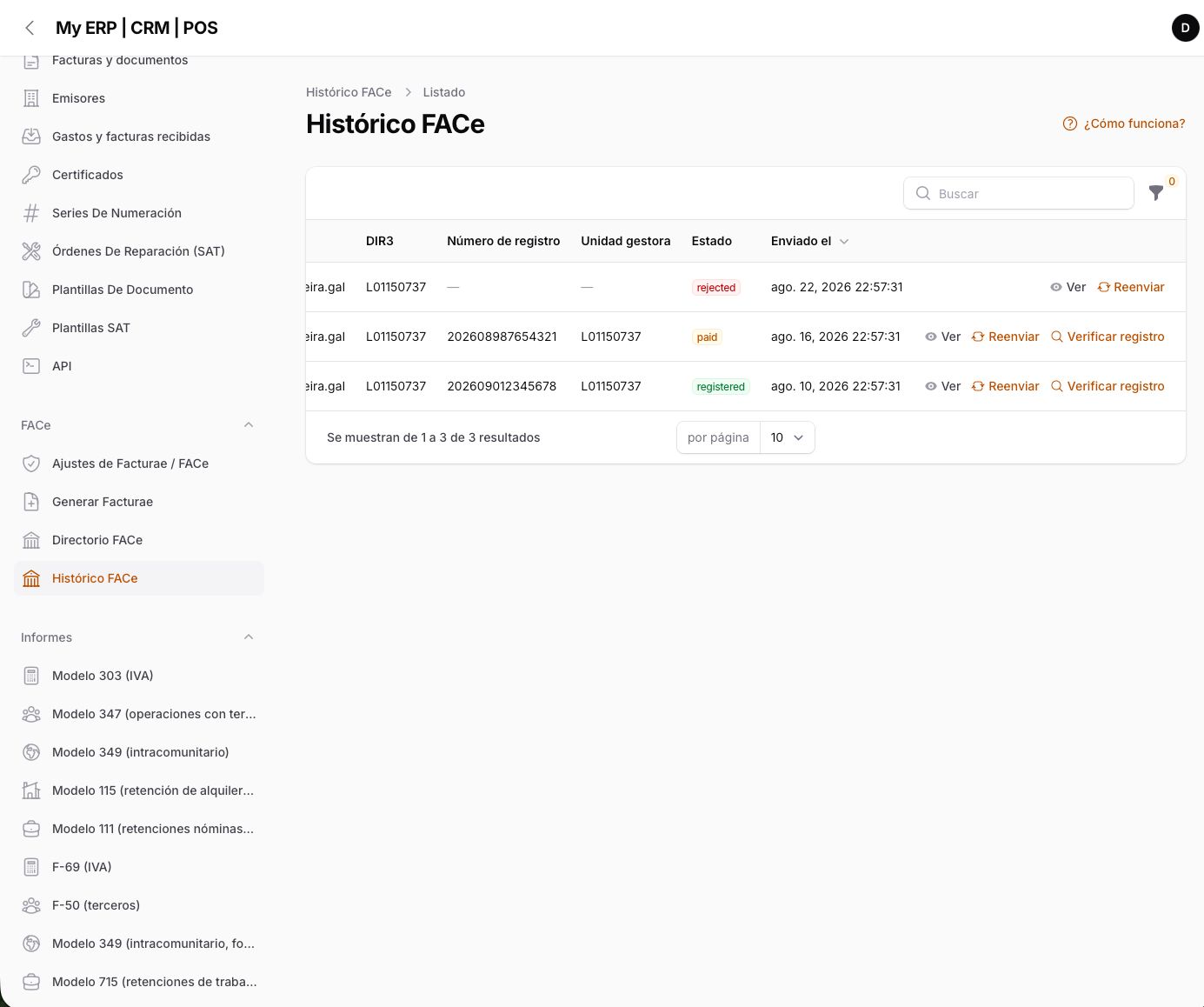
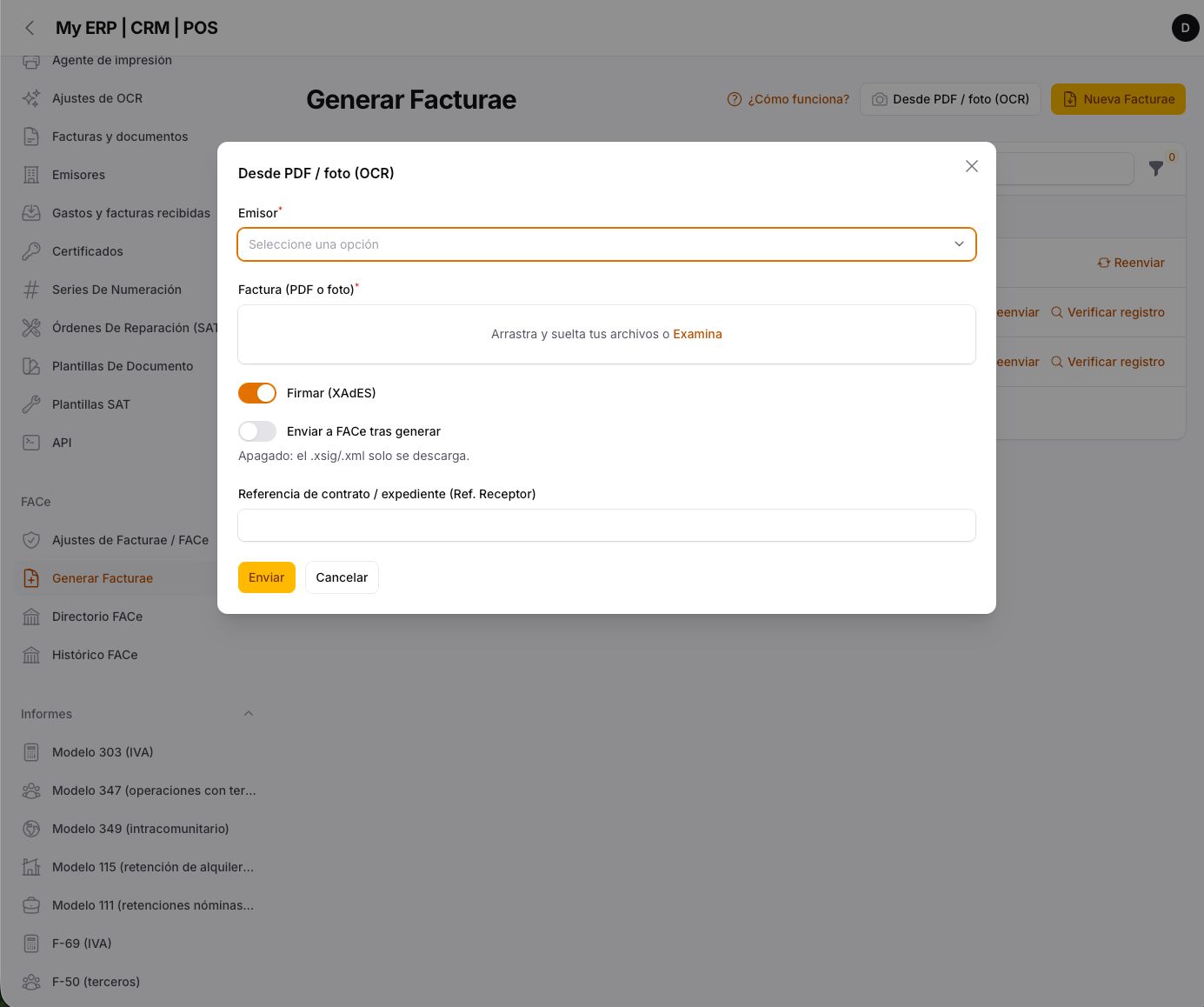
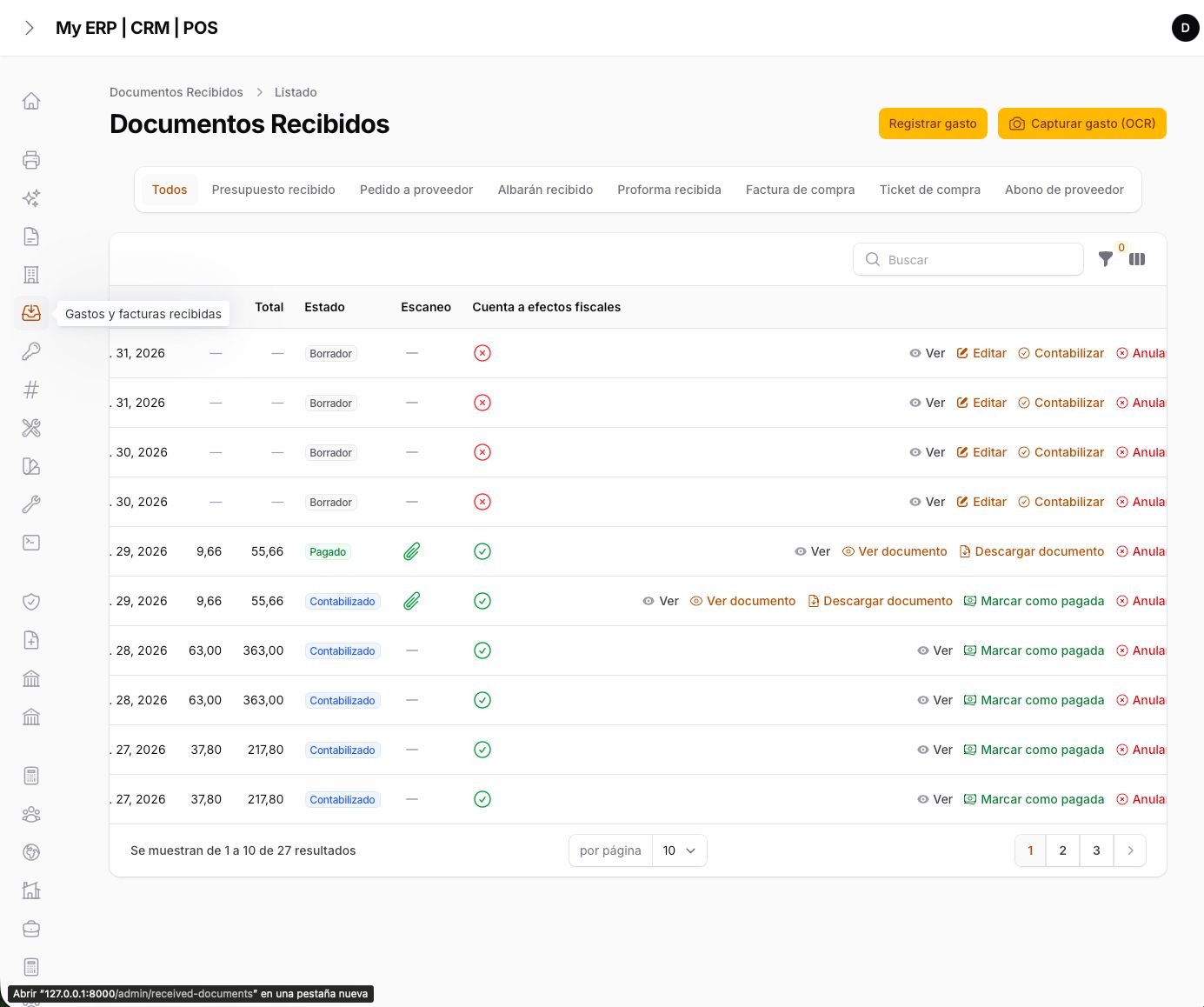
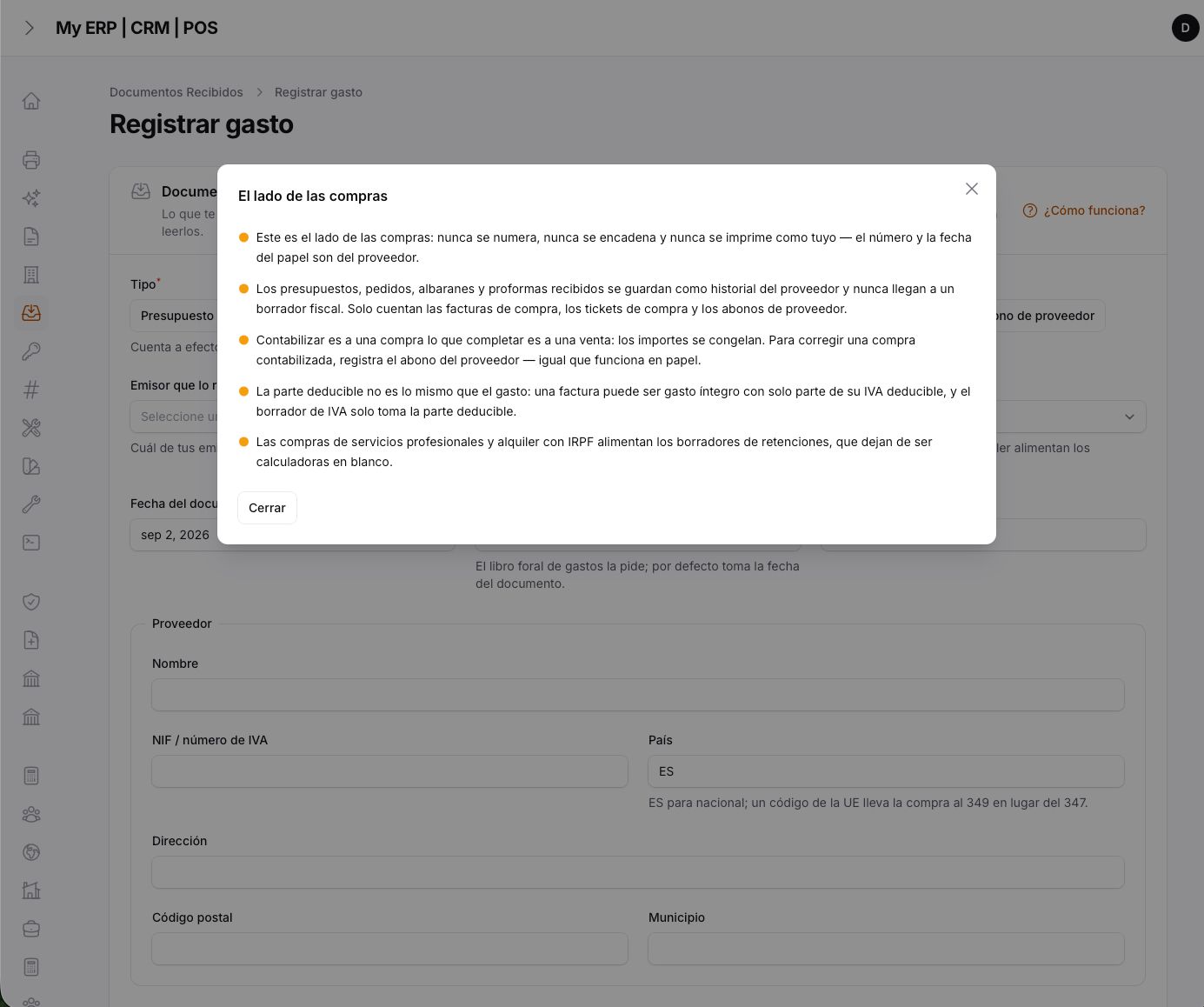
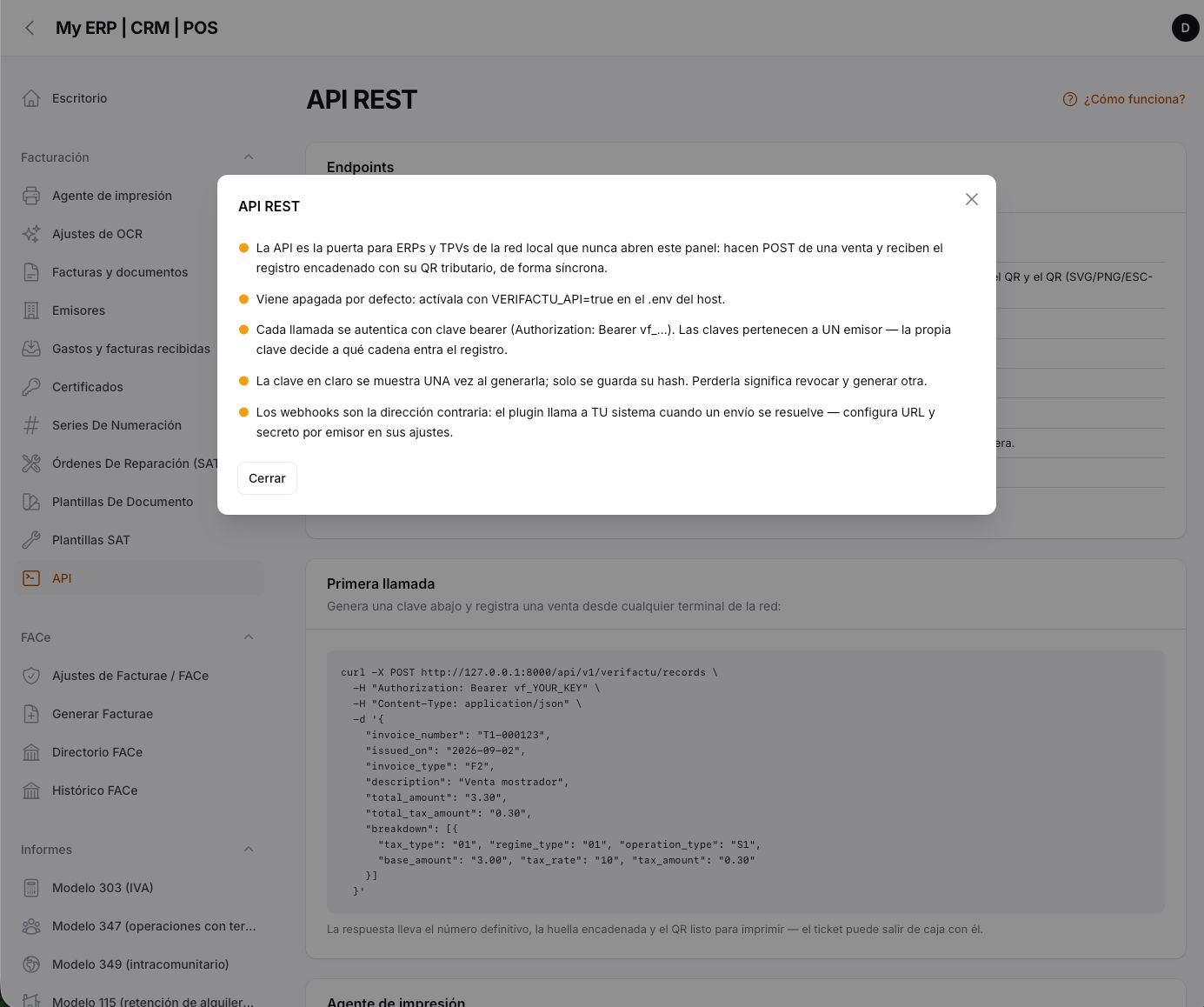
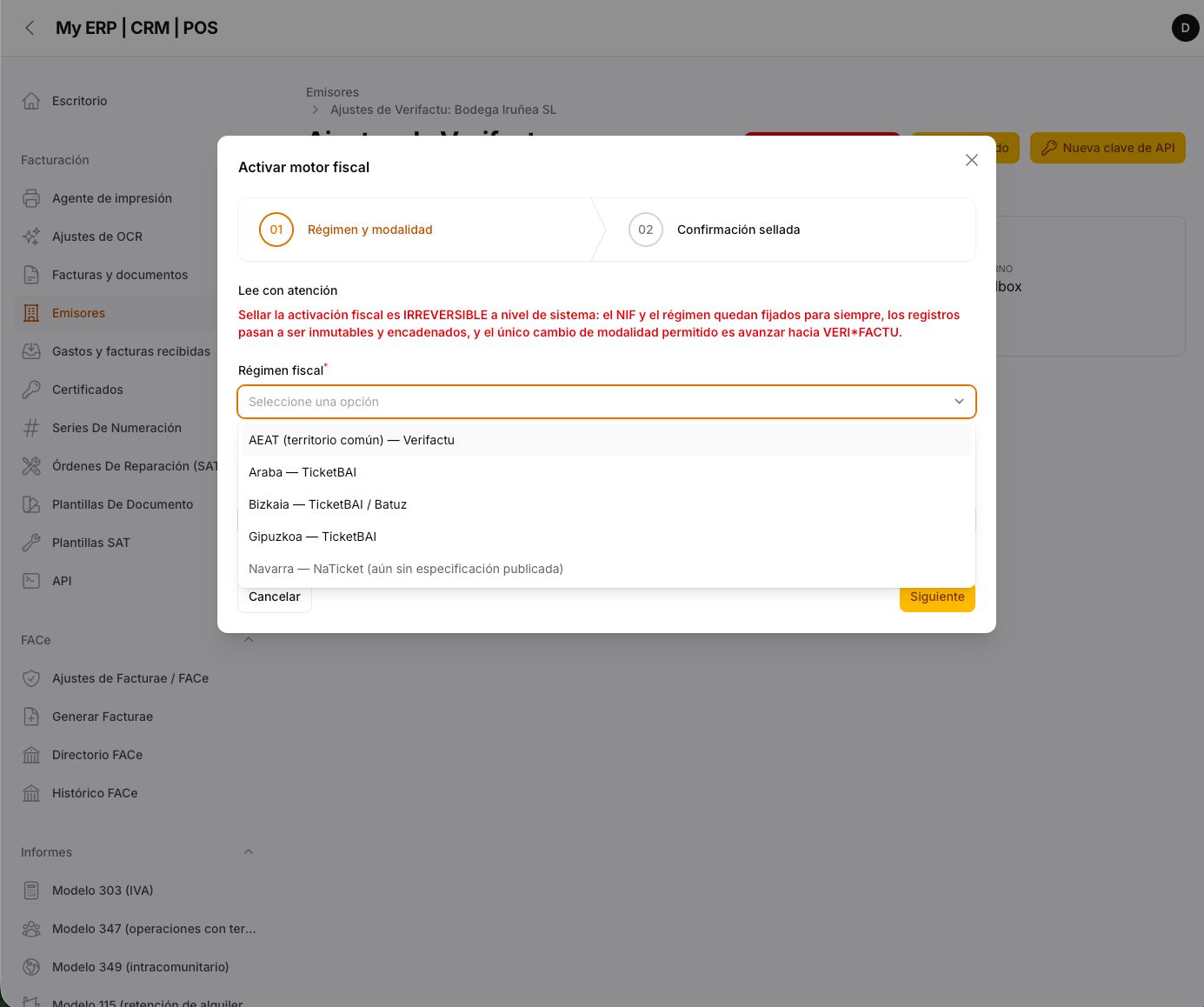
#Requirements
- PHP >= 8.4
- Laravel >= 13.0
- Filament >= 5.0
#Installation
This is a commercial package distributed through Anystack — it is not on public Packagist. Your license key is what authenticates the download.
1. Add the private repository to your project's composer.json:
{
    "repositories": [
        {
            "type": "composer",
            "url": "https://filament-verifactu.composer.sh"
        }
    ]
}
2. Require the package:
composer require komma-softhouse/filament-verifactu
Composer will prompt for authentication against
filament-verifactu.composer.sh:
- Username: the email address your license is registered to.
- Password: your license key. If your license policy requires a
fingerprint, append it to the key separated by a colon —
your-license-key:your-domain.com— using the fingerprint you entered when activating the license.
Answer yes when Composer offers to store the credentials (they go in
auth.json — add that file to .gitignore). For CI, configure the same
credentials as http-basic auth from your secrets instead:
composer config http-basic.filament-verifactu.composer.sh your@email.com YOUR-LICENSE-KEY
3. Install:
php artisan filament-verifactu:install
It publishes the config and offers to run the migrations (php artisan migrate by hand works exactly the same).
Register the plugin on your panel provider:
use Komma\Verifactu\VerifactuPlugin;

public function panel(Panel $panel): Panel
{
    return $panel
        ->plugin(
            VerifactuPlugin::make()
                // Who you are, as the implementer. Travels in every record,
                // AEAT and foral alike.
                ->computerSystem(
                    vendorName: 'Your Company SL',
                    vendorNif: 'B00000000',
                    name: 'Your ERP',
                    version: '1.0',
                )
                // TicketBAI identity and the software-guarantor licences
                // per territory: the vendor's, never the customer's.
                ->ticketBai(developerNif: 'B00000000', licenses: ['gipuzkoa' => 'TBAIGIP…'])

                // Surfaces. Every one ships off; enable what you sell.
                ->documents()          // quotes → invoices, series, templates
                ->repairs()            // SAT repair orders
                ->expenses()           // the received side: supplier invoices and expenses
                ->escPos()             // thermal ticket printing
                ->printAgent()         // cloud → till printing through the Windows agent
                ->face()               // FACe (public administrations)
                ->faceb2b()            // FACeB2B (large private subcontractors)
                ->ocr()                // draft a document or an expense from a photo
                ->api()                // the API page and the sidecar routes
                ->dashboardWidgets()

                // PDF engine: pick one, or PDF actions stay hidden.
                ->mpdf()               // bundled, pure PHP
                // ->gotenbergPdf('http://gotenberg:8')
                // ->pdfDriver(YourConverter::class)

                // Where template logos and watermark images live.
                ->brandingDisk('public'),

                // ->einvoicing() lands once the Orden Ministerial is published.
        );
}
Everything in that snippet can also be set through .env or the published
config — the fluent calls simply win when present, so a host never has to
publish the config to get going.
Publish and fill in the config:
php artisan vendor:publish --tag="filament-verifactu-config"
At minimum, set the ComputerSystem (implementer identity) variables before
the first submission — see Configuration.
#Configuration
| Toggle | What it enables |
|---|---|
->documents() |
Document, series-format and template resources, the document lifecycle |
->repairs() |
SAT repair order resource |
->catalog() |
A minimal product & service catalogue that prefills document lines — for hosts that have none. Global items or per issuer |
->reports(false) |
Turn off the fiscal reports (303/347/349/111/115, foral models, corporate tax, aging) and the filing calendar; on by default |
->events(false) |
Turn off the event log and audit trail resources; on by default |
->developer() |
The developer preset: ->api()->reports(false)->events(false) — issuers, records, submissions, certificates and the API, nothing else |
->expenses() |
The received side: supplier invoices, tickets and credit notes, OCR capture, attachment preview, and Bizkaia's LROE expenses book. Turns the tax drafts' input side on |
->mpdf() |
PDFs through the bundled pure-PHP engine — nothing to install, no Docker |
->gotenbergPdf($url) |
PDFs through a Gotenberg instance (Docker, best fidelity, same layout) |
->pdfDriver(Class::class) |
Your own Printing\Contracts\PdfConverter implementation |
->brandingDisk($disk, $visibility = null) |
The filesystem disk template logos and watermark images are stored on and read from (public unless told otherwise — any disk of your config/filesystems.php: local, s3, minio…) |
->computerSystem(...) |
The implementer identity for AEAT records (vendor name/NIF, product name/id/version, installation number) |
->ticketBai(...) |
The implementer identity for TicketBAI (developer NIF, product) and the software-guarantor licences per territory — the vendor's, never the customer's |
->escPos() |
Thermal ticket printing |
->printAgent() |
Print agent pairing page and installer generation |
->einvoicing() |
Pending BOE publication of the Orden Ministerial (Ley Crea y Crece / RD 238/2026) |
->face() |
FACe: the "Send to FACe" action, history, settings, generate and directory pages |
->faceb2b() |
FACeB2B: the "Send to FACeB2B" action and cancellation requests |
->ocr() |
The "Create from photo" OCR-assisted draft action and its settings page |
->api() |
The API panel page and the sidecar routes (VERIFACTU_API for hosts with no panel) |
->dashboardWidgets() |
Dashboard widgets: fiscal stats overview + 30-day records chart |
The core fiscal resources (Issuers, Fiscal records, Submissions, System
events, Audit trail), the Certificates page and the report pages are
always registered — and each page hides from navigation when the install
has no issuer it serves, so nobody ever reads another treasury's model
numbers. The shared-numbering pages (303, 347, 349, 115) serve AEAT and
Basque issuers alike, each filing with its own Hacienda; the state 111
is AEAT-only and the Basque quarterly 110 is its own page; the 347 hides
for Bizkaia-only installs (the LROE replaces it); and the Navarra foral
set (F-69, F-50, foral 349, 715, 759) shows only with Navarrese
issuers. PDF generation is an opt-in like every other surface:
without ->mpdf(), ->gotenbergPdf() or VERIFACTU_PDF_DRIVER, the
PDF, email and ZIP actions stay hidden.
With ->dashboardWidgets() (or VERIFACTU_WIDGETS=true) the panel
dashboard gains widgets — modular like the plugin itself, so every ACTIVE
module contributes its own: the fiscal pulse always (records today,
accepted this month with a 7-day sparkline, rejections and
awaiting-submission linking straight to the records list, plus a 30-day
line chart by outcome); with ->documents(), the billing pulse (euros
billed today bcmath-summed with credit notes subtracting themselves,
documents completed, credit notes this month, open drafts); with
->face(), the public-sector view (registered this month, marked as paid
by the administration, rejections to resend); and with ->repairs(), the
workshop counter (in progress, ready for pickup, delivered this month).
Everything aggregates across every issuer and auto-refreshes.
The API sidecar (the /api/v1/verifactu/... routes) is on when any
panel registers the plugin with ->api(), or — for installations with no
panel at all, such as a LAN box that only serves POS terminals — with
VERIFACTU_API=true.
Keys and multi-issuer integrations. An issuer key (vf_…) is bound to
one issuer. An account key (vfk_test_… / vfk_live_…) may operate
several — limited to a list of issuers and to one environment — and the
caller names the issuer of each call with X-Issuer: <NIF or id>. Account
keys can list and create issuers (/issuers), register account webhooks
(/webhooks, named events such as record.accepted or document.completed,
HMAC-signed, retried with backoff by verifactu:webhooks:retry), validate a
NIF (/nif/validate: format, VIES, AEAT census when a certificate is at
hand) and file the representation document of an issuer
(/issuer/representation). Send Idempotency-Key on every POST: a retry
returns the original response with Idempotency-Replay: true. Every call is
logged with its X-Request-Id, status, latency and bounded bodies (never the
bearer token); verifactu:api:purge-logs keeps the log bounded. The OpenAPI
3.1 contract of everything registered is served at
/api/v1/verifactu/openapi.json.
See the published config/filament-verifactu.php for every environment
variable. The full list:
# ComputerSystem identification (RRSIF art. 8.1/13 — the implementer's
# responsible declaration; required before the first submission).
# Use YOUR OWN company's data here — you are the implementer.
VERIFACTU_VENDOR_NAME="Your Company SL"
VERIFACTU_VENDOR_NIF=B00000000
VERIFACTU_SYSTEM_NAME="Komma Fiscal"
VERIFACTU_SYSTEM_ID=01
VERIFACTU_SYSTEM_VERSION=1.0
VERIFACTU_INSTALLATION_NUMBER=1

# TicketBAI implementer identity (Araba/Bizkaia/Gipuzkoa only) — the foral
# equivalent of the ComputerSystem block above, plus the software-guarantor
# licences. The licences are issued BY EACH FORAL TREASURY TO THE SOFTWARE
# VENDOR when it registers as "software garante" — they are yours, not the
# customer's: an issuer is activated without typing any of them. (An
# issuer-level Issuer::tbai_license, when set, overrides the territory one
# — for a host that registered as garante itself.)
VERIFACTU_TBAI_DEVELOPER_NIF=
VERIFACTU_TBAI_SYSTEM_NAME="Komma Verifactu"
VERIFACTU_TBAI_SYSTEM_VERSION=1.0
VERIFACTU_TBAI_LICENSE_ARABA=
VERIFACTU_TBAI_LICENSE_BIZKAIA=
VERIFACTU_TBAI_LICENSE_GIPUZKOA=

# Template branding storage (logos, watermark images). One disk for uploads
# and for rendering; any disk of your config/filesystems.php. Filament v5
# uploads to the app's default disk (private `local` on a fresh Laravel)
# unless told otherwise — this setting is what keeps both sides aligned.
VERIFACTU_BRANDING_DISK=public
VERIFACTU_BRANDING_VISIBILITY=        # empty = the disk's own default; public | private

# Submission pipeline
VERIFACTU_QUEUE=verifactu
VERIFACTU_BATCH_SIZE=1000
VERIFACTU_CERTIFICATES_STORAGE=disk      # or database
VERIFACTU_CERTIFICATES_DISK=local
VERIFACTU_CERTIFICATES_DIR=verifactu/certificates

# Representative/collaborator header (requires AEAT form GENERALLEY58 filed
# by the taxpayer being represented)
VERIFACTU_REPRESENTATIVE_NAME=
VERIFACTU_REPRESENTATIVE_NIF=

# AEAT read-back (ConsultaFactuSistemaFacturacion) — defaults follow the
# official WSDL; override only if the AEAT moves the service.
VERIFACTU_AEAT_QUERY_SANDBOX=https://prewww1.aeat.es
VERIFACTU_AEAT_QUERY_PRODUCTION=https://www1.agenciatributaria.gob.es
VERIFACTU_AEAT_QUERY_PATH=/wlpl/TIKE-CONT/ws/SistemaFacturacion/VerifactuSOAP   # the query shares the submission endpoint

# PDF rendering — an explicit choice. mpdf: bundled pure-PHP engine, nothing
# to install. gotenberg: Chromium over HTTP (Docker), best fidelity. Or the
# FQCN of your own PdfConverter. Unset = PDF disabled (actions hidden).
VERIFACTU_PDF_DRIVER=mpdf
GOTENBERG_URL=http://gotenberg:8

# ESC/POS printing, print agent
VERIFACTU_ESCPOS=true
VERIFACTU_PRINT_AGENT=false

# FACe (public-sector) / FACeB2B (large private subcontractors, Ley 25/2013)
# — module toggles only. Seller address, FACe defaults and OCR provider
# are NOT env vars: they're set from their own settings pages
# (FacturaeSettingsPage → FaceSettings, OcrSettingsPage → OcrSettings,
# both spatie/laravel-settings), editable without touching .env or deploying.
VERIFACTU_FACE=true
VERIFACTU_FACEB2B=false

# Optional TSA timestamping of the Facturae XAdES signature
VERIFACTU_FACE_TSA_URL=
VERIFACTU_FACE_TSA_USER=
VERIFACTU_FACE_TSA_PASSWORD=

# OCR-assisted drafting (module toggle only — the provider itself, model
# and enabled flag are all set from OcrSettingsPage; any Laravel AI
# provider works, the host supplies its own key in their own config/ai.php
# or stores it encrypted on that page)
VERIFACTU_OCR=true

# Documents, repairs, expenses (received side), on-prem API sidecar
VERIFACTU_DOCUMENTS=true
VERIFACTU_REPAIRS=true
VERIFACTU_EXPENSES=true
VERIFACTU_API=true
#Licensing at runtime
The plugin validates its licence against Anystack once a day and keeps
the verdict in the database (verifactu_license_state), so a
cache:clear never restarts the clock. The fingerprint is the host of
APP_URL — nobody types it, so a key bought for one domain does not
validate on another.
There is nothing to configure. The licence key is the one you typed once
at composer require — it lives in Composer's auth.json (in the project
or in COMPOSER_HOME) on whichever machine runs the plugin, exactly as
for any private package, and the plugin reads it from there. Renewals
happen on Anystack, which the key already identifies; nobody ever types a
key into the panel.
The product, the endpoint, the fingerprint and the grace period are fixed in code on purpose — nothing about the check is a setting. Your own test suite never touches the licence server.
What an expired, wrong-domain or missing licence means, in order:
- 30, 15 and 7 days before expiry — a banner on every panel page. Nothing changes.
- Once the licence server says no — a 15-day grace period: red banner, everything keeps working. A three-day administrative delay never takes a business down on a Friday.
- After the grace period, issuing stops: completing documents, chaining records, submitting to the AEAT or a foral treasury, FACe, OCR capture, booking purchases — from the panel, the facade and the API sidecar alike, with the reason and a renewal link.
- What never stops: logging in, viewing and exporting every record, document and submission already made, downloading PDFs and signed XML, the FACe history, chain verification. The records belong to the taxpayer, who is legally bound to keep and exhibit them; the licence buys the right to issue new ones.
If the licence server is unreachable, the last known verdict stands — our
outage is never yours. php artisan verifactu:license shows the verdict,
--refresh asks Anystack now; schedule it daily so the banner is fresh
before anyone opens the panel.
#Authorization
Every panel action — completing, voiding, sending to FACe, uploading
certificates, generating API keys, all 41 of them — is gated through
VerifactuGate, resolved in three layers, most specific first and
permissive by default (a drop-in install shows everything):
-
A programmatic resolver, when the host registered one — the escape hatch for centralized custom logic. Return
nullto fall through to the next layer:use Komma\Verifactu\Support\VerifactuGate; // e.g. in a service provider's boot(): VerifactuGate::resolveUsing(function (string $ability): ?bool { if (str_starts_with($ability, 'download-')) { return auth()->user()?->can('export-fiscal-data'); } return null; // everything else falls through }); -
A Laravel Gate named
verifactu.{ability}— per-user control that plays naturally with policies and spatie/laravel-permission. A defined Gate always wins over the config switch:use Illuminate\Support\Facades\Gate; Gate::define('verifactu.void-document', fn ($user) => $user->hasRole('manager')); Gate::define('verifactu.upload-certificate', fn ($user) => $user->hasPermissionTo('manage certificates')); -
The config switch —
config('filament-verifactu.permissions.{ability}'), the global on/off layer,truewhen absent. Flip one tofalseto hide that action for everyone:// config/filament-verifactu.php 'permissions' => [ 'void-document' => false, // nobody voids from the panel 'query-aeat' => true, // ... all 41 keys ship in the published config, grouped by domain ],
An unauthorized action is hidden (Filament's native behavior): a cashier who cannot void documents never sees the button. The "How does it work?" help modals are deliberately ungated — read-only guidance stays visible to everyone.
#The full ability list
| Ability | Gates |
|---|---|
| Documents | |
complete-document |
Completing a draft (numbering + chaining the fiscal record) |
convert-document |
Forward conversions (quote → order → … → invoice) |
create-from-photo |
OCR-assisted draft from a photo |
merge-into-invoice |
Merging delivery notes into one invoice (bulk) |
void-document |
Credit notes / cancellations |
delete-draft |
Deleting a draft or pre-billed document (single and bulk) — completed and voided documents can never be deleted, the model refuses regardless of the UI |
reprint-ticket |
Thermal reprint (the COPIA-marked duplicate) |
send-by-email |
Emailing the document PDF |
download-document |
PDF and HTML downloads of a document |
| FACe / Facturae | |
send-to-face |
Send to FACe action |
send-to-faceb2b |
Send to FACeB2B action |
download-facturae |
Signed/unsigned Facturae download from a document |
generate-facturae |
The "New Facturae" page action |
generate-facturae-ocr |
The "From PDF / photo (OCR)" standalone flow |
check-face-registration |
Polling FACe and persisting the tramitación status |
resend-to-face |
Resending a stored submission |
cancel-faceb2b |
FACeB2B cancellation requests |
download-xsig |
Downloading the stored signed .xsig |
view-face-xml |
The pretty-printed XML inspector |
| Advisory-firm bulks | |
download-pdf-zip |
ZIP of selected documents' PDFs |
download-facturae-zip |
ZIP of selected invoices as signed Facturae |
| Issuers & fiscal lifecycle | |
create-issuer |
Creating an issuer from auxiliary screens |
activate-fiscal |
The sealed, irreversible fiscal activation |
switch-to-verifactu |
The one-way non-Verifactu → VERI*FACTU switch |
edit-tbai-settings |
TicketBAI territory settings (Bizkaia self-employed flag, advanced licence override) |
remit-on-demand |
The non-Verifactu voluntary/requirement remission |
upload-certificate |
Uploading an issuer certificate |
remove-certificate |
Removing an issuer certificate |
manage-social-collaborator |
The global gestoría certificate (upload and remove) |
generate-api-key |
Generating a bearer key |
revoke-api-key |
Revoking a bearer key |
| Fiscal records | |
resend-record |
Requeueing a rejected record (single and bulk) |
download-tbai-xsig |
Downloading the signed TicketBAI XML |
query-aeat |
The AEAT read-back (quick status and detailed modal) |
view-qr |
Viewing and downloading the tributary QR |
| Templates & SAT | |
quote-repair |
Issuing the repair quote (Q series) from the order's lines |
decline-repair-quote |
Closing a quoted order as declined, optionally charging the diagnostic fee |
transition-repair |
Moving a repair order through its lifecycle |
deliver-repair |
Delivering (which issues the fiscal document) |
print-repair-paper |
Deposit receipt and repair report printing |
send-repair-by-email |
Emailing either SAT paper |
Groupings are deliberate: receipt and report share print-repair-paper,
the quick and detailed AEAT queries share query-aeat, viewing and
downloading the QR share view-qr, PDF and HTML downloads share
download-document, and the bulk requeue falls under resend-record —
same power, different scale.
Note the boundary: this system gates panel actions. Resource-level CRUD (viewing lists, editing an issuer's plain fields) follows Filament's standard model policies, exactly as in any Filament app; and the API sidecar authenticates by bearer key per issuer, independent of panel permissions.
#Architecture notes
invoice_numberalways stores series+number concatenated (e.g.F2026-0001), matching what AEAT expects asNumSerieFactura.hashed_atis always UTC; the chain hash payload usesformat('c')on that UTC instant, per the exact formula the AEAT engine requires.- Series are resolved per issuer and document type with placeholders
{PREFIX}{YEAR}{STORE}{TERMINAL}(default prefixes Q·PE·A·P·F·T·R); changing a format resolves to a different series string going forward — the previous series stays closed with its numbering intact. - The document flow only moves forward: quote → order · delivery note · proforma · invoice; order → delivery note · proforma · invoice; delivery note → proforma · invoice; proforma → invoice. A ticket is never a conversion target — it is born at the point of sale. Conversions and merges carry everything: general discount, withholding, price mode (tax-inclusive or not), the shipping block and, per line, discount, IRPF, surcharge, kitchen zone, traceability and the host product link; a credit note rectifies the invoice at the invoice's own terms, so the credited amount is the amount that was charged.
- Repairs (SAT) are a node of that same flow: an order can issue a repair quote (Q), and delivery opens the ticket/invoice descending from that quote (parent + source documents), with the device IMEI/serial as line traceability. Every document born from a repair shows its order.
- Documents carry a shipping block (carrier, tracking number, packages, weight) and per-line traceability (serial numbers, batch, expiry) — printed as written, never part of the fiscal record.
- The chain check (
verifactu:validate-chain,GET /chain/verify) verifies both the link (eachprevious_hash) and the content (every AEAT record's hash recomputed from its stored fields with the AEAT formula); a record altered straight in the database with its hash left in place is reported asreason: content. - The Facturae seller block resolves per issuer: NIF and legal name always come from the issuer; its fiscal address wins when filled, the installation-wide one from the Facturae settings is the fallback — the advisory-firm scenario (many issuers, one installation) depends on it.
- Multi-tenant hosts, read this first:
verifactu_issuers.nifis UNIQUE globally across the whole database. If you run this behind a multi-tenant package (Stancl or similar), add atenant_idcolumn and a compound unique constraint (tenant_id+nif) in your own migration before going live — two different tenants both legitimately having their ownB12345678-style issuer will otherwise collide.
#Legal references
Verified against BOE-A-2023-24840, Real Decreto 1007/2023, consolidated text as of 03/12/2025:
- Art. 8.2.a — integrity/immutability duty → enforced by the append-only
guard and the sealed-issuer guard on
Issuer. - Art. 8.2.b — traceability/chaining duty →
RecordService,ChainVerifier. - Art. 8.3 (Reglamento) / Orden HAC/1177/2024 art. 9 — event log duty → the system events log.
- Art. 12 — hash and electronic signature duty →
SignatureService. - Art. 16.3 — VERI*FACTU systems are exempt from signing (hash only) →
SignatureServiceis only invoked in non-Verifactu mode. - Arts. 15–16 — voluntary remission and the VERI*FACTU system definition →
SubmissionContext, on-demand submission (requirement/voluntary) and the "Remit on demand" panel action. - The QR + "Factura verificable en la sede electrónica de la AEAT" /
"VERI*FACTU" legend requirement comes from RD 1619/2012 arts. 6.5/7.5, as
introduced by RD 1007/2023's disposición final primera, referencing RRSIF
arts. 15–16 →
QrRenderer, plus a self-check of the generated QR URL (parameters against the record, environment against the issuer) wired into the QR view modal and the homologation battery. - RD 1619/2012 (Reglamento de facturación) is the backbone of the whole
document layer: art. 6 (full invoice content — why an F1 requires a
named recipient with NIF, enforced by
DocumentGate); art. 7 (simplified invoices/F2 and their thresholds — ≤400€ VAT included in general, or ≤3.000€ in the traditionally ticket-authorised retail sectors); art. 13 (recapitulative invoices — the legal figure behind merging several delivery notes for the same customer into one invoice); art. 14 (duplicates must be marked as such — the "COPIA" watermark and the print-copy audit trail); art. 15 (corrective invoices — mandatory when the original breaches art. 6/7 requirements or quotas were wrong —CreditNoteService, R1-R5). - Modelo 349's legal basis: arts. 78–81 of the VAT Reglamento (RD 1624/1992) regulate the recapitulative declaration of intra-community operations; the modelo itself is approved by Orden EHA/769/2010 → the per-line E/S operation-key classification in the 349 draft.
- Modelo 347 threshold: €3,005.06/year, unchanged for decades.
- Modelo 111/115 default rates verified current as of this build: 15% general professional fees, 7% new professionals (first 3 years), 19% rent withholding.
- Basque foral models keep the state numbering, filed with each foral Hacienda: 303 (e.g. Araba's Orden Foral of 2021 approving its own 303), 349, and 115 (115-A in Araba). Their general payroll-withholding model is the quarterly 110 (Orden Foral 631/2014 in Gipuzkoa, 104/2014 in Araba); the foral 111 is the monthly large-company variant, out of scope like every monthly filer. In Bizkaia the LROE (Batuz) replaces the Modelo 347 — models 140/240 cover income AND expenses, and this plugin submits both chapters — so the 347 draft refuses and the page hides.
- Corporate income tax rates for periods started in 2026 (Ley 7/2024, art. 29.1 LIS and transitional provision 44ª): a two-band scale of 19% up to €50,000 and 21% beyond for net turnover under €1M, a flat 23% between €1M and €10M, the 25% general rate, and 15% for newly created entities. Instalments follow art. 40.2 LIS (18% of the quota); the optional art. 40.3 modality is out of scope.
- Navarra models (Convenio Económico, art. 34: VAT follows the same substantive rules as the state law): F-69 quarterly VAT (Orden Foral 280/2006; monthly filers above €6,010,121.04 use F-66, out of scope like the state monthly 303) · F-50 annual third-party operations (Decreto Foral 69/2010, Orden Foral 177/2010 — same €3,005.06 threshold) · its own 349 filing · 715 payroll/professional withholding · 759 urban-lease withholding (19%, quarterly; monthly filers use 760, out of scope).
- Modelo 303's output VAT (devengado) is derived from the issuer's own sales; input VAT (soportado) comes from the booked purchases of the period — only its deductible share, which is what the return asks for — with the manual figure kept as an adjustment for prorrata or invoices outside the ledger.
- FACe response parsing matches the documented
FaceClientresponse shape (resultado.codigo"0" = success;factura.numeroRegistro,factura.organoGestoron success), and registration checks map the tramitación codes (1200/1300/2400 registered · 2500 paid · 2600/3100 rejected) onto the submission's lifecycle status. - AEAT rejection codes are translated through the official
errores.propertiescatalog (239 codes) with the catalog's own three severities: whole-submission rejection, per-record rejection, and accepted-but-must-fix.
TicketBAI (each territory regulates it through its own foral instruments; the obligation itself is anchored identically in each territory's IRPF and Sociedades Normas Forales):
- Gipuzkoa — Norma Foral 3/2020 (the TicketBAI obligation) and Decreto Foral 32/2020, de 22 de diciembre (its development reglamento) → registration/cancellation via the Gipuzkoa endpoint, Zuzendu supported.
- Araba — Norma Foral 13/2021, de 21 de abril (the obligation, BOTHA) and its development regulations → registration/cancellation via the Araba endpoint, Zuzendu supported.
- Bizkaia — Norma Foral 5/2020, de 15 de julio (the Batuz system: TicketBAI + the LROE ledger + administration-drafted returns) and Norma Foral 8/2023, de 22 de noviembre (definitive implantation ordering) → every Bizkaia submission is wrapped in its Batuz/LROE envelope (Modelo 140 for autónomos, 240 for sociedades) automatically; Zuzendu is not part of Bizkaia's system (its endpoint rejects it — see Scope).
- The per-territory XAdES signing policies (policy identifier +
digest each foral treasury publishes — e.g. Bizkaia's
batuz.eus/.../especificaciones_de_la_firma_electronica_v1_1.pdf, Gipuzkoa'sgipuzkoa.eus/ticketbai/sinadura) → applied automatically per issuer regime when signing; TicketBAI records are always signed, unlike VERI*FACTU's art. 16.3 exemption. - The TBAI identifier + QR on every invoice and the chaining by the
previous invoice's own signature value (not by hash, as AEAT chains) →
QrRendererand the TicketBAI fingerprint inRecordService. - The software-guarantor licence each foral treasury issues to the
registered software vendor → configured per territory at installation
level (
VERIFACTU_TBAI_LICENSE_*or->ticketBai(licenses: [...])); the customer activating an issuer never types it.Issuer::tbai_licenseremains as an advanced per-issuer override.
Facturae / FACe / FACeB2B:
- Ley 25/2013, de 27 de diciembre (impulso de la factura electrónica y
creación del registro contable de facturas en el Sector Público) — the
foundational law: art. 4 defines who must invoice public administrations
electronically; its disposición adicional segunda is what fixes the
structured Facturae 3.2 format itself →
FacturaeInvoiceBuilder(builds 3.2.2). - Orden HAP/1074/2014, de 24 de junio — the technical and functional
conditions of the Punto General de Entrada de Facturas Electrónicas
(FACe as the AGE's PGEFe); it also anchors the advanced electronic
signature requirement on the invoice (per RD 1619/2012 art. 10.1.a) →
the XAdES signing step in
FacturaeInvoiceBuilder. Signing is optional only for local inspection downloads (an unsigned.xmlto validate externally); every submission to FACe is signed, always — the builder throws rather than ever exporting a silently-unsigned submission. - Orden PRE/2971/2007, de 5 de octubre — the original order establishing the facturae XML format for invoices addressed to the AGE.
- FACe routes every invoice by DIR3 codes (órgano gestor / oficina contable / unidad tramitadora) — all three centres travel on every submission, gestor/tramitador falling back to the accounting office (the single-code town-hall case) → the DIR3 directory the plugin remembers per (issuer, recipient) and its management screen.
- Ley 9/2017, de 8 de noviembre (LCSP), disposición adicional trigésima
segunda, apartado 3 — creates the FACeB2B registry: subcontractors
in the art. 4.1 (Ley 25/2013) cases must invoice their main contractor
electronically through it when the invoice exceeds €5,000 → the whole
->faceb2b()module (send, cancel, and the receiver-side lifecycle), routed by DIRe codes rather than DIR3. Note RD 238/2026's transitional regime: FACeB2B will eventually be replaced by the new general B2B e-invoicing system (24-month adaptation window from the pending Orden Ministerial) — which is exactly what the Roadmap's->einvoicing()toggle is reserved for.
#Dark mode and translations
Every screen this plugin adds is dark-mode aware out of the box — hooks
into Filament's own light/dark toggle with no configuration needed. The
panel itself ships in Spanish, Galician, Catalan, Basque and Portuguese
(resources/lang/{es,gl,ca,eu,pt}.json) alongside English, and resolves
against your own application's resources/lang/{locale}.json too if you
add translations there. Language and regime are independent: a Catalan
business is common territory (AEAT / VERI*FACTU) in Catalan; a Basque one
is TicketBAI in Basque or Spanish.
Every form field with rules validates the moment you leave it, with the field's own messages — a wrong NIF is flagged before the submit.
#Usage
use Komma\Verifactu\Facades\Verifactu;
use Komma\Verifactu\Enums\FiscalRegime;
use Komma\Verifactu\Models\Issuer;
use Komma\Verifactu\Models\FiscalDocument;

$issuer = Issuer::create(['name' => 'My Company SL', 'nif' => 'B12345678']);
$issuer->activateFiscal(FiscalRegime::Aeat); // sealed, irreversible

$document = FiscalDocument::create([
    'issuer_id' => $issuer->id,
    'type' => DocumentType::Ticket,
    'status' => DocumentStatus::Draft,
]);
$document->lines()->create(['description' => 'Coffee', 'quantity' => 1, 'unit_price' => '1.50', 'tax_rate' => '10.00']);

Verifactu::completeDocument($document); // numbers, freezes, chains the fiscal record
Verifactu::submitPending($issuer);
Verifactu::verifyChain($issuer);
Hosts with their own invoicing model can skip the document layer entirely and call the fiscal engine directly:
Verifactu::register($issuer, $invoiceData);   // InvoiceData DTO
Verifactu::cancel($issuer, $cancellationData);
#Minimal integration: bolting compliance onto existing host software
This is the scenario for a third-party developer who installs this plugin
into a shop or bar's existing POS/ERP — one that has no VERI*FACTU or
TicketBAI compliance at all — and only needs two things: register the
sale and get its QR. None of ->documents(), ->repairs(),
->escPos(), FACe or OCR are required for this — only the core fiscal
resources, which are always registered.
#1. One-time setup per issuer (regime picked once, sealed forever)
use Komma\Verifactu\Enums\FiscalRegime;
use Komma\Verifactu\Enums\FiscalMode;
use Komma\Verifactu\Models\Issuer;

$issuer = Issuer::create(['name' => 'Bar Rosalía SL', 'nif' => 'B12345678']);

// AEAT / common territory:
$issuer->activateFiscal(FiscalRegime::Aeat, FiscalMode::NonVerifactu);

// Araba, Bizkaia or Gipuzkoa (TicketBAI) instead — VERI*FACTU mode does
// not exist there, only NonVerifactu is valid:
// $issuer->activateFiscal(FiscalRegime::Araba, FiscalMode::NonVerifactu);
// The software-guarantor licence is the VENDOR's, configured once per territory
// (VERIFACTU_TBAI_LICENSE_ARABA or ->ticketBai(licenses: [...])) — nothing per issuer.

// Navarra instead: set the regime at creation and do NOT activate —
// activateFiscal() refuses the regime until NaTicket publishes its
// specification. The issuer issues numbered documents without a chain,
// and its report drafts already take the foral numbers:
// $issuer = Issuer::create(['name' => 'Bodega Iruñea SL', 'nif' => 'B31000001', 'regime' => FiscalRegime::Navarra]);
Upload the issuer's certificate once (CertificateService::store(), the
"Upload certificate" action on VerifactuSettingsPage, or the Certificates
page — all three manage the same certificate). The service itself has no
Filament dependency at all:
use Komma\Verifactu\Enums\CertificateHolderType;
use Komma\Verifactu\Services\CertificateService;

app(CertificateService::class)->store(
    $issuer,
    file_get_contents('/path/to/certificate.p12'),
    'the certificate passphrase',
    CertificateHolderType::Obligado, // or Representative / SocialCollaborator
);
An advisory firm (gestoría) managing many client issuers can instead upload one global social-collaborator certificate — it signs and submits for every issuer that has no certificate of its own, across VERI*FACTU, TicketBAI and Facturae alike:
app(CertificateService::class)->storeSocialCollaborator(
    file_get_contents('/path/to/gestoria.p12'),
    'the passphrase',
);
Resolution is always issuer-first: an issuer's own certificate wins; the social-collaborator one is the fallback; with neither, nothing signs.
#2. Per sale: register, then print/display the QR
use Komma\Verifactu\Facades\Verifactu;
use Komma\Verifactu\Data\{InvoiceData, BreakdownData, RecipientData};

$record = Verifactu::register($issuer, new InvoiceData(
    invoiceNumber: 'T2026-0001',       // the host's own series+number
    issuedOn: new DateTimeImmutable(),
    invoiceType: 'F2',                 // F2: simplified (ticket) — the common POS case
    description: 'Coffee and toast',
    breakdown: [
        new BreakdownData(
            taxType: '01', regimeType: '01', operationType: 'S1',
            baseAmount: '4.50', taxRate: '10.00', taxAmount: '0.45',
        ),
    ],
    totalTaxAmount: '0.45',
    totalAmount: '4.95',
));

// Same call for BOTH regimes — RecordService routes to AEAT or TicketBAI
// internally from $issuer->regime. Only difference: a named recipient on
// a TicketBAI issuer needs postalCode/address (AEAT/VERI*FACTU do not):
// recipients: [new RecipientData('Customer SL', 'B87654321', postalCode: '01001', address: 'Calle Mayor 1')]

$qrSvg = Verifactu::qrSvg($record);       // print/display straight away
$qrUrl = Verifactu::qrUrl($record);       // or just the URL, to build your own QR
This is not the whole picture for an AEAT issuer. register() only
chains and hashes the record locally (and, in non-Verifactu mode, signs it
XAdES) — it does not submit to the AEAT by itself, in either
remission mode. What actually sends depends on the issuer's mode:
- VERI*FACTU mode — continuous cadence: schedule
php artisan verifactu:send-pendingevery few minutes; it queues every pending record automatically. - Non-Verifactu mode — records stay signed and local, and leave
only on demand, whenever the issuer decides: a voluntary remission
(no requirement needed — just pick the period end date) or an answer to
an AEAT requirement. Both from the "Remit on demand" action on the
Issuers list, or
php artisan verifactu:submit-batch/BatchService::submitVoluntarily()/submitOnRequirement()programmatically. The continuousverifactu:send-pendingpipeline refuses these issuers by design — a non-Verifactu issuer can never be drip-submitted by accident.
Skip all of this only for a TicketBAI issuer — register() there is
fully synchronous end-to-end, nothing else to run.
That is the entire integration surface: two calls (three if AEAT
VERI*FACTU mode, for the submission cron), no Filament UI required on the
host's side at all (though php artisan migrate still needs to have run,
and the host process needs the certificate on disk/its configured disk,
and — for AEAT — a queue worker running).
#3. Or integrate from outside PHP entirely: the on-prem API sidecar
For host software that isn't Laravel (or isn't PHP) at all, the same two
steps go over HTTP instead — enable it with VERIFACTU_API=true and
generate a bearer key per issuer from VerifactuSettingsPage or the API
panel page.
The same operational note from step 2 applies here too, just moved to the
server side: for an AEAT VERI*FACTU issuer, whatever Laravel app is
actually running this plugin (even if it only ever receives calls from
the API, never loads its panel for anything else) still needs
php artisan verifactu:send-pending scheduled — the client calling the
API is never responsible for that, only for calling store()/cancel().
POST /api/v1/verifactu/records
Authorization: Bearer vf_...
Content-Type: application/json

{
  "invoice_number": "T2026-0001",
  "issued_on": "2026-08-27",
  "invoice_type": "F2",
  "description": "Coffee and toast",
  "total_tax_amount": "0.45",
  "total_amount": "4.95",
  "breakdown": [
    {"tax_type": "01", "regime_type": "01", "operation_type": "S1", "base_amount": "4.50", "tax_rate": "10.00", "tax_amount": "0.45"}
  ],
  "recipients": [
    {"name": "Customer SL", "nif": "B87654321", "postal_code": "01001", "address": "Calle Mayor 1"}
  ]
}
recipients (and its postal_code/address, required only for a
TicketBAI issuer) is optional and omittable for a plain ticket with no
named buyer. The response includes the QR URL directly. To check whether
an AEAT submission actually resolved (without setting up a webhook
receiver — see below for that), poll the same id later:
GET /api/v1/verifactu/records/{id}
Authorization: Bearer vf_...
{"id": 1, "status": "accepted", "error_code": null, "error_message": null, "qr_url": "https://..."}
GET /api/v1/verifactu/records/{id}/qr?size=300&module=5
Authorization: Bearer vf_...
Everything a POS needs to put the tributary QR on its own ticket, in whichever form its printer consumes:
{
  "invoice_number": "T2026-0001", "status": "accepted", "hash": "…",
  "url": "https://…",
  "regime": "aeat",
  "legend": "Factura verificable en la sede electrónica de la AEAT / VERI*FACTU",
  "ticketbai_identifier": null,
  "csv": "…",
  "svg": "<svg …>",
  "png_base64": "…",
  "escpos_base64": "…"
}
legend is present in VERI*FACTU mode (AEAT non-Verifactu prints the QR
alone, as the Orden requires); for a foral issuer legend is null and
ticketbai_identifier carries the 39-character identifier that must be
printed on the invoice. escpos_base64 is the native ESC/POS QR block,
sent as-is to the printer port; png_base64 fits any other driver.
For a TicketBAI issuer specifically, correcting an already-registered invoice's data (Zuzendu — Araba/Gipuzkoa only, Bizkaia does not implement it) goes through its own endpoint rather than a new corrective invoice:
POST /api/v1/verifactu/records/correct
Authorization: Bearer vf_...
Content-Type: application/json

{
  "original_invoice_number": "T2026-0001",
  "invoice_number": "T2026-0001",
  "issued_on": "2026-08-27",
  "invoice_type": "F2",
  "description": "Corrected description or amounts",
  "total_tax_amount": "0.45",
  "total_amount": "4.95",
  "breakdown": [
    {"tax_type": "01", "regime_type": "01", "operation_type": "S1", "base_amount": "4.50", "tax_rate": "10.00", "tax_amount": "0.45"}
  ]
}
Corrective (rectificativa/abono) invoices — a return or a billing error,
the single most common thing a shop or bar needs beyond a plain sale — go
through the exact same endpoint: set invoice_type to R1-R5,
corrective_type to S (substitution) or I (differences, the common
case for a partial return), and corrected_invoices to the original
sale's invoice_number/issued_on:
{
  "invoice_number": "T2026-0002",
  "issued_on": "2026-08-27",
  "invoice_type": "R5",
  "description": "Return: cold coffee",
  "corrective_type": "I",
  "corrected_invoices": [{"invoice_number": "T2026-0001", "issued_on": "2026-08-27"}],
  "total_tax_amount": "-0.45",
  "total_amount": "-4.95",
  "breakdown": [
    {"tax_type": "01", "regime_type": "01", "operation_type": "S1", "base_amount": "-4.50", "tax_rate": "10.00", "tax_amount": "-0.45"}
  ]
}
Bearer keys are generated per issuer from VerifactuSettingsPage or the
API panel page.
The same key also onboards the issuer and drives the document layer, so an integration never has to open the panel:
GET    /api/v1/verifactu/issuer                    the issuer behind the key
PATCH  /api/v1/verifactu/issuer                    plain fields (address, webhook…) — never NIF, regime or mode
POST   /api/v1/verifactu/issuer/activate           {regime, mode, rrsif_exemption?, environment?} — sealed, once
GET    /api/v1/verifactu/issuer/certificate        present? validity window, holder
POST   /api/v1/verifactu/issuer/certificate        multipart .p12 + passphrase (+ holder_type), or certificate_base64
DELETE /api/v1/verifactu/issuer/certificate

GET    /api/v1/verifactu/documents                 ?type ?status ?from ?to ?customer_nif ?per_page
POST   /api/v1/verifactu/documents                 {type, customer?, lines[], prices_include_tax?, discount_percentage?, withholding_rate?, due_date?, payment_method?, complete?}
GET    /api/v1/verifactu/documents/{id}
POST   /api/v1/verifactu/documents/{id}/complete   numbers, freezes, chains — the single gate
POST   /api/v1/verifactu/documents/{id}/convert    {target}
POST   /api/v1/verifactu/documents/{id}/credit-note {reason: R1–R5, lines?: [{line_id, quantity}]}
POST   /api/v1/verifactu/documents/{id}/void
GET    /api/v1/verifactu/documents/{id}/pdf        ?copy=1
A document of another issuer is a 404, never a leak. Line amounts go through the same bcmath totals as the panel; the answer carries subtotal, tax, total, withholding, collection status and — once completed — the record's hash, CSV or TBAI identifier.
A host that built its own FiscalDocument (again, plain Eloquent — create
the FiscalDocument/DocumentLine rows and call
app(Komma\Verifactu\Documents\Services\DocumentGate::class)->complete($document)
directly, no Filament UI required) can send it to FACe or FACeB2B the same
way. The seller_* fields are optional — the issuer's fiscal address and
the Facturae settings resolve them exactly as the panel does; send them
only to override. The three DIR3 centres, the contract reference and the
embedded-PDF flag travel too:
POST /api/v1/verifactu/face/send        (FACe — needs dir3_code + recipient_email)
POST /api/v1/verifactu/faceb2b/send     (FACeB2B — routes by buyer_nif, no DIR3)
Authorization: Bearer vf_...
Content-Type: application/json

{
  "document_id": 42,
  "buyer_name": "Ayuntamiento de Ejemplo", "buyer_nif": "P0000000A",
  "recipient_email": "facturas@ejemplo.es",
  "dir3_code": "L01000000",
  "dir3_gestor": null, "dir3_tramitador": null,
  "contract_reference": "EXP 2026/0042",
  "attach_pdf": true
}
#Recurring documents, catalog, aging
Recurring documents (Billing → Recurring documents): a template — customer,
lines, VAT/IRPF, payment method, due days — with a schedule (weekly, monthly,
quarterly, yearly, on a given day of the month, until a date). Schedule
verifactu:recurring:run daily; it generates an ordinary draft per due
template, or a numbered and chained document when "complete automatically" is
on, through the same gate as everything else. A template the host vetoes
(quota, licence) stays due and is retried. "Run now" and "Generate now" from
the panel.
Catalog (->catalog()): products and services with price, VAT, surcharge,
IRPF and kitchen zone, global or per issuer; every document line gets a
"From the catalog" picker that fills it in. Off by default — a host with its
own catalogue keeps using it.
Aging & balances (Reports): receivables (completed sales not collected) and payables (booked purchases not paid) bucketed by days past due — not due, 1–30, 31–60, 61–90, over 90 — summed per customer or supplier with the oldest due date, and the document list as CSV.
Presentation files (BOE layout): every AEAT draft downloads as the file
the AEAT's own "diseño de registro" describes, ready for "Presentación
mediante fichero" on the portal: the 347 and 349 as 500-position
records (declarant with totals, one record per party with the quarterly
amounts and province — key B sales, key A purchases; per EU operator and key
for the 349); the 303, 111 and 115 in the tagged self-assessment
layout (<T3030EEEEPP0000><AUX>…</AUX><T30301000>…), each box on the
position the 2026 design assigns — output VAT per rate on 150/165/01/153/04/07,
deductible input on 28/29, the manual adjustment on 41, the result through
45/46/64/66/69/71; payees, base and withheld on the 111 (economic activities)
and the 115. ISO-8859-1 throughout. Boxes this plugin does not track — cash
above 6.000 €, cash-basis, carry-forward credits, previous declarations,
property rentals — are left at zero for the portal to complete.
Self-test: verifactu:selftest {issuer} registers and submits one real
one-cent ticket for an issuer against the sandbox with its own certificate,
and prints the treasury's verdict. Refuses production.
#Hooks for a host that meters or bills
Two things a SaaS host needs that the plugin never decides itself:
// A veto before anything is issued — quota, plan, paused tenant. A non-null
// return is the reason shown to the user; issuing stops there. Reading,
// exporting and verifying are never asked.
Verifactu::beforeIssuing(function (string $operation, Issuer $issuer): ?string {
    // $operation: complete-document | register-record | cancel-record | book-expense | activate-issuer
    return $meter->allows($issuer, $operation) ? null : __('Monthly quota reached');
});
And domain events, dispatched after commit, to count, bill or notify:
IssuerActivated, DocumentCompleted, DocumentVoided, RecordRegistered,
RecordCancelled, ExpenseBooked, SubmissionResolved (with accepted),
all under Komma\Verifactu\Events, plus the existing RepairStatusChanged.
The API answers a host veto with 402 and reason: denied_by_host.
#Printed papers and templates
Document templates (A4 and thermal, per issuer or global — the most specific wins: issuer + type, then issuer default, then global) and SAT templates (deposit receipt and repair report) are designed live in the panel, and what the designer shows is exactly what prints: every field — logo, colours, header texts and HTML blocks, footer notes, column labels, legal legend and QR toggles, the watermark (text or image, with opacity, size and rotation), the SAT title, custody clause, warranty text and signature/tracking toggles — reaches the on-screen preview, the PDF and the ESC/POS ticket. The regime is respected on every output: AEAT VERI*FACTU prints the QR with its legend and CSV, AEAT non-Verifactu the QR alone, TicketBAI the 39-character identifier and the foral QR.
Logos and watermark images are stored on the branding disk
(->brandingDisk() / VERIFACTU_BRANDING_DISK, public by default —
any disk of yours) and travel inside the rendered HTML as data URIs, so
neither PDF engine ever needs to reach your disks by URL.
PDFs are the document as previewed: an A4 sheet for invoices, quotes and
the rest, and a roll-width page (80 or 58 mm, as tall as the content)
for tickets. Two engines, one layout: ->mpdf() (bundled, pure PHP) or
->gotenbergPdf() (Chromium, Docker). The only engine-specific limit:
mPDF does not rotate image watermarks (text watermarks rotate on both);
Gotenberg honours the configured rotation.
#OCR: drafting from a photo or PDF
With ->ocr(), Invoices & documents gains Create from photo: upload a
photo or a PDF and the AI provider you picked in OCR settings transcribes
it into a pre-filled draft. Any Laravel AI
provider works (OpenAI, Anthropic, Gemini, …) — you choose the provider and
model there, and the key comes from your own config/ai.php/.env or is
stored encrypted on that page.
Fiscal data is never guessed. The reading is only turned into a draft when the lines the model read add up to the total printed on the paper — as net prices plus tax, or as tax-inclusive prices (receipts often print them that way), within a cent per line of rounding. Otherwise nothing is created and the error says what did not reconcile. PDFs are sent as documents (not as images), transient provider conditions (overloaded, rate limited) are retried, and a failure is always reported in the panel. Gemini 2.0 Flash tends to answer "overloaded" at peak hours; if it keeps failing, switch the model or the provider in OCR settings.
#Print Agent (thermal printing from the cloud)
Hosts on a local server usually print ESC/POS straight to the receipt
printer (IP:port, a Windows share or /dev/usb/lp0) — nothing to install.
Hosts that cannot reach the till from the browser (cloud installs, tablets)
enable ->printAgent() and pair a small Windows service that sits next to
the printer:
- In Print agent, pick the issuer and the printer address and download
the installer. It is a
.batgenerated for that terminal, with a pairing token minted for the issuer. - Run it on the till PC. It installs
pos-agent.exeas a Windows service (throughnssm.exe), authenticates back to the panel and starts a heartbeat — the page shows the agent online. - From then on every ticket, kitchen order or Z report the panel prints is
broadcast to the agent (
PrintJobDispatchedon a private channel), which pushes the raw ESC/POS bytes to the paired printer. Test print sends a real ticket with logo and cut.
The agent listens over websockets, so the host needs a broadcasting
connection: Laravel Reverb or Pusher configured under
broadcasting.connections.pusher (the installer preview on the page shows
the PUSHER_HOST/PORT/SCHEME/KEY it will write on the terminal — if they
are empty, broadcasting is not configured yet). The page's own How does
it work? and Windows installation guide walk the installer through it.
The installer downloads the agent binaries itself; nothing to place on the
host.
The agent pairs against /api/v1/printer-agent (register · auth ·
heartbeat · test-print), routes registered unconditionally because they
are reached without a panel. The uninstaller is generated the same way.
#FACe and FACeB2B lifecycle
Beyond sending, this plugin keeps a full FACe history: download
re-streams the already-signed .xsig stored on the submission; resend
reuses that same stored XML (never rebuilds or re-signs it); view XML
shows the exact delivered Facturae pretty-printed; and check
registration polls FACe, maps its tramitación codes (registered · paid ·
rejected) and persists the new status on the submission — a town hall
marking the invoice paid shows up in the history. Every submission runs a
pre-flight validator first (totals against the engine's own math,
IBAN mod-97, the three DIR3 centres, duplicate contract references).
The DIR3 codes used for a registered send are remembered per (issuer,
recipient NIF) and pre-fill the next invoice to the same public body —
manageable from its own directory screen in the panel.
Two more Facturae flows live next to the send action: generate without
submitting (signed .xsig, or an unsigned .xml to inspect or run
through an external validator first), and from PDF/photo (OCR) — an
invoice that already exists on paper is transcribed literally (amounts
copied verbatim, never recomputed) into a standalone Facturae, downloaded
or delivered straight to FACe.
FACeB2B counterparties manage invoice state themselves rather than the public administration, so it exposes a materially larger lifecycle than FACe: sending, cancelling, and status-checking are wired into the panel today; the fuller receiver-side lifecycle (download, reject, mark as paid, resolve a sender's cancellation, validate signatures) is implemented at the service/facade layer with no dedicated panel screen yet — see Roadmap.
#4. Getting notified without polling: webhooks (AEAT only)
For an AEAT issuer specifically, submission is asynchronous — store()
only chains and queues the record; the actual accept/reject verdict
arrives later, when verifactu:send-pending runs. Set webhook_url (and
optionally webhook_secret) on the Issuer — from IssuerForm in the
panel, or $issuer->update(['webhook_url' => ..., 'webhook_secret' => ...])
directly — and this plugin POSTs the verdict there itself instead of
making the host poll:
{
  "event": "submission.accepted",
  "issuer_nif": "B12345678",
  "submission_id": 42,
  "status": "accepted",
  "csv": "...",
  "records_count": 3,
  "error": null,
  "occurred_at": "2026-08-27T10:00:00+00:00"
}
If webhook_secret is set, the body is signed with HMAC-SHA256 in the
X-Verifactu-Signature header — verify it before trusting the payload.
TicketBAI has no webhook of its own, and does not need one: unlike
AEAT, register()/correctTbaiInvoice() there are fully synchronous —
the accepted/rejected verdict is already in the same response store()
gives back, so there is nothing later to be notified about.
#Notifying customers on repair status changes
The repair lifecycle now has its quote branch: from received or diagnosing, Issue quote turns the order's parts/labour lines into a completed Q-series document (numbered, never fiscalized) and parks the order in "quoted"; accepting means moving it on to parts or repairing; Decline quote closes it as rejected, returning the device unrepaired, with an optional diagnostic fee fiscalized on the spot as a simplified invoice through the single gate.
Every transition on a repair order (RepairService::transition(),
including the initial "received", "quoted"/"rejected", and the final
"delivered") fires
Komma\Verifactu\Documents\Events\RepairStatusChanged — listen for it to
send an SMS/email/WhatsApp yourself; this plugin only builds the tracking
page behind each order's own QR (RepairOrder::tracking_token), it never
sends anything on its own:
use Komma\Verifactu\Documents\Events\RepairStatusChanged;

Event::listen(function (RepairStatusChanged $event) {
    // $event->repairOrder, $event->from, $event->to (both RepairStatus enums)
    $phone = $event->repairOrder->customer['phone'] ?? null; // 'customer' is a plain JSON column — whatever shape the host stored
    if ($phone) {
        Notification::route('vonage', $phone)->notify(new RepairUpdated($event->repairOrder));
    }
});
#Navarra: the fourth regime
The Comunidad Foral has its own treasury under the Convenio Económico: neither VERI*FACTU (common territory) nor TicketBAI (Araba, Bizkaia, Gipuzkoa) applies to a business whose tax home is Navarra. Its own antifraud system, NaTicket, is being developed by the Hacienda Foral de Navarra under the 2025-2027 fraud plan — with no technical specification, no schemas, no endpoints and no mandatory calendar published at the time of this build.
This plugin models that reality instead of papering over it:
-
FiscalRegime::Navarrais picked at issuer creation like any other regime. The issuer runs the entire document lifecycle — quotes, orders, delivery notes, proformas, invoices, tickets, credit notes, SAT repairs, gapless series numbering, templates, A4 and thermal printing, FACe/FACeB2B — exactly like every other issuer. -
Fiscal activation stays locked for this regime:
activateFiscal()refuses it, the panel shows the option disabled with the reason, andRecordServicerefuses to chain even a force-sealed Navarra issuer. No record is ever invented against an unpublished spec. -
Report drafts take the foral numbers, computed from the completed fiscal documents (their numbers, customers and lines freeze at completion — the same immutable base the AEAT drafts get from the chained records; credit notes subtract through their negative lines, voided documents drop out):
State model Navarra model Draft source 303 (quarterly VAT) F-69 (monthly F-66 out of scope, like the state monthly 303) completed documents 347 (third parties) F-50 — same €3,005.06 threshold completed documents 349 (intra-EU) 349, filed with the Hacienda Foral — lines flagged E?to confirmcompleted documents 111 (payroll/fees withholding) 715 manual entries 115 (rent withholding) 759 — urban leases, same 19% default manual entries Each foral model is its own page — nobody ever reads another treasury's numbers: a common-territory install sees only 303/347/349/ 111/115, a Navarrese install sees only F-69/F-50/349/715/759, and a mixed install sees both sets side by side, each with its issuer select filtered to its own regime.
-
When the Orden Foral lands, NaTicket joins as the fourth driver behind the same
RecordServicegate the other engines share — the TicketBAI-only code paths are guarded byFiscalRegime::usesTicketBai(), never by "not AEAT", so nothing misroutes in the meantime. -
A Navarrese business also selling from a common-territory establishment models that as two issuers (one AEAT, one Navarra), same as any multi-administration business.
#Fiscal calendar, collections and the chart of accounts
Three things the accountant asks about on day one, all reading the same sources as the tax drafts.
Fiscal calendar (Reports → Fiscal calendar). Every issuer owes the
models of its treasury for each quarter since its fiscal activation, plus
the annual third-party model — 303/111/115/349 and the 347 for the AEAT,
303/110/115/349 for the Basque treasuries (no 347 in Bizkaia: the LROE
replaces it), F-69/715/759/349 and the F-50 for Navarra. Deadlines are the
statutory ones (the 20th after each quarter for the AEAT and Navarra, the
25th for the Basque treasuries; 20 January for the fourth-quarter
withholding models, 30/31 January for the rest; end of February for the
annual models). The menu badge counts overdue obligations across every
issuer; "Fill in" opens the draft of that exact model and period;
"File at the treasury" opens the portal (filings.portals in the config);
filed rows keep the receipt reference, omitted rows the reason, and both
reopen.
Registered in the SII. When activating an AEAT issuer in non-Verifactu mode, "Situation before the RRSIF" offers Registered in the SII: the issuer is sealed as exempt from the RRSIF (art. 3.2 RD 1007/2023) — its invoices complete and number as usual, no record is chained, no tributary QR is printed, the switch to VERIFACTU never appears, and its 303/347/349 drafts read the completed documents. Foral issuers and VERIFACTU mode refuse the exemption.
Collections. A completed fiscal document is collected once it has a collection date, overdue when its due date has passed without one, and pending otherwise. The documents list shows the status, filters by it and by payment method, offers "Mark as collected" (date and method) and "Mark as not collected", and opens on three cards — Collected (with the share of what was invoiced), Pending, Overdue (with the count). Purchases gain a due date and a payment method, and "Mark as paid" asks for both. Collection is bookkeeping: it changes freely on a completed document while the fiscal content stays frozen.
Chart of accounts (Billing → Chart of accounts). "Seed the default chart" loads the PGC Pymes accounts — groups 7 (income), 6 (expense), 2 (assets) and the usual financing and treasury ones — editable and extendable with subaccounts (6230, 6231…). Every sale carries an income account and every purchase an expense account; expense categories propose theirs (rent → 621, professional services → 623, supplies → 628, equipment → 217) and the account chosen for a counterparty is remembered per NIF and proposed on the next document. "Accounting export" streams one CSV a year with both sides — date, number, counterparty, NIF, account code and name, base, VAT, withheld, total, payment method and settlement date.
Financial summary on the dashboard: income and output VAT, booked purchases and deductible VAT, result, VAT to settle (output minus deductible input, with a note when it is in your favour) and IRPF to settle (withheld on purchases — the 111/115 payable), year to date across every issuer.
#Roadmap
B2B electronic invoicing (Ley 18/2022 "Crea y Crece", RD 238/2026): the
Reglamento is already published (BOE, 31 March 2026) and mandates EN 16931 /
UBL for structured B2B invoices, but the Orden Ministerial fixing the
technical detail of Hacienda's public solution is still pending its
definitive BOE publication (public consultation closed 8 May 2026, in force
expected 1 October 2026 — the date that starts the 12/24-month countdown to
mandatory adoption in October 2027, >€8M turnover, and October 2028 for
everyone else). ->einvoicing() will ship once that Order is published and
its technical annex is stable enough to build against. This is unrelated to
FACeB2B (Ley 25/2013), already fully supported today.
FACeB2B received-invoices inbox: sending, cancelling and status-checking are built and wired into the panel; the full receiver-side lifecycle (download, reject, mark as paid, resolve a sender's cancellation, validate signatures) is implemented at the service/facade layer but has no dedicated panel screen yet for browsing invoices this issuer has received.
Document module over the API for external POS/ERP terminals that want this plugin to number, fiscalize and render their documents (create a draft with lines, complete it, fetch the PDF) — today the sidecar assumes the terminal owns its numbering and only needs the fiscal record and the QR.
SII (Suministro Inmediato de Información): near-real-time VAT ledger
submission for REDEME and large-company issuers — the AEAT flavour and the
foral ones that exist (Navarra runs its own SII; Bizkaia's ledger duty is
already Batuz/LROE, which this plugin submits today, both chapters). Both
ledgers exist now — issued invoices from the chained records, received
ones from the expenses module — so ->sii() is the next engine.
NaTicket engine: everything around it already ships — see
Navarra: the fourth regime. The driver
itself joins behind the same RecordService gate the moment the Hacienda
Foral de Navarra publishes the technical specification; nothing is built
against an unpublished spec.
#Scope
TicketBAI's Zuzendu (subsanación) is not implemented for Bizkaia — its own
Endpoint class rejects it outright; that territory's corrections go
through Batuz/LROE's own modification operations instead, which this
package does not build. TicketBAI's breakdown only covers goods/services
sold nationally or abroad as classified by each line's own AEAT-style
operation code (S1/S2/E1-E6/N1-N2) — foreign lines default to the "service"
category absent a line-level goods/services signal in BreakdownData, the
same honest limitation Modelo 349's classification already documents.
Modelo 111/110/715 and 115/759 prefill their payees from booked purchases
(professional fees and rent); payroll has no ledger here and is still
entered by hand.
#Architecture and add-on pricing
See ARCHITECTURE.md for how the plugin is built internally (the single-gate/two-engines design) and — the part that matters for selling this — exactly which toggles map to which add-ons, and what pricing was actually settled on versus what's still an open decision.
#Going to production
What the plugin cannot do for you and the installer must set up once:
- Choose the PDF engine —
->mpdf()(no infrastructure) or->gotenbergPdf('http://gotenberg:8')with a Gotenberg container reachable from PHP. Without one there are no PDFs, by design. - Queue worker — AEAT submissions run as queued jobs
(
SubmitRecordsJob, queueVERIFACTU_QUEUE,verifactuby default). A worker must be running:php artisan queue:work --queue=verifactu(or Horizon). TicketBAI does not use the queue. - Scheduler — for VERI*FACTU issuers the continuous remission is
php artisan verifactu:send-pending; schedule it every few minutes in the host's scheduler (Schedule::command('verifactu:send-pending')->everyFiveMinutes()) and make sure the cron that runsschedule:runexists. Non-Verifactu issuers never need this: they remit on demand from the panel. - Certificates and disks —
VERIFACTU_CERTIFICATES_STORAGE=diskkeeps the.p12onVERIFACTU_CERTIFICATES_DISK(a private disk; neverpublic);=databasekeeps it encrypted withAPP_KEYon the issuer row instead, materialised as a private temporary file only while an engine signs — the choice for multi-tenant hosts and for anything with more than one replica. Template branding goes toVERIFACTU_BRANDING_DISK. - Implementer identity —
->computerSystem(...)/->ticketBai(...)(or their env variables) with your company's data: it travels in every record and is what the responsible declaration names. - Certificates — one
.p12per issuer (or the global social-collaborator one for advisory firms), uploaded from the panel; the passphrase is stored encrypted with the app key, so back upAPP_KEY: without it neither passphrases nor stored API keys can be read. - Backups — the tables
verifactu_records,verifactu_submissionsandverifactu_eventsare append-only and legally must be kept (four years of prescription). Back them up with the rest of the database; never restore them partially or older than the rest — a restored chain that misses its tail is a broken chain. - HTTPS and a real
APP_URL— the customer repair-tracking page, the print-agent endpoints and the API sidecar are public routes of the host. With->printAgent(), also a broadcasting connection (Reverb or Pusher) reachable from the tills: the agent receives its jobs over websockets. - Run the homologation battery before the first real submission (see Testing): it proves certificate, identity, chain, signature and QR against the sandbox with your own data.
#Testing
composer test
The suite ships with the package — 285 tests covering the chained hash formula against the AEAT payload spec, record immutability, sealed activation, gapless numbering, both remission modes and their guards, the TicketBAI driver per territory (including Zuzendu and the Batuz envelopes), Facturae validation, the FACe/FACeB2B lifecycles, the API sidecar, document totals in bcmath, the printing pipeline, template fidelity (every template field reaching the paper), field-complete conversions and credit notes, chain content tampering, OCR reconciliation and the repair lineage. Run it after installing to verify your environment.
Run the local homologation battery against a disposable sandbox issuer before going live:
php artisan verifactu:query-records B12345678 --last=10   # ask the AEAT what it holds, hash-checked
php artisan verifactu:homologate                    # AEAT
php artisan verifactu:homologate --submit           # also attempts a real AEAT sandbox round-trip, if a certificate is present
php artisan verifactu:homologate-tbai                       # TicketBAI, Araba by default
php artisan verifactu:homologate-tbai --territory=bizkaia    # or --territory=gipuzkoa
#Changelog
Please see CHANGELOG for more information on what has changed recently.
#Support and community
The plugin's source is private. Everything public lives in the docs repository:
- Documentation — this README and the guides.
- Issues — bugs and feature requests.
- Discussions — questions, integration help, show and tell.
Lifetime licence holders get access to the source repository and may report there directly.
#Security Vulnerabilities
Never in a public issue or discussion. Please review our security policy — a private advisory on the docs repository, or security@kommasofthouse.com.
#Credits
#License
This is commercial software. Please see License File for the full terms.
The author
Komma SoftHouse builds Laravel and Filament software for Spanish businesses, with a focus on fiscal compliance and point-of-sale systems. Our plugins bring Spanish tax and business requirements — VERI*FACTU, TicketBAI, FACe/FACeB2B electronic invoicing, and more — to any Filament panel, built for developers who need to add these capabilities to existing software without building them from scratch.
Featured Plugins
A selection of plugins curated by the Filament team
Custom Dashboards
Let your users build and share their own dashboards with a drag-and-drop interface. Define your data sources in PHP and let them do the rest.
 Filament
Custom Fields
Eliminate custom field migrations forever. Let your users create and manage form fields directly in Filament admin panels with 20+ built-in field types, validation, and zero database changes.
 Relaticle

Spotlight Pro
Browse your Filament Panel with ease. Filament Spotlight Pro adds a Spotlight like Command Palette to your Filament Panel.
 Dennis Koch