
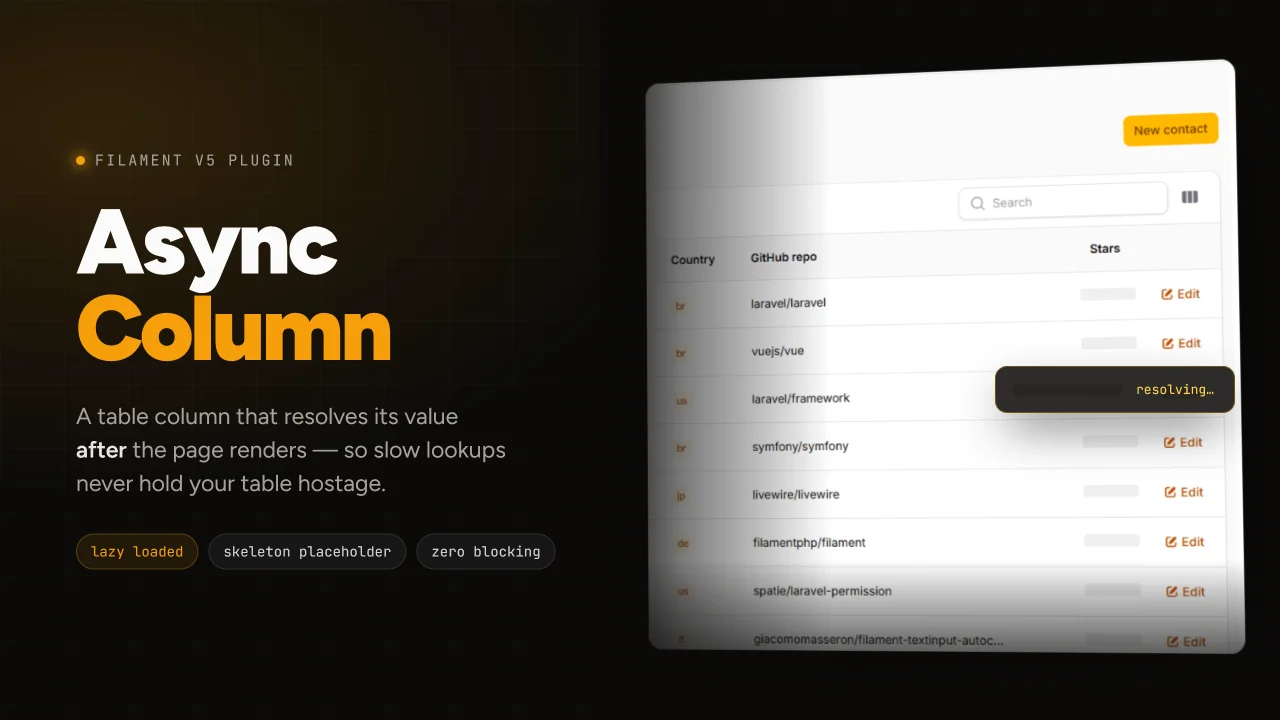
Async Column
CommunityA table column that renders instantly and resolves its value afterwards, in one batched follow-up request - instead of making every page load wait on however many expensive lookups your columns need (API calls, remote aggregates, anything slower than a plain SQL select).
 Author:
Giacomo Masseroni
Author:
Giacomo Masseroni
Package health
BetaAutomated checks of this plugin's Composer package
15 checks
- Passed: GitHub Actions pinned to SHA
- Skipped: GitLab CI includes pinned to SHA
- Passed: Open security advisories
- Passed: Dependabot PR responsiveness — No open Dependabot PRs.
- Skipped: Renovate MR responsiveness
- Passed: Dependabot or Renovate configured
- Passed: Dependency update cooldown configured
- Passed: Provides a security policy
- Passed: Abandoned or archived — No consulted source marks the package abandoned (packagist, github).
- Passed: Commit and release recency — Active: last commit 0 days ago; last release 34 days ago.
-
Passed:
composer.lock not committed by library
—
composer.lockis absent from the released dist archive. - Passed: Dist archive is lean
-
Passed:
Current Laravel version supported
—
Package dependencies resolve together with current Laravel
13.0. -
Passed:
Current PHP version supported
—
Constraint
^8.2supports current PHP8.5. - Skipped: Current Symfony version supported
filament/
namespace. Review the source and install at your own risk. Found
malware or an unresolved security issue the author won't
address?
Report it
.
Documentation
- Why?
- Contents
- Installation
- Quick start
- Formatting the value
- Recipes
- Options reference
- Caching
- Guardrails
- Limitations
- Security
- Configuration
- Testing
- License




A Filament v5 table column that renders now and loads later.
#Why?
One slow column shouldn't hold up your whole page.
If a column calls an API, reads a remote aggregate, or does anything slower than a plain SQL select, your table waits for it - once per row. Twenty rows means twenty round-trips, and nothing appears on screen until the last one finishes.
AsyncColumn splits that in two:
- The table renders straight away, with a light skeleton where each async cell will go.
- Once the page has painted, the browser makes one Livewire call that resolves every visible async cell in the table.
- The values drop into place.
One request for the whole table, not one per cell. No blocked render.
#Contents
- Installation
- Quick start
- Formatting the value
- Recipes
- Options reference
- Caching
- Guardrails
- Limitations
- Security
- Configuration
#Installation
You need PHP 8.2+ and filament/tables ^5.0. If you already have filament/filament ^5.0, you
have it.
composer require giacomomasseron/filament-async-column
That's the whole install for panel users - no build step, no npm. The column's JS and CSS go
through Filament's own asset pipeline (FilamentAsset, under the package name
giacomomasseron/filament-async-column), so they're served anywhere @filamentStyles and
@filamentScripts render. Every Filament panel renders both already.
Using filament/tables on its own, outside a panel? Include those two directives in your layout,
and read this next part.
[!IMPORTANT] Outside a panel, run
php artisan filament:assetsafter installing - and again after everycomposer update.php artisan filament:assetsRegistering an asset isn't the same as publishing it. Filament still has to copy the file into
public/before@filamentStyles/@filamentScriptscan serve it.
- Panels already handle this.
filament:install --panelsadds apost-autoload-dumphook to your application'scomposer.jsonthat re-copies assets on everycomposer update. That hook belongs to the panel installer - neither this package norfilament/tablescan add it for you.- Skip it and the JS and CSS 404. Alpine throws a console error on every cell, and every column sits on its loading skeleton forever.
- It fails quietly, not loudly. The store lookup is optional-chained (
$store.asyncColumn?.register($el)), so a missing asset leaves a static skeleton instead of breaking the page - which makes it easy to misread as a bug in the column.
The defaults work with no configuration at all. To change the cache store or the batch cap, see Configuration.
#Quick start
Add the column and give it a resolveUsing() callback:
use GiacomoMasseroni\AsyncColumn\Columns\AsyncColumn;
use Filament\Tables\Table;
use Illuminate\Support\Facades\Http;

public function table(Table $table): Table
{
    return $table->columns([
        AsyncColumn::make('open_support_tickets')
            ->resolveUsing(fn ($record) => Http::get('https://support.example.com/api/tickets/count', [
                'customer_id' => $record->id,
            ])->json('count')),
    ]);
}
That's it. resolveUsing() is the only method every AsyncColumn needs.
AsyncColumn extends Filament's TextColumn, so every formatting method you already know keeps
working - it just applies to the resolved value instead of a database one. badge(), color(),
icon(), weight(), copyable(), money(), date(), limit(), prefix()/suffix(),
markdown(), formatStateUsing(), and the rest:
AsyncColumn::make('lifetime_value')
    ->resolveUsing(fn ($record) => $this->billingService->lifetimeValue($record))
    ->money('USD')
    ->weight('bold')
    ->color(fn (?float $state) => $state > 1000 ? 'success' : 'gray');
#Formatting the value
You can render a resolved value three ways, exactly as you would for any other column type.
1. Plain text (the default). The value is cast to a string and HTML-escaped:
AsyncColumn::make('status')->resolveUsing(fn ($record) => $record->status);
2. Raw HTML, via ->html(). Use this when your resolver returns markup you trust:
AsyncColumn::make('status_badge')
    ->resolveUsing(fn ($record) => '<span class="badge">'.$record->status.'</span>')
    ->html();
3. A view, via ->view(). The resolved state and the record are available just like they are
in any other Filament column view:
AsyncColumn::make('status')
    ->resolveUsing(fn ($record) => $record->status)
    ->view('columns.status-pill');
#Recipes
#Wait until the cell scrolls into view
By default every visible cell resolves as soon as the page paints. For a column far down a long
table, whenVisible() holds off until the cell actually scrolls into the viewport (it uses
IntersectionObserver):
AsyncColumn::make('inventory_level')
    ->resolveUsing(fn ($record) => $this->warehouse->stockFor($record))
    ->whenVisible();
#Change what the cell shows while loading, or when it fails
The default is a CSS skeleton while loading and a translated "Could not load" on failure. Both
take a string, an Htmlable, or a closure:
AsyncColumn::make('shipment_eta')
    ->resolveUsing(fn ($record) => $this->carrier->eta($record))
    ->loadingState('Checking carrier...')
    ->errorState('Carrier unavailable');
If you need the exception itself, use errorStateUsing() - its closure is the only place the
underlying Throwable is ever exposed, and the parameter has to be named $exception for
Filament to inject it:
->errorStateUsing(fn (Throwable $exception) => $exception instanceof ConnectionException
    ? 'Carrier offline'
    : 'Could not load')
Never render $exception->getMessage() straight into the cell. Resolvers hit APIs with
credentials in URLs and databases that echo SQL back in their errors - see Security.
#Turn off click-to-retry
A failed cell can be clicked to retry. Pass false if that isn't appropriate - for a resolver
that isn't safe to repeat, say, or one that costs money per call:
AsyncColumn::make('credit_check')
    ->resolveUsing(fn ($record) => $this->bureau->check($record))
    ->retryable(false);
#Cache an expensive resolution
cacheFor() stores the resolved value so the next page load doesn't repeat the work:
AsyncColumn::make('open_support_tickets')
    ->resolveUsing(fn ($record) => $this->tickets->count($record))
    ->cacheFor(300); // seconds
Read Caching before you use this - the keys are shared across users, which is what you want for record-specific data and a problem for viewer-specific data.
#Options reference
| Method | Description |
|---|---|
resolveUsing(Closure $callback) |
Required. Supplies the resolved value. Receives $record (and other Filament-standard parameters via dependency injection). |
loadingState(string | Htmlable | Closure | null $state) / loadingStateUsing(Closure $callback) |
What's shown in the cell before it resolves. Defaults to a CSS skeleton (<span class="fi-async-column-skeleton">). |
errorState(string | Htmlable | Closure | null $state) / errorStateUsing(Closure $callback) |
What's shown if the resolver throws. The default is a translated "Could not load". errorStateUsing()'s closure is the only place the underlying Throwable is ever exposed - see Security. |
whenVisible(bool | Closure $condition = true) |
Defers resolving a column's cells until they scroll into the viewport (via IntersectionObserver), instead of resolving them immediately after paint. Useful for columns far down a long table. |
retryable(bool | Closure $condition = true) |
Whether a failed cell can be clicked to retry. Defaults to true. |
cacheFor(int | CarbonInterface | Closure | null $ttl) |
Opt-in caching of the resolved value. null (the default) disables caching. Read Caching before using this. |
cacheVersion(mixed $version) |
A value folded into the cache key, for busting the cache (deploys, viewer scoping - see Caching). Accepts a scalar, a DateTimeInterface, or a Closure. |
There's also one static method, AsyncColumn::forget(), for
removing a cached cell from outside a table render.
#Caching
Caching is off unless you ask for it. When you do turn it on with cacheFor(), the key looks like
this:
{cache_prefix}:{livewire_component_class}:{column_name}:{record_key}:{cache_version}
Note what isn't in there: any notion of who is looking.
[!WARNING]
cacheFor()keys are shared across users. The key is built from column + record + version, deliberately, so a warm cache benefits everyone. If your resolver returns data specific to the viewer rather than the record, scope it yourself:AsyncColumn::make('my_price') ->cacheFor(300) ->cacheVersion(fn () => auth()->id())
#Invalidating a cached cell
Before AsyncColumn::forget(), a cached cell could only be cleared two ways: wait out its TTL, or
change cacheVersion() - which busts the column for every record, not just the one that
changed. Neither helps much when one record's data moves and that single cell is now wrong.
AsyncColumn::forget() removes cells written by cacheFor(). It takes the key's parts rather
than a column instance, so you can call it from anywhere - a model observer, a queued job,
tinker - where no table is being rendered:
use GiacomoMasseroni\AsyncColumn\Columns\AsyncColumn;

// One cell.
AsyncColumn::forget(ListPosts::class, 'stock_level', $post->getKey());

// Many cells of the same column, in one call.
AsyncColumn::forget(ListPosts::class, 'stock_level', [1, 2, 3]);

// A cell written under a ->cacheVersion().
AsyncColumn::forget(ListPosts::class, 'stock_level', $post->getKey(), version: 'v2');
The usual home for it is an observer, so the cell disappears the moment the data behind it changes:
class PostObserver
{
    public function saved(Post $post): void
    {
        AsyncColumn::forget(ListPosts::class, 'stock_level', $post->getKey());
    }
}
The same call suits a queued job or an external sync that already knows which records moved - pass their keys as an array - and tinker, when a resolver bug has cached bad output and you'd rather not deploy to clear it.
Reach for cacheVersion() instead when what changed is the column rather than a record: the
resolver's logic, a formatting change, a deploy. forget() is for "this record changed"; a new
version is for "this column changed".
Four things worth knowing:
- The record key is the one the table uses -
$table->getRecordKey($record), which is(string) $record->getKey()unless your component overridesgetTableRecordKey(). If it does, pass that same value or you'll remove a key nothing ever wrote. - The version has to match. It's part of the key, so a
forget()without aversion:removes only the unversioned cell. It isn't a wildcard. - A
Closureversion can't be forgotten, and throws aLogicExceptionrather than failing quietly. There's no column instance or record to evaluate it against outside a render, and a request-scoped version likecacheVersion(fn () => auth()->id())writes one key per viewer - which plain string keys can't enumerate. Bust those by changing the version instead. - It doesn't touch the client-side cache. A cell already resolved in an open browser tab keeps
its HTML until that page is reloaded - see the client-side cache note under
Limitations.
forget()only affects what the next resolution computes.
#Guardrails
Two TextColumn methods are deliberately blocked on AsyncColumn. Both only make sense for a
value that exists at render time, and not needing one is this column's entire purpose:
-
getStateUsing()throws. It evaluates during the initial, synchronous table render - which would put back exactly the page-blocking slowness this package exists to remove. UseresolveUsing()instead. -
sortable()/searchable()throw, unless you pass aquery:closure. Your value doesn't exist in SQL; the resolver produces it after the table's query has already run, so there's nothing for Filament toORDER BYorWHERE ... LIKE. If the underlying data is sortable some other way, supply that query yourself:AsyncColumn::make('open_support_tickets') ->resolveUsing(fn ($record) => $this->ticketService->count($record)) ->sortable(query: fn (Builder $query, string $direction) => $query ->withCount('supportTickets') ->orderBy('support_tickets_count', $direction))
#Limitations
These are deliberate trade-offs rather than bugs. They're written down here so you meet them on this page instead of in production:
cacheFor(0)never persists anything. Laravel's cacheput()reads a TTL of0or less as "forget", not "store forever" or "store briefly" - socacheFor(0)quietly behaves like caching being off, just with an extra round-trip to the cache store on every resolution. UsecacheFor(null), or leavecacheFor()off entirely, to disable caching. A resolver that legitimately returnsnullis cached correctly when you set a real TTL; that case is handled explicitly.- Array-backed and other non-Eloquent tables aren't supported.
BatchResolverhydrates records through the table's own Eloquent query ($table->getQuery()). If that returnsnull, the placeholder renders but never resolves. - A
TrashedFilterdoesn't hide soft-deleted records from resolution the way it hides them from the listing. A forged token can resolve a cell for a soft-deleted record even when the table'sTrashedFilterexcludes trashed rows. This isn't specific to this package - it matches Filament's own single-record resolution (getTableRecord()) exactly, and that consistency is worth more than diverging. BelongsToManytables usingallowsDuplicates()aren't supported. When a pivot relation lets the same related record appear more than once (keyed by pivot row rather than by the related model's primary key), the record keysBatchResolverrelies on stop mapping cleanly onto a singlewhereKey()lookup.- The client-side cache is per page-load, unbounded, and unrelated to
cacheFor(). Once a cell resolves, its HTML stays in memory on the client for the lifetime of that page/Livewire component - so sorting or paginating back to a row you've already seen repaints instantly, with no server round-trip. It isn't persisted across page loads and has nothing to do with the server-sidecacheFor()TTL.
#Security
Cell tokens travel to the browser and come back again, so they're treated as untrusted input. The guarantee is:
A forged token cannot reach data - or even reveal that a column exists - that the requesting user could not already see through the table itself.
Two mechanisms enforce it.
Records are hydrated only through the table's own Eloquent query. That query is scoped exactly the way Filament scopes its own single-record resolution, so tenancy, global scopes and active table filters all apply automatically instead of being reimplemented here. A hand-crafted token for a row outside that scope simply never comes back from the query, and no cell is produced.
Only columns genuinely defined on the table can be resolved - and among those, only
AsyncColumn instances that are currently visible and not toggled off. An unknown, mistyped,
hidden or foreign column name is dropped silently rather than reported, so nobody can use error
responses to probe which columns exist.
[!NOTE] The active search term is a deliberate exception: it isn't applied when resolving. Search narrows what's displayed; it doesn't gate what's authorized. Applying it would let a cell that was already in flight vanish out from under its batch request the moment someone typed into the search box.
#Reporting a vulnerability
Please don't open a public issue. Follow the security policy to report it privately.
#Configuration
Everything has a working default. To change any of it, publish the config file:
php artisan vendor:publish --tag="filament-async-column-config"
// config/async-column.php

return [
    // Cache store used by ->cacheFor(). Null = the application's default store.
    'cache_store' => env('ASYNC_COLUMN_CACHE_STORE'),

    // Prefix for every cache key this package writes.
    'cache_prefix' => 'async-column',

    // Maximum number of cell tokens resolved in a single batch request. Extra
    // tokens beyond this cap are silently truncated, never an error. A value
    // <= 0 (including a malformed env value) falls back to the default of
    // 200 rather than disabling the cap.
    'max_batch_size' => (int) env('ASYNC_COLUMN_MAX_BATCH_SIZE', 200),
];
#max_batch_size bounds each request, not the request rate
The cap limits how many resolvers a single request can invoke. It does not limit how often
those requests can be made - anyone holding a valid Livewire snapshot for a page can keep issuing
them, each one costing up to max_batch_size resolver invocations.
If your resolvers call a paid, rate-limited, or otherwise expensive upstream service, treat this
like any other authenticated endpoint and add your own throttling: Laravel's throttle middleware
on the Livewire update route, a per-user rate limiter inside the resolver, or cacheFor() so
repeat work is served from cache instead of the upstream.
#Testing
composer test
#License
The MIT License (MIT). Please see LICENSE.md for more information.
The author
From the same author

Featured Plugins
A selection of plugins curated by the Filament team
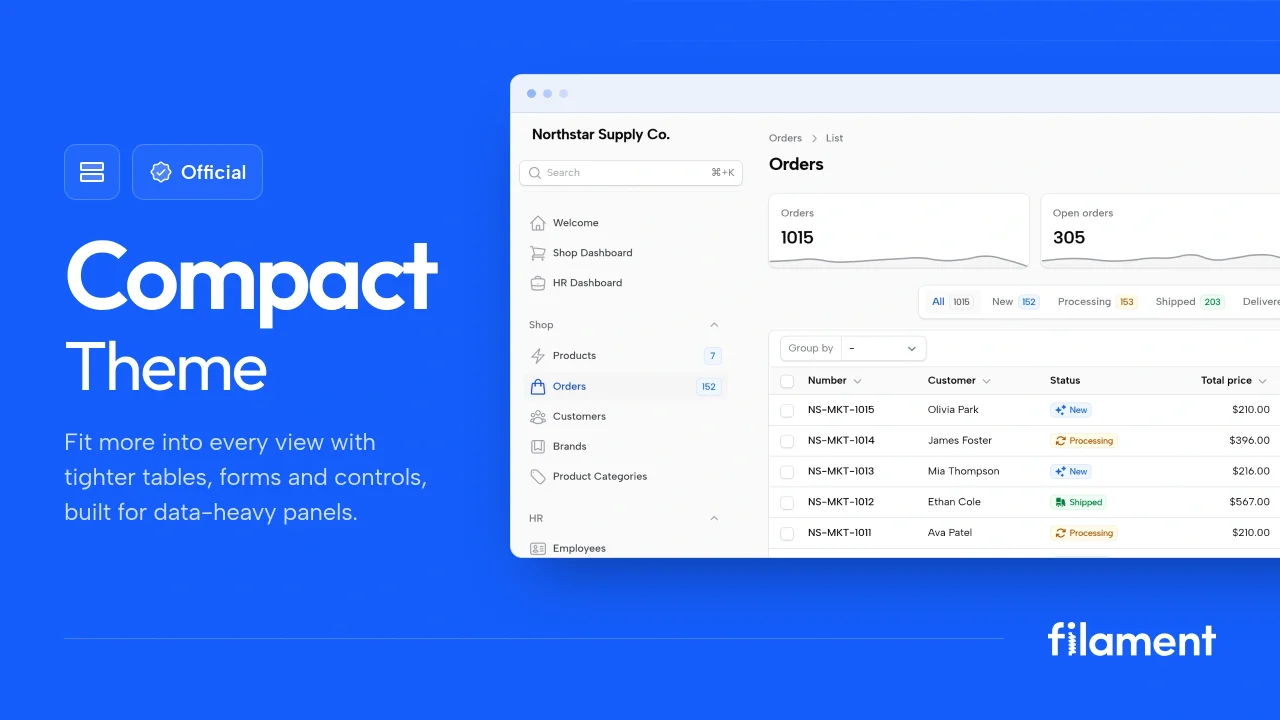
Compact Theme
A theme that makes data-heavy panels easier to scan by fitting more useful information on each screen.
 Filament

Spotlight Pro
Browse your Filament Panel with ease. Filament Spotlight Pro adds a Spotlight like Command Palette to your Filament Panel.
 Dennis Koch
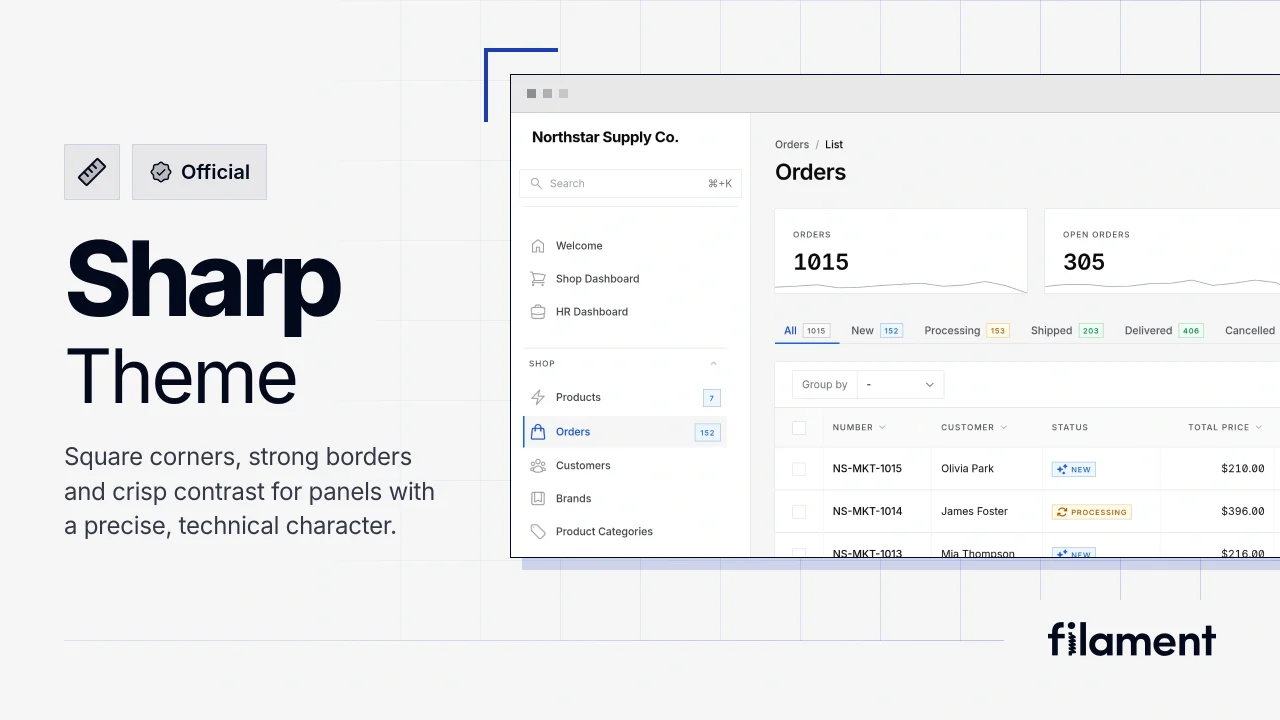
Sharp Theme
A theme that gives panels a precise, technical look with square corners, strong borders, and clear contrast.
Filament