
Shield Enhanced by AGMedia
CommunityA standalone addon for bezhansalleh/filament-shield that adds fine-grained page permissions and a structured Role Resource UI — without forking or replacing the original package.
 Author:
AGMedia
Package health
Automated checks of this plugin's Composer package
15 checks
- Passed: GitHub Actions pinned to SHA
- Skipped: GitLab CI includes pinned to SHA
- Passed: Open security advisories
- Passed: Dependabot PR responsiveness — No open Dependabot PRs.
- Skipped: Renovate MR responsiveness
- Passed: Dependabot or Renovate configured
- Passed: Dependency update cooldown configured
- Passed: Provides a security policy
- Passed: Abandoned or archived — No consulted source marks the package abandoned (packagist, github).
- Passed: Commit and release recency — Active: last commit 35 days ago; last release 35 days ago.
-
Passed:
composer.lock not committed by library
—
composer.lockis absent from the released dist archive. - Passed: Dist archive is lean
-
Passed:
Current Laravel version supported
—
Package dependencies resolve together with current Laravel
13.0. -
Passed:
Current PHP version supported
—
Constraint
^8.2supports current PHP8.5. - Skipped: Current Symfony version supported
filament/
namespace. Review the source and install at your own risk. Found
malware or an unresolved security issue the author won't
address?
Report it
.
Documentation
- Table of Contents
- Features
- Requirements
- Installation
- Usage — Pages
- Usage — Resources
- Usage — Components
- Configuration
- Localization
- How it works internally
- Changelog
- License
- Credits


Warning
Testing Phase: Versions 0.*.* are currently in the testing phase. At present, there are no known bugs.
A standalone addon for bezhansalleh/filament-shield that adds fine-grained page, resource and component permissions and a structured Role Resource UI — without forking or replacing the original package.
Why this exists.
The features were proposed upstream in bezhanSalleh/filament-shield#698. The author has not had time to review the PR. This addon ships the same functionality as a composable layer on top of the official package.
#Table of Contents
- Features
- Requirements
- Installation
- Usage — Pages
- Usage — Resources
- Usage — Components
- Configuration
- Localization
- How it works internally
- Changelog
- License
- Credits
#Features
| Feature | Description |
|---|---|
| Multi-action page permissions | Declare several permissions per page via getShieldPagePermissions(). |
| Multi-action resource permissions | Declare custom permissions per resource via getShieldResourcePermissions() — beyond the standard CRUD policy methods. |
| Multi-action component permissions | Declare permissions on any Livewire component (not registered with a panel) via getShieldComponentPermissions(). |
canShield('action') |
Fluent, type-safe permission check — instance method on Pages and Components, static method on Resources. |
getShieldPermissions() |
Returns a pre-resolved action → bool map for injection into child Livewire components. |
HasInjectedShieldPermissions |
Trait for child Livewire components that receive the map from a parent page or component. |
EnhancedPagePermissionsForm |
Form builder helper for the published RoleResource — one Section per Page, combining filament-shield's own standard permission with any fine-grained actions from getShieldPagePermissions() in the same checkbox list. |
EnhancedResourcePermissionsForm |
Form builder helper for the published RoleResource — one Section per Resource, combining the standard CRUD permissions with any fine-grained actions from getShieldResourcePermissions() in the same checkbox list. |
EnhancedComponentPermissionsForm |
Form builder helper for the published RoleResource — renders each enhanced component as a separate Section with individual checkboxes. |
getShieldPermissionDescriptions() |
Optional hook on Resources/Pages (with or without fine-grained actions) to attach a help text under any individual permission checkbox — standard CRUD included. Use it where the checkbox's real-world effect deviates from what its label implies. |
NavigationGroupResolver |
Resolves a Resource's/Page's navigation group to a display string, and the panel's own ->navigationGroups() order — the building block behind grouping the RoleResource UI the same way the sidebar is grouped. |
discoverResources() / discoverPages() |
Public on EnhancedResourcePermissionsForm / EnhancedPagePermissionsForm — return every Resource/Page's merged permission options, descriptions, navigation group and sort as plain data, for building a custom RoleResource layout (see §8c). |
| Three-part page key convention | {Prefix}{sep}{Action}{sep}{Subject} (e.g. Page:EditSettings:SettingsPage) — fully respects filament-shield's separator and case config. |
| Three-part component key convention | {Prefix}{sep}{Action}{sep}{Subject} (e.g. Component:Delete:CommentComponent) — same shape as pages, configurable prefix. |
| Two-part resource key convention | {Action}{sep}{ModelBasename} (e.g. ViewContactInfo:Member) — matches Shield's own resource permission format, no extra prefix. |
| Zero conflict | Does not replace any original class. Falls back gracefully on entities that do not declare the method. |
#Requirements
| Dependency | Version |
|---|---|
| PHP | ^8.2 |
| Laravel | ^11.0 | ^12.0 | ^13.0 |
| Filament | ^4.0 | ^5.0 |
| bezhansalleh/filament-shield | ^4.0 |
#Installation
composer require agroezinger/filament-shield-enhanced
Publish the config (optional):
php artisan vendor:publish --tag="filament-shield-enhanced-config"
#Usage — Pages
#1 — Declare fine-grained permissions on a Page
Replace (or complement) the original HasPageShield with the enhanced version:
<?php

namespace App\Filament\Pages;

use Agroezinger\FilamentShieldEnhanced\Traits\HasPageShield;
use Filament\Pages\Page;

class SettingsPage extends Page
{
    use HasPageShield;

    /**
     * Declare every action that can be independently granted on this page.
     * The 'view' action controls whether the user can navigate to the page at all.
     *
     * Three entry formats can be mixed freely:
     *
     *   'action'                          → label auto-generated from action name
     *   'action' => 'Label'               → explicit label
     *   'action' => ['text'        => 'Label',
     *                'description' => 'Shown below the checkbox in the role editor']
     */
    public static function getShieldPagePermissions(): array
    {
        return [
            'view'               => 'Can view this page',
            'editGlobalSettings' => [
                'text'        => 'Can change global settings',
                'description' => 'Grants access to all fields in the Global Settings section.',
            ],
            'exportData'         => 'Can export data as CSV / Excel',
        ];
    }
}
Then run the enhanced generator to create the permissions in the database:
php artisan shield:generate-enhanced-pages --all-panels
Use
--panel=<id>to limit the scan to a single panel.
This will create three permissions for the page above:
Page:View:SettingsPage
Page:EditGlobalSettings:SettingsPage
Page:ExportData:SettingsPage
#2 — Check permissions in PHP (Pages)
// Inside the Page class
if ($this->canShield('editGlobalSettings')) {
    // Perform restricted action
}
{{-- Inside the Page Blade view --}}
@if($this->canShield('exportData'))
    <x-filament::button wire:click="export">Export</x-filament::button>
@endif
#3 — Inject permissions into child Livewire components
Parent page Blade:
@livewire('settings-sidebar', [
    'permissions' => $this->getShieldPermissions()
])
Child Livewire component:
<?php

namespace App\Livewire;

use Agroezinger\FilamentShieldEnhanced\Traits\HasInjectedShieldPermissions;
use Livewire\Component;

class SettingsSidebar extends Component
{
    use HasInjectedShieldPermissions;

    // $this->permissions is automatically populated by Livewire.

    public function save(): void
    {
        $this->authorizeShield('editGlobalSettings'); // aborts 403 if not permitted
        // … save logic
    }

    public function render()
    {
        return view('livewire.settings-sidebar');
    }
}
#Usage — Resources
#4 — Declare fine-grained permissions on a Resource
Add HasResourceShield to any Filament Resource and declare custom actions via getShieldResourcePermissions():
<?php

namespace App\Filament\Resources;

use Agroezinger\FilamentShieldEnhanced\Traits\HasResourceShield;
use App\Models\Member;
use Filament\Resources\Resource;

class MemberResource extends Resource
{
    use HasResourceShield;

    protected static ?string $model = Member::class;

    /**
     * Declare custom permissions beyond the standard CRUD policy methods.
     * Keys are action names; values are human-readable labels (shown in the role editor).
     *
     * Same three entry formats as getShieldPagePermissions():
     *   'action'                                   → auto-generated label
     *   'action' => 'Label'                        → explicit label
     *   'action' => ['text' => '...', 'description' => '...']
     */
    public static function getShieldResourcePermissions(): array
    {
        return [
            'Export'          => 'Export member list (basic data)',
            'ExportFinance'   => 'Export member list including financial data (IBAN, fees)',
            'ViewContactInfo' => 'View contact details (email, phone, address)',
            'ViewBankingInfo' => 'View bank details (IBAN, BIC, account holder)',
        ];
    }
}
Then create the permissions in the database:
php artisan shield:generate-enhanced-resources --all-panels
This will create (for the example above):
Export:Member
ExportFinance:Member
ViewContactInfo:Member
ViewBankingInfo:Member
The key format (Action:ModelBasename) is identical to Shield's own resource permission format so everything looks consistent.
#5 — Check resource permissions in PHP
canShield() is a static method on Resources (unlike Pages, where it is an instance method):
// Anywhere in your application
if (MemberResource::canShield('ViewContactInfo')) {
    // show contact section
}

// Returns ['Export' => true, 'ViewContactInfo' => false, …]
$permissions = MemberResource::getShieldPermissions();
Super-admin bypass is applied automatically — identical behaviour to the page trait.
#Attaching a deviation hint to any permission checkbox
getShieldPermissionDescriptions() is a separate, optional hook — it works even on standard CRUD permissions that were never declared via getShieldResourcePermissions()/getShieldPagePermissions(). Use it where the checkbox's real-world effect doesn't match what its label implies (an unimplemented scope, a permission that also grants an unrelated side effect, …):
class SquadResource extends Resource
{
    // No HasResourceShield/getShieldResourcePermissions() needed — this hook
    // works standalone against filament-shield's own standard CRUD keys too.

    public static function getShieldPermissionDescriptions(): array
    {
        $hint = 'Applies to ALL squads — team-manager assignment and department '
            . 'scoping are not enforced here yet.';

        return [
            'View:Squad'   => $hint,
            'Update:Squad' => $hint,
            'Delete:Squad' => $hint,
        ];
    }
}
The description renders directly under the matching checkbox in the RoleResource UI, regardless of whether that checkbox came from Shield's own CRUD policy methods or from getShieldResourcePermissions()/getShieldPagePermissions().
#Usage — Components
Components are arbitrary Livewire components that aren't registered with any Filament panel (e.g. a shared widget dropped into several pages via @livewire(...)). Shield's own Page/Resource/Widget discovery never sees them, so they get their own trait, key format and generator command — everything else (checks, injection, RoleResource UI) works the same way as Pages.
#6 — Declare fine-grained permissions on a component
<?php

namespace App\Livewire;

use Agroezinger\FilamentShieldEnhanced\Traits\HasComponentShield;
use Livewire\Component;

class CommentComponent extends Component
{
    use HasComponentShield;

    /**
     * No default action — unlike pages there is no universally meaningful
     * "view" action for an arbitrary component, so declare exactly what you need.
     * Same three entry formats as getShieldPagePermissions().
     */
    public static function getShieldComponentPermissions(): array
    {
        return [
            'delete' => 'Can delete any comment',
            'edit'   => 'Can edit any comment',
        ];
    }

    public function delete(int $commentId): void
    {
        $this->authorizeShield('delete'); // aborts 403 if not permitted
        // …
    }
}
By default, components are discovered by scanning app/Livewire for classes using HasComponentShield (configurable — see Configuration). Then create the permissions in the database:
php artisan shield:generate-enhanced-components
This will create (for the example above):
Component:Delete:CommentComponent
Component:Edit:CommentComponent
#7 — Check permissions in PHP (Components)
// Inside the component class
if ($this->canShield('delete')) {
    // Show the delete button
}
getShieldPermissions() and HasInjectedShieldPermissions work exactly as documented for Pages (see step 3) — a component can inject its resolved permission map into a child component the same way a page does.
#8 — Structured UI in the published RoleResource
After publishing the RoleResource with php artisan shield:publish --panel=<id> two files need small changes.
#8a — RoleResource: replace the standard Resources/Pages tabs
EnhancedResourcePermissionsForm::make() / EnhancedPagePermissionsForm::make() fully replace Shield's own "Resources"/"Pages" tabs — each Resource/Page gets one Section combining the standard CRUD permissions with any fine-grained actions in the same checkbox list, instead of splitting them across a standard tab and a separate "(Fine-grained)" tab. No getPageOptions() override is needed any more — there is nothing left to de-duplicate.
use Agroezinger\FilamentShieldEnhanced\Forms\EnhancedComponentPermissionsForm;
use Agroezinger\FilamentShieldEnhanced\Forms\EnhancedPagePermissionsForm;
use Agroezinger\FilamentShieldEnhanced\Forms\EnhancedResourcePermissionsForm;
use Filament\Schemas\Components\Tabs;
use Filament\Schemas\Components\Tabs\Tab;

public static function getShieldFormComponents(): \Filament\Schemas\Components\Component
{
    $resourceComponents = EnhancedResourcePermissionsForm::make();
    $resourceCount      = array_sum(array_map('count', EnhancedResourcePermissionsForm::getResourcePermissionFields()));

    $pageComponents = EnhancedPagePermissionsForm::make();
    $pageCount      = array_sum(array_map('count', EnhancedPagePermissionsForm::getPagePermissionFields()));

    $componentComponents = EnhancedComponentPermissionsForm::make();
    $componentCount      = array_sum(array_map('count', EnhancedComponentPermissionsForm::getComponentPermissionFields()));

    $tabs = [
        static::getTabFormComponentForWidget(),
        static::getTabFormComponentForCustomPermissions(),
    ];

    if (! empty($resourceComponents)) {
        $tabs[] = Tab::make('resources')
            ->label('Resources')
            ->badge($resourceCount ?: null)
            ->schema($resourceComponents);
    }

    if (! empty($pageComponents)) {
        $tabs[] = Tab::make('pages')
            ->label('Pages')
            ->badge($pageCount ?: null)
            ->schema($pageComponents);
    }

    if (! empty($componentComponents)) {
        $tabs[] = Tab::make('components')
            ->label('Components')
            ->badge($componentCount ?: null)
            ->schema($componentComponents);
    }

    return Tabs::make('Permissions')
        ->contained()
        ->tabs($tabs)
        ->columnSpan('full');
}
Each make() output is already grouped into sub-tabs by navigation group internally, always in the panel's own ->navigationGroups() order — Resources/Pages without a $navigationGroup fall into a "Sonstige" bucket. Widgets and Custom Permissions have no navigation group at all, so they stay on Shield's own standard tabs.
#8b — EditRole: add the pre-fill trait
Open the published EditRole.php and add use HasEnhancedRoleForm. This pre-fills page-, resource- and component-permission checkboxes when the form opens.
use Agroezinger\FilamentShieldEnhanced\Traits\HasEnhancedRoleForm;

class EditRole extends EditRecord
{
    use HasEnhancedRoleForm;

    // … rest of the file unchanged
}
The mutateFormDataBeforeSave() / afterSave() logic from Shield's own EditRole handles saving — no additional overrides needed.
#8c — Optional: group everything by navigation, in one unified tab bar
A plain make() (§8a) puts every Resource/Page in the panel into one flat list of Sections — fine for a handful of them, but once a panel has two or three dozen, a role editor scrolling through an undifferentiated wall of checkboxes stops being able to find anything. Grouping by navigation — the same grouping the sidebar already uses, so nothing new to learn — exists as an option rather than the default specifically to keep that overview intact for larger panels, without forcing it on apps where a flat list is already perfectly readable.
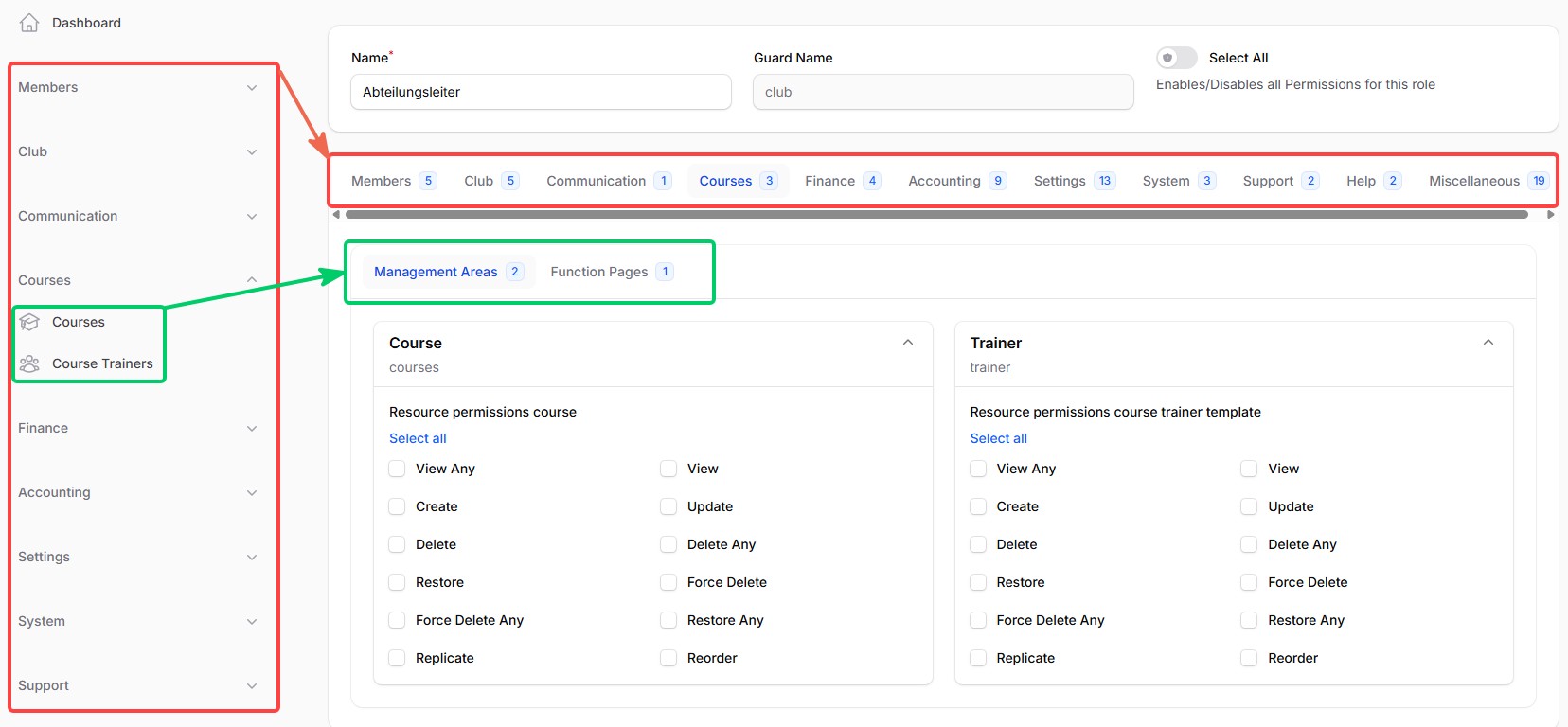
make() (§8a) already groups Resources and Pages by navigation group internally, as two separate top-level tabs ("Resources", "Pages"). If you'd rather have navigation group be the outermost grouping — one tab bar for "Members"/"Team"/"Settings"/…, each containing a "Resources"/"Pages" sub-split underneath, matching the sidebar exactly — combine the public discoverResources() / discoverPages() / buildSection() methods yourself. ui.group_by_navigation (see Configuration) toggles the two:
group_by_navigation: true — top level clusters by navigation group, matching the sidebar exactly (red); a second tab row underneath separates Resources from Pages within each group (green):
group_by_navigation: false — no navigation-group tabs at all; the Resources/Pages/Widgets sub-tabs sit directly at the top level instead, each showing every entry of that type across the whole panel in one flat list (red):
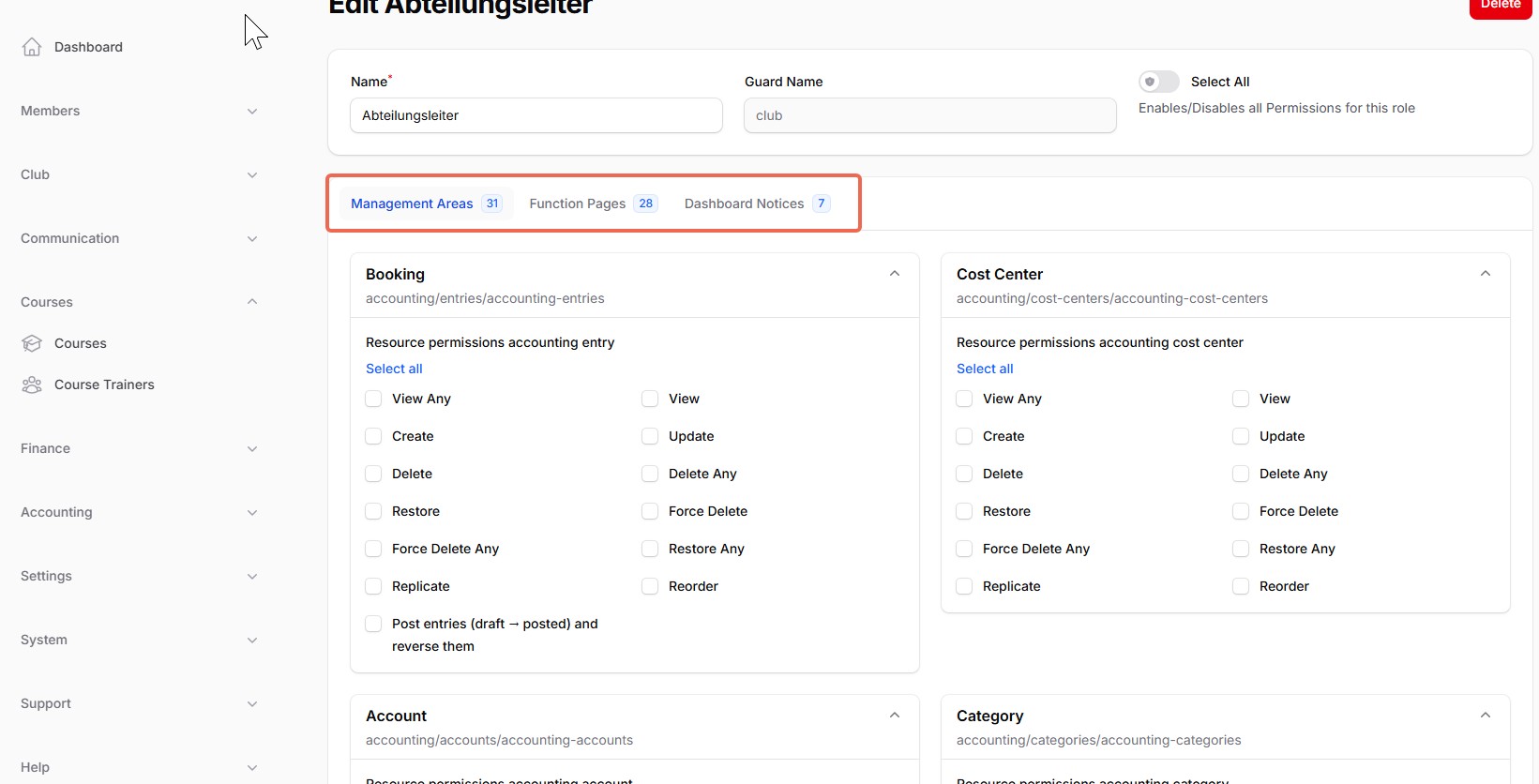
This is exactly the recipe the screenshots above were taken from:
use Agroezinger\FilamentShieldEnhanced\Forms\EnhancedPagePermissionsForm;
use Agroezinger\FilamentShieldEnhanced\Forms\EnhancedResourcePermissionsForm;
use Agroezinger\FilamentShieldEnhanced\Support\NavigationGroupResolver;
use Filament\Schemas\Components\Grid;
use Filament\Schemas\Components\Tabs;
use Filament\Schemas\Components\Tabs\Tab;
use Illuminate\Support\Collection;
use Illuminate\Support\Str;

public static function getShieldFormComponents(): \Filament\Schemas\Components\Component
{
    $entries = EnhancedResourcePermissionsForm::discoverResources()
        ->map(fn (array $entry): array => $entry + ['category' => 'resources'])
        ->concat(
            EnhancedPagePermissionsForm::discoverPages()
                ->map(fn (array $entry): array => $entry + ['category' => 'pages'])
        );

    $grouped    = $entries->groupBy('navigationGroup');
    $ungrouped  = $grouped->get('', collect()); // Resources/Pages with no $navigationGroup
    $groupOrder = NavigationGroupResolver::order();
    $groupSort  = config('filament-shield-enhanced.ui.group_sort', 'navigation');

    $tabs = $grouped->except([''])
        ->sortBy(fn (Collection $g, string $label) => $groupSort === 'alphabetical'
            ? $label
            : (array_search($label, $groupOrder, true) === false ? count($groupOrder) : array_search($label, $groupOrder, true)))
        ->map(fn (Collection $g, string $label) => Tab::make(Str::slug($label ?: 'misc'))
            ->label($label ?: config('filament-shield-enhanced.ui.labels.misc_group', 'Miscellaneous'))
            ->badge($g->count())
            ->schema(static::buildCategorySchema($g)))
        ->values()
        ->all();

    return Tabs::make('Permissions')->contained()->tabs($tabs)->columnSpan('full');
}

/**
 * Collects the Resources/Pages sub-tabs as plain data (label/badge/schema)
 * rather than building Tab objects straight away: a Tab can only be
 * introspected (e.g. to read its schema back out) once it's attached to a
 * container, which only happens when it's handed to a parent Tabs::make() —
 * so if only one category ends up present, this reaches for the raw
 * $categories entry directly instead of building-then-unwrapping a Tab.
 */
protected static function buildCategorySchema(Collection $entries): array
{
    $labels = [
        'resources' => config('filament-shield-enhanced.ui.labels.resources', 'Management Areas'),
        'pages'     => config('filament-shield-enhanced.ui.labels.pages', 'Function Pages'),
    ];

    $categories = collect($labels)
        ->map(function (string $label, string $category) use ($entries): ?array {
            $categoryEntries = $entries->where('category', $category);
            if ($categoryEntries->isEmpty()) return null;

            $sections = $categoryEntries->sortBy('navigationSort')->map(
                fn (array $entry) => $category === 'resources'
                    ? EnhancedResourcePermissionsForm::buildSection($entry)
                    : EnhancedPagePermissionsForm::buildSection($entry)
            )->all();

            return ['label' => $label, 'badge' => $categoryEntries->count(), 'schema' => [Grid::make()->schema($sections)]];
        })
        ->filter()
        ->values();

    if ($categories->count() > 1) {
        return [Tabs::make('categories')->tabs(
            $categories->map(fn (array $c, int $i) => Tab::make('cat_' . $i)->label($c['label'])->badge($c['badge'])->schema($c['schema']))->all()
        )];
    }

    return $categories->first()['schema'] ?? [];
}
This full pattern — including the "Sonstige" catch-all tab for ungrouped Resources/Pages plus Widgets/Custom Permissions, and the ui.group_by_navigation on/off switch — is what ClubManager's own RoleResource implements; treat the sketch above as a starting point, not a drop-in.
#Configuration
// config/filament-shield-enhanced.php

return [
    'pages' => [
        // First segment of the three-part key: Page:Action:Subject
        'permission_prefix' => 'Page',
    ],

    'components' => [
        // First segment of the three-part key: Component:Action:Subject
        'permission_prefix' => 'Component',

        // Directories scanned for classes using HasComponentShield, each
        // mapped to its base namespace. Add more entries if components
        // live outside app/Livewire.
        'scan_paths' => [
            app_path('Livewire') => 'App\\Livewire',
        ],
    ],

    'ui' => [
        'grid_columns' => [
            'default' => 1,
            'sm'      => 2,
            'lg'      => 3,
        ],

        'checkbox_list_columns' => [
            'default' => 1,
            'sm'      => 2,
        ],

        // None of the three keys below are read by make() itself — make()
        // always groups by navigation order and always calls things
        // "Resources"/"Pages". They exist purely as a shared config contract
        // for apps implementing the §8c recipe; nothing happens unless your
        // own getShieldFormComponents() reads them (as the §8c snippet does).
        'group_by_navigation' => true,

        'group_sort' => 'navigation', // 'navigation' | 'alphabetical'

        // End users configuring roles don't know what a Filament "Resource"
        // or "Page" is — override with labels that describe what the
        // category lets someone DO. The defaults already avoid the raw
        // Filament terms; treat them as a starting point, not a fixed set.
        'labels' => [
            'resources'  => 'Management Areas',
            'pages'      => 'Function Pages',
            'widgets'    => 'Dashboard Widgets',
            'custom'     => 'Other Permissions',
            'misc_group' => 'Miscellaneous',
        ],
    ],
];
#Localization
Section titles come from each Resource's/Page's own getModelLabel() / navigation label — if your app already localizes those, they localize here too. Everything this addon itself adds — permission labels/descriptions passed to getShieldResourcePermissions() / getShieldPagePermissions() / getShieldPermissionDescriptions(), and the ui.labels.* config values from §8c — are plain strings, not routed through __(). If your app supports multiple locales, wrap them yourself (__('permissions.squad_view_hint') instead of a literal string) — this addon won't do it for you. Shield's own standard CRUD labels (View, Create, Update, …) and RoleResource chrome (Save changes, Select All, …) already come from filament-shield's own translated lang files independently of this addon.
#How it works internally
This addon does not override any class from filament-shield. Instead it uses the package's public extension point:
FilamentShield::buildPermissionKeyUsing(function (...) { ... });
When a Page class exposes getShieldPagePermissions(), the addon intercepts the key builder and applies its three-part naming convention. All other entities (Resources, Widgets, regular Pages) are delegated back to the original builder unchanged.
Resource permissions use a two-part format matching Shield's own convention and are not created via shield:generate — only via shield:generate-enhanced-resources. This means the hook is not involved for Resources at all.
Component permissions work the same way as Resources with respect to the hook — the hook is not involved, since arbitrary Livewire components were never part of Shield's Page/Resource/Widget discovery pipeline in the first place. shield:generate-enhanced-components discovers them independently by scanning the configured components.scan_paths for classes using HasComponentShield, rather than iterating a panel's registered entities.
#Changelog
See CHANGELOG.md.
#License
MIT — see LICENSE.md.
#Credits
- Alexander Groezinger — addon author
- Bezhan Salleh — original filament-shield package
The author
From the same author
Featured Plugins
A selection of plugins curated by the Filament team
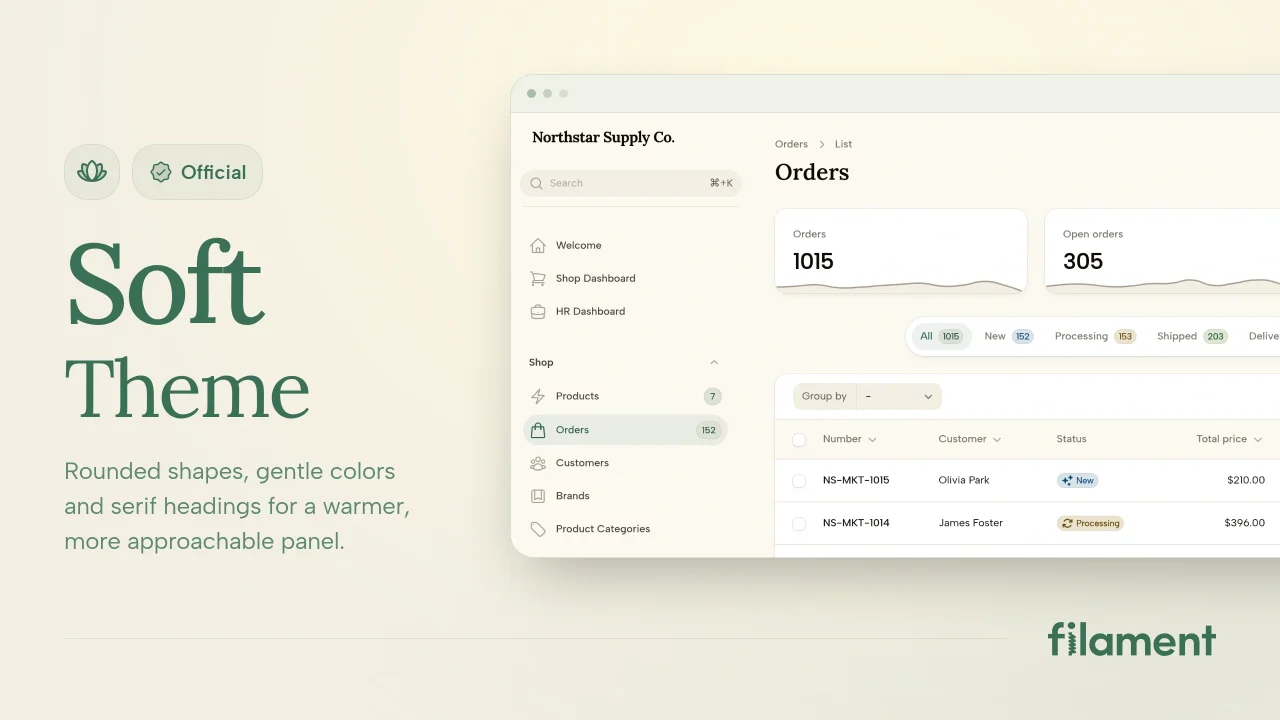
Soft Theme
A theme that gives panels a warm, approachable look with rounded shapes, gentle colors, and serif headings.
 Filament
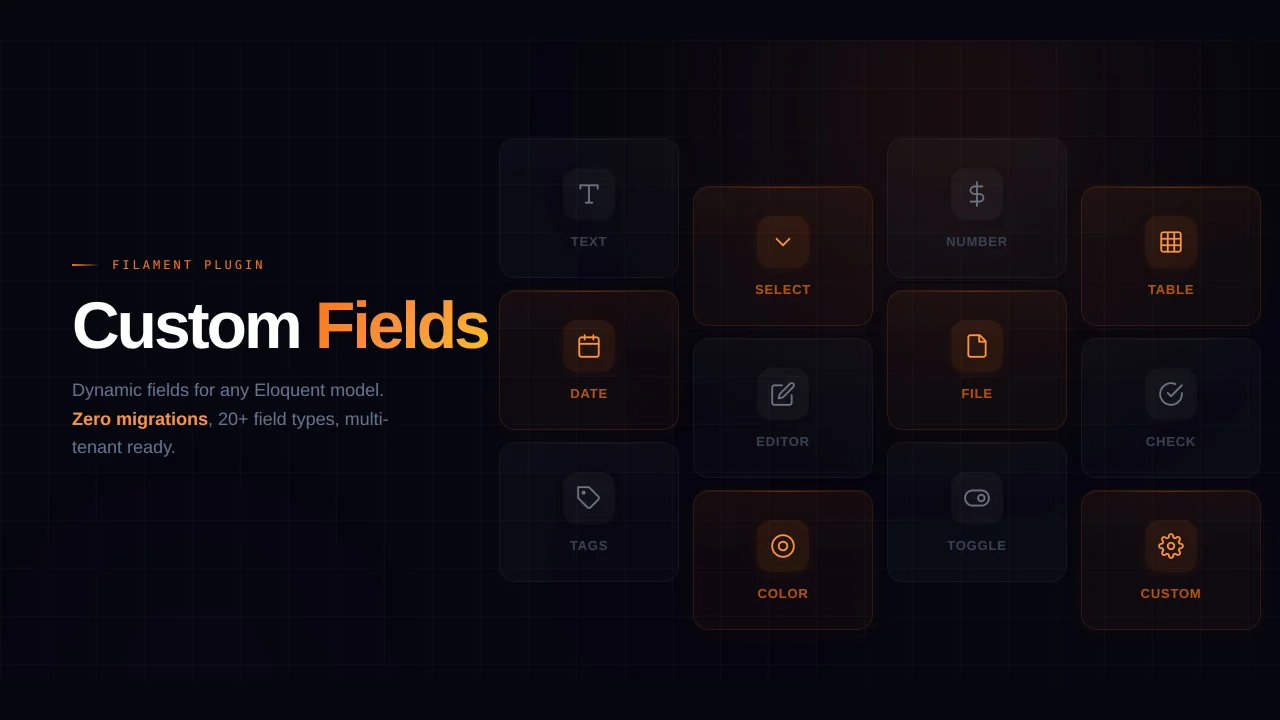
Custom Fields
Eliminate custom field migrations forever. Let your users create and manage form fields directly in Filament admin panels with 20+ built-in field types, validation, and zero database changes.
 Relaticle
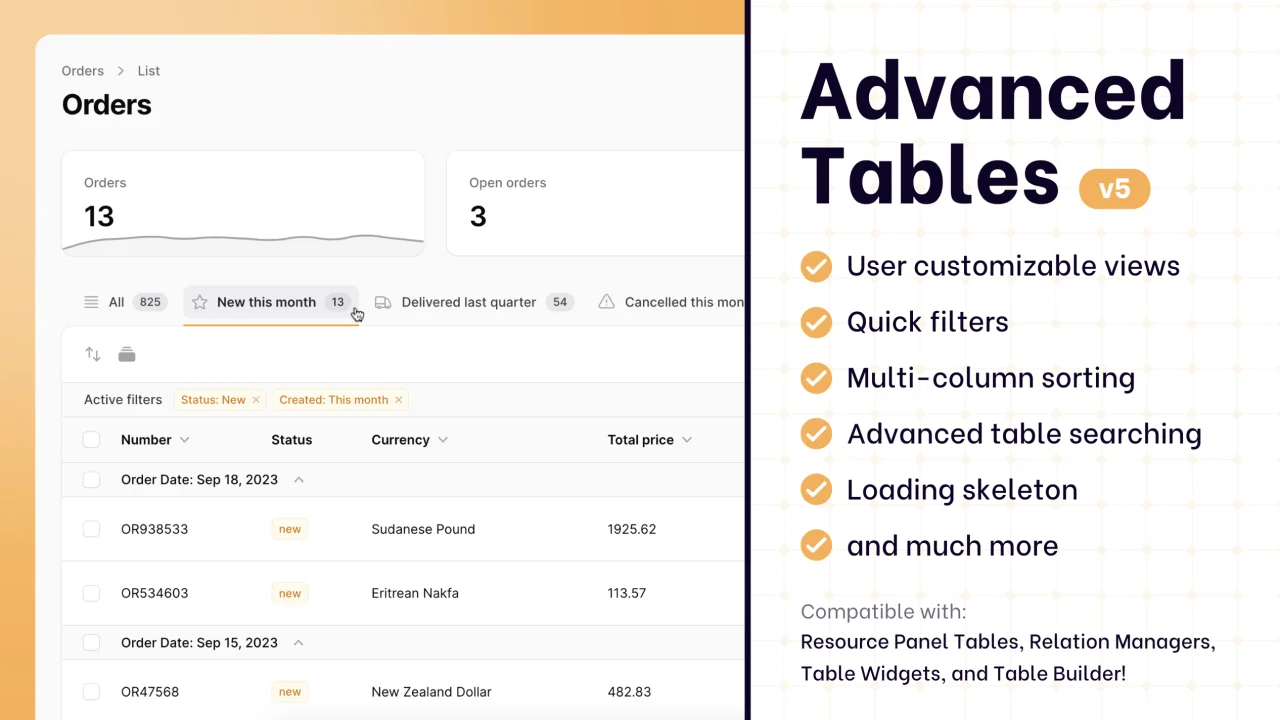
Advanced Tables (formerly Filter Sets)
Supercharge your tables with powerful features like user-customizable views, quick filters, multi-column sorting, advanced table searching, convenient view management, and more. Compatible with Resource Panel Tables, Relation Managers, Table Widgets, and Table Builder!
 Kenneth Sese