DBView
CommunityAn Adminer-like, strictly read-only database viewer for Filament panels.
Author:
R Sivasubramanian
Package health
BetaAutomated checks of this plugin's Composer package
13 checks
-
Passed:
Current Laravel version supported
—
Package dependencies resolve together with current Laravel
13.0. -
Passed:
Current PHP version supported
—
Constraint
^8.2supports current PHP8.5. - Skipped: Current Symfony version supported
- Passed: Abandoned or archived — No consulted source marks the package abandoned (packagist, github).
- Passed: Commit and release recency — Active: last commit 1 days ago; last release 1 days ago.
-
Passed:
composer.lock not committed by library
—
composer.lockis absent from the released dist archive. - Warning: Dist archive is lean
- Failed: GitHub Actions pinned to SHA — View details on Plumb
- Passed: Open security advisories
- Passed: Dependabot PR responsiveness — No open Dependabot PRs.
- Failed: Dependabot or Renovate configured — No dependency updater configuration found. View details on Plumb
- Skipped: Dependency update cooldown configured
- Failed: Provides a security policy — View details on Plumb
filament/
namespace. Review the source and install at your own risk. Found
malware or an unresolved security issue the author won't
address?
Report it
.

Documentation
- Requirements
- Installation
- Features
- Query Runner scope
- Model discovery & registry cache
- Auditing
- Authorization (opt-in)
- Security model (read-only in depth)
- Configuration
- Development
- Changelog
- License
An Adminer-like, read-only database viewer for Filament panels. By default it is scoped to your app's Eloquent models and gives you two ways to explore data:
- Database Browser — pick any model-backed table and browse it with Filament's native table (search, sort, per-column filters, pagination), a full-record slide-over, and one-click relationship previews via detected foreign keys.
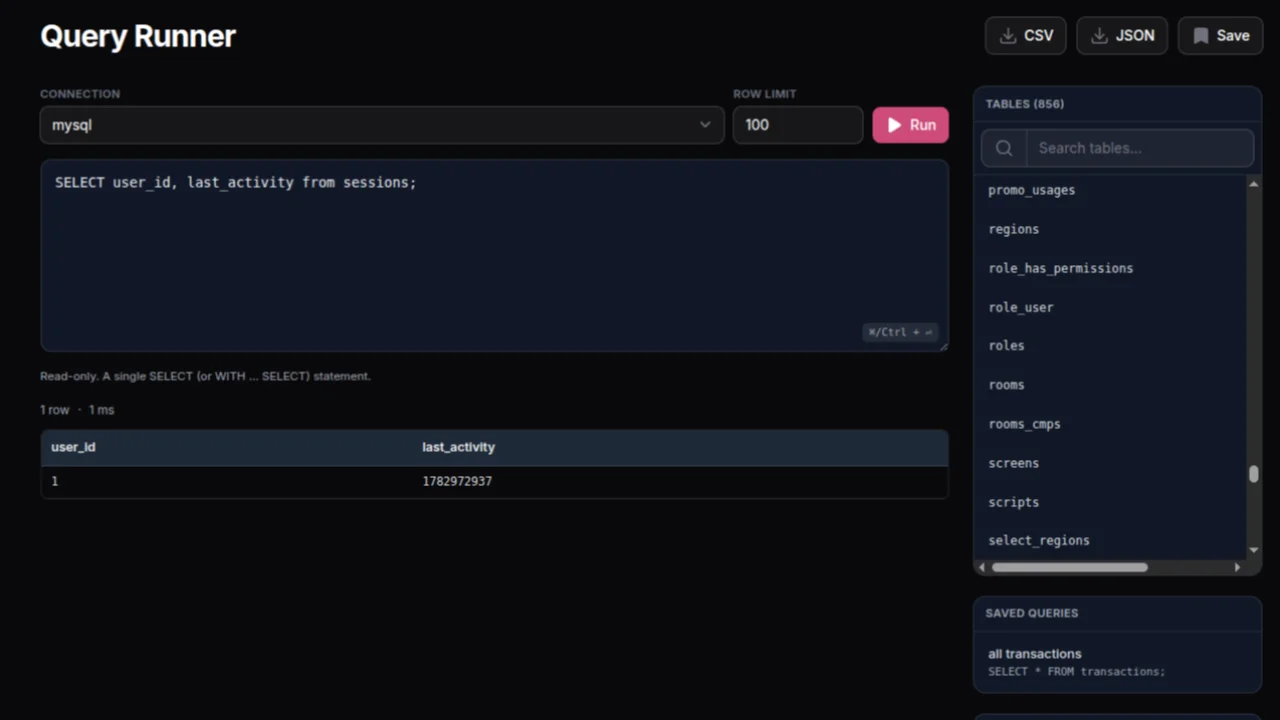
- Query Runner — run ad-hoc
SELECTqueries in an Adminer-style console, withEXPLAIN/EXPLAIN ANALYZE, a table structure view (columns, indexes, foreign keys), CSV/JSON export, saved queries, and optional per-user query history (feature opt-in; table migration ships with the package).
By default the viewer is scoped to Eloquent models your app discovers. The Query
Runner can optionally list every table on an allowed connection (->allTables())
so you can run SELECTs without a model — see Query Runner scope.
AI assistants / agents: start with AGENTS.md for a configuration checklist (install, defaults, gates, audit, production). This README has the full narrative docs.
#Requirements
- PHP 8.2+
- Laravel 11, 12, or 13
- Filament v4 or v5
#Installation
composer require sridhar-s-subramanian/filament-dbview
php artisan vendor:publish --tag="filament-dbview-config"
php artisan vendor:publish --tag="filament-dbview-migrations"
php artisan migrate
Register the plugin on your panel:
use SridharSSubramanian\FilamentDbview\DbviewPlugin;
public function panel(Panel $panel): Panel
{
return $panel->plugin(DbviewPlugin::make());
}
The migrations create two package tables (both ship by default):
dbview_saved_queries— saved Query Runner snippets (feature on by default)dbview_query_history— storage for per-user query history
History writes and UI are opt-in (features.history defaults to false) so
the table does not grow unbounded on busy panels. The table may still be empty
after migrate until you enable the feature:
$panel->plugin(
DbviewPlugin::make()
->history() // persist + show per-user query history
);
PSR-3 audit logging always runs, whether or not history is enabled.
#Features
#Database Browser
A point-and-click browser for one model-backed table at a time — no SQL required:
- Filament's native table with search, click-to-sort, column show/hide (remembered per table), and pagination.
- Adminer-style filters auto-derived from each column's type (text / number / date / boolean), combinable with AND/OR groups.
- Row detail slide-over showing the full record with long/JSON values expanded.
- Relationship previews — one action per foreign key (
→ Related) opens the related rows in a modal, so you can follow relationships without writing joins. - A bookmarkable
?table=URL, so a table can be linked or shared.
#Query Runner
An Adminer-style console for SQL-literate users:
- Run a single read-only
SELECT/WITH … SELECT. Results render in an ad-hoc grid with a row-detail slide-over. Press⌘/Ctrl + Enterto run. - EXPLAIN and EXPLAIN ANALYZE — inspect a query's plan. You never type
EXPLAIN; the typedSELECTpasses the same read-only guards and only then is a driver-appropriate prefix prepended, so the analysed statement is always a single SELECT.EXPLAIN ANALYZEexecutes the query to collect real timings, still row-capped, timed out, and rolled back. - Show structure — header Structure uses the table referenced in your SQL (first real table if several; CTEs ignored). Sidebar icons still open structure for any listed table without writing a query. Shows columns, indexes, and foreign keys, Adminer-style.
- Export results to CSV or JSON (on by default; disable with
features.export => false, or restrict withauthorization.export_gate), saved queries, and optional per-user query history (feature off by default; enable with->history()). - A searchable table sidebar — click a table name to insert it into the editor, the structure icon to inspect it, or the browse link to open it in the Database Browser.
#Moving between the two
The two tools are cross-linked so a table flows from one lens to the other without retyping:
- Runner → Browser: model-backed tables in the Runner sidebar have a Browse link that opens them in the Database Browser.
- Browser → Runner: the Browser's Query and Structure header actions
open the Query Runner with the current table prefilled (
SELECT * FROM <table>) or on its structure view.
#Query Runner scope
The Database Browser is always limited to model-backed tables.
The Query Runner defaults to the same (scope = models), but can be widened
so operators can run SELECTs against any real table on an allowed
connection — including tables that have no Eloquent model. That is
intentional: use it when you need Adminer-style ad-hoc reads beyond the model
map.
| Scope | How to enable | Tables listed / queryable |
|---|---|---|
models (default) |
(default) | Only discovered Eloquent models |
connection |
->allTables() or queryRunnerScope('connection') |
Every real table on the connection |
$panel->plugin(
DbviewPlugin::make()
->allTables() // list + allow every table on allowed connections
// Optional: still block a few sensitive framework tables
->denyTables(['password_reset_tokens', 'sessions', 'personal_access_tokens']),
);
Details:
->allTables()is shorthand for->queryRunnerScope('connection').- The deny list is empty by default so model-less tables are fully reachable
when you opt into connection scope. Add
->denyTables([...])only when you want exceptions (e.g. token/session tables). - Read-only guards, redaction, row limits, timeouts, connection allowlisting, and the optional read-only DB remap still apply to every table.
- Fluent plugin setters take precedence over the
query_runnervalues in the config file.
Query history is off by default (the dbview_query_history migration still
ships). Enable the feature with ->history() or features.history => true when
you want the Query Runner to persist and re-load per-user queries. PSR-3 audit
logging is separate and always runs — see Auditing.
#Model discovery & registry cache
The package scans your app for concrete Eloquent models and builds a registry (model → table → connection → columns / FKs). That registry is the default table allowlist for:
- the Database Browser (always), and
- the Query Runner when
query_runner.scopeismodels(the default).
With ->allTables() / scope = connection, the Runner can also list other real
tables on the connection; discovery still drives the Browser and model-backed
labels/links. Per-user table_gate filters the registry further when set (see
Authorization).
#Configuration knobs
| Key | Default | Purpose |
|---|---|---|
models.paths |
[app_path('Models')] |
Directories to scan for *.php model classes |
models.exclude |
[] |
Fully-qualified class names to never register (global) |
models.cache.enabled |
true (FILAMENT_DBVIEW_CACHE) |
Cache the registry to avoid filesystem/schema work every request |
models.cache.ttl |
3600 (seconds) |
Cache lifetime; null = until manually cleared |
models.cache.store |
null |
Cache store name; null = default store |
models.cache.key |
filament-dbview.registry |
Cache key |
// config/filament-dbview.php
'models' => [
'paths' => [
app_path('Models'),
// app_path('Domain/Orders/Models'),
],
// Global denylist — these models never appear in the Browser / models-scope Runner
'exclude' => [
// \App\Models\PersonalAccessToken::class,
// \App\Models\Passport\Token::class,
// \App\Models\Admin::class,
],
'cache' => [
'enabled' => env('FILAMENT_DBVIEW_CACHE', true),
'store' => null,
'key' => 'filament-dbview.registry',
'ttl' => 3600, // null = cache until filament-dbview:clear
],
],
#Exclude vs table_gate vs allTables
| Mechanism | Scope | Use when |
|---|---|---|
models.exclude |
All users; model never enters the registry | Table should not be browsable as a model at all |
authorization.table_gate |
Per user; filters the registry | Some roles may see orders, others may not |
->allTables() |
Query Runner only | Need SELECT on tables without an Eloquent model |
#Cache & deploys
With cache enabled (default), the registry is stored for ttl seconds. After
you:
- add/remove/rename models,
- change a model’s
$tableor connection, - or change
models.paths/exclude,
run:
php artisan filament-dbview:clear
Add that command to your deploy script when registry cache is on in production, so new models show up immediately instead of waiting for TTL.
For local development you can disable the cache:
FILAMENT_DBVIEW_CACHE=false
Abstract models, interfaces, and classes that are not subclasses of
Illuminate\Database\Eloquent\Model are ignored. Models whose table/connection
cannot be introspected are skipped (not fatal).
#Auditing
Every Query Runner attempt (allowed or denied) is written as a structured PSR-3 log line for accountability. This is always on and independent of query history.
| Destination | Default | Contains full SQL? |
|---|---|---|
PSR-3 log (audit.log_channel) |
On (app default logger) | Yes (audit.log_sql default true) |
dbview_query_history table / UI |
Off (features.history) |
Yes, when history is enabled |
Typical log context:
filament-dbview query allowed|denied
user_id, connection, allowed, reason, row_count, duration_ms
sql ← included when audit.log_sql is true (default)
#Configuration
// config/filament-dbview.php
'audit' => [
// null = Laravel's default logger. Prefer a dedicated channel in production.
'log_channel' => env('FILAMENT_DBVIEW_LOG_CHANNEL', null),
// true = include full SQL in the log context (default; useful for debugging denials).
// false = metadata only (omit SQL if you treat logs as less trusted than the DB).
// filter_var so FILAMENT_DBVIEW_LOG_SQL=false in .env is a real boolean false.
'log_sql' => filter_var(env('FILAMENT_DBVIEW_LOG_SQL', true), FILTER_VALIDATE_BOOLEAN),
],
Example dedicated channel in config/logging.php (host app):
'channels' => [
'dbview' => [
'driver' => 'daily',
'path' => storage_path('logs/dbview.log'),
'level' => env('LOG_LEVEL', 'debug'),
'days' => 14,
],
],
Then:
FILAMENT_DBVIEW_LOG_CHANNEL=dbview
# FILAMENT_DBVIEW_LOG_SQL=false
#Operational notes
- Full SQL may include secrets typed into
WHEREclauses (passwords, tokens, PII). Treat the audit log (and history, if enabled) as sensitive. - Use a restricted channel and retention policy when logs leave the app server (SIEM, CloudWatch, etc.).
- Setting
log_sql => falsedoes not disable auditing — only the SQL field is omitted. Denied attempts still logreason, user, and connection. - Query history (when enabled) still stores full SQL so users can re-load past queries in the UI; turn history off if you do not want SQL in the database.
#Authorization (opt-in)
Access is allow by default for anyone who can open your Filament panel. This package does not ship a roles system and does not depend on Spatie Permission, Filament Shield, Bouncer, or similar. Panel login is enough unless you opt in to extra checks.
To restrict by role or permission, point the package at Laravel Gate ability
names. Any roles plugin (or your own logic) can define those abilities — the
package only calls Gate::allows(...).
| Config key | Default | When set (opt-in) |
|---|---|---|
authorization.gate |
null → allow |
User must pass this ability to open Browser and Runner |
authorization.query_runner_gate |
null → allow |
Extra ability required for Query Runner only |
authorization.table_gate |
null → all in-scope tables |
Per-table filter; ability receives the table name |
authorization.export_gate |
null → allow if export is on |
Extra ability required for CSV/JSON export |
#1. Publish config (if you have not already)
php artisan vendor:publish --tag="filament-dbview-config"
#2. Define Gate abilities in your app
Register them in AppServiceProvider, AuthServiceProvider, or wherever you
define policies — using whatever permission system you already have.
Custom / simple:
use Illuminate\Support\Facades\Gate;
Gate::define('viewDbview', function ($user) {
return (bool) ($user->is_admin ?? false);
});
Gate::define('runDbviewQueries', function ($user) {
return (bool) ($user->is_admin ?? false);
});
// Optional: limit which tables appear / can be queried
Gate::define('viewDbviewTable', function ($user, string $table) {
return in_array($table, ['users', 'orders', 'posts'], true);
});
// Optional: who may download CSV/JSON from the Query Runner
Gate::define('exportDbview', function ($user) {
return (bool) ($user->is_admin ?? false);
});
Spatie Laravel Permission (or any package that exposes $user->can(...)):
use Illuminate\Support\Facades\Gate;
Gate::define('viewDbview', fn ($user) => $user->can('dbview.access'));
Gate::define('runDbviewQueries', fn ($user) => $user->can('dbview.query'));
Gate::define('viewDbviewTable', fn ($user, string $table) =>
$user->can('dbview.tables.*') || $user->can("dbview.tables.{$table}")
);
Gate::define('exportDbview', fn ($user) => $user->can('dbview.export'));
Ability names are arbitrary — use whatever strings you prefer, then mirror them in config.
#3. Point the package at those abilities
In config/filament-dbview.php:
'authorization' => [
// Leave as null to allow every authenticated panel user (default).
'gate' => 'viewDbview',
// Optional: tighter control for the Query Runner (raw SELECT console).
// If set, the user must pass both `gate` and this ability.
'query_runner_gate' => 'runDbviewQueries',
// Optional: hide / block tables the user may not see.
// The Gate is invoked as: allows('viewDbviewTable', $tableName)
'table_gate' => 'viewDbviewTable',
// Optional: who may download CSV/JSON (null = any user who can run queries).
'export_gate' => 'exportDbview',
],
Or via environment-driven config if you prefer:
'authorization' => [
'gate' => env('FILAMENT_DBVIEW_GATE'), // null when unset → allow
'query_runner_gate' => env('FILAMENT_DBVIEW_QUERY_GATE'),
'table_gate' => env('FILAMENT_DBVIEW_TABLE_GATE'),
'export_gate' => env('FILAMENT_DBVIEW_EXPORT_GATE'),
],
#Export: feature flag vs gate
| Goal | Config |
|---|---|
| Export on for everyone who can use the Query Runner (default) | features.export => true, export_gate => null |
| Export only for some roles | features.export => true, export_gate => 'exportDbview' (define the Gate) |
| No export for anyone | features.export => false (hides CSV/JSON entirely) |
#Behaviour summary
- All authorization keys
null→ any user who can access the Filament panel can use DB View (subject to table scope: models vsallTables(), etc.), including CSV/JSON export whenfeatures.exportis true. gateset → user must pass that ability or both pages are hidden / denied.query_runner_gateset → user must also pass it to open Query Runner; Browser still only needsgate.table_gateset → sidebar, browser, runner scope, and structure only include tables for which the Gate returns true.export_gateset → user must also pass it to download CSV/JSON (and must still be allowed to run queries). Export actions re-check the gate server-side.features.export => false→ export is off for everyone, regardless of gates.
If you do not need role-based restrictions, leave the authorization section untouched.
#Security model (read-only in depth)
Direct database access is guarded on multiple, independent layers — see
ReadOnlyGuard:
- Lexical allowlist — only a single
SELECT/WITH … SELECTstatement is accepted. Stacked statements, executable comments (/*! … */,/*+ … */), and many write/DDL/file/DoS tokens (INSERT,UPDATE,DROP,INTO OUTFILE,LOAD_FILE,SLEEP, lock helpers, …) are rejected. Strings and comments are stripped before keyword scanning. Schema/database-qualified names (other_db.users) are refused. Prefer a SELECT-only DB user as the strongest write barrier (see below). - Table scope — default
modelsscope: only discovered models the user may see.connectionscope (->allTables()): any real table on an allowed connection (optionaldenyTables()). The Browser is always model-only. - Connection allowlist — the runner may only use connections derived from
discovered models (or an explicit
connections.allowedlist). - Enforced
LIMITand statement timeout cap runaway queries. - Rolled-back transaction (Query Runner) — reads run inside a transaction
that is always rolled back (including
EXPLAIN ANALYZE). The Browser uses Eloquent reads with optional read-only connection remaps and timeouts. - Optional dedicated read-only connection — map app connections to a DB user
granted only
SELECT(recommended for production).
#SQL analysis limits
The Query Runner uses a lexical analyzer (SqlAnalyzer), not a full SQL
engine grammar. It is built for security questions (one statement? read-only?
which tables? sensitive columns?) and is intentionally fail-closed on many
ambiguous forms.
What it handles well today:
- Single
SELECT/WITH … SELECT(including multiple CTEs andRECURSIVE) - Comma joins and
JOINs; quoted identifiers (backticks /"…"/[…]) - Rejecting stacked statements, executable comments, many write/DoS tokens
- Rejecting schema/database-qualified table names (
other_db.users) - Rejecting row-lock clauses (
FOR UPDATE,FOR SHARE,SKIP LOCKED,LOCK IN SHARE MODE, …) so the viewer cannot block other sessions - Postgres-style
AS MATERIALIZED/AS NOT MATERIALIZEDCTEs
Practical guidance:
- Prefer bare table names from the sidebar (logical names the app already knows).
- If a complex CTE or dialect-specific form is rejected, simplify the SQL or split the query; report persistent false denies with a minimal repro.
- The analyzer is one layer only — pair it with a SELECT-only database user for the strongest write prevention.
Additional controls:
- Sensitive-column redaction (
password,*_token,*_secret, …) in the browser, the runner, and exports (including common alias/expression cases). - Authorization — allow any panel user by default; optional Laravel Gates (see Authorization (opt-in)).
- Auditing — every allowed/denied Query Runner attempt is written to a PSR-3
log channel (see Auditing); the history table is used only when
features.historyis enabled.
#Configuration
Everything is configured in config/filament-dbview.php. The most useful knobs:
'models' => [
'paths' => [app_path('Models')], // see Model discovery section
'exclude' => [], // FQCNs never registered
'cache' => ['enabled' => true, 'ttl' => 3600, /* store, key */],
],
'connections' => [
'allowed' => null, // null = every connection a model uses
'read_only' => [], // e.g. ['mysql' => 'mysql_readonly']
],
'limits' => [
'default_rows' => 100,
'max_rows' => 1000,
'timeout' => 15, // statement timeout (seconds)
'max_result_bytes' => 5 * 1024 * 1024,
],
'redact' => ['password', '*_token', '*_secret', /* … */],
'features' => [
'query_runner' => true,
'explain' => true, // EXPLAIN / EXPLAIN ANALYZE buttons
'structure' => true, // "Show structure" (columns/indexes/FKs)
'export' => true, // false = hide CSV/JSON for everyone
'history' => false, // feature opt-in (table still migrates); ->history()
'saved_queries' => true,
'relationship_preview' => true, // FK preview actions in the browser
],
'query_runner' => [
'scope' => 'models', // 'models' | 'connection' (allTables)
'deny' => [], // optional blocks in connection scope only
],
// Authorization is allow-by-default; set ability names to opt in (see Authorization section).
'authorization' => [
'gate' => null, // e.g. 'viewDbview'
'query_runner_gate' => null, // e.g. 'runDbviewQueries'
'table_gate' => null, // e.g. 'viewDbviewTable' (receives table name)
'export_gate' => null, // e.g. 'exportDbview' (CSV/JSON)
],
'audit' => [
'log_channel' => null, // e.g. 'dbview' — dedicated Laravel log channel
'log_sql' => true, // false = omit SQL body from PSR-3 context
],
After changing models or discovery config with the registry cache enabled, clear it (see Model discovery & registry cache):
php artisan filament-dbview:clear
#Development
composer test # Pest + Testbench (incl. OWASP security suite)
composer analyse # PHPStan / Larastan
composer format # Pint (PER)
composer lint # PHP_CodeSniffer (PSR-12)
#Changelog
See CHANGELOG.md for a list of changes per release.
#License
MIT. See LICENSE.md.
Featured Plugins
A selection of plugins curated by the Filament team
Blueprint
Filament Blueprint is a premium Laravel Boost extension that helps AI agents produce accurate, detailed implementation plans and security reports for Filament apps.
Filament
Advanced Tables (formerly Filter Sets)
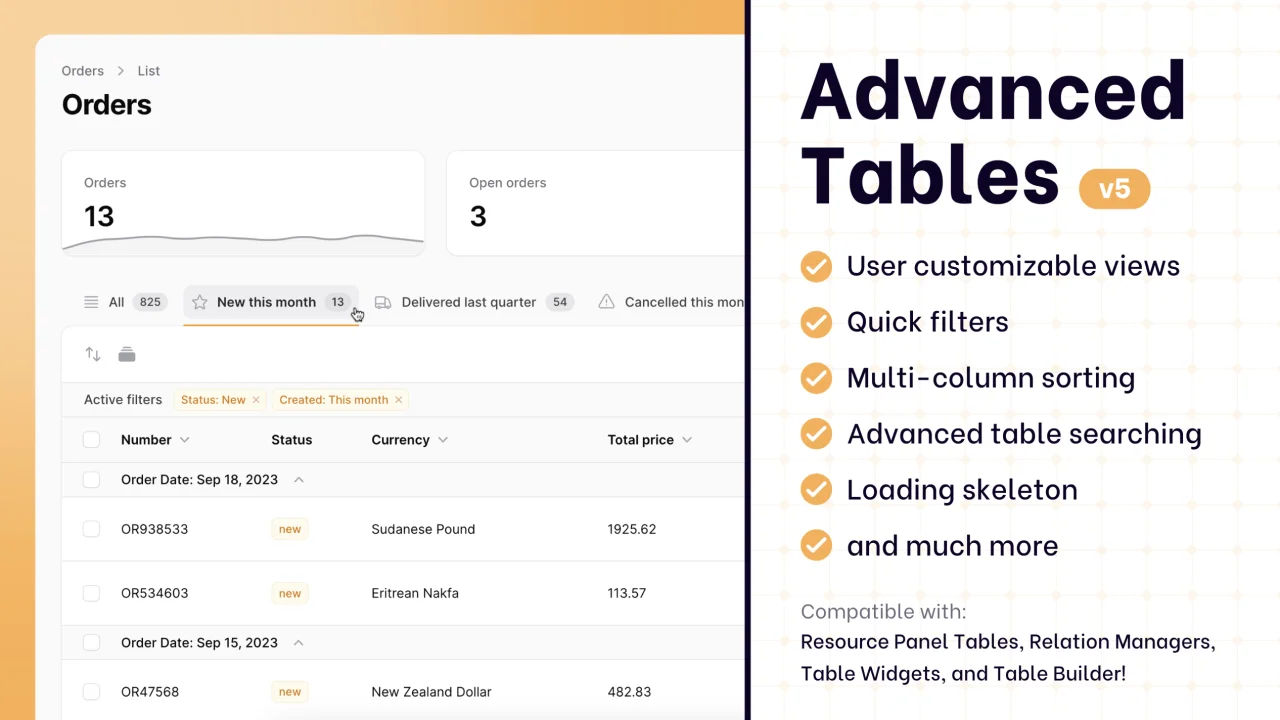
Supercharge your tables with powerful features like user-customizable views, quick filters, multi-column sorting, advanced table searching, convenient view management, and more. Compatible with Resource Panel Tables, Relation Managers, Table Widgets, and Table Builder!

Kenneth Sese
Spotlight Pro
Browse your Filament Panel with ease. Filament Spotlight Pro adds a Spotlight/Raycast like Command Palette to your Filament Panel.
Dennis Koch