Reveal by Rawand Rasool
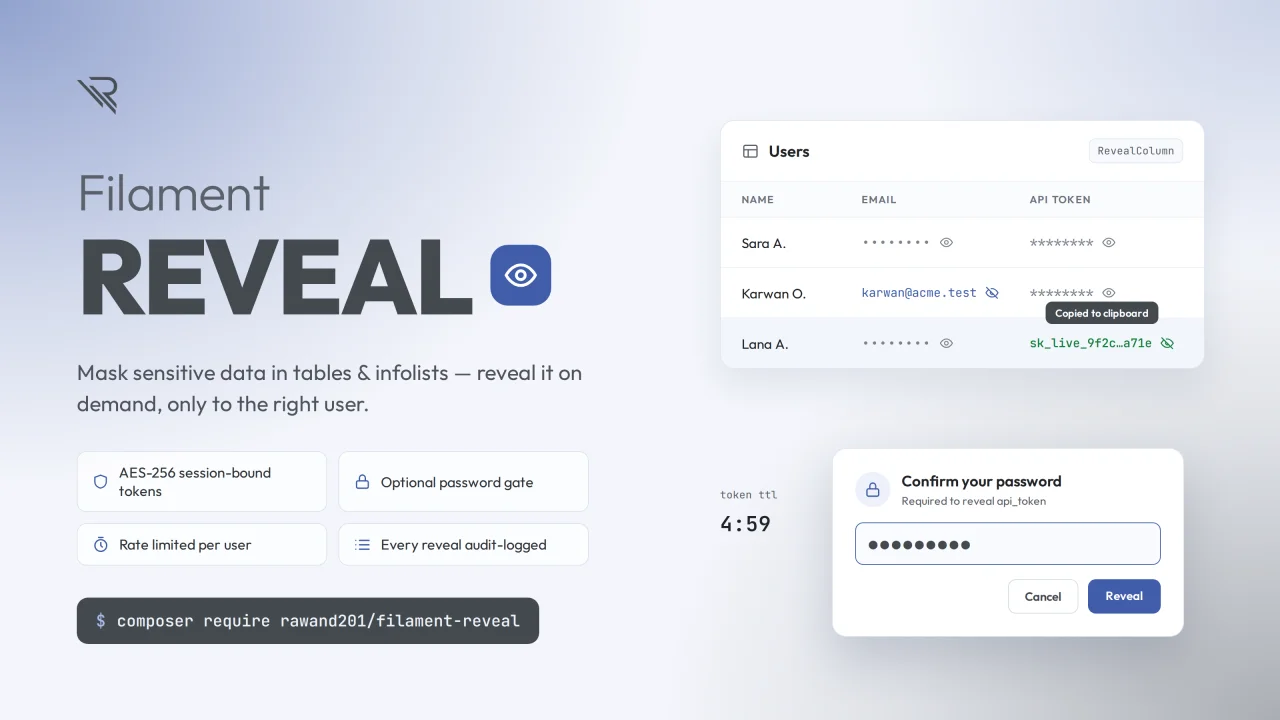
CommunityFilament column & infolist components to safely reveal sensitive data on demand.
 Author:
Rawand Rasool
Package health
Automated checks of this plugin's Composer package
15 checks
- Passed: GitHub Actions pinned to SHA
- Skipped: GitLab CI includes pinned to SHA
- Passed: Open security advisories
- Passed: Dependabot PR responsiveness — No open Dependabot PRs.
- Skipped: Renovate MR responsiveness
- Passed: Dependabot or Renovate configured
- Passed: Dependency update cooldown configured
- Passed: Provides a security policy
- Passed: Abandoned or archived — No consulted source marks the package abandoned (packagist, github).
- Passed: Commit and release recency — Active: last commit 0 days ago; last release 182 days ago.
-
Passed:
composer.lock not committed by library
—
composer.lockis absent from the released dist archive. - Passed: Dist archive is lean
-
Passed:
Current Laravel version supported
—
Package dependencies resolve together with current Laravel
13.0. -
Passed:
Current PHP version supported
—
Constraint
^8.2supports current PHP8.5. - Skipped: Current Symfony version supported
filament/
namespace. Review the source and install at your own risk. Found
malware or an unresolved security issue the author won't
address?
Report it
.
Documentation
- Demo screencasts
- Features
- Requirements
- Installation
- Quick Start
- Column & Entry API
- Model — HasRevealableColumns Trait
- Configuration
- Security Model
- Laravel Events
- Advanced Examples
- Translations
- Frequently Asked Questions
- Changelog
- Compatibility
- Support
- Upgrade guide
- Contributing
- Code of Conduct
- Security Vulnerabilities
- License
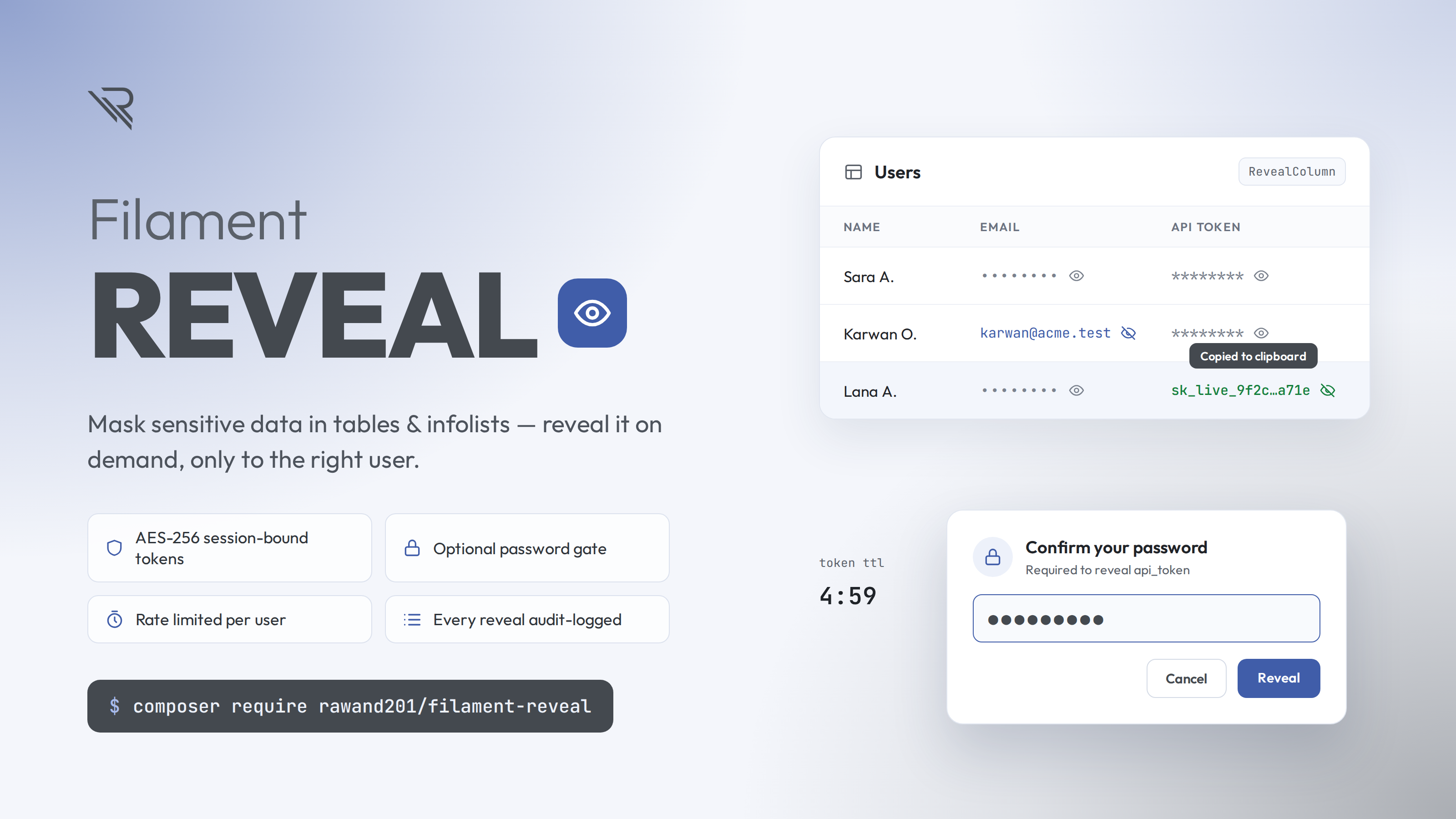



A secure, production-ready Filament package for safely revealing sensitive data — API keys, tokens, emails, and secrets — on demand in both tables and infolists, with optional password authentication, rate limiting, audit logging, and full dark mode support.
#Demo screencasts
Main demo — mask, toggle, reveal, copy:

Authentication — requiresAuthentication(), password modal:

Infolist — RevealEntry on a view page:

#Features
- Hidden by default — sensitive values are masked with bullets, asterisks, or a custom string
- Tables & Infolists —
RevealColumnfor tables,RevealEntryfor infolist view pages - Click to reveal — eye-icon toggle fetches the real value via an encrypted AJAX request
- Password authentication — optionally require the user to enter their password before revealing
- Click to copy — click the revealed value to copy it to the clipboard
- Security-first tokens — each token is AES-256 encrypted, session-bound, user-bound, and expires in 5 minutes
- Rate limiting — configurable per-user request throttle (default 10/min)
- Audit logging — every reveal attempt (success or failure) is logged with user, model, IP, and timestamp
- Laravel events — fire
ColumnRevealed,ColumnRevealFailed, andUnauthorizedRevealAttemptfor security monitoring - Column whitelist — only columns you explicitly allow can ever be revealed
- Custom authorization — override
authorizeRevealColumn()per model for fine-grained access control - Multi-language — ships with English and Arabic; easily extensible
- Dark mode — full Filament dark mode support
- Zero build step — no Vite/npm required in your project
#Requirements
| Version | |
|---|---|
| PHP | ^8.2 (8.2 / 8.3 / 8.4 / 8.5) |
| Laravel | 10.x / 11.x / 12.x / 13.x |
| Filament | ^4.0 | ^5.0 |
#Installation
composer require rawand201/filament-reveal
The service provider is auto-discovered. No manual registration needed.
#Publish assets
php artisan filament:assets
#Publish the config (optional)
php artisan vendor:publish --tag="filament-reveal-config"
#Publish translations (optional)
php artisan vendor:publish --tag="filament-reveal-translations"
#Quick Start
#1 — Add the trait to your model
use Rawand\FilamentReveal\Concerns\HasRevealableColumns;

class User extends Authenticatable
{
    use HasRevealableColumns;

    // Whitelist of columns that are allowed to be revealed
    protected array $revealableColumns = [
        'api_token',
        'email',
    ];
}
#2 — Add RevealColumn to your Filament table
use Rawand\FilamentReveal\Columns\RevealColumn;

public static function table(Table $table): Table
{
    return $table->columns([
        TextColumn::make('name'),

        RevealColumn::make('email'),

        RevealColumn::make('api_token')
            ->maskAsterisk()
            ->revealedColor('success')
            ->requiresAuthentication(),
    ]);
}
#3 — Add RevealEntry to your Filament infolist (optional)
use Rawand\FilamentReveal\Entries\RevealEntry;

public static function infolist(Schema $schema): Schema
{
    return $schema->components([
        RevealEntry::make('email'),

        RevealEntry::make('api_token')
            ->maskAsterisk()
            ->revealedColor('success')
            ->requiresAuthentication(),
    ]);
}
That's it. Values show •••••••• by default and reveal when the eye icon is clicked.
#Column & Entry API
RevealColumn and RevealEntry share the same API.
#Mask
Control how the value is hidden before it is revealed.
->maskBullet()       // ••••••••  (default)
->maskAsterisk()     // ********
->maskHash()         // ########
->mask('xxxx-xxxx') // custom string
Set the default globally in config/filament-reveal.php:
'default_mask' => 'bullet', // 'bullet' | 'asterisk' | 'hash' | 'your-custom-string'
#Revealed color
The color applied to the value after it is revealed.
->revealedColor('primary')  // blue (default)
->revealedColor('success')  // green
->revealedColor('warning')  // yellow
->revealedColor('danger')   // red
->revealedColor('info')     // light blue
->revealedColor('gray')     // gray
#Password authentication
Require the user to enter their account password before the value is revealed. A modal appears, collects the password, verifies it server-side, and only then fetches the real value.
->requiresAuthentication()

// Or pass a boolean/closure
->requiresAuthentication(fn () => auth()->user()->isAdmin())
Enable for all columns/entries by default in config:
'require_authentication' => true,
#Model — HasRevealableColumns Trait
#$revealableColumns
Explicit whitelist. Only columns listed here can ever be revealed, regardless of what the frontend requests.
protected array $revealableColumns = [
    'api_token',
    'secret_key',
    'email',
];
#authorizeRevealColumn()
Override to add your own authorization logic. Return false to block the reveal.
public function authorizeRevealColumn(string $column, ?Authenticatable $user = null): bool
{
    // Only super-admins can reveal secret keys
    if ($column === 'secret_key') {
        return $user?->hasRole('super-admin') ?? false;
    }

    // Users can reveal their own data; admins can reveal anyone's
    return $this->id === $user?->id || $user?->hasRole('admin');
}
#getRevealableColumnValue()
Override to transform the value before it is sent to the browser.
public function getRevealableColumnValue(string $column): mixed
{
    $value = parent::getRevealableColumnValue($column);

    if ($column === 'api_token') {
        return 'Bearer ' . $value;
    }

    return $value;
}
#Configuration
Full reference for config/filament-reveal.php:
return [
    // Color of the revealed value
    'revealed_color' => 'primary', // primary | success | warning | danger | info | gray

    // Default mask style
    'default_mask' => 'bullet', // bullet | asterisk | hash | custom-string

    // Eye icon size
    'icon_size' => 'md', // sm | md | lg

    // Allow searching masked columns (disabled for security)
    'searchable' => false,

    // Require password before revealing (global default)
    'require_authentication' => false,

    // Token validity window in seconds
    'token_expiry' => 300, // 5 minutes

    // Per-user rate limiting
    'rate_limit' => [
        'max_attempts' => 10,
        'decay_minutes' => 1,
    ],

    // Log successful reveals to Laravel's log channel
    'audit_logging' => true,

    // Log failed / unauthorized reveal attempts
    'log_failed_attempts' => true,

    // Include the client IP in log entries and events
    'log_ip_address' => true,

    // Middleware applied to the reveal endpoint
    'middleware' => [
        'web',
    ],
];
#Security Model
#How tokens work
When a table or infolist is rendered, each RevealColumn / RevealEntry cell receives a short-lived encrypted token instead of the actual value. The token is generated server-side and contains:
| Field | Content |
|---|---|
r |
Record ID |
c |
Column name |
m |
Model class |
t |
Issued-at timestamp |
s |
HMAC of the current session ID |
u |
Authenticated user ID |
The token is encrypted with AES-256-CBC using your APP_KEY. Even though it is visible in the page source, its contents cannot be read or tampered with without the key.
#What happens when the eye icon is clicked
- Alpine.js POSTs the token to the obfuscated endpoint (
/x-fr-{hash}) - The server verifies:
- The user is authenticated (all configured guards are checked)
- The token decrypts successfully
- The token has not expired (default 5 min)
- The token's session fingerprint matches the current session
- The token's user ID matches the authenticated user
- The column is in the model's
$revealableColumnswhitelist authorizeRevealColumn()returnstrue
- The rate limiter is checked (default 10 requests/minute per user)
- The real value is returned and rendered in the browser
- A
ColumnRevealedevent is fired and the attempt is logged
#Defence layers
| Layer | What it prevents |
|---|---|
| AES-256 encrypted token | Token contents cannot be read or forged |
| Session binding | A token stolen from devtools cannot be used in a different browser |
| User binding | Admin A cannot use a token generated for Admin B |
| 5-minute expiry | Captured tokens become worthless quickly |
| Column whitelist | Cannot reveal columns not explicitly allowed on the model |
authorizeRevealColumn() |
Per-record, per-column, per-user access control |
| CSRF token required | Cross-site request forgery blocked |
| Rate limiting | Brute force and enumeration attacks throttled |
| Obfuscated endpoint | Endpoint URL is not guessable without the APP_KEY |
| Audit logging | Every attempt is traceable |
#Laravel Events
Listen to these events for security monitoring, alerting, or additional logging.
#ColumnRevealed — successful reveal
use Rawand\FilamentReveal\Events\ColumnRevealed;

Event::listen(ColumnRevealed::class, function (ColumnRevealed $event) {
    // $event->user         — the authenticated user
    // $event->modelClass   — e.g. "App\Models\User"
    // $event->recordId     — e.g. "42"
    // $event->columnName   — e.g. "api_token"
    // $event->ipAddress    — client IP (if log_ip_address is true)
    // $event->metadata     — ['user_agent' => '...']
});
#UnauthorizedRevealAttempt — authorization failed
use Rawand\FilamentReveal\Events\UnauthorizedRevealAttempt;

Event::listen(UnauthorizedRevealAttempt::class, function ($event) {
    Log::critical('Unauthorized reveal attempt', [
        'user_id' => $event->user->id,
        'column'  => $event->columnName,
        'ip'      => $event->ipAddress,
    ]);
});
#ColumnRevealFailed — token invalid, expired, or rate-limited
use Rawand\FilamentReveal\Events\ColumnRevealFailed;

Event::listen(ColumnRevealFailed::class, function ($event) {
    Log::warning('Reveal failed', ['reason' => $event->reason]);
});
#Advanced Examples
#Role-based column access
public function authorizeRevealColumn(string $column, ?Authenticatable $user = null): bool
{
    return match ($column) {
        'secret_key' => $user?->hasRole('super-admin'),
        'api_token'  => $user?->hasAnyRole(['admin', 'developer']),
        default      => $user !== null,
    };
}
#Own-record-only access
public function authorizeRevealColumn(string $column, ?Authenticatable $user = null): bool
{
    return $this->getKey() === $user?->getKey()
        || $user?->hasRole('admin');
}
#Environment-conditional authentication
RevealColumn::make('api_token')
    ->requiresAuthentication(fn () => app()->isProduction())
#Translations
The package ships with English (en) and Arabic (ar). Add your own by publishing and creating a new locale file:
php artisan vendor:publish --tag="filament-reveal-translations"
This creates lang/vendor/filament-reveal/{locale}/reveal-column.php. Copy an existing file and translate the values.
#Frequently Asked Questions
Does the actual value ever appear in the page HTML? No. Only an encrypted token is embedded in the page. The real value is fetched via a separate authenticated AJAX request, only when the user explicitly clicks the eye icon.
Can I use it outside a Filament Resource?
Yes — any Filament table that uses InteractsWithTable supports RevealColumn, and any infolist that uses InteractsWithInfolists supports RevealEntry. This includes pages, relation managers, and widgets.
What if my app uses a non-default auth guard?
The controller and the authentication modal both iterate over all guards defined in config/auth.guards, so custom guards work automatically.
Does it work with Filament multi-tenancy?
Yes. Add your tenancy check inside authorizeRevealColumn() to restrict reveals to the current tenant's records.
What happens if APP_KEY rotates?
All existing tokens become invalid immediately (they fail decryption). New tokens are issued on the next page load. No data is lost — only the short-lived reveal tokens are affected.
#Changelog
Please see CHANGELOG for more information on what has changed recently.
#Compatibility
- PHP: ^8.2 (8.2, 8.3, 8.4, 8.5)
- Laravel: 10.x / 11.x / 12.x / 13.x
- Filament: ^4.0 | ^5.0
#Support
- Bug reports & feature requests: please use GitHub Issues.
- Security reports: please follow SECURITY (do not disclose publicly).
#Upgrade guide
- Patch/minor releases (e.g.
1.0.x→1.1.x): update via Composer as usual. - Major releases (e.g.
1.x→2.x): check CHANGELOG for breaking changes and upgrade notes.
#Contributing
Please see CONTRIBUTING for details.
#Code of Conduct
Please see CODE_OF_CONDUCT.
#Security Vulnerabilities
Please review our security policy on how to report security vulnerabilities.
#License
The MIT License (MIT). Please see License File for more information.
The author
Senior Laravel & Filament Developer with strong experience building scalable SaaS and admin systems. Actively working with the Filament ecosystem to create efficient, user-friendly dashboards and custom solutions. Experienced in leading teams, architecting backend systems, and delivering production-ready applications. Passionate about clean code, performance, and developer experience.
From the same author
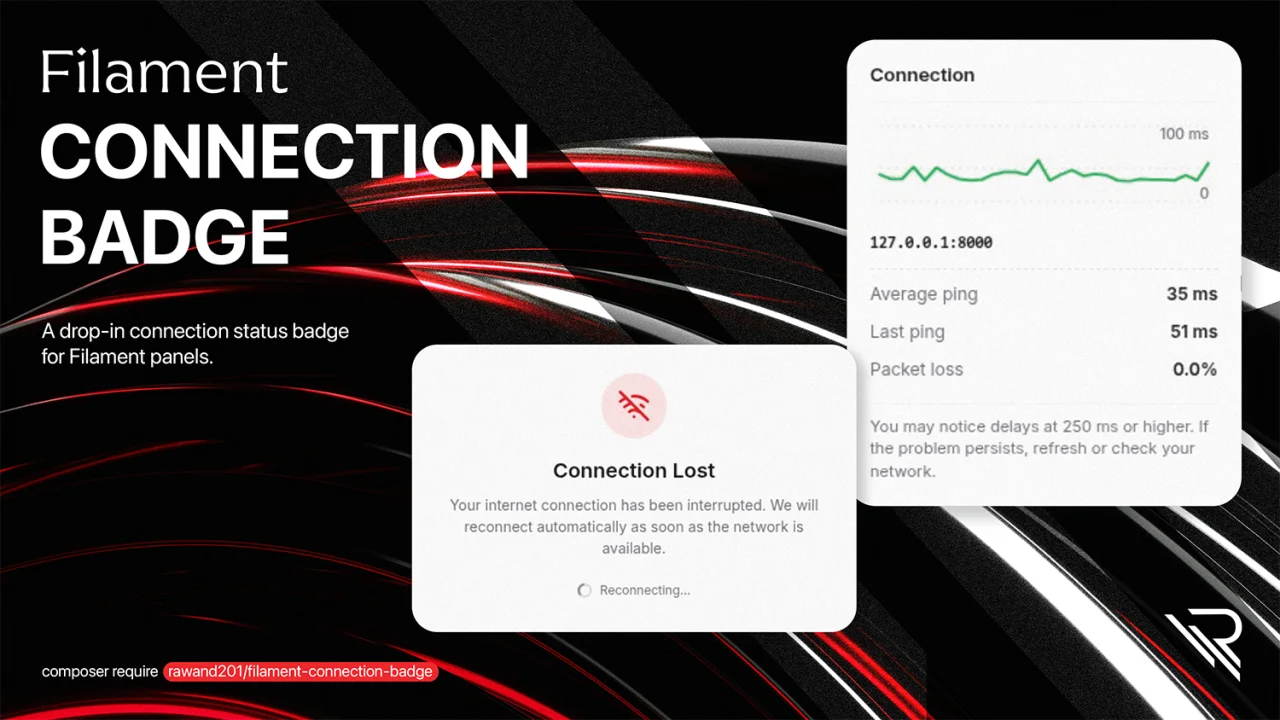
Connection Badge
A drop-in connection status badge for Filament panels — shows a live signal-bars icon in the topbar, a live ping graph on hover, and a full-screen overlay when the connection drops.
Author:
Rawand Rasool
Spatie Lighthouse
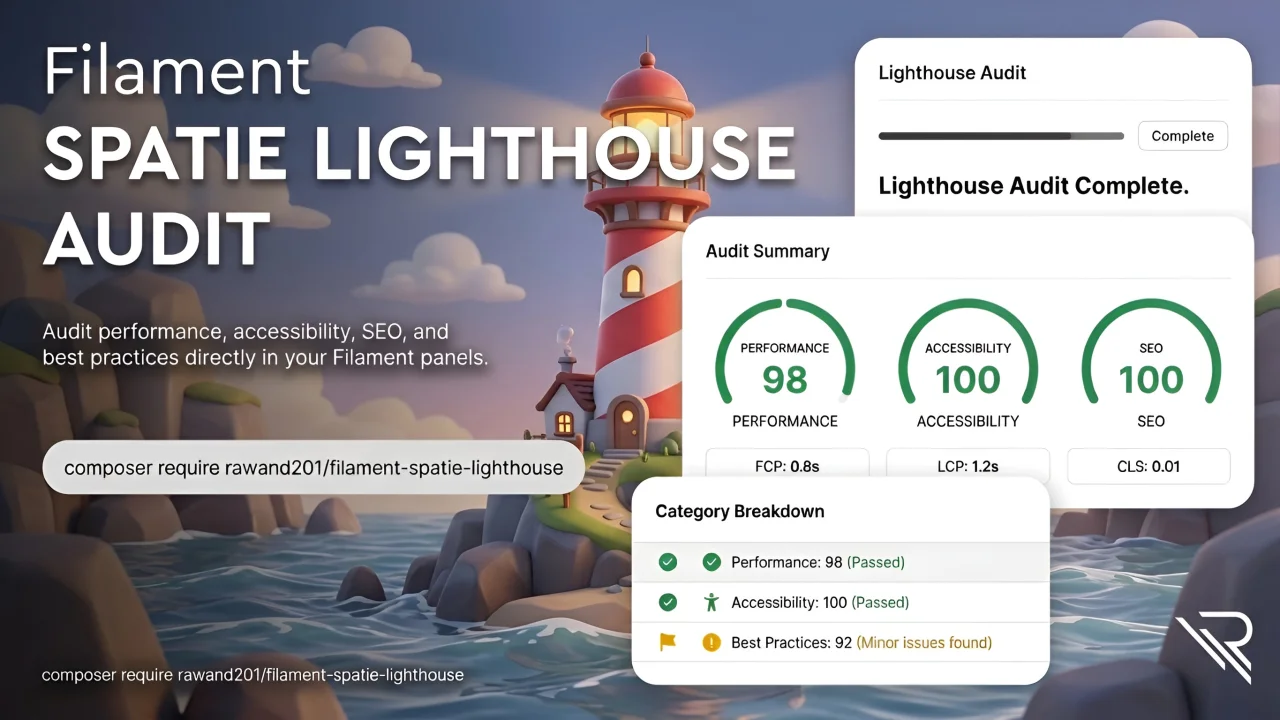
A Filament plugin built on spatie/lighthouse-php that brings Google Lighthouse auditing into your admin panel. Enter a URL and get category scores, Core Web Vitals, and failed audits, plus the native Lighthouse HTML report inline or as a download. Supports queued and scheduled audits, per-URL history with auto-pruning, email and Slack notifications, read-only REST endpoints, Artisan commands, lifecycle events, and pluggable result stores (database, cache, or your own) with optional filesystem/S3
Author:
Rawand Rasool
Featured Plugins
A selection of plugins curated by the Filament team
Soft Theme
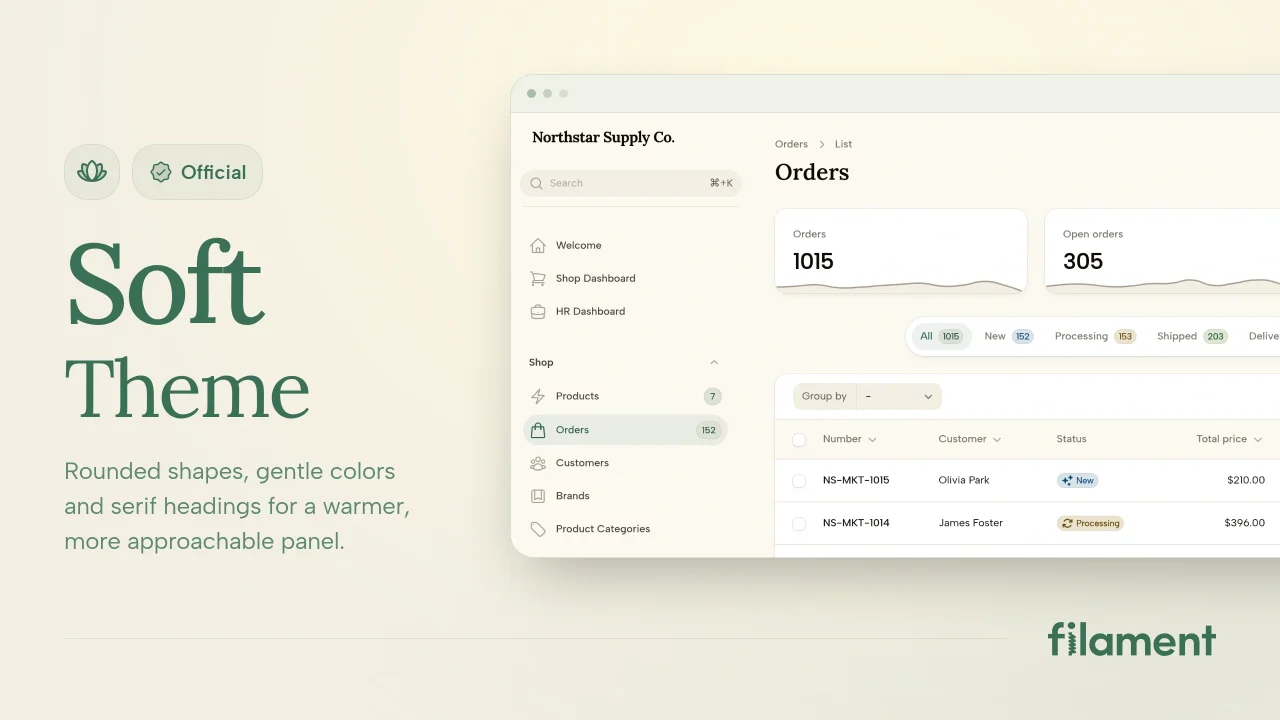
A theme that gives panels a warm, approachable look with rounded shapes, gentle colors, and serif headings.
 Filament
Spotlight Pro
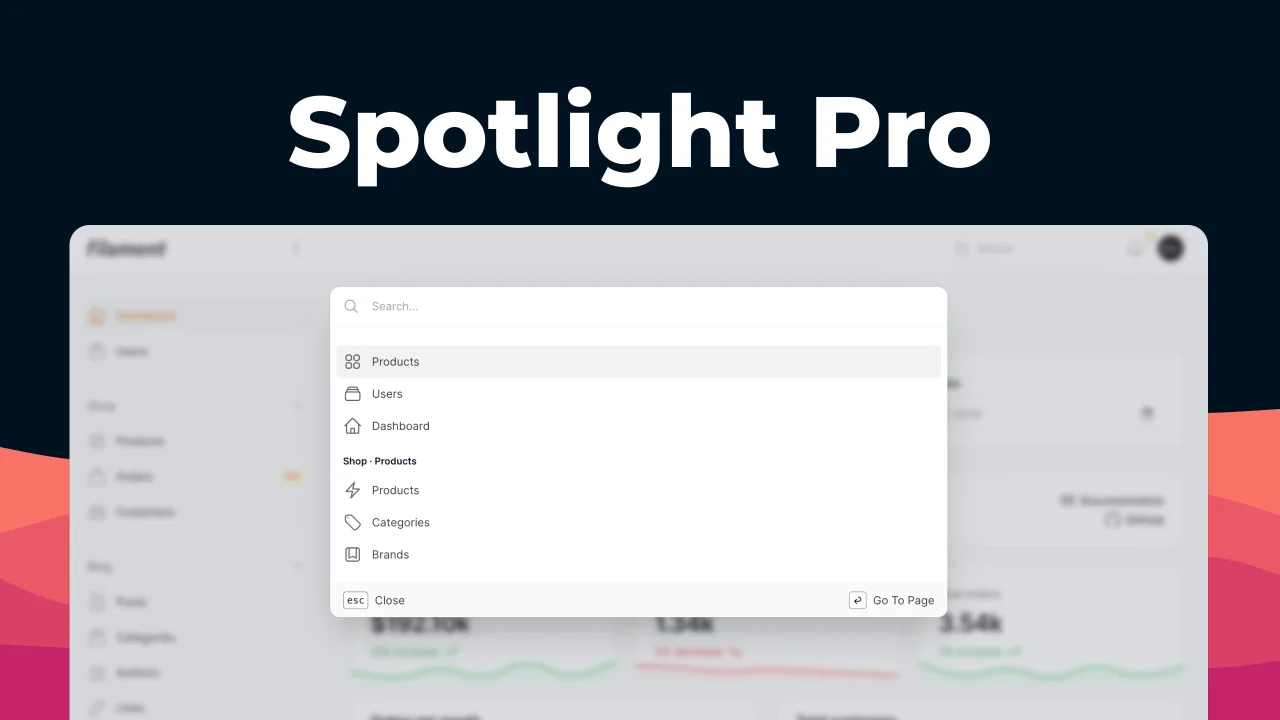
Browse your Filament Panel with ease. Filament Spotlight Pro adds a Spotlight like Command Palette to your Filament Panel.
 Dennis Koch
Custom Fields
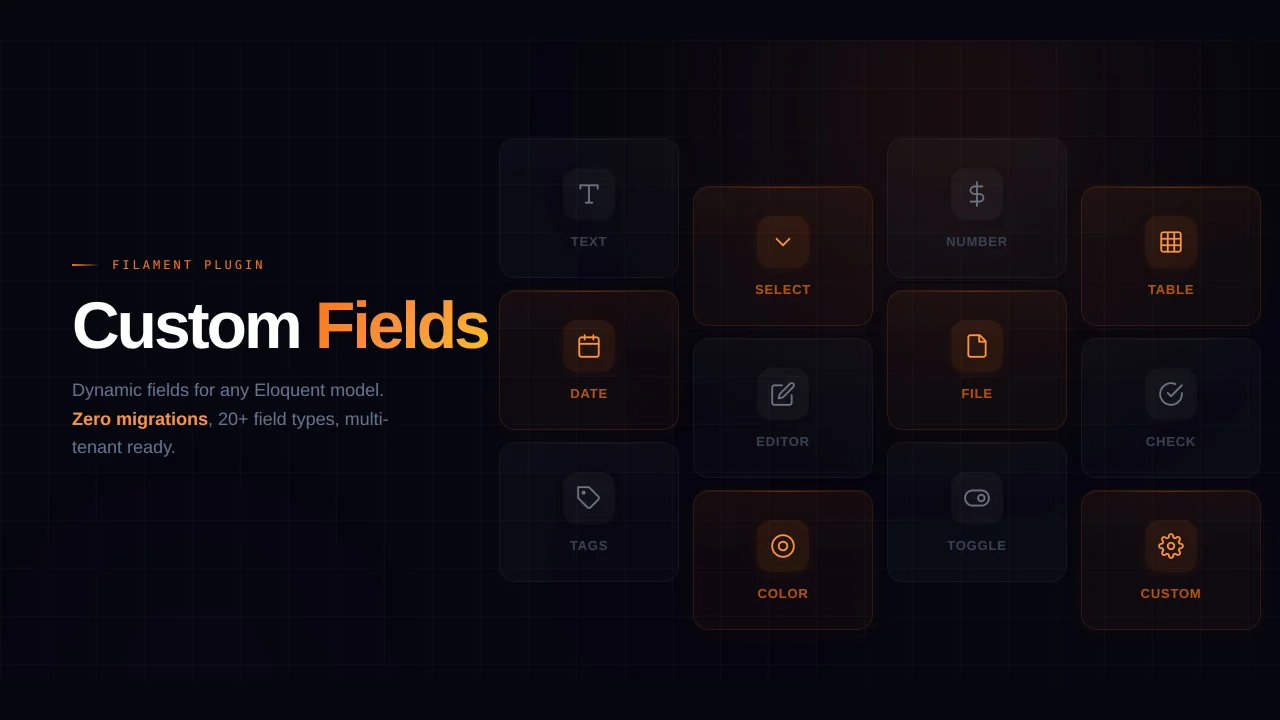
Eliminate custom field migrations forever. Let your users create and manage form fields directly in Filament admin panels with 20+ built-in field types, validation, and zero database changes.
 Relaticle