Lockbox
A security addon for Filament v4 that protects sensitive fields with user-bound encryption keys (Split-Key, TOTP, crypto password or Passkeys).
 Author:
Ilya Beliaev
Author:
Ilya Beliaev
Documentation
- 🧪 Code Quality & Coverage
- 🚧 Project Status
- ✨ Features
- 🗄️ Centralized Lockbox Storage
- 🔑 How It Works (Key Derivation)
- 🚀 Installation
- 🔌 Register the Plugin (Filament v4)
- ⚙️ Model Setup
- 🧑💻 User Flow
- 🧩 Usage in Filament Forms
- 🔒 Security Model
- 📖 Roadmap
- 📜 License




Secure per-user field encryption for Filament v4.
This package allows you to encrypt and decrypt sensitive data on a per-user basis, using a split-key approach:
- Part A (server-side key) is stored encrypted in the database.
- Part B (user-provided secret) is collected at runtime (crypto password, passkey, or TOTP).
- Final key is derived from PartA + PartB using
hash('sha256', ...).
This ensures that even administrators cannot decrypt data without the user-provided input.
#🧪 Code Quality & Coverage
To ensure long-term maintainability and security, this package is continuously analyzed with two systems:
-
SonarQube Cloud
Monitors code quality, maintainability, and potential security issues. Results are automatically updated on every commit. -
qlty.sh
Provides detailed path coverage via PHPUnit’s--path-coverage, ensuring not only that lines are executed but also that different execution paths are validated.
For cryptographic code, this level of coverage is especially important: it verifies complete execution flows (e.g. valid vs. invalid keys, missing secrets, or failed TOTP checks).
Compared to branch coverage, path coverage ensures higher confidence in correctness and security-critical behavior.
Both tools run in CI and guarantee that security and quality checks are part of the development workflow.
#🚧 Project Status
This package is currently in alpha and under active development. Features and APIs may change before a stable release.
#✨ Features
- 🔑 Per-user encryption keys (split key: server + user)
- 🧩 Plug-and-play Filament components:
EncryptedTextInput→ encrypts before saveDecryptedTextDisplay→ decrypts on displayUnlockLockboxAction→ prompts for crypto password or TOTP
- 🔒 User-configurable crypto password support
- 🗝️ Passkey (WebAuthn) support if your user implements
HasPasskeys - 🔐 TOTP support if your user implements
HasAppAuthentication - 🛡️ Zero-knowledge for admins – data is unreadable without user input
- ⚙️ Configurable key material providers (PBKDF2, Passkeys, TOTP, custom)
#🗄️ Centralized Lockbox Storage
Unlike typical field encryption solutions, Filament Lockbox does not store encrypted data on your models.
Instead, all encrypted values are kept in a dedicated, polymorphic lockbox table — completely transparent to your
application.
#✅ Benefits of This Architecture
-
Drop-in Usage
Simply useEncryptedTextInputanywhere in your Filament form schema — no schema changes or model attributes required. -
Polymorphic & Universal
Works with any Eloquent model (User,Product,Order, ...).
All sensitive data is centralized, making it easy to see which records have encrypted fields. -
Performance-Friendly
Main tables remain lean and fast, as encrypted data is kept out of your core business tables. -
Compliance & Auditing
- Simplified GDPR / “Right to be Forgotten”: just delete Lockbox entries per user.
- Perfect for audits: one table gives full visibility of all encrypted fields.
- Allows separate backup and retention strategies.
-
Developer Experience
- No manual hooks or closures needed — saving & loading is handled automatically.
dehydrated(false)is applied internally.- Just replace
TextInputwithEncryptedTextInputand get full encryption.
$form->schema([
    // Before:
    TextInput::make('credit_card'),

    // After:
    EncryptedTextInput::make('credit_card')
        ->label('Credit Card'),
]);
The plugin takes care of everything:
- 🔑 Per-user key management
- 🔐 Encryption & decryption
- 🗄️ Transparent Lockbox record handling
- 🔄 Auto-loading of values on form display
- 🧹 Automatic cleanup when models are deleted
#🔑 How It Works (Key Derivation)
           ┌────────────────────────┐
           │  encrypted_user_key    │  (in DB, encrypted with APP_KEY)
           └──────────┬─────────────┘
                      │ decrypt
                      ▼
                 ┌──────────┐
                 │  Part A  │  (server key)
                 └─────┬────┘
                       │
                       │
           ┌───────────▼───────────┐
           │  Part B (User Input) │  ← crypto password, passkey, or TOTP
           └───────────┬──────────┘
                       │ combine
                       ▼
              ┌───────────────────┐
              │  Final Key (32B)  │
              └─────────┬─────────┘
                        │
          ┌─────────────▼─────────────┐
          │ Encrypt / Decrypt fields │
          └──────────────────────────┘
This means database leaks alone cannot decrypt your data – PartB must be provided by the user.
#🚀 Installation
Install the package via Composer:
composer require n3xt0r/filament-lockbox
Important:
This package integrates withspatie/laravel-passkeys. Before running the install command, make sure you have published and run the Spatie migrations:
php artisan vendor:publish --provider="Spatie\\LaravelPasskeys\\LaravelPasskeysServiceProvider" --tag="laravel-passkeys-migrations"
php artisan migrate
Run the install command to publish all required assets and migrations:

```bash
php artisan filament-lockbox:install
#🔌 Register the Plugin (Filament v4)
Add the plugin to your Filament panel provider:
// app/Providers/Filament/AdminPanelProvider.php

use Filament\Panel;
use Filament\PanelProvider;
use N3XT0R\FilamentLockbox\FilamentLockboxPlugin;

class AdminPanelProvider extends PanelProvider
{
    public function panel(Panel $panel): Panel
    {
        return $panel
            ->plugins([
                FilamentLockboxPlugin::make(),
            ]);
    }
}
Optional configuration:
// config/filament-lockbox.php
return [
    'show_widget' => true, // set false to hide the status widget
    'providers' => [
        \N3XT0R\FilamentLockbox\Managers\KeyMaterial\TotpKeyMaterialProvider::class,
        \N3XT0R\FilamentLockbox\Managers\KeyMaterial\CryptoPasswordKeyMaterialProvider::class,
    ],
];
You can publish the config and translations if you need customization:
php artisan vendor:publish --tag="filament-lockbox-config"
php artisan vendor:publish --tag="filament-lockbox-translations"
#⚙️ Model Setup
Your User model must:
- Implement
HasLockboxKeys - Use the
InteractsWithLockboxKeystrait - Hide and cast the lockbox fields
#Example: User Model
use Filament\Models\Contracts\FilamentUser;
use Illuminate\Contracts\Auth\MustVerifyEmail;
use Illuminate\Foundation\Auth\User as Authenticatable;
use N3XT0R\FilamentLockbox\Contracts\HasLockboxKeys;
use N3XT0R\FilamentLockbox\Concerns\InteractsWithLockboxKeys;

class User extends Authenticatable implements FilamentUser, MustVerifyEmail, HasLockboxKeys
{
    use InteractsWithLockboxKeys;

    protected $hidden = [
        'encrypted_user_key',
        'crypto_password_hash',
        'lockbox_provider',
    ];

    protected function casts(): array
    {
        return [
            'encrypted_user_key' => 'encrypted',
            'crypto_password_hash' => 'string',
            'lockbox_provider' => 'string',
        ];
    }
}
#Example: Any Model with Encrypted Fields
Any Eloquent model that should have encrypted fields must:
- Implement
HasLockbox - Use the
InteractsWithLockboxtrait
This enables the polymorphic relation to the lockbox table and lets the package handle encryption transparently.
use Illuminate\Database\Eloquent\Model;
use N3XT0R\FilamentLockbox\Contracts\HasLockbox;
use N3XT0R\FilamentLockbox\Concerns\InteractsWithLockbox;

class Company extends Model implements HasLockbox
{
    use InteractsWithLockbox;

    protected $fillable = [
        'name',
        'email',
        // no need to list encrypted fields here – they live in the lockbox table
    ];
}
You can now use EncryptedTextInput::make('field_name') in your Filament form schemas for this model —
the package will automatically store and retrieve the data from the centralized lockbox table.
#🧑💻 User Flow
- Go to the Lockbox widget in your Filament panel.
- Click Generate Lockbox Key.
- Set a crypto password, register a passkey, or enable TOTP.
- Unlock once per session to access or modify encrypted fields.
#🧩 Usage in Filament Forms
#1️⃣ Storing Encrypted Data
use N3XT0R\FilamentLockbox\Forms\Actions\UnlockLockboxAction;
use N3XT0R\FilamentLockbox\Forms\Components\EncryptedTextInput;

$form
    ->schema([
        EncryptedTextInput::make('secret_notes')
            ->label('Secret Notes'),
    ])
    ->extraActions([
        UnlockLockboxAction::make(),
    ]);
#2️⃣ Displaying Decrypted Data
use N3XT0R\FilamentLockbox\Forms\Components\DecryptedTextDisplay;
use N3XT0R\FilamentLockbox\Forms\Actions\UnlockLockboxAction;

$form
    ->schema([
        DecryptedTextDisplay::make('secret_notes')
            ->label('Secret Notes'),
    ])
    ->extraActions([
        UnlockLockboxAction::make(),
    ]);
#🔒 Security Model
- Split-key encryption (PartA + PartB → Final Key)
- PBKDF2 key derivation with 100,000 iterations
- Server keys stored encrypted with
APP_KEY - Extensible providers for alternative key material
#🔑 Passkeys (WebAuthn)
This package ships with built-in support for spatie/laravel-passkeys and requires it by default.
You can control Passkey usage via this package's configuration.
If you don't plan to use WebAuthn/Passkeys, disable the integration in config/filament-lockbox.php.
#📖 Roadmap
- Textarea and file encryption support
- Automatic modal prompt if unlock is missing
- Session-based unlock expiry
- Configurable PBKDF2 parameters
- Improve TOTP integration: ensure user-assigned secrets (crypto password) are required and TOTP is used only as a second factor
#📜 License
MIT © N3XT0R
The author
I’m a software engineer with 15+ years of experience in backend development, system architecture, and DevOps. As a certified ISO 27001 Information Security Officer, I combine development expertise with a strong focus on security and compliance. I enjoy contributing to open-source and creating tools that make complex systems more secure and developer-friendly.
From the same author

Featured Plugins
A selection of plugins curated by the Filament team
Custom Dashboards
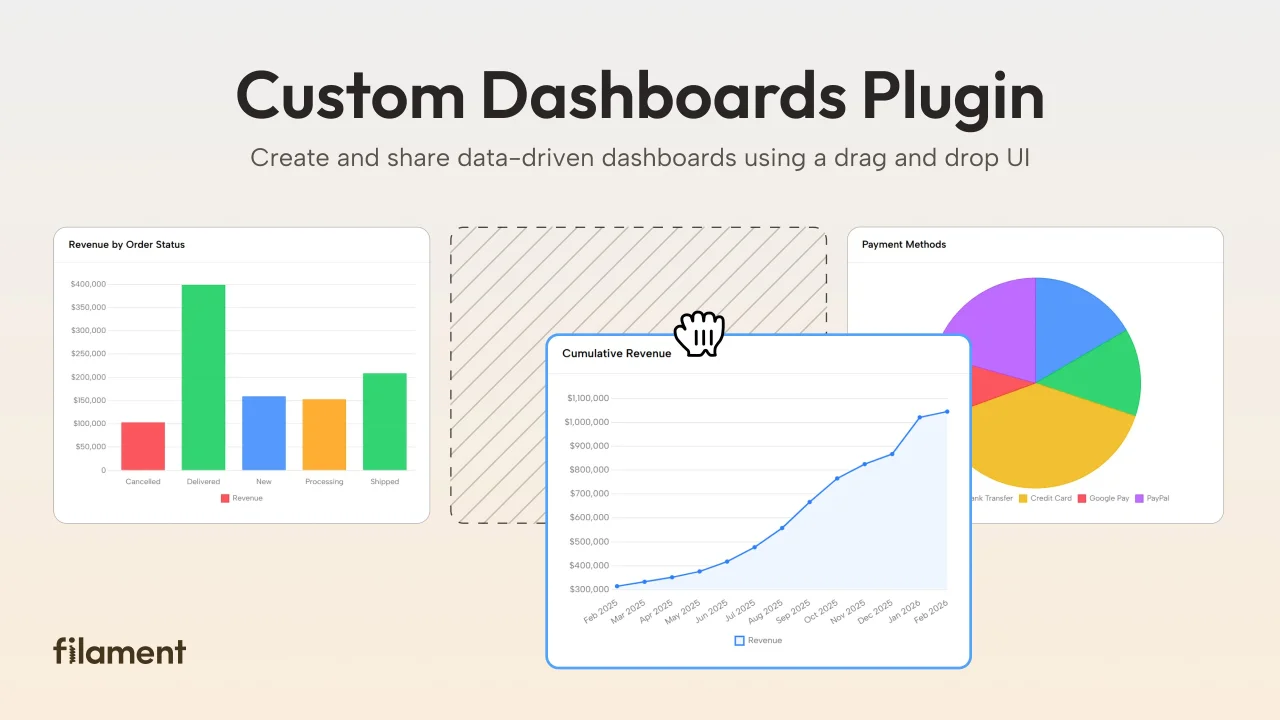
Let your users build and share their own dashboards with a drag-and-drop interface. Define your data sources in PHP and let them do the rest.
 Filament
Custom Fields
Eliminate custom field migrations forever. Let your users create and manage form fields directly in Filament admin panels with 20+ built-in field types, validation, and zero database changes.
 Relaticle
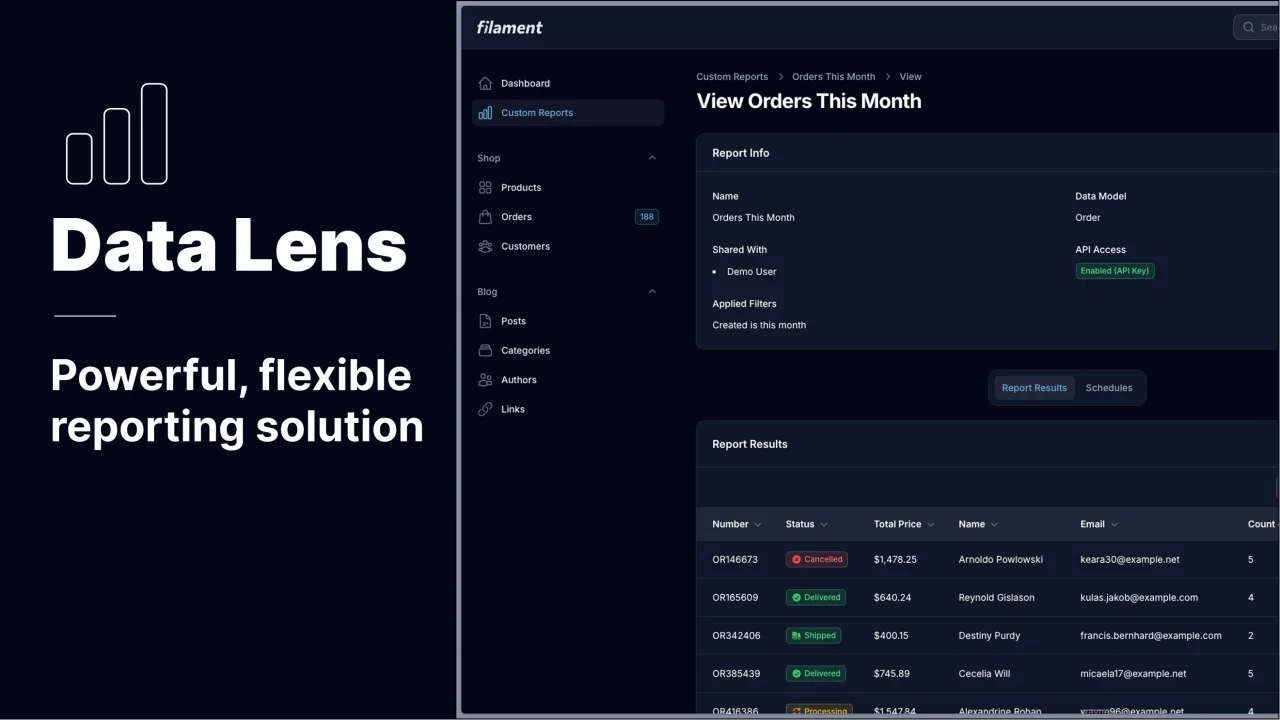
Data Lens
Advanced Data Visualization for Laravel Filament - a premium reporting solution enabling custom column creation, sophisticated filtering, and enterprise-grade data insights within admin panels.
 Padmission