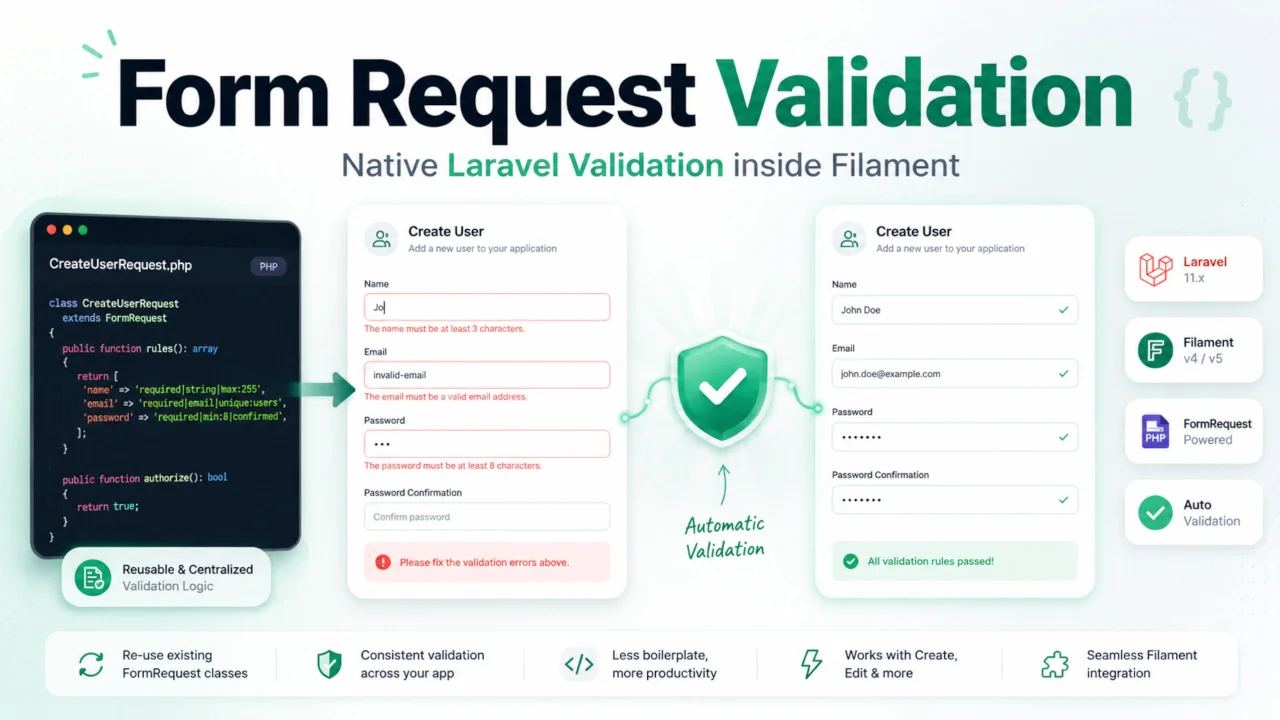
Form Request Validation
CommunityUse Laravel Form Request validation inside Filament schemas. Define your rules, messages, and attributes once — reuse them across API routes, controllers, and Filament forms.
 Author:
Igor Clauss
Author:
Igor Clauss
Package health
BetaAutomated checks of this plugin's Composer package
13 checks
- Passed: Current Laravel version supported — Package dependencies resolve together with current Laravel 13.0.
- Passed: Current PHP version supported — Constraint ^8.2 supports current PHP 8.5.
- Skipped: Current Symfony version supported
- Passed: Abandoned or archived — No consulted source marks the package abandoned (packagist, github).
- Passed: Commit and release recency — Active: last commit 0 days ago; last release 2 days ago.
- Passed: composer.lock not committed by library — composer.lock is absent from the released dist archive.
- Passed: Dist archive is lean
- Skipped: GitHub Actions pinned to SHA
- Passed: Open security advisories
- Passed: Dependabot PR responsiveness — No open Dependabot PRs.
- Failed: Dependabot or Renovate configured — View details on Plumb
- Skipped: Dependency update cooldown configured
- Failed: SECURITY.md present — View details on Plumb
filament/
namespace. Review the source and install at your own risk. Found
malware or an unresolved security issue the author won't
address?
Report it
.
Documentation
- Why this plugin?
- Features
- Supported contexts
- Requirements
- Installation
- Quick start
- API reference
- Usage by context
- Field mapping
- Rule merging
- Orphan rules
- Accessing validated data
- How it works
- Limitations
- Testing
- Contributing
- License


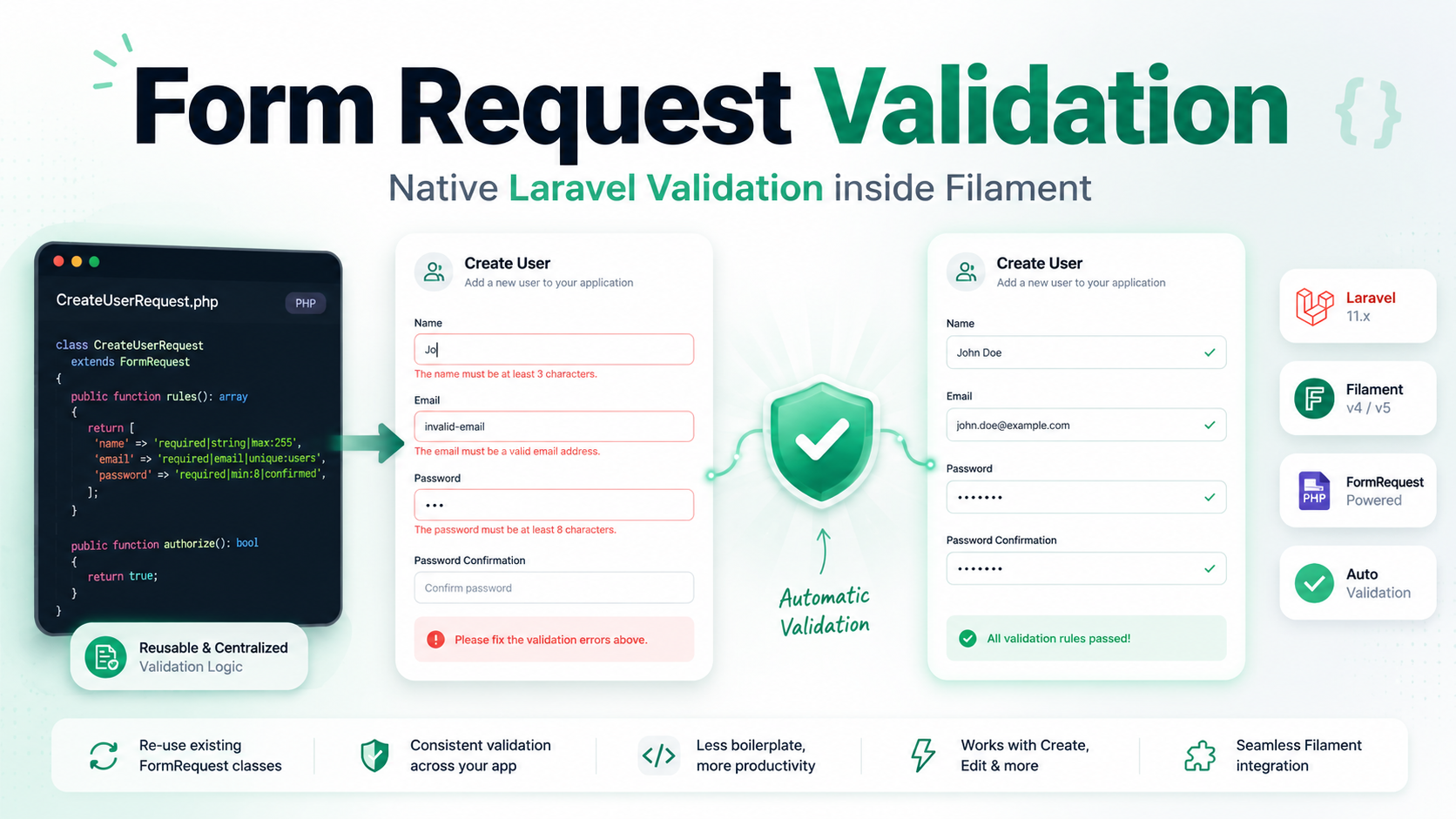
Use Laravel Form Request validation inside Filament — define your rules, messages, and attributes once, reuse them across API routes, controllers, and Filament UI.
#Why this plugin?
Filament validates fields through dedicated methods like ->required() and ->email() on each input. That works well for simple forms, but validation logic often belongs in a central place — especially when the same rules already exist in a Form Request.
This plugin bridges that gap: attach a Form Request to your schema or table filters and its validation rules are automatically applied to the matching fields.
#Features
- Form Request integration —
rules(),messages(), andattributes() - Automatic field mapping — by field name, dot notation, and wildcards (
items.*.name) - Array & pipe syntax —
'email' => ['required', 'email']and'email' => 'required|email' - Context-aware — different Form Requests per page via callback (create vs. edit)
- Dynamic rules — re-resolved on every validation (
required_if,Rule::unique(), etc.) - Request simulation — route parameters and input context for Form Requests
- Smart rule merging — Form Request rules take precedence on conflicts
- Orphan rule handling — unmatched rules show a Filament notification
getFormRequestValidated()— optional helper trait for validated data- Filament 4 & 5 — single package, internal adapter layer
#Supported contexts
| Context | API |
|---|---|
| Resource Create / Edit | Schema::formRequest() |
| Standalone forms / Settings pages | Schema::formRequest() |
| Action modals | Schema::formRequest() |
| Wizards (per-step validation) | Schema::formRequest() |
| Relation managers | Schema::formRequest() |
| Table filters | Table::filtersFormRequest() |
#Requirements
| Dependency | Version |
|---|---|
| PHP | 8.2+ |
| Laravel | 11, 12, or 13 |
| Filament | 4.x or 5.x |
#Installation
composer require occ-therapist/form-request-validation-for-filament
Auto-registers via Laravel package discovery. No manual setup required.
#Quick start
#1. Create a Form Request
// app/Http/Requests/StoreUserRequest.php

namespace App\Http\Requests;

use Illuminate\Foundation\Http\FormRequest;

class StoreUserRequest extends FormRequest
{
    public function rules(): array
    {
        return [
            'name' => ['required', 'string', 'max:255'],
            'email' => ['required', 'email', 'unique:users'],
        ];
    }

    public function messages(): array
    {
        return [
            'email.unique' => 'This email address is already registered.',
        ];
    }

    public function attributes(): array
    {
        return [
            'name' => 'full name',
        ];
    }
}
#2. Attach it to your Filament schema
use App\Http\Requests\StoreUserRequest;
use App\Http\Requests\UpdateUserRequest;
use Filament\Resources\Pages\CreateRecord;
use Filament\Resources\Pages\EditRecord;
use Filament\Schemas\Schema;

public function form(Schema $schema): Schema
{
    return $schema
        ->components([
            TextInput::make('name'),
            TextInput::make('email'),
        ])
        ->formRequest(
            class: fn () => $this instanceof EditRecord
                ? UpdateUserRequest::class
                : StoreUserRequest::class,
        );
}
Important: Call
->formRequest()after->components()so the validation hook is appended correctly.
Validation errors appear directly on the matching input fields.
#API reference
#Schema::formRequest()
$schema->formRequest(
    class: fn (Component $livewire): string => StoreUserRequest::class,
    mergeInput: fn (array $state, Component $livewire): array => $state,
);
| Parameter | Type | Required | Description |
|---|---|---|---|
class |
Closure |
Yes | Returns the Form Request class. Receives $livewire via dependency injection. |
mergeInput |
Closure |
No | Merges additional data into the simulated request input. Receives $state and $livewire. |
#Context selection
->formRequest(
    class: fn () => match (true) {
        $this instanceof CreateRecord => StorePostRequest::class,
        $this instanceof EditRecord => UpdatePostRequest::class,
        default => StorePostRequest::class,
    },
)
#Enriching input data
->formRequest(
    class: fn () => UpdateUserRequest::class,
    mergeInput: fn (array $state) => [
        ...$state,
        'role' => $this->record?->role,
        'tenant_id' => filament()->getTenant()?->id,
    ],
)
Useful when Form Requests depend on record data, route parameters, or values not visible in the form.
#Table::filtersFormRequest()
$table->filtersFormRequest(
    class: fn () => FilterCustomersRequest::class,
    mergeInput: fn (array $state, Component $livewire): array => $state,
);
Same parameters as Schema::formRequest(). Attaches validation to the table's filter form.
| Filter mode | When validation runs |
|---|---|
| Deferred (default) | When the user clicks Apply |
Live (->deferFilters(false)) |
On every filter change |
#Usage by context
#Resource pages
public function form(Schema $schema): Schema
{
    return $schema
        ->components([/* fields */])
        ->formRequest(class: fn () => StoreUserRequest::class);
}
#Action modals
Action::make('invite')
    ->schema(fn (Schema $schema) => $schema
        ->components([
            TextInput::make('email'),
            TextInput::make('role'),
        ])
        ->formRequest(class: fn () => InviteUserRequest::class))
    ->action(function (array $data): void {
        // ...
    });
#Wizards
One Form Request for the entire wizard — attach it to the root schema:
return $schema
    ->components([
        Wizard::make([
            Step::make('Account')->schema([
                TextInput::make('email'),
            ]),
            Step::make('Profile')->schema([
                TextInput::make('name'),
            ]),
        ]),
    ])
    ->formRequest(class: fn () => StoreUserRequest::class);
Only fields in the active step are validated per step. Use mergeInput if rules depend on data from other steps:
mergeInput: fn (array $state, Component $livewire): array => [
    ...($livewire->data ?? []),
    ...$state,
],
#Relation managers
class PostsRelationManager extends RelationManager
{
    public function form(Schema $schema): Schema
    {
        return $schema
            ->components([
                TextInput::make('title'),
            ])
            ->formRequest(class: fn () => StorePostRequest::class);
    }
}
For modal actions on the table, attach formRequest() inside the action's schema callback.
#Table filters
use Filament\Tables\Filters\Filter;
use Filament\Tables\Table;

public function table(Table $table): Table
{
    return $table
        ->filters([
            Filter::make('created')
                ->schema([
                    DatePicker::make('from'),
                    DatePicker::make('until'),
                ]),
        ])
        ->filtersFormRequest(class: fn () => FilterCustomersRequest::class);
}
// app/Http/Requests/FilterCustomersRequest.php
public function rules(): array
{
    return [
        'created.from' => ['nullable', 'date'],
        'created.until' => ['nullable', 'date', 'after_or_equal:created.from'],
    ];
}
#Field mapping
Rules are matched to fields automatically by name — no per-field configuration needed.
| Form Request key | Filament field | Match type |
|---|---|---|
email |
TextInput::make('email') |
Exact |
address.street |
TextInput::make('address.street') |
Dot notation |
items.*.name |
Repeater child TextInput::make('name') |
Wildcard |
created.from |
Filter field DatePicker::make('from') in Filter::make('created') |
Dot notation |
#State path normalization
Filament uses prefixed state paths internally. The plugin strips these automatically:
| Internal state path | Resolved key |
|---|---|
data.email |
email |
mountedActions.0.data.email |
email |
tableDeferredFilters.created.from |
created.from |
#Rule merging
When a field already has Filament validation rules, both sets are merged:
TextInput::make('email')->email()->nullable()
// Form Request
'email' => ['required', 'email', 'unique:users']
Result: string, required, email, unique:users
- Form Request rules take precedence on conflicts (
nullablevs.required) - Identical rules are deduplicated
- Non-conflicting field rules are kept
#Orphan rules
Rules without a matching schema field still run on submit. Failures show a Filament notification instead of an inline field error.
To show the error on a field, add a matching input (visible or hidden):
Checkbox::make('terms_accepted')->label('I accept the terms'),
// or
Hidden::make('terms_accepted'),
#Accessing validated data
use OccTherapist\FormRequestValidationForFilament\Concerns\InteractsWithFormRequestValidation;

class CreateUser extends CreateRecord
{
    use InteractsWithFormRequestValidation;

    protected function handleRecordCreation(array $data): Model
    {
        $data = $this->getFormRequestValidated();

        return User::create($data);
    }
}
#How it works
formRequest() / filtersFormRequest()
        │
        ▼
  Form Request resolved with simulated HTTP request
  (form state + optional mergeInput + route parameters)
        │
        ▼
  rules(), messages(), attributes() extracted
        │
        ▼
  Rules mapped to fields (exact + wildcard + state path normalization)
        │
        ▼
  Merged with existing field rules → applied on validation
        │
        ▼
  Orphan rule failures → Filament notification
#Limitations
| Form Request feature | Status |
|---|---|
rules() |
Supported |
messages() |
Supported |
attributes() |
Supported |
authorize() |
Not supported — use Filament policies |
prepareForValidation() |
Not supported |
withValidator() |
Not supported |
passedValidation() / failedValidation() |
Not supported |
#Testing
composer test
#Contributing
Contributions are welcome! Please open an issue or pull request on GitHub.
#License
MIT © occTherapist
The author
I am a freelance developer from Oldenburg, helping companies move their digital projects forward with clear communication and reliable delivery.
Many clients contact me when a project is stuck. That is where I usually start: I work through existing structures, remove blockers, and get momentum back into the project.
A good example is the reservation and booking system for Spieleparadies OKIDOKI. Their administration now saves several hours every day, and that time can be used for new initiatives.
Clients value the personal collaboration: you work directly with me, I think proactively, and I usually reply within a few hours. That keeps communication close, fast, and honest.
From the same author

Advanced Table Export
Export and print Filament admin tables in seconds — CSV, XLSX, and PDF with column selection, preview, and flexible PDF drivers. Built for Filament v4 and v5 on Laravel 11/12/13. A modern, actively maintained successor to the export workflow many teams relied on with alperenersoy/filament-export (https://github.com/alperenersoy/filament-export).
Author:
Igor Clauss
Advanced Roster
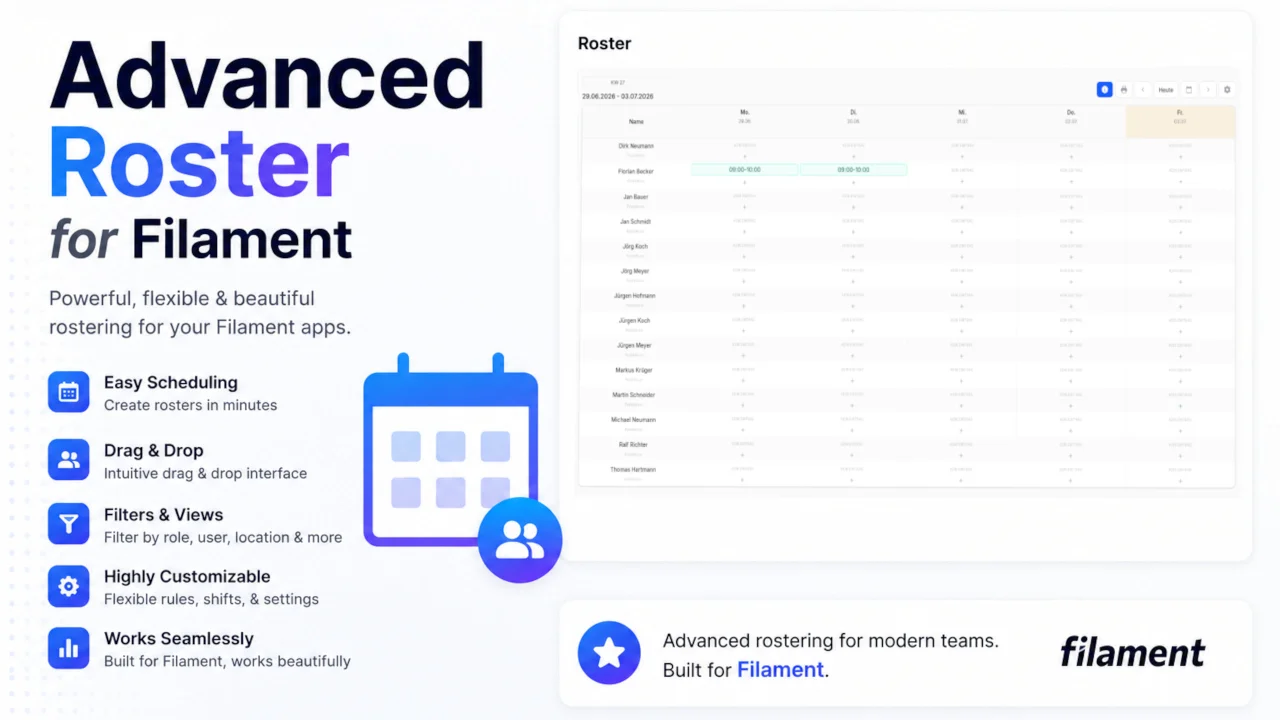
A flexible weekly roster page for Filament — drag-and-drop entries, row reordering, recurring shifts, day notes, and optional PDF export.
Author:
Igor Clauss
Featured Plugins
A selection of plugins curated by the Filament team

Blueprint
Filament Blueprint is a premium Laravel Boost extension that helps AI agents produce accurate, detailed implementation plans and security reports for Filament apps.
 Filament
Advanced Tables (formerly Filter Sets)
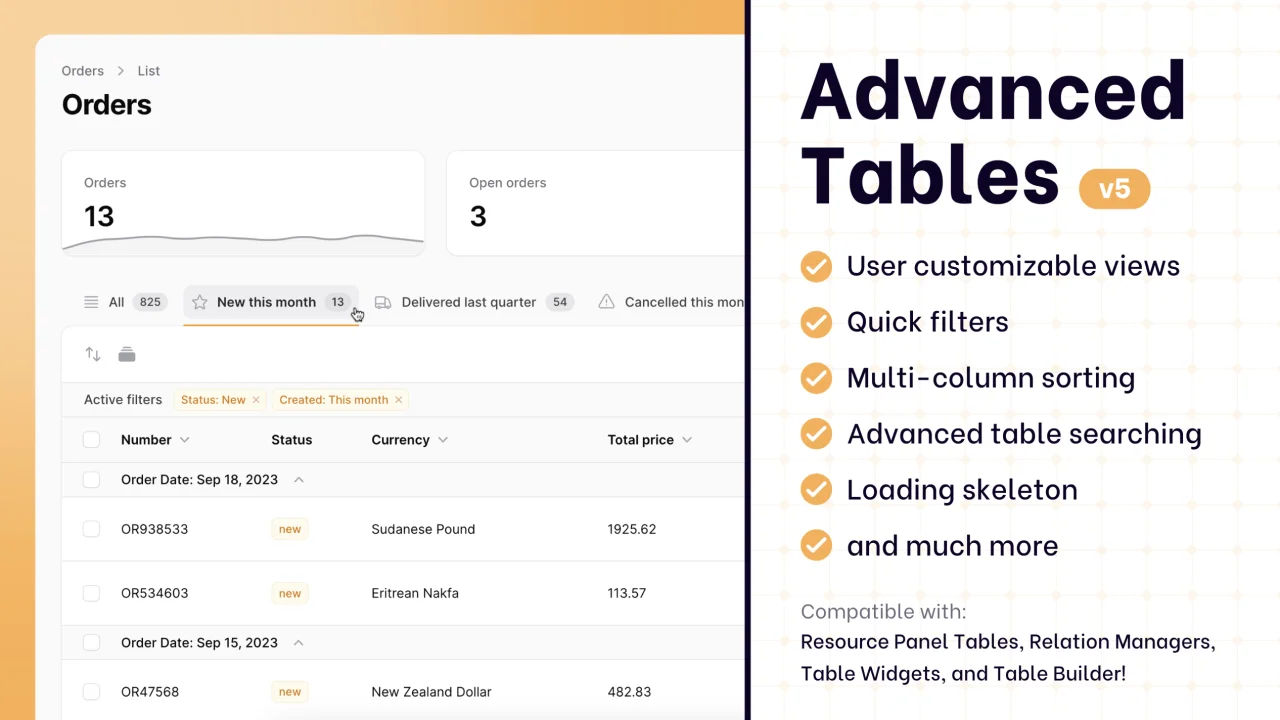
Supercharge your tables with powerful features like user-customizable views, quick filters, multi-column sorting, advanced table searching, convenient view management, and more. Compatible with Resource Panel Tables, Relation Managers, Table Widgets, and Table Builder!
 Kenneth Sese

Spotlight Pro
Browse your Filament Panel with ease. Filament Spotlight Pro adds a Spotlight/Raycast like Command Palette to your Filament Panel.
 Dennis Koch