Canary
CommunityA runtime smoke-sweep for your Filament panels. It introspects every panel, resource and page at runtime and asserts the one thing you almost never write tests for: every page mounts for an authorized user, and is denied to guests. No generated files, no drift — new resources are covered automatically, and it runs in CI on every PR. A canary in the coal mine: if a page starts throwing a 500 or quietly leaks access, the sweep falls over before your users do.
filament/
namespace. Review the source and install at your own risk. Found
malware or an unresolved security issue the author won't
address?
Report it
.
 Author:
Bas van Dinther
Author:
Bas van Dinther
Documentation
- Why this instead of generating test files?
- Why not just ask AI to generate the tests?
- Installation
- Usage
- How a page is judged
- Configuration
- Safety
- What's out of scope (on purpose)
- Non-standard authentication
- Testing
- License






A runtime smoke-sweep for your Filament panels. It introspects every panel, resource and page at runtime and asserts the one thing you almost never write tests for: every page mounts for an authorized user, and is denied to guests. No generated files, no drift — new resources are covered automatically, and it runs in CI on every PR.
A canary in the coal mine: if a page starts throwing a 500 or quietly leaks access, the sweep falls over before your users do.
#Why this instead of generating test files?
Because generated tests rot. Filament is introspectable — Filament::getPanels() → resources → pages — so instead of writing a file per resource that you have to maintain (and that goes stale the moment you add a resource), Canary walks the live route table each run. One sweep covers the whole panel, today and after every refactor.
It is deliberately narrow: it proves pages mount and authorize. It does not submit forms or assert CRUD — that's the genuinely app-specific part you should write by hand.
#Why not just ask AI to generate the tests?
You can — an AI agent can even keep generated tests up to date as you build. For the app-specific parts (form validation, business rules) that's a great use of it. The difference isn't "AI can't keep up." It's that "every page still mounts and authorizes" is a standing guarantee that shouldn't depend on someone remembering to ask:
- It runs with no AI in the loop. A junior adding a resource, a Dependabot PR bumping Filament, a teammate without an agent, CI itself — they all get the coverage for free. No "don't forget to regenerate the tests."
- No per-change review step. AI-updated tests have to be re-read every time — did it cover the new page, did it pass for the right reason? The sweep is reviewed once; new pages flow through it automatically.
- The failure mode is the exception. It breaks precisely the one time you don't ask — a hotfix, a rename buried in a big diff, someone else's PR. The sweep has no "remember to" step.
- Zero generated files. Even AI-maintained test files are files that can half-update or conflict. Canary holds none — it reads the live panel each run.
So it's not AI vs. Canary. Use AI for the deep, bespoke tests; let Canary make the one mechanical guarantee — "every page loads and authorizes" — structural instead of dependent on a human-plus-agent getting it right every single time.
#Installation
composer require baspa/filament-canary --dev
Then let Canary inspect your panels and propose a config for you:
php artisan canary:install
It reads each panel's access gate (the user model's canAccessPanel, plus tenancy) and proposes an acting_as resolver — assignRole('admin') for role gates, a matching email for allowlists, a factory flag for boolean gates, or a plain factory user when it can't tell (clearly marked, for you to adjust). After you confirm, it writes config/filament-canary.php with the proposed closures baked in. Decline, and it just prints the snippet to paste.
Prefer to do it by hand? Publish the config and edit it yourself:
php artisan vendor:publish --tag="filament-canary-config"
#Usage
#In your test suite (recommended)
use Baspa\FilamentCanary\Testing\InteractsWithCanary;

uses(InteractsWithCanary::class);

it('every Filament page mounts and authorizes', function () {
    $this->canarySweep();
});
canarySweep() runs the whole sweep and fails the test if any page returned a server error or leaked access to a guest. It returns every result, so you can make extra assertions if you want.
#As a CI command
php artisan canary:check
Prints a per-page report and exits non-zero when there are hard failures:
  ✅  admin   filament.admin.resources.posts.index    authorized: 200, guest: 302
  ✅  admin   filament.admin.resources.posts.edit     authorized: 200, guest: 302
  🔒  admin   filament.admin.resources.audits.index   authorized user was denied (403); configure filament-canary.acting_as
  ⏭️  admin   filament.admin.resources.tags.edit      model [App\Models\Tag] has no factory; cannot build a record
  ❌  admin   filament.admin.resources.orders.index   authorized request returned 500

  ✅ 12 passed   ❌ 1 failed   🔒 1 needs-auth   ⏭️ 2 skipped
Pass --strict to also fail on needs-auth pages once you've wired up acting_as.
#How a page is judged
| Result | Meaning |
|---|---|
| ✅ passed | Authorized user got a 2xx and a guest was denied (redirect / 401 / 403). |
| ❌ failed | Server error (5xx), or a guest reached the page (authorization leak). The canary's whole reason for existing. |
| 🔒 needs-auth | The resolved user couldn't reach the page (401/403/redirect). Almost always means you need to configure acting_as. Not a hard failure unless --strict. |
| ⏭️ skipped | Couldn't be swept automatically — no model factory for a record page, a tenant that needs a resolver, or route parameters Canary can't fill. Always shown with a reason; nothing is silently left untested. |
#Configuration
By default Canary creates an authorized user via your guard's provider-model factory. When panel access needs a specific user (a role, a flag), give it one:
// config/filament-canary.php
'acting_as' => fn (\Filament\Panel $panel) => \App\Models\User::factory()->admin()->create(),
Per panel:
'acting_as' => [
    'admin'   => fn ($panel) => \App\Models\User::factory()->admin()->create(),
    'default' => fn ($panel) => \App\Models\User::factory()->create(),
],
Tenant-aware panels resolve a tenant the same way (defaults to the tenant-model factory):
'tenant' => fn (\Filament\Panel $panel) => \App\Models\Team::factory()->create(),
Other options: panels.only / panels.except, exclude (resource/page classes), test_guests, strict_authorization, use_transaction. See the published config for details.
#Safety
The sweep creates users and records via factories and requests every page as an authenticated user, so it takes two precautions:
- It runs in a database transaction and rolls it back — nothing it creates is
persisted. (Covers the default connection; disable with
use_transaction => false.) - It refuses to run in the
productionenvironment — a rollback can't undo the other side effects of hitting every page as an admin (queued jobs, mail, audit logs, writes on other connections), so Canary simply won't run there.
#What's out of scope (on purpose)
- Form submissions / full CRUD assertions — that's the app-specific part to write by hand.
- Filament v3 (this targets v4 and v5).
- Non-Filament Laravel routes.
#Non-standard authentication
By default Canary authenticates each request by setting the resolved user on the panel's
guard. That covers the common case (session/Eloquent guards). It does not fit panels
whose access depends on custom state Canary can't see — for example a custom API/SSO guard,
or a canAccessPanel() that checks session data rather than the user itself:
public function canAccessPanel(Panel $panel): bool
{
    return session()->has('user') && session()->has('loginToken'); // Canary can't satisfy this by default
}
For these, swap the requester. Baspa\FilamentCanary\Sweep\Requester is a one-method
interface bound in the container, so you can bind your own implementation that establishes
auth however your app needs it (seed the session, mint an API token, etc.):
// e.g. in a test's setUp() or a service provider
use Baspa\FilamentCanary\Sweep\Requester;

$this->app->bind(Requester::class, MyRequester::class);
use Baspa\FilamentCanary\Sweep\Requester;
use Illuminate\Contracts\Auth\Authenticatable;

class MyRequester implements Requester
{
    public function get(string $url, ?Authenticatable $user, string $guard): int
    {
        // establish whatever state the panel's gate requires, then return the status code
    }
}
#Testing
composer test
#License
The MIT License (MIT). Please see License File for more information.
The author
Passionate full stack developer building web apps and working / collaborating on open source projects.
Featured Plugins
A selection of plugins curated by the Filament team

Blueprint
Filament Blueprint is a premium Laravel Boost extension that helps AI agents produce accurate, detailed implementation plans and security reports for Filament apps.
 Filament
Advanced Tables (formerly Filter Sets)
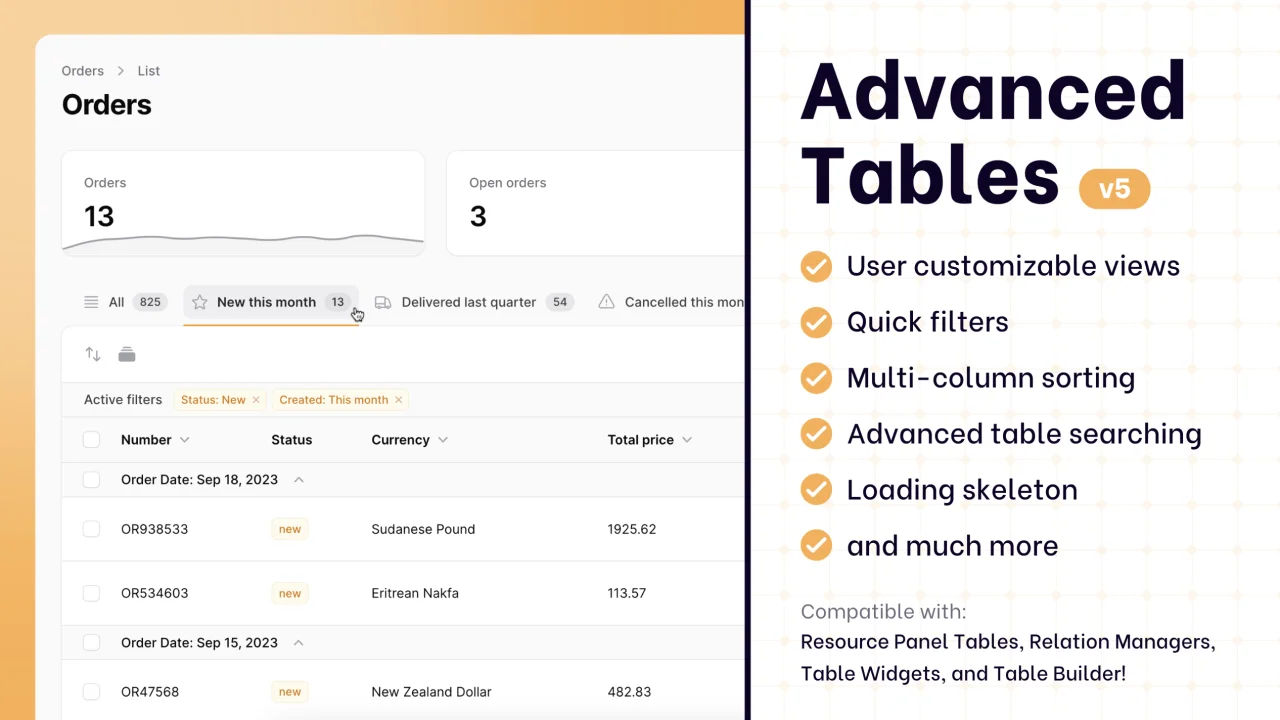
Supercharge your tables with powerful features like user-customizable views, quick filters, multi-column sorting, advanced table searching, convenient view management, and more. Compatible with Resource Panel Tables, Relation Managers, Table Widgets, and Table Builder!
 Kenneth Sese
Custom Dashboards
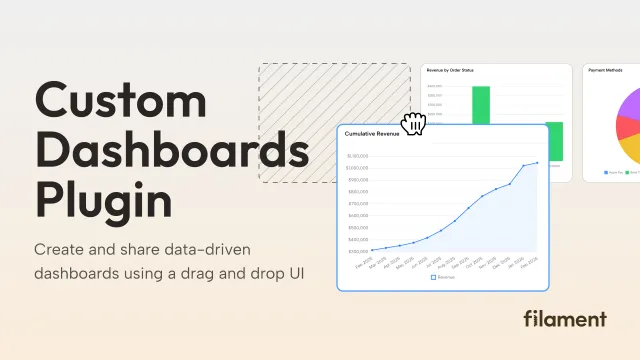
Let your users build and share their own dashboards with a drag-and-drop interface. Define your data sources in PHP and let them do the rest.
Filament