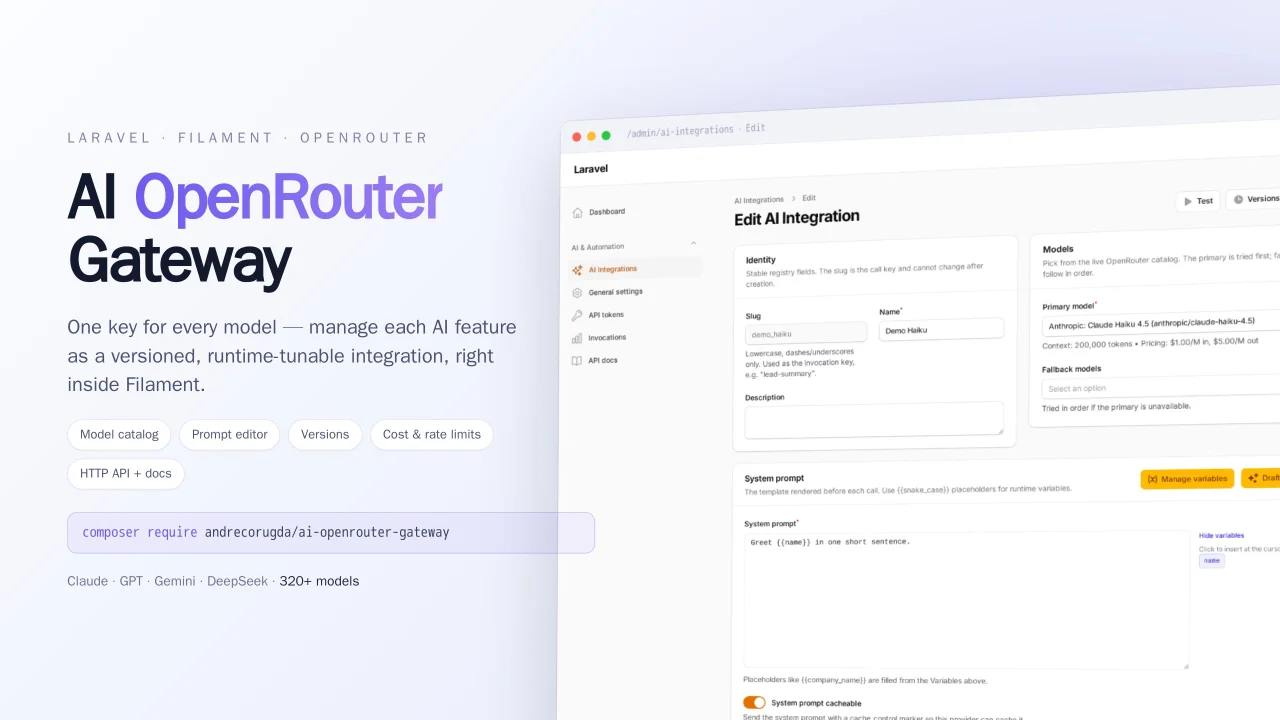
AI OpenRouter Gateway
CommunityA self-hostable, OpenRouter-backed AI gateway for Laravel + Filament. Define each AI use case as a **named integration** — a versioned prompt, a model picked from the live OpenRouter catalog, generation params, and guardrails — and tune it at runtime from the admin panel. No more hardcoded prompts or redeploys to change a model.
 Author:
Andre Corugda
Author:
Andre Corugda
Package health
BetaAutomated checks of this plugin's Composer package
15 checks
- Failed: GitHub Actions pinned to SHA — View details on Plumb
- Skipped: GitLab CI includes pinned to SHA
- Passed: Open security advisories
- Passed: Dependabot PR responsiveness — No open Dependabot PRs.
- Skipped: Renovate MR responsiveness
- Failed: Dependabot or Renovate configured — No dependency updater configuration found. View details on Plumb
- Skipped: Dependency update cooldown configured
- Failed: Provides a security policy — View details on Plumb
- Passed: Abandoned or archived — No consulted source marks the package abandoned (packagist, github).
- Passed: Commit and release recency — Active: last commit 26 days ago; last release 29 days ago.
-
Passed:
composer.lock not committed by library
—
composer.lockis absent from the released dist archive. - Warning: Dist archive is lean
-
Passed:
Current Laravel version supported
—
Package dependencies resolve together with current Laravel
13.0. -
Passed:
Current PHP version supported
—
Constraint
^8.2supports current PHP8.5. - Skipped: Current Symfony version supported
filament/
namespace. Review the source and install at your own risk. Found
malware or an unresolved security issue the author won't
address?
Report it
.
Documentation
- Why?
- How it works
- Features
- Requirements
- Version compatibility
- Installation
- Quickstart
- The admin UI (Filament)
- Conversations (multi-turn threads)
- Interactive API docs
- Rate & cost limiting
- Configuration highlights
- Observability
- Testing
- Security
- Credits
- License
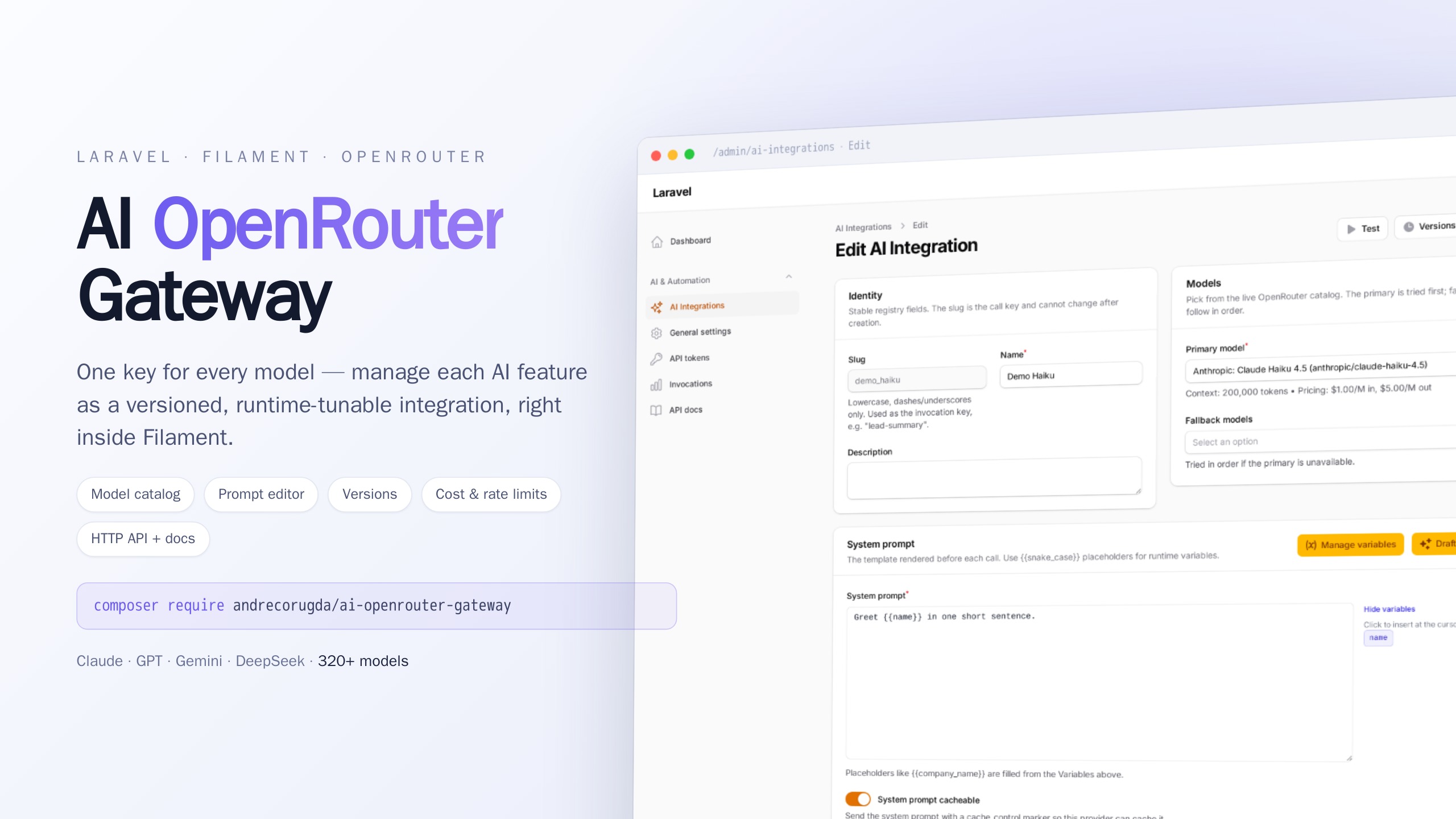



Manage every AI feature in your Laravel app as a versioned, runtime-tunable integration — one OpenRouter key for every model, behind one service, one audit log, and one cost view.
Stop hardcoding prompts and model ids. Define a use case once, then tune its prompt, model, and parameters from a bundled Filament admin UI — no code change, no redeploy. Call it from PHP or over an authenticated HTTP API, with multi-turn conversations, rate limits, daily cost caps, and per-call telemetry built in.
use Andre\AiGateway\Facades\AiGateway;

$result = AiGateway::invoke('lead_summary', ['company' => 'Acme Corp']);

$result->text;        // the model's reply
$result->model_used;  // 'anthropic/claude-sonnet-4'
$result->cost_usd;    // 0.0004
Swap anthropic/claude-sonnet-4 for openai/gpt-4o or google/gemini-2.5-pro from a dropdown — every model OpenRouter offers, no code change.
Your prompts, customer data, and OpenRouter key never leave your app — there's no third-party SaaS in the trust boundary.
#Why?
- No hardcoded prompts. Prompt, variables, model, and params live in the database and the admin UI — not your source tree.
- Tune in production, instantly. Edit and save; the next call uses it. Every save mints a new version you can roll back to.
- Test across models in seconds. Pick any model from the live catalog, hit Test, and compare output, tokens, latency, and cost — then promote the better or cheaper one.
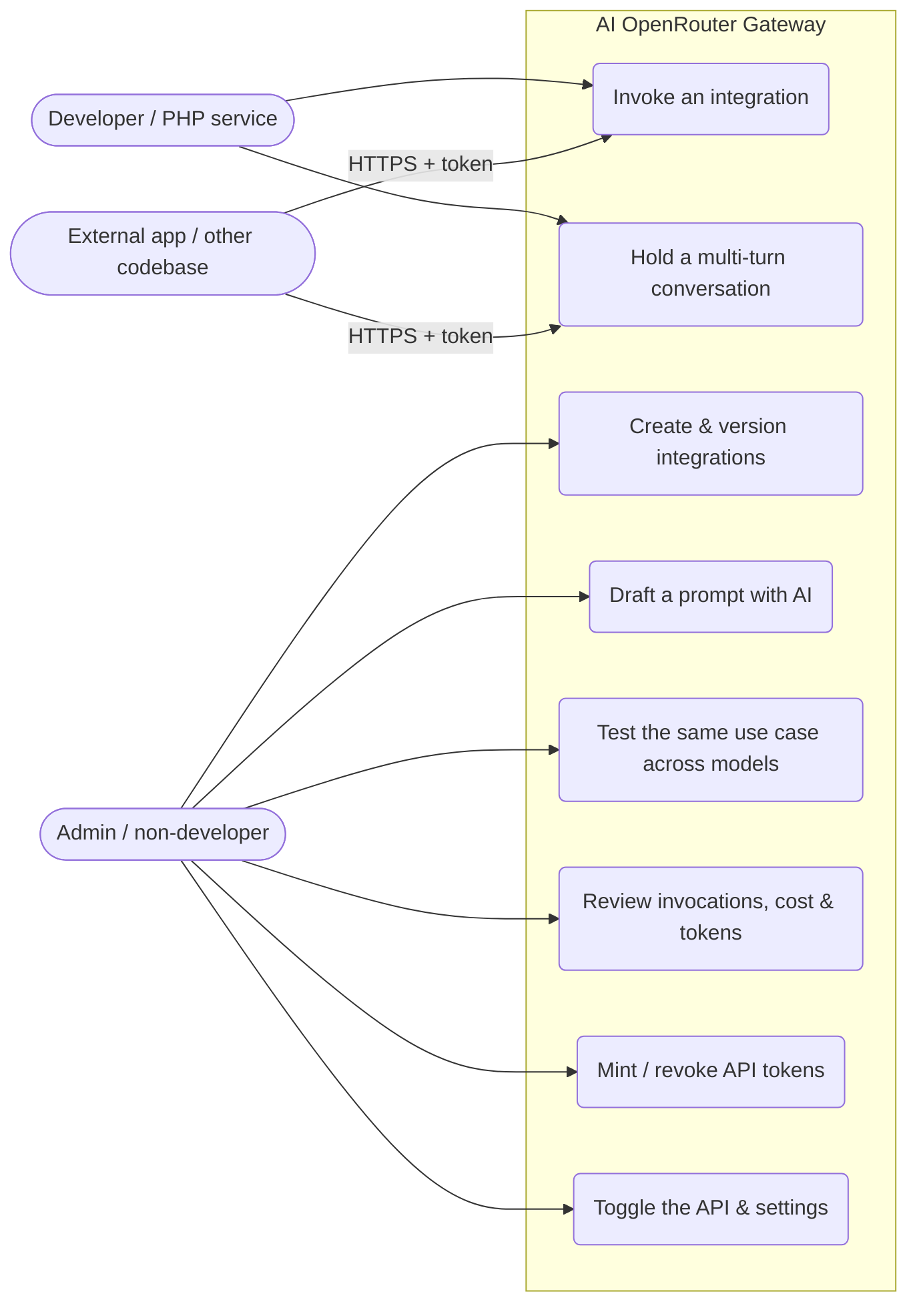
- One use case, every caller. Invoke it from any PHP service and any external app or language over HTTPS — one source of truth, reused across platforms.
- Spend you can see and cap. Per-call cost / token / latency telemetry, plus per-integration rate limits and daily budgets.
#How it works
#Who uses it (use cases)
#Architecture
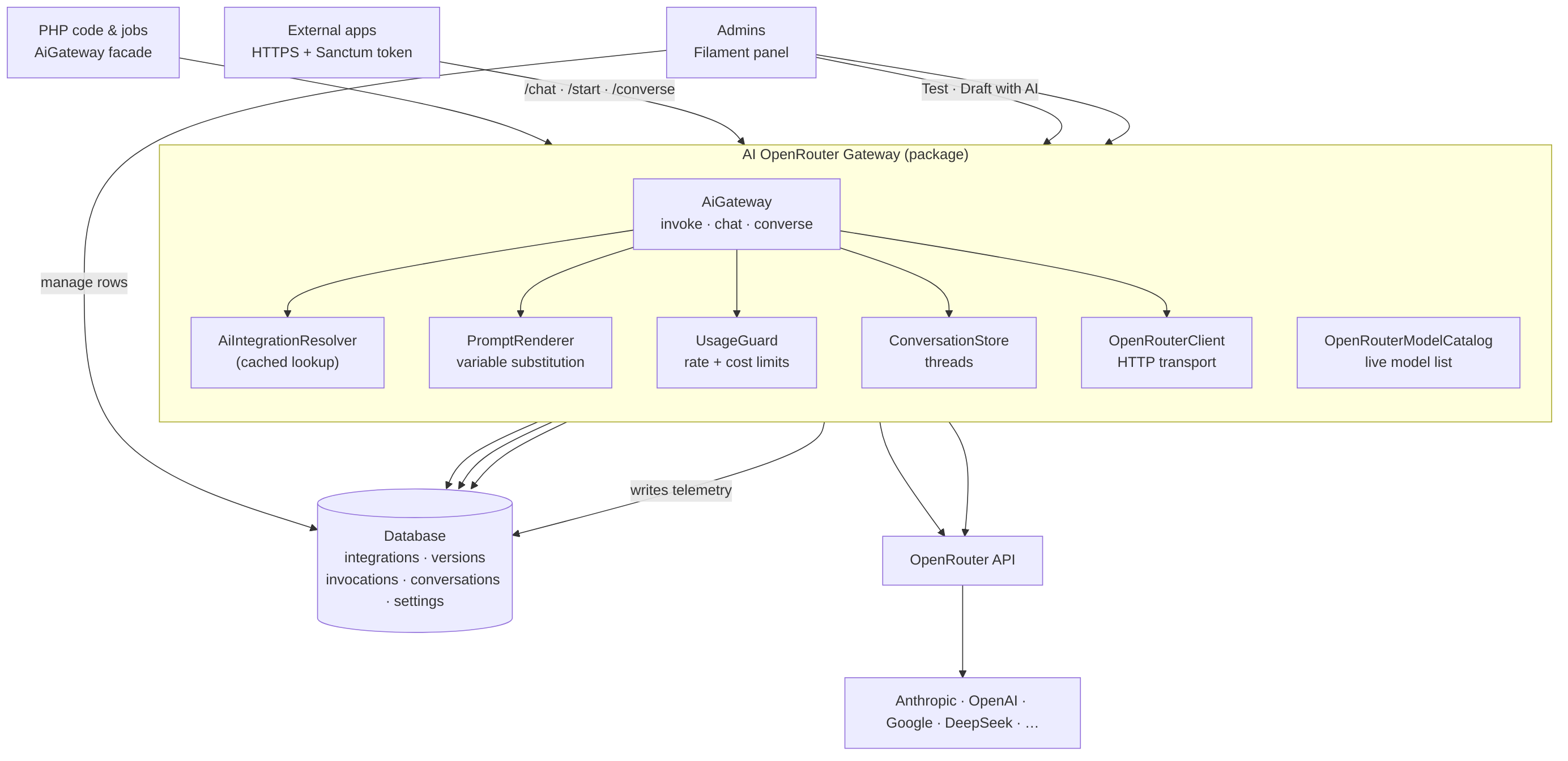
Request flow (one call): resolve the integration's active version (cached) → render the prompt template with the caller's args → enforce rate + daily-cost limits → compose the OpenRouter payload (model[s], params, server tools, optional cache markers) → call OpenRouter → write an ai_invocations telemetry row (cost / tokens / latency / status) → return a typed AiResult. Conversational calls additionally load and persist thread turns via ConversationStore.
#Features
- 🔌 One key, every model — OpenRouter under the hood; switch models per-integration with no code change.
- 🧩 Named integrations — register a use case once, invoke it by slug everywhere.
- 🗂️ Versioned prompts — every edit mints a new version; activate/roll back without losing history.
- 🧮 Telemetry built in — tokens, cost, latency, model, and status for every call in
ai_invocations. - 🚦 Rate limiting — per-integration, per-caller, per-minute.
- 💰 Cost limiting — per-integration daily USD budget, enforced before each call.
- 🌐 HTTP API —
POST /api/ai/{integration}/chat, Sanctum-authenticated, toggleable at runtime. - 💬 Conversation threads — opt-in multi-turn memory with
/start+/converse, per-caller ownership, TTL expiry, and a prune command. - 📖 Live API docs — an OpenAPI 3 spec + interactive Scalar "try it" page generated from your integrations.
- 🔑 API token management — mint and revoke scoped tokens from the admin UI.
- 🔎 OpenRouter server tools — per-version
web_search/web_fetch. - ✨ AI prompt builder — describe what you want; a fast Haiku drafts the template + variables.
- 🗂️ Live model catalog — searchable model picker from OpenRouter's
/models, with per-model generation params and caching eligibility. - 📊 Invocations browser — read-only telemetry with status/caller/date filters, cost + token Σ summaries, and per-call detail.
- 🎛️ Filament admin UI — integration CRUD, versions (load-into-form), a live test panel, an interactive prompt editor, settings.
- ⚙️ Fully configurable — connection, table names, route prefix/middleware, cache store, limits, models.
#Requirements
- PHP 8.2+
- Laravel 11, 12, or 13
- An OpenRouter API key
- Filament 4 or 5 for the admin UI (optional) — see version compatibility below
#Version compatibility
| Package | Filament |
|---|---|
^2.0 |
4.x / 5.x |
^1.0 |
3.x |
Composer installs the right line for your Filament version automatically — composer require andrecorugda/ai-openrouter-gateway.
#Installation
composer require andrecorugda/ai-openrouter-gateway
Publish and run the migrations:
php artisan vendor:publish --tag="ai-openrouter-gateway-migrations"
php artisan migrate
Optionally publish the config:
php artisan vendor:publish --tag="ai-openrouter-gateway-config"
Add your key to .env:
OPENROUTER_API_KEY=sk-or-v1-...
That's the only required variable — referer/title default to your APP_URL / APP_NAME.
#Quickstart
#1. Create an integration
Either through the Filament UI (recommended) or in code:
use Andre\AiGateway\Models\AiIntegration;
use Andre\AiGateway\Services\AiIntegrationService;

$integration = AiIntegration::create([
    'slug' => 'expense_extract',
    'name' => 'Expense Extractor',
    'visibility' => 'internal',
]);

app(AiIntegrationService::class)->saveVersion($integration, [
    'system_prompt' => 'Extract the merchant, total, and date from this receipt:\n\n{{receipt_text}}',
    'models' => ['anthropic/claude-sonnet-4', 'openai/gpt-4o'], // primary + fallback
    'default_params' => ['max_tokens' => 512, 'temperature' => 0.1],
    'prompt_args' => [
        ['name' => 'receipt_text', 'type' => 'string', 'required' => true],
    ],
]);
#2. Invoke it from PHP
use Andre\AiGateway\Facades\AiGateway;

$result = AiGateway::invoke('expense_extract', [
    'receipt_text' => $ocrText,
]);

$result->text;        // the assistant's reply
$result->model_used;  // 'anthropic/claude-sonnet-4'
$result->cost_usd;    // 0.0021
$result->usage;       // ['prompt_tokens' => ..., 'completion_tokens' => ...]
Multi-turn chat layers messages on top of the templated system prompt:
$result = AiGateway::invoke('support_assistant',
    args: ['kb_version' => 'v3'],
    messages: [
        ['role' => 'user', 'content' => 'How do I reset my password?'],
    ],
);
#3. Or call it over HTTP
The HTTP API and the API Tokens admin page are authenticated with Laravel Sanctum. One-time setup in your app:
composer require laravel/sanctum
php artisan migrate            # creates personal_access_tokens
Then add the HasApiTokens trait to your User model:
use Laravel\Sanctum\HasApiTokens;

class User extends Authenticatable
{
    use HasApiTokens;
    // ...
}
Now call the endpoint:
curl -X POST https://your-app.test/api/ai/expense_extract/chat \
  -H "Authorization: Bearer <token>" \
  -H "Content-Type: application/json" \
  -d '{"args": {"receipt_text": "..."}, "options": {"max_tokens": 256}}'
Mint the token from the admin UI (API Tokens page — with an optional expiry of 7/30/90 days or 1 year) or in code:
// never expires
$token = $user->createToken('integration-client', ['ai-gateway:invoke'])->plainTextToken;

// expires in 30 days — Sanctum rejects it automatically after that
$token = $user->createToken('integration-client', ['ai-gateway:invoke'], now()->addDays(30))->plainTextToken;
Sweep expired tokens from the table on a schedule with Sanctum's built-in command:
// routes/console.php
Schedule::command('sanctum:prune-expired --hours=24')->daily();
#The admin UI (Filament)
Register the plugin on your panel:
use Andre\AiGateway\Filament\AiGatewayPlugin;

public function panel(Panel $panel): Panel
{
    return $panel
        // ...
        ->plugin(AiGatewayPlugin::make());
}
You get:
- AI Integrations — create/edit integrations with a searchable model picker from the live OpenRouter catalog, generation params that auto-populate per model, a model-aware prompt-caching control, an interactive prompt editor (click a declared variable to insert
{{name}}), a Versions action that loads any past version back into the form, and a Test panel that runs it live and shows tokens/cost/latency. - Draft with AI — describe the use case in plain language; the prompt builder fills the template and variable schema for you.
- Invocations — a read-only telemetry browser: filter by status / caller / integration / date, with cost + token Σ summaries and a per-call detail modal (usage, error, OpenRouter generation link).
- General settings — toggle the HTTP API, toggle the prompt builder, and pick the helper model (also a catalog-backed Select).
- API Tokens — mint (with an optional expiry) and revoke scoped invocation tokens; the one-time token has a one-click Copy to clipboard button.
- API docs — the interactive OpenAPI (Scalar) reference embedded right in the panel; browse and test every integration's endpoints without leaving Filament.
#Screenshots
| Integration form — catalog model picker, per-model params, caching, prompt editor | 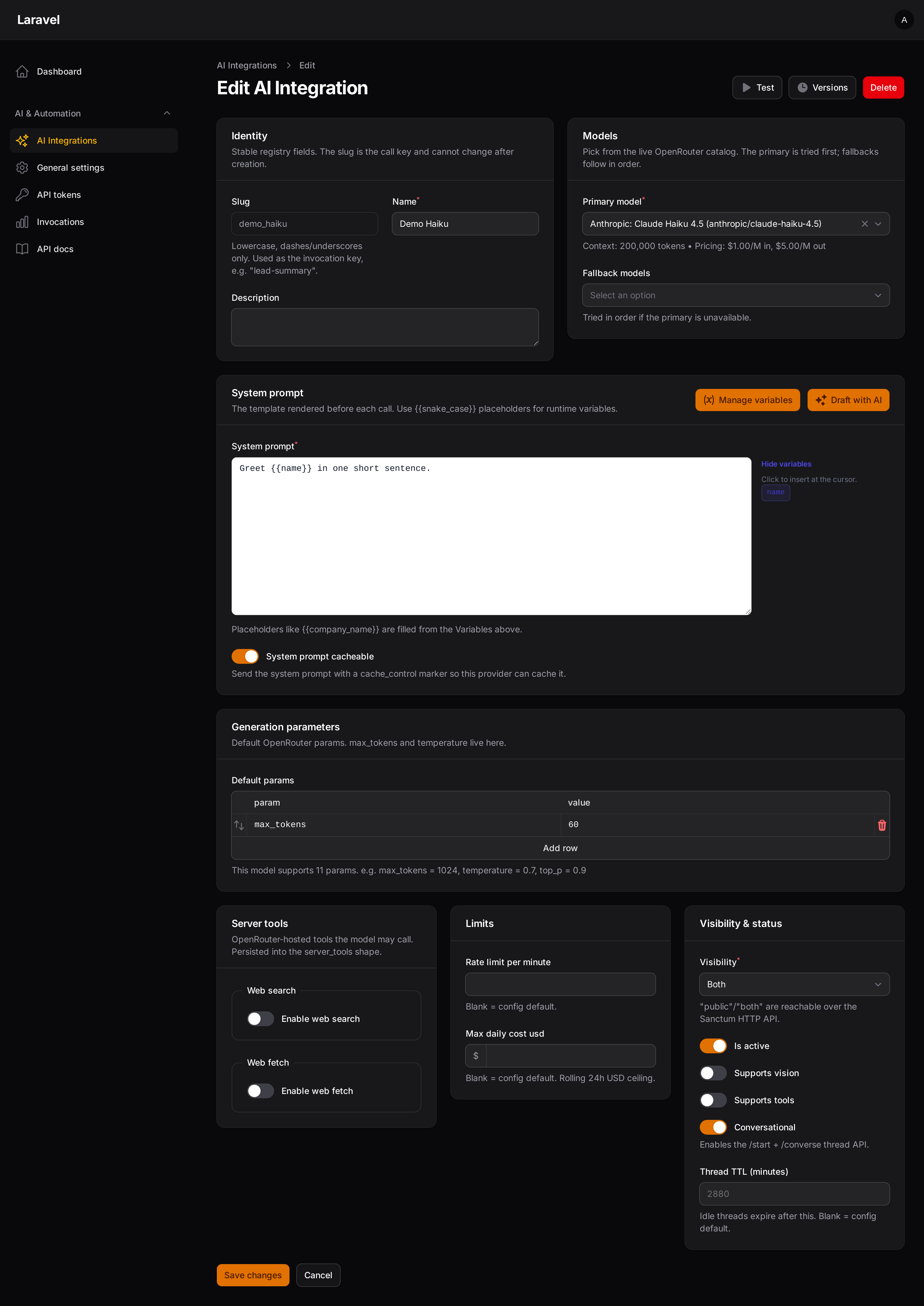 |
| Integrations list | 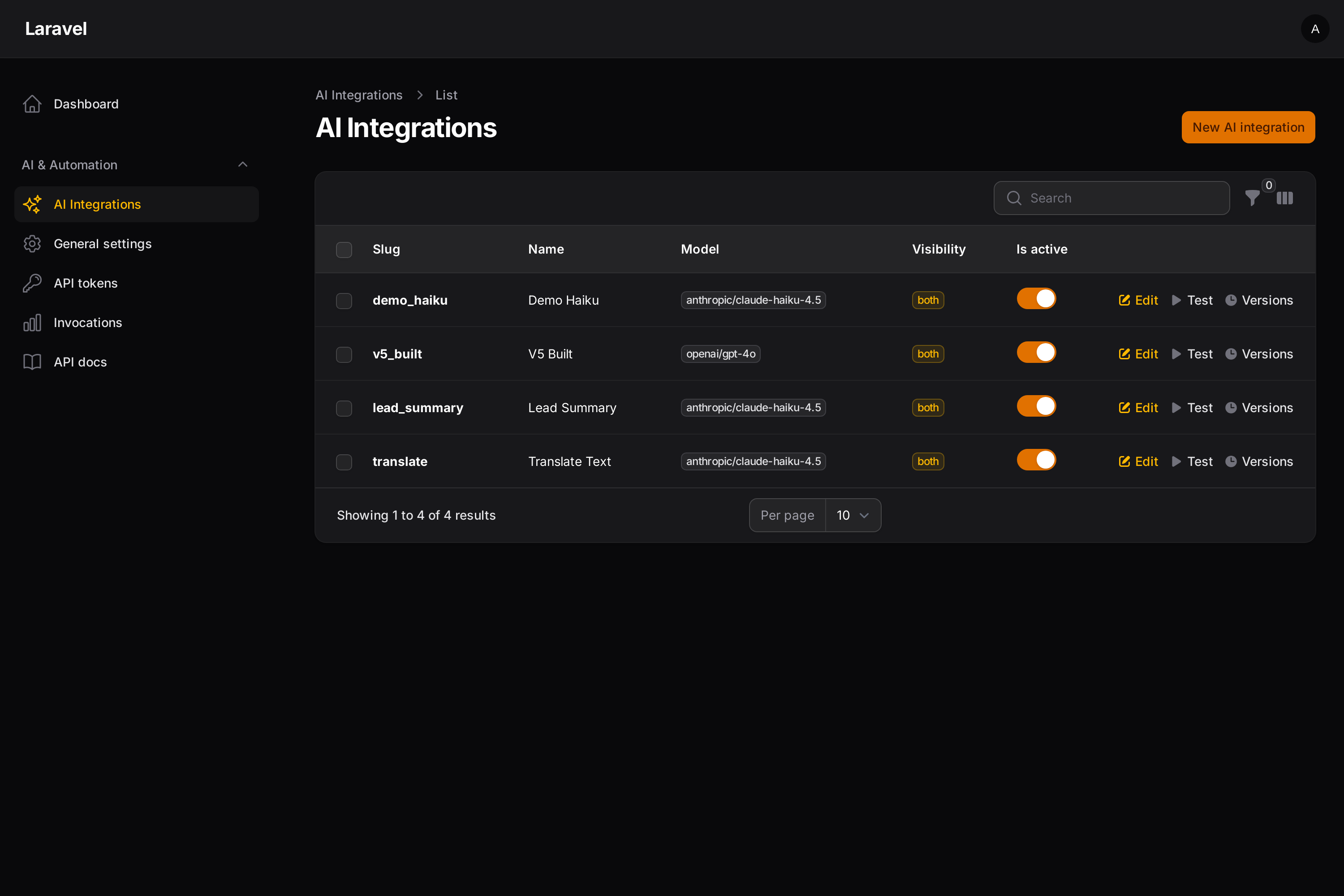 |
| Invocations — telemetry with Σ summaries | 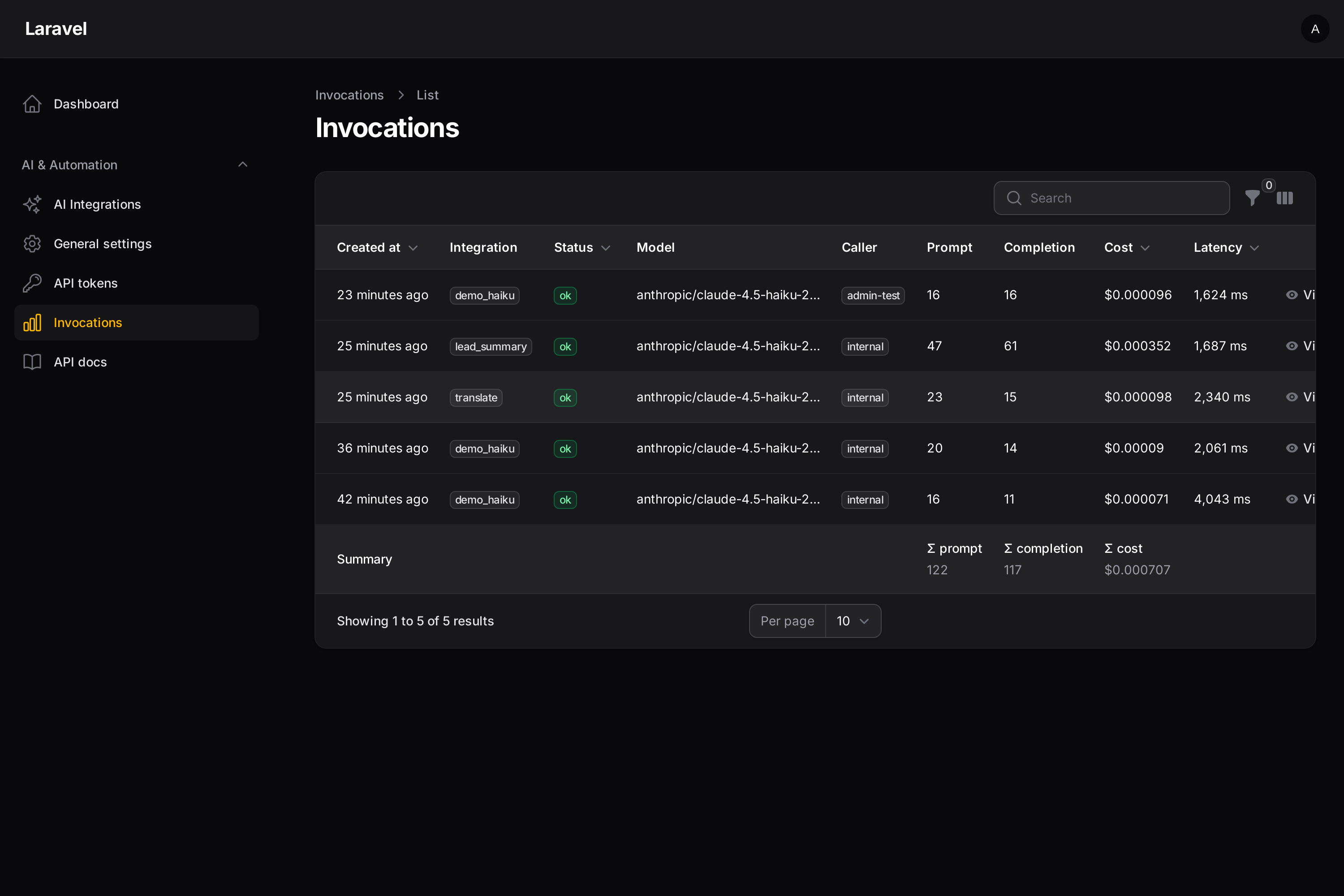 |
| Invocation detail — per-call tokens, cost, latency, OpenRouter id | 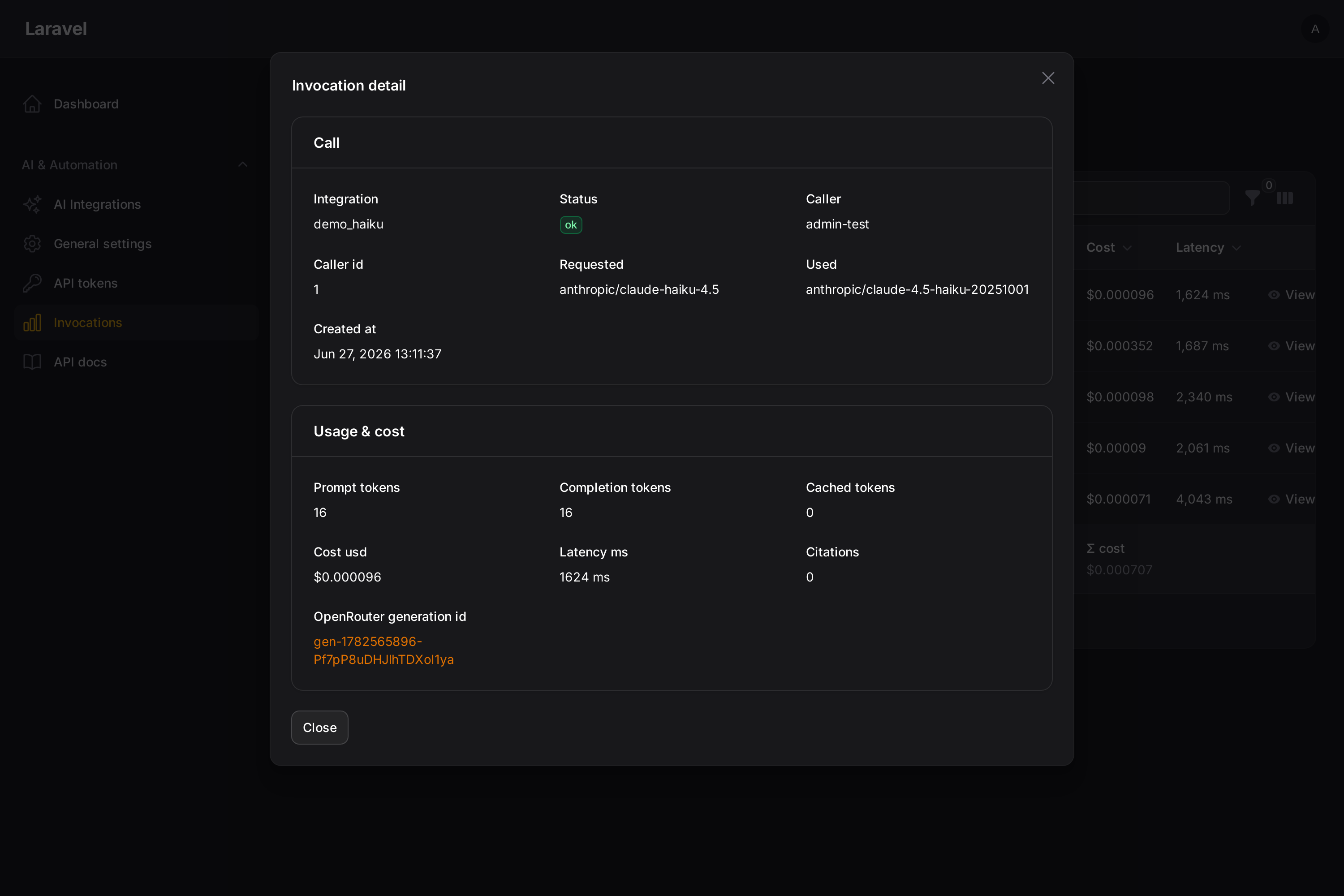 |
| Versions — load a past version into the form | 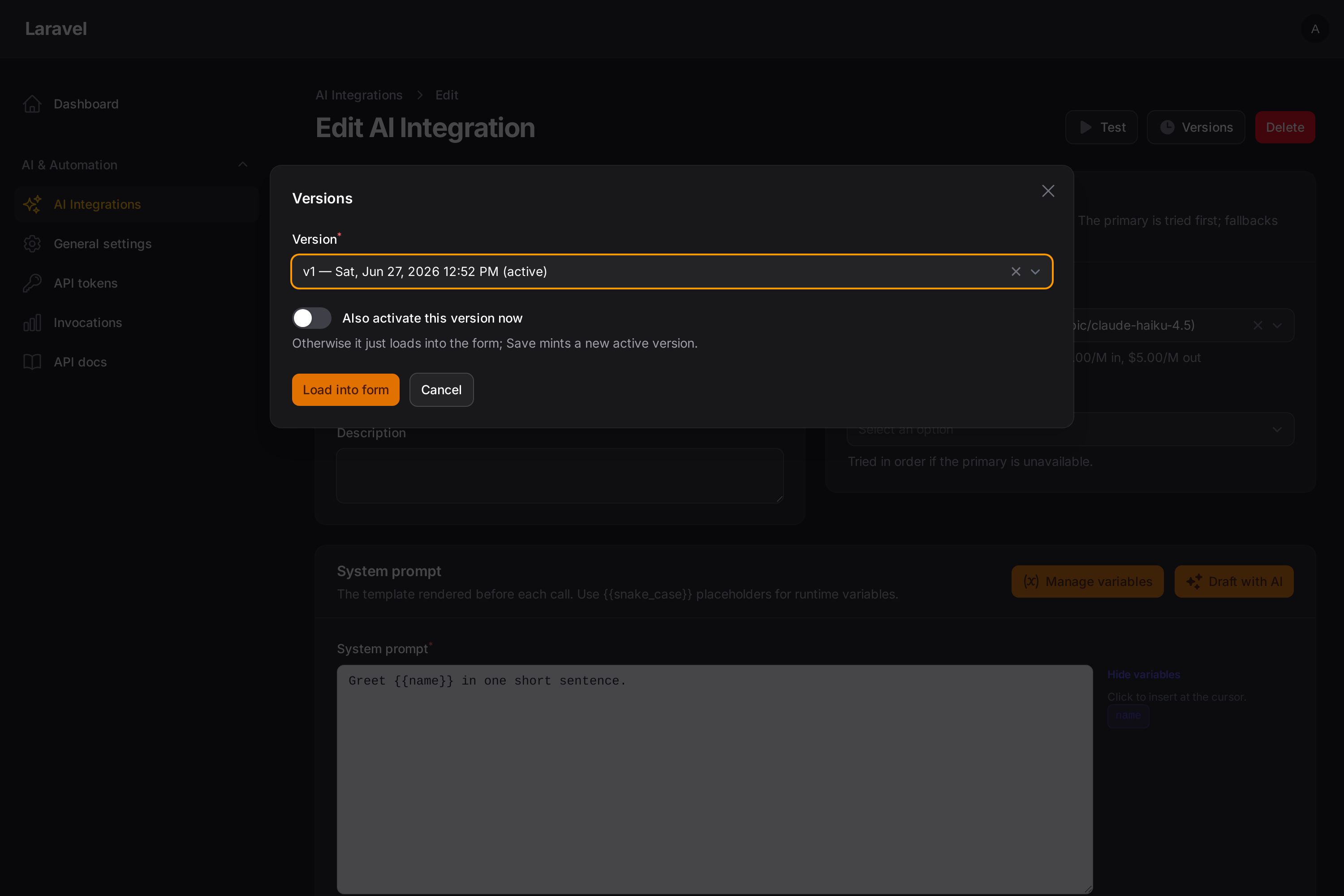 |
| General settings | 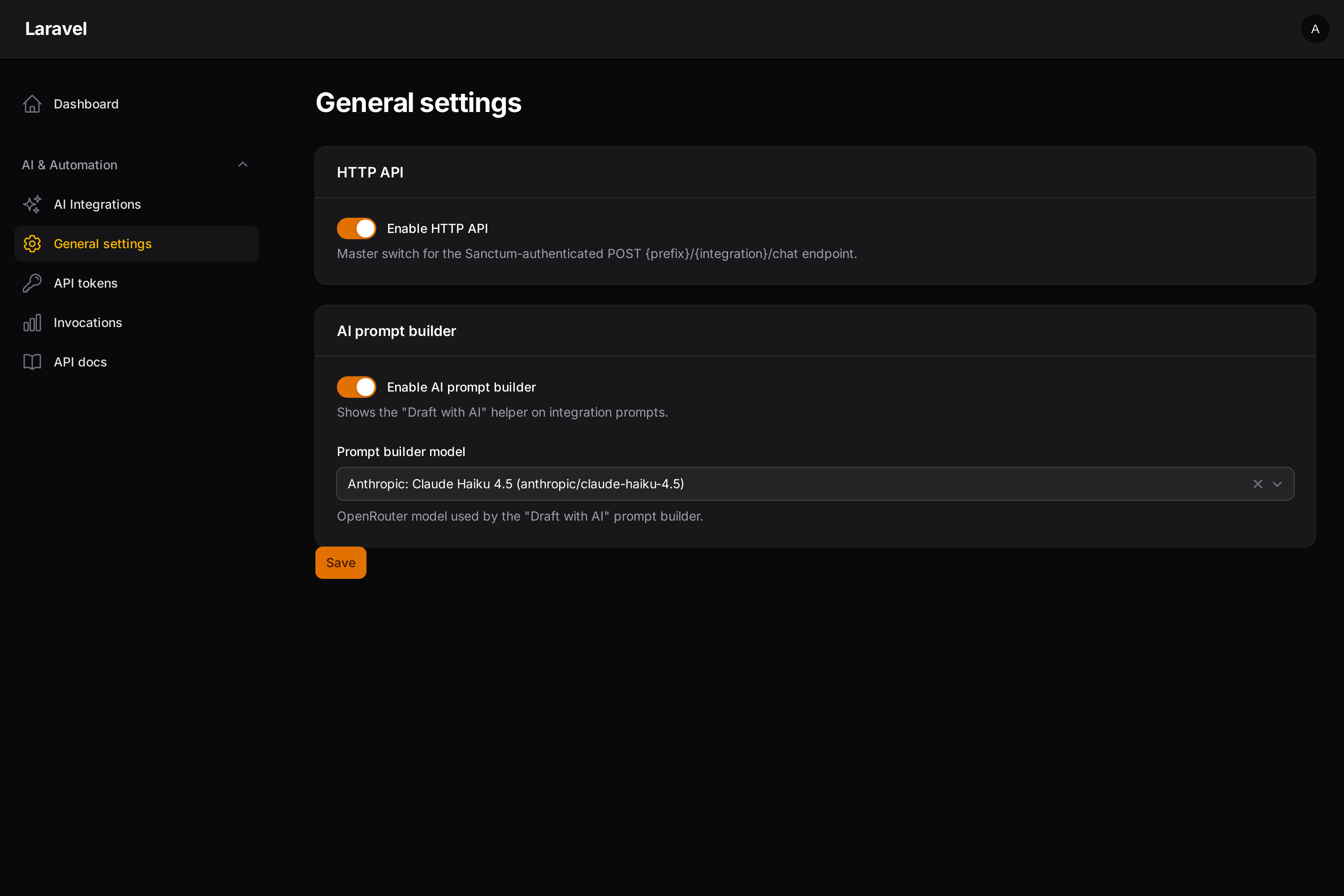 |
| API tokens — mint scoped tokens; one-time value with one-click copy | 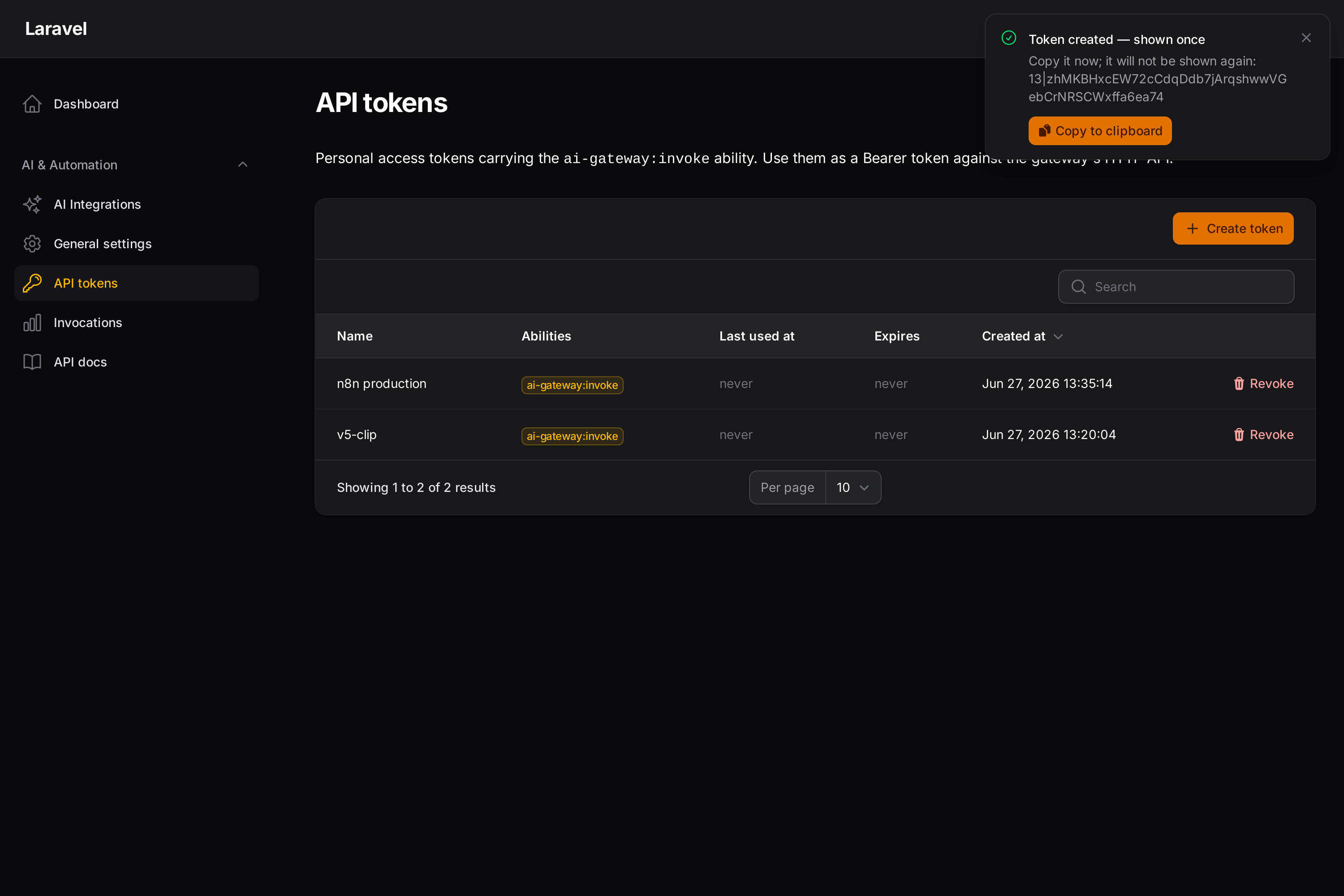 |
#Conversations (multi-turn threads)
Flag an integration conversational (UI toggle, or is_conversational + conversation_ttl_minutes) to get server-side memory: the gateway persists each turn, so clients send only the next message — no replaying history.
From PHP:
use Andre\AiGateway\Facades\AiGateway;

$first  = AiGateway::converse('support', null, 'My order is late');      // null → new thread
$id     = $first->conversation_id;                                       // keep this
$second = AiGateway::converse('support', $id, 'Order #4471');            // continues with full history
Over HTTP (two calls, à la a chatbot /start then /chat):
# 1) open a thread
curl -X POST https://your-app.test/api/ai/support/start \
  -H "Authorization: Bearer <token>"
# → { "data": { "conversation_id": "0779…", "expires_at": "…" } }

# 2) send turns
curl -X POST https://your-app.test/api/ai/support/converse \
  -H "Authorization: Bearer <token>" -H "Content-Type: application/json" \
  -d '{"conversation_id": "0779…", "message": "Order #4471"}'
Threads are owned by their caller (a guessed id returns 404), expire after the TTL, and link each turn to its telemetry row. Prune expired threads on a schedule:
// routes/console.php
Schedule::command('ai-gateway:prune-conversations')->daily();
#Interactive API docs
The package serves a live OpenAPI 3 document built from your integrations, plus an interactive Scalar docs page with a built-in request tester:
GET {prefix}/docs— the docs UI (paste a token, try any endpoint live)GET {prefix}/openapi.json— the raw spec- …and as an "API docs" page right inside the Filament panel (embedded, so admins never leave the UI)
Every API-visible integration becomes real endpoints: POST /{slug}/chat with a request body shaped from its declared variables (types + required flags) and the allow-listed options, plus /{slug}/start and /{slug}/converse when the integration is conversational. The model and prompt-caching mode appear in each endpoint's description.

Gate or disable it via config('ai-gateway.api.docs') — add middleware (e.g. ['auth']) to make it private, or override script_src to self-host the renderer instead of the CDN.
#Rate & cost limiting
Set ceilings per integration (UI → Limits, or the rate_limit_per_minute / max_daily_cost_usd columns). Blank falls back to the config default; a null default means unlimited.
// config/ai-gateway.php
'rate_limit' => [
    'enabled' => true,
    'default_per_minute' => 60,   // null = unlimited
],
'cost_limit' => [
    'enabled' => true,
    'default_daily_usd' => 25.0,  // null = uncapped
    'window_hours' => 24,
],
When a caller exceeds a limit the gateway throws RateLimitExceededException (HTTP 429) or CostLimitExceededException (HTTP 402) before any spend occurs.
#Configuration highlights
Everything in config/ai-gateway.php is overridable. Common knobs:
| Key | Purpose |
|---|---|
openrouter.api_key |
Your OpenRouter key (OPENROUTER_API_KEY). |
default_model |
Model pre-filled on new integrations. |
database.connection / database.tables |
Relocate / rename the package's tables. |
models.* |
Swap any Eloquent model for an app subclass. |
cache.store / cache.ttl_seconds |
Integration-resolver cache. |
api.enabled / api.prefix / api.middleware / api.token_ability |
HTTP API surface. |
prompt_builder.model |
Helper model (defaults to anthropic/claude-haiku-4.5). |
filament.navigation_group / filament.authorize |
Admin UI placement & access gate. |
#Observability
Every call writes one row to ai_invocations (success and failure both):
use Andre\AiGateway\Models\AiInvocation;

// Per-integration spend over the last 24h
AiInvocation::where('ai_integration_id', $id)
    ->where('created_at', '>=', now()->subDay())
    ->sum('cost_usd');
Each row keeps OpenRouter's openrouter_generation_id, linked to https://openrouter.ai/logs?transaction={id} (and copyable) for full provider-side cost forensics — or fetch it via GET /api/v1/generation?id=….
#Testing
composer install
vendor/bin/pest
#Security
The gateway never sends data to anyone but OpenRouter. Rotate your key by updating OPENROUTER_API_KEY and redeploying. If you discover a vulnerability, please email andre.alarcon.corugda@gmail.com.
#Credits
Built by Andre Corugda.
#License
The MIT License (MIT). See LICENSE.
The author
Hi, I'm Andre. Almost everything I've learned as a developer came from people who shared freely — open source, late-night forum answers, strangers who took the time to help. I owe a lot to this community. So I'm releasing free tools for anyone who needs them, hoping to give back even a fraction of what I've received.
From the same author
Featured Plugins
A selection of plugins curated by the Filament team
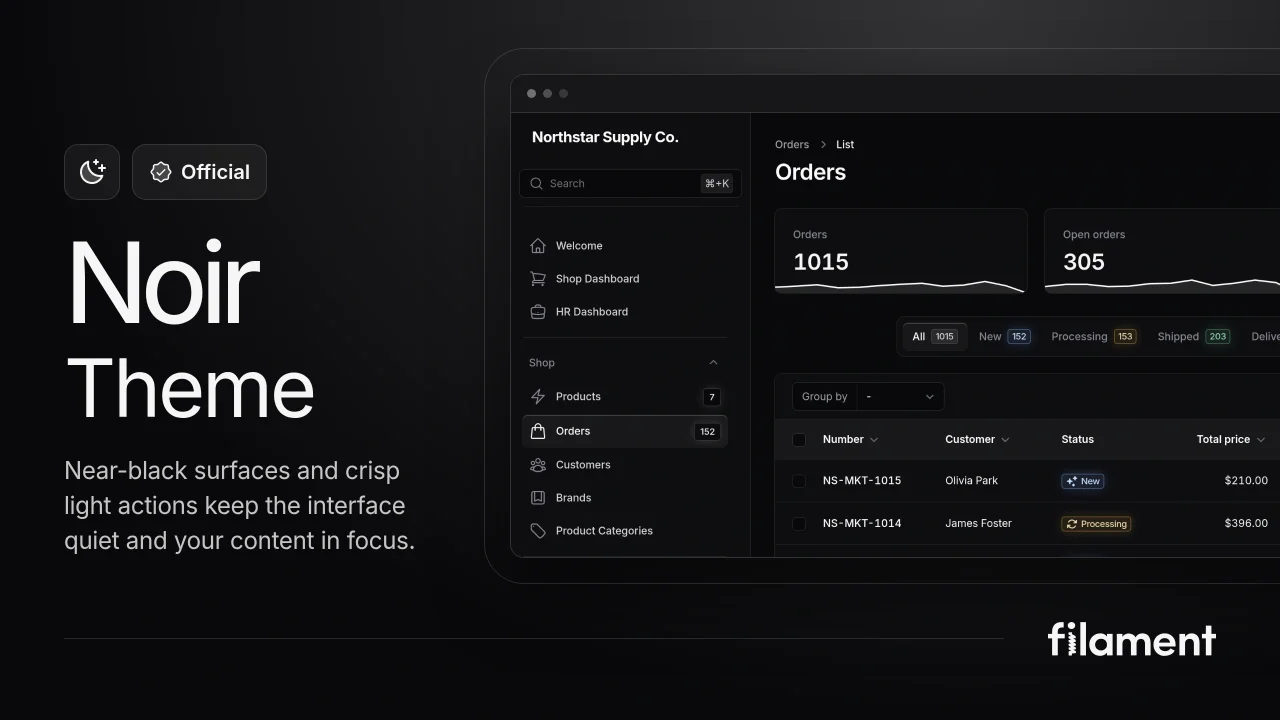
Noir Theme
A theme that gives panels a focused, refined look with near-black surfaces, crisp actions, and restrained color.
 Filament
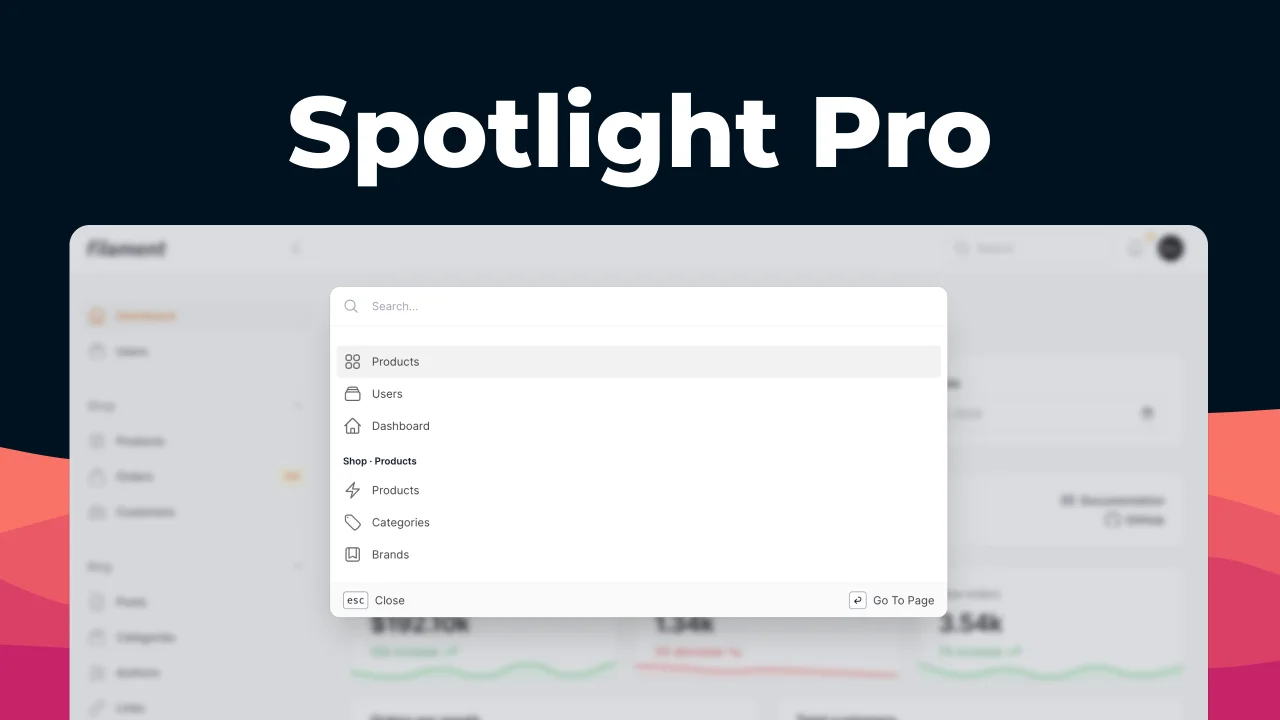
Spotlight Pro
Browse your Filament Panel with ease. Filament Spotlight Pro adds a Spotlight like Command Palette to your Filament Panel.
 Dennis Koch
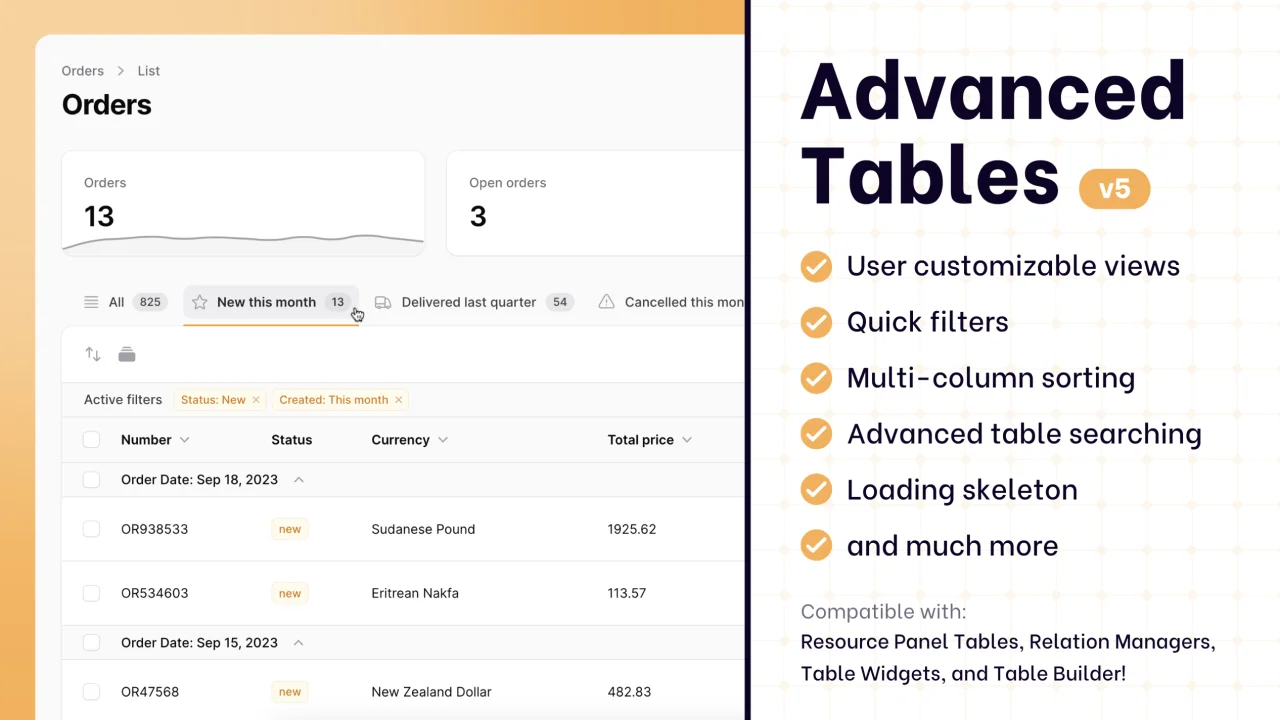
Advanced Tables (formerly Filter Sets)
Supercharge your tables with powerful features like user-customizable views, quick filters, multi-column sorting, advanced table searching, convenient view management, and more. Compatible with Resource Panel Tables, Relation Managers, Table Widgets, and Table Builder!
 Kenneth Sese