OTP login
OTP login using SMS, Email, and other methods.
 Author:
Taha Moghaddam
Author:
Taha Moghaddam
Documentation
- Features
- Requirements
- Installation
- Configuration (env)
- Custom OTP sender
- Translations
- Flow
- Security
- Changelog
- License
- Publish to Packagist and GitHub
- Filament


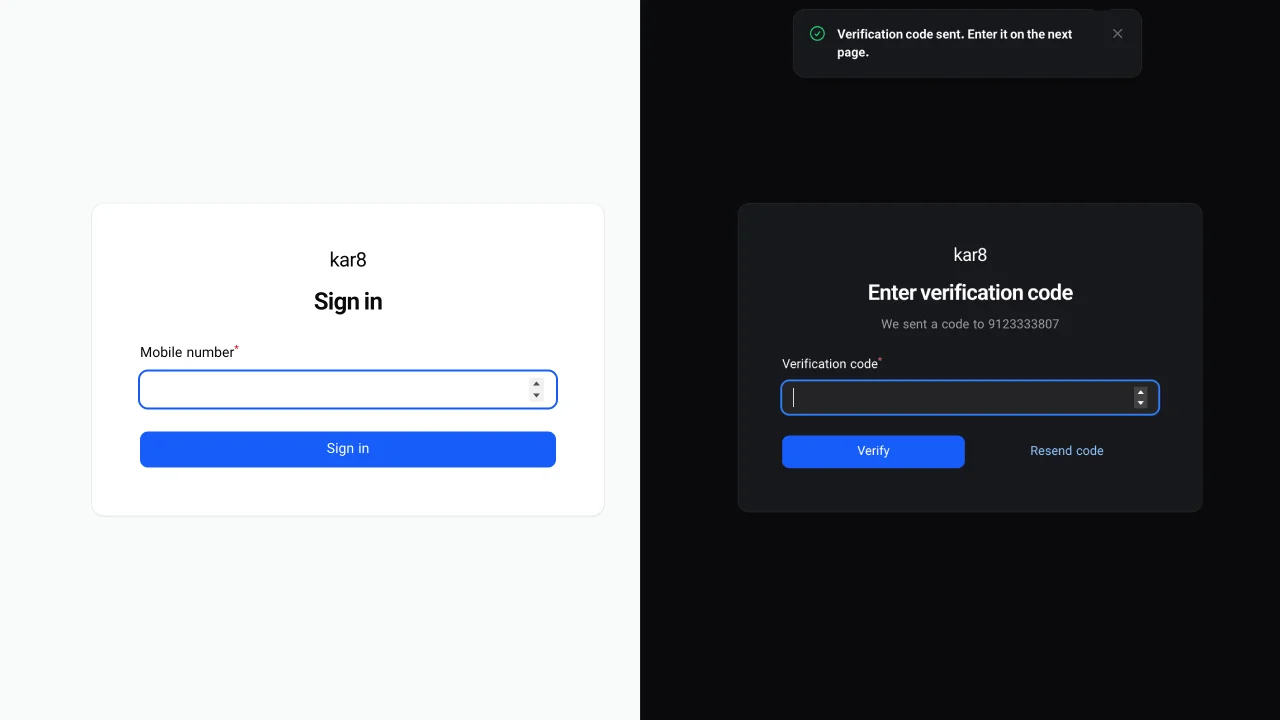
OTP (One-Time Password) login for Filament v5: mobile/phone number login with OTP code, no password, no session (mobile passed in URL). Users can “register” by logging in with OTP for the first time.
#Features
- Mobile + OTP only – No password, no email. User enters mobile → receives OTP → enters code on next page.
- No session for pending state – Mobile number is passed in the URL (e.g.
?mobile=...) to the OTP verification page. - Configurable request block –
request_block_seconds: time (in seconds) before the same mobile can request another OTP. - Same OTP resend – Up to N times (configurable, default 3) the same code is resent; after that a new OTP is generated.
- Pluggable OTP delivery – Implement
OtpSenderInterface(SMS, email, log, etc.) and set it in config. - Filament 5 – Built for Filament v5 panels.
#Requirements
- PHP 8.2+
- Laravel 11 or 12
- Filament 4 or 5
- Livewire 3 or 4
#Installation
composer require taha-moghaddam/filament-otp-login
#1. User model and table
Your user model (e.g. App\Models\AdminUser) must have at least:
- A mobile column (name configurable, default:
mobile) – unique, stored as string or bigInteger. - OTP fields:
otp_code(nullable int),otp_expires_at(nullable timestamp),otp_sent_count(int, default 0),mobile_verified_at(nullable timestamp).
Example migration for admin_users:
Schema::create('admin_users', function (Blueprint $table) {
    $table->id();
    $table->string('name');
    $table->unsignedBigInteger('mobile')->unique();
    $table->timestamp('mobile_verified_at')->nullable();
    $table->unsignedSmallInteger('otp_code')->nullable();
    $table->timestamp('otp_expires_at')->nullable();
    $table->unsignedTinyInteger('otp_sent_count')->default(0);
    $table->rememberToken();
    $table->timestamps();
});
#2. Publish and run migrations (OTP logs table)
php artisan vendor:publish --tag="filament-otp-login-migrations"
php artisan migrate
#3. Publish config (optional)
php artisan vendor:publish --tag="filament-otp-login-config"
Then edit config/filament-otp-login.php:
- user_model – Your user model class (e.g.
App\Models\AdminUser). - otp_log.table – Table name for OTP logs (default:
admin_otp_logs). - otp_log.user_foreign_key – Foreign key to users (default:
admin_user_id). - mobile_column – Column name for mobile number (default:
mobile). - sender – Class implementing
FilamentOtpLogin\Contracts\OtpSenderInterface(default:LogOtpSender– logs to Laravel log). - otp_length, otp_expires_seconds, request_block_seconds, same_otp_max_sends – Behaviour and limits.
#4. Register the plugin on your panel
In your Filament panel provider (e.g. AdminPanelProvider):
use FilamentOtpLogin\FilamentOtpLoginPlugin;

public function panel(Panel $panel): Panel
{
    return $panel
        ->id('admin')
        ->path('admin')
        ->authGuard('admin')  // use the guard that uses your user model
        ->plugins([
            FilamentOtpLoginPlugin::make(),
        ])
        // ... rest of panel config
        ;
}
Do not call ->login() or ->registration() on the panel; the plugin sets the login page and disables registration.
#5. Auth guard (optional)
Ensure config/auth.php has a guard that uses your user model, e.g.:
'guards' => [
    'admin' => [
        'driver' => 'session',
        'provider' => 'admin_users',
    ],
],
'providers' => [
    'admin_users' => [
        'driver' => 'eloquent',
        'model' => App\Models\AdminUser::class,
    ],
],
#Configuration (env)
| Key | Description | Default |
|---|---|---|
FILAMENT_OTP_LOGIN_USER_MODEL |
User model class | App\Models\AdminUser |
FILAMENT_OTP_LOGIN_OTP_LOG_TABLE |
OTP logs table name | admin_otp_logs |
FILAMENT_OTP_LOGIN_USER_FOREIGN_KEY |
FK column in OTP logs | admin_user_id |
FILAMENT_OTP_LOGIN_MOBILE_COLUMN |
Mobile column on user | mobile |
FILAMENT_OTP_LOGIN_SENDER |
OTP sender class | FilamentOtpLogin\Services\LogOtpSender |
FILAMENT_OTP_LOGIN_OTP_LENGTH |
OTP code length | 6 |
FILAMENT_OTP_LOGIN_OTP_EXPIRES_SECONDS |
OTP validity (seconds) | 120 |
FILAMENT_OTP_LOGIN_REQUEST_BLOCK_SECONDS |
Block before next request (seconds) | 60 |
FILAMENT_OTP_LOGIN_SAME_OTP_MAX_SENDS |
Same code resend limit | 3 |
#Custom OTP sender
Implement FilamentOtpLogin\Contracts\OtpSenderInterface:
use FilamentOtpLogin\Contracts\OtpSenderInterface;
use Illuminate\Contracts\Auth\Authenticatable;

class MySmsOtpSender implements OtpSenderInterface
{
    public function send(Authenticatable $user, string $code): void
    {
        $mobile = $user->mobile; // or $user->{config('filament-otp-login.mobile_column')}
        // Send SMS to $mobile with $code
    }
}
Register it in config:
'sender' => \App\Services\MySmsOtpSender::class,
#Translations
Publish and edit translations:
php artisan vendor:publish --tag="filament-otp-login-translations"
Keys are under resources/lang/vendor/filament-otp-login/ (e.g. en/filament-otp-login.php). English and Persian (fa) are included in the package.
#Flow
- User opens panel login → sees mobile field only.
- Submits mobile → rate limit checked (
request_block_seconds), user found or created, OTP generated or same code resent (up tosame_otp_max_sends), OTP sent viaOtpSenderInterface, redirect to phone-verification-prompt?mobile=.... - User enters OTP on verification page → code validated, user logged in, redirect to panel.
No session is used for the “pending” user; the mobile in the URL identifies the user on the OTP page.
#Security
- Use HTTPS in production.
- Rate limiting is applied per mobile (
request_block_seconds). - OTP logs table can be pruned (e.g. scheduled job) to avoid bloat.
#Changelog
See Releases.
#License
MIT. See LICENSE.md.
#Publish to Packagist and GitHub
- Create a new repository on GitHub (e.g.
taha-moghaddam/filament-otp-login). - Push the
filament-otp-loginfolder to GitHub. - Register the package on Packagist and link your GitHub repo.
- Submit to the Filament plugin directory so it appears on the Filament site.
#Filament
This plugin is built for Filament v5.
Featured Plugins
A selection of plugins curated by the Filament team
Custom Dashboards
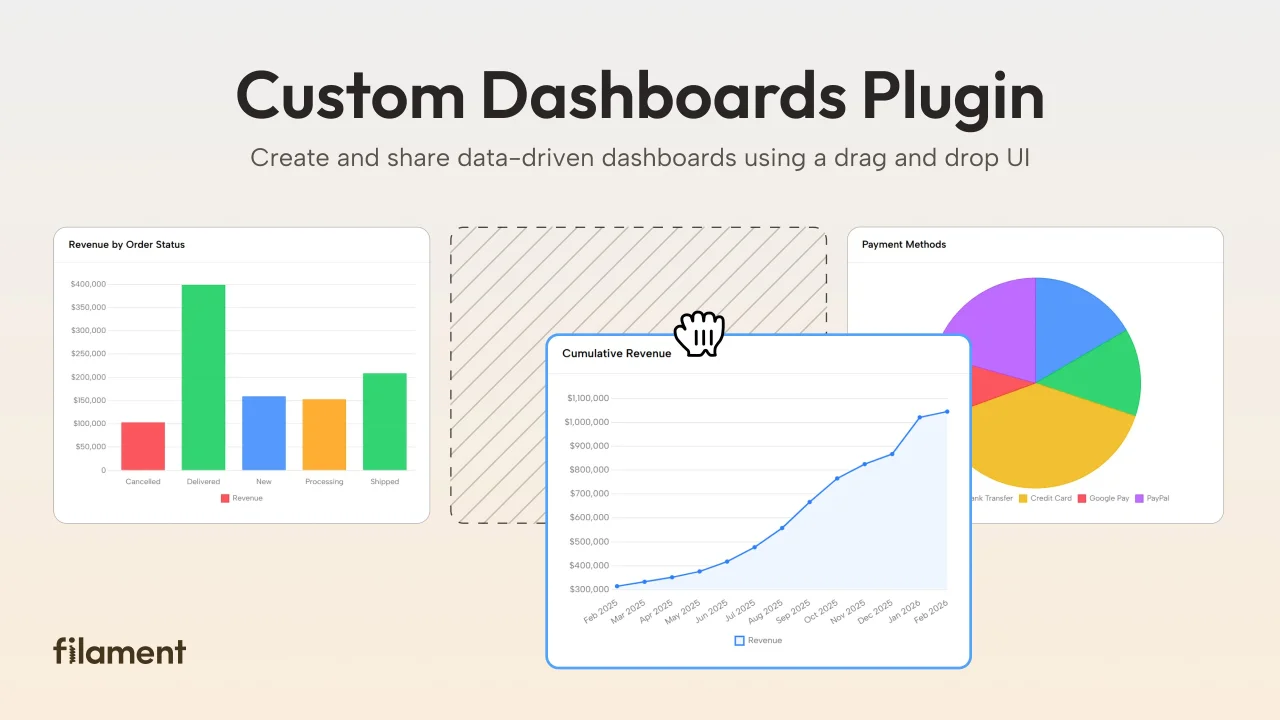
Let your users build and share their own dashboards with a drag-and-drop interface. Define your data sources in PHP and let them do the rest.
 Filament
Spotlight Pro
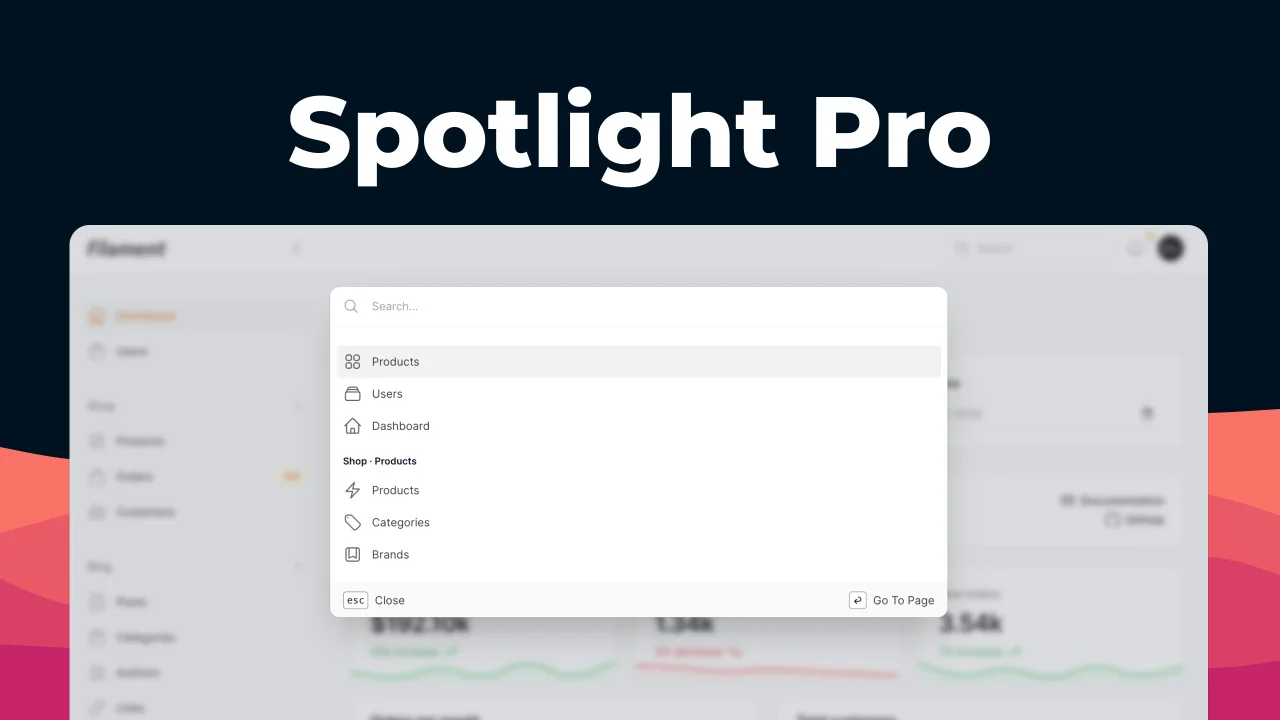
Browse your Filament Panel with ease. Filament Spotlight Pro adds a Spotlight/Raycast like Command Palette to your Filament Panel.
 Dennis Koch
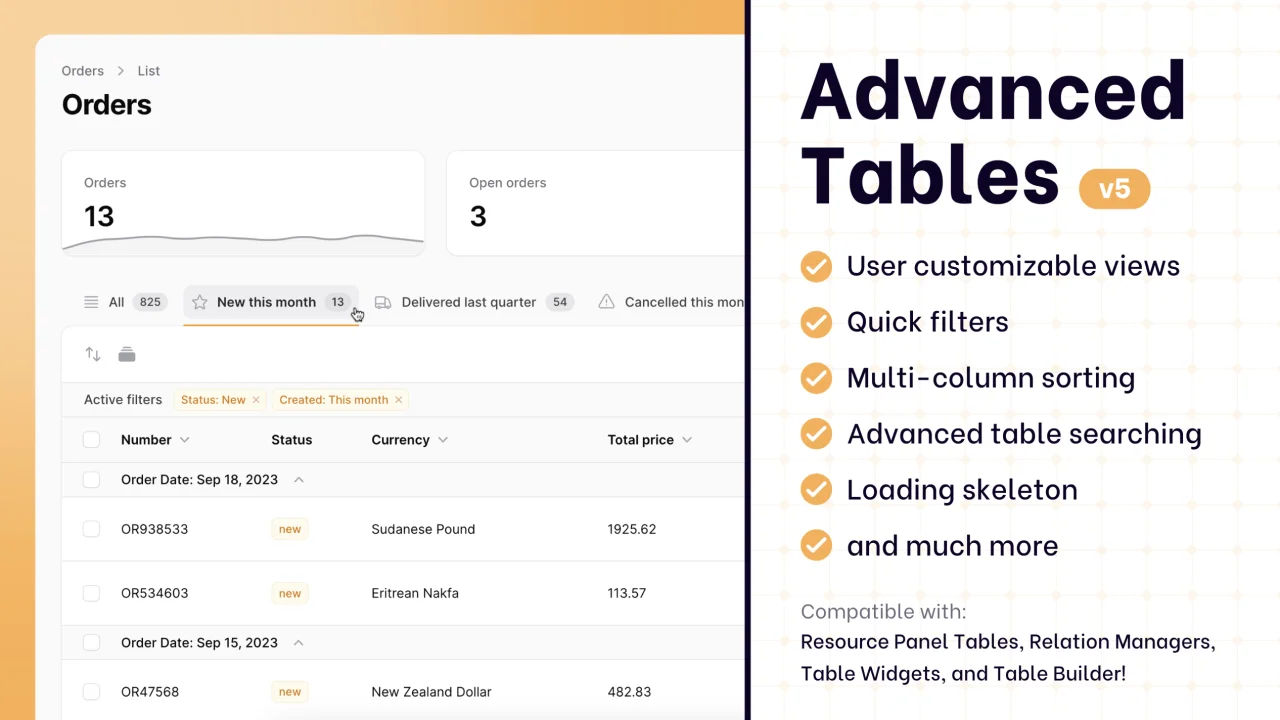
Advanced Tables (formerly Filter Sets)
Supercharge your tables with powerful features like user-customizable views, quick filters, multi-column sorting, advanced table searching, convenient view management, and more. Compatible with Resource Panel Tables, Relation Managers, Table Widgets, and Table Builder!
 Kenneth Sese