Page Header
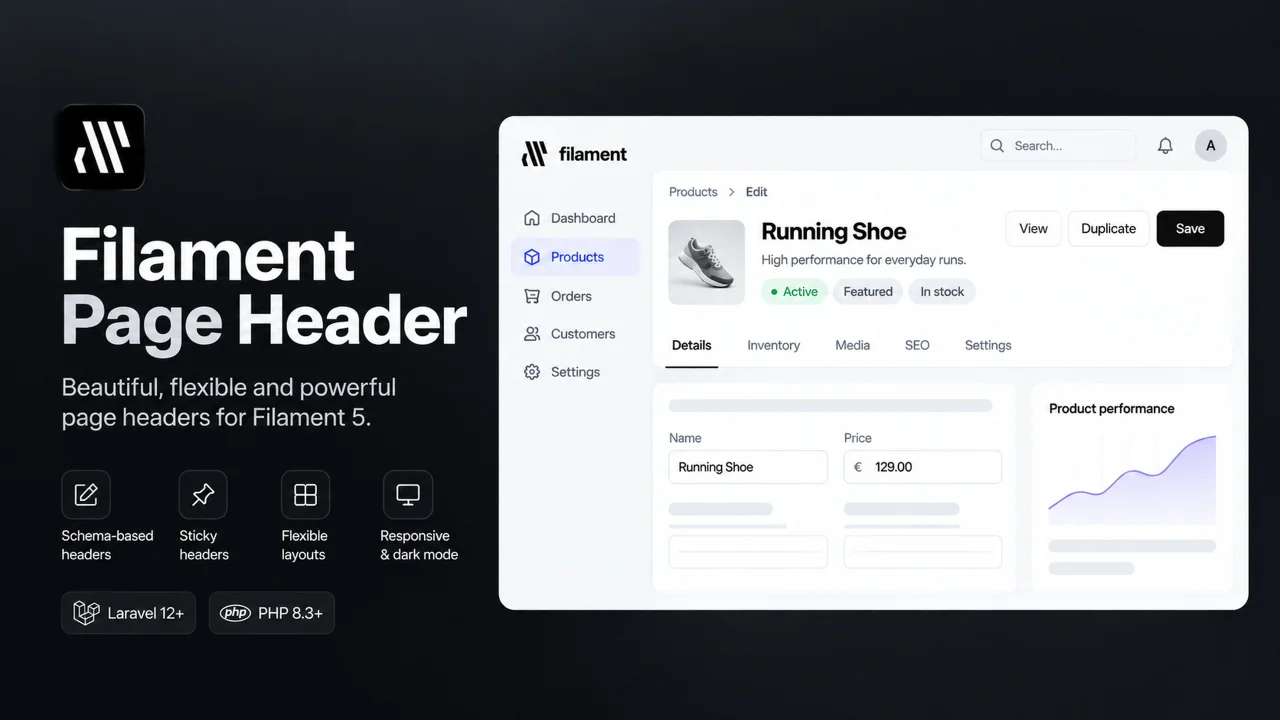
CommunityBuild informative, responsive page headers with native Filament 5 schemas. Combine identity, status, metadata and page actions, then choose what stays visible while scrolling. Enable headers only on the panels and pages you choose. No custom theme build, application-specific models or required icon library.
 Author:
Pedro Monteiro
Author:
Pedro Monteiro
Package health
BetaAutomated checks of this plugin's Composer package
15 checks
- Passed: GitHub Actions pinned to SHA
- Skipped: GitLab CI includes pinned to SHA
- Passed: Open security advisories
- Passed: Dependabot PR responsiveness — No open Dependabot PRs.
- Skipped: Renovate MR responsiveness
- Passed: Dependabot or Renovate configured
- Passed: Dependency update cooldown configured
- Passed: Provides a security policy
- Passed: Abandoned or archived — No consulted source marks the package abandoned (packagist, github).
- Passed: Commit and release recency — Active: last commit 0 days ago; last release 0 days ago.
-
Passed:
composer.lock not committed by library
—
composer.lockis absent from the released dist archive. - Passed: Dist archive is lean
-
Passed:
Current Laravel version supported
—
Package dependencies resolve together with current Laravel
13.0. -
Passed:
Current PHP version supported
—
Constraint
^8.3supports current PHP8.5. - Skipped: Current Symfony version supported
filament/
namespace. Review the source and install at your own risk. Found
malware or an unresolved security issue the author won't
address?
Report it
.
Documentation
- Contents
- Features
- Screenshots
- Version compatibility
- Installation
- Your first header
- Configuration
- Sticky and compact modes
- Migration from v1
- Troubleshooting
- Testing and contributing
- Changelog
- Security
- Support this project
- Credits and license
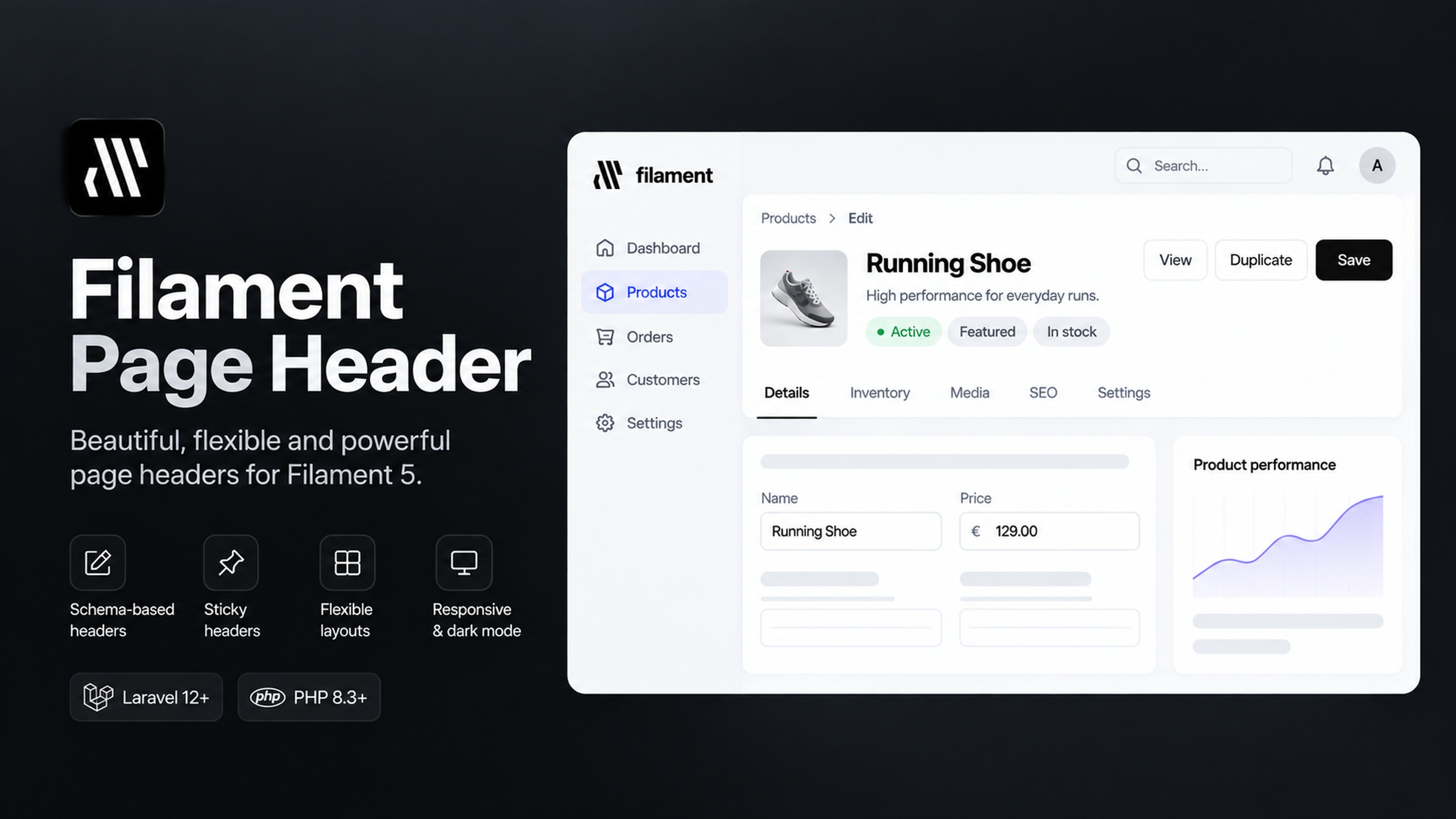








Build informative, responsive page headers with native Filament 4 and 5 schemas. Combine identity, status, metadata and page actions, then choose what stays visible while scrolling.
Enable headers only on the panels and pages you choose. No custom theme build, application-specific models or required icon library.
#Contents
- Features
- Screenshots
- Version compatibility
- Installation
- Your first header
- Configuration
- Sticky and compact modes
- Migration from v1
- Troubleshooting
- Testing and contributing
- Changelog
- Security
- Support this project
- Credits and license
#Features
- Headings, descriptions, badges, avatars, initials and product images.
- Native schema fields for metadata and summary metrics, with responsive separators.
- Field icons before or after the complete label/value, with configurable size.
- Native page actions aligned right on desktop and stacked at full width on mobile.
- Normal, sticky and compact layouts, with configurable responsive thresholds.
- Typed compact configuration: keep entire blocks or select individual fields.
- Native light/dark colors, keyboard focus handling and reduced-motion support.
- Shared resource schemas, with individual page overrides.
#Screenshots
Real captures of the package's product demo: a product image, two actions and three information fields. The example uses fictional product data, English labels and a native indigo/gray palette. The product image and banner are illustrative assets; the header itself is rendered by Filament. Native action colors follow your panel configuration.
| Layout | Light | Dark |
|---|---|---|
| Desktop | 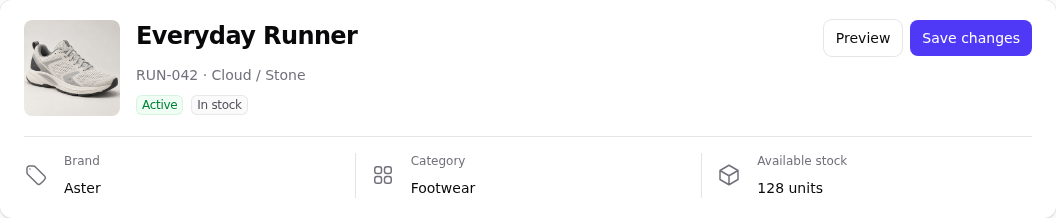 |
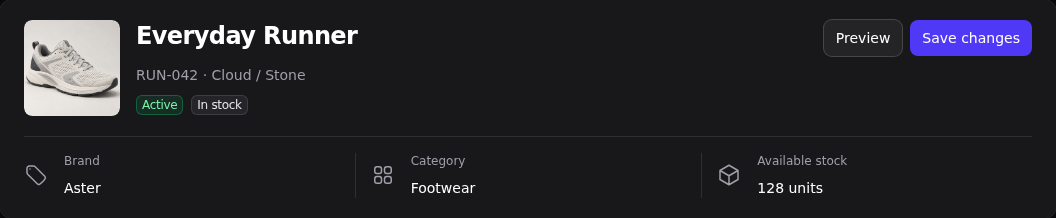 |
| Compact after scrolling |  |
 |
| Mobile | 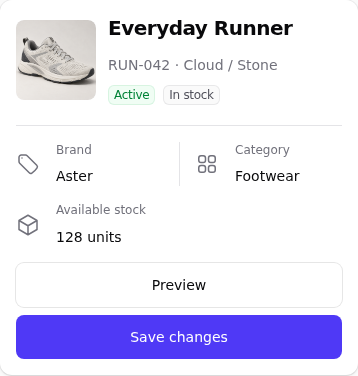 |
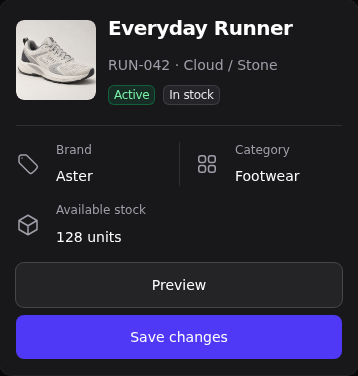 |
Run the demo locally to explore the layouts and native actions.
#Version compatibility
This README documents 2.x. Package major versions identify this package's API; they do not correspond to Filament major versions.
| Package version | Filament requirement | PHP requirement | Laravel | API |
|---|---|---|---|---|
^2.0 |
^4.12.6 || ^5.8.1 |
^8.3 |
12 or 13 | Header, MetadataEntry, typed compact configuration |
^1.0 |
^5.8.1 |
^8.3 |
12 or 13 | Previous HeaderLayout API |
Version 2 runs its PHP suite against the minimum secure Filament 4 release (4.12.6), the latest release resolved by ^4.12.6, the minimum Filament 5 release (5.8.1) and the latest release resolved by ^5.8.1, across Laravel 12 and 13. The Chromium suite runs on the minimum supported release of each Filament major. Versions before 4.12.6 are outside the declared requirement; Composer specifically blocks 4.0.0 and 4.12.0–4.12.5 because of known security advisories. Filament 5.0–5.8.0 is also outside the declared requirement and has not been validated. Other Filament majors are outside these releases' requirements. PHP must also satisfy your selected Laravel version's requirements.
See the 1.x README for the previous API and the verification record for executed checks. Security maintenance is documented separately in the security policy.
#Installation
#1. Install the package
composer require mortalkiller/filament-page-header:^2.0
#2. Publish Filament assets
php artisan filament:assets
The service provider is discovered automatically. There are no package migrations to run and no custom theme build is required.
#3. Register the plugin
Add the plugin to the intended panel's existing configuration:
use MortalKiller\FilamentPageHeader\PageHeaderPlugin;

$panel->plugin(PageHeaderPlugin::make());
Register it separately for each panel that needs custom headers, then add the page trait as shown below. Installation alone does not replace existing headers.
#Your first header
For an existing CustomerResource, add HasPageHeader and headerSchema() to its Edit page. This example assumes the model has name and email attributes; retain your page's existing methods and actions.
<?php

namespace App\Filament\Resources\Customers\Pages;

use App\Filament\Resources\Customers\CustomerResource;
use Filament\Resources\Pages\EditRecord;
use Filament\Schemas\Schema;
use Illuminate\Database\Eloquent\Model;
use MortalKiller\FilamentPageHeader\Components\Header;
use MortalKiller\FilamentPageHeader\Concerns\HasPageHeader;

class EditCustomer extends EditRecord
{
    use HasPageHeader;

    protected static string $resource = CustomerResource::class;

    public function headerSchema(Schema $schema): Schema
    {
        return $schema->components([
            Header::make()
                ->heading(fn (Model $record) => $record->getAttribute('name'))
                ->description(fn (Model $record) => $record->getAttribute('email'))
                ->initials(fn (Model $record) => $record->getAttribute('name')),
        ]);
    }
}
The trait also works with Create, View, List and custom pages. Use nullable record closures where no record exists. Header::make() inherits the page heading and subheading by default and does not change the browser tab title.
#Configuration
Use native Filament entries for content and keep business logic in your application. The package handles layout, images, spacing and light/dark appearance.
| Configure | API | Guide |
|---|---|---|
| Identity | heading(), description(), avatar(), image(), initials(), icon(), initialsBgColor(), initialsTextColor(), iconBgColor(), iconColor() |
Images and icons |
| Badges and details | badges(), metadata(), summary() |
Layout slots |
| Field icons | fieldIcon(), fieldIconPosition(), fieldIconSize() |
Metadata fields |
| Product identity | image() and descriptionSchema() |
Product example |
| Reusable resource headers | Convention discovery or schemaFor() |
Shared configuration |
| Custom composition | headingSchema(), leading(), schema() |
Layout slots |
Native getHeaderActions() continues to define the page actions. They render once, right-aligned on desktop and after the details on mobile. Native button groups, modals, form targets and authorization remain in place. Breadcrumbs sit outside the card and scroll with the page.
Color an initials fallback with a panel color alias or a native Filament palette. The text color is chosen for contrast unless you override it:
use Filament\Support\Colors\Color;
use Filament\Support\Icons\Heroicon;

Header::make()
    ->initials(fn (Model $record) => $record->name)
    ->initialsBgColor('primary');

Header::make()
    ->initials(fn (Model $record) => $record->name)
    ->initialsBgColor(Color::Blue)
    ->initialsTextColor(Color::Blue);

Header::make()
    ->icon(Heroicon::OutlinedUser)
    ->iconBgColor('primary')
    ->iconColor(Color::Blue);
See Images and icons for imports, closures and fallback behavior.
For a resilient identity, configure image, initials and an icon together. The header renders one visual in this order: custom leading() content, a resolved avatar/image, initials, then icon().
#Sticky and compact modes
Set a default on the panel plugin:
PageHeaderPlugin::make(); // Scroll normally.
PageHeaderPlugin::make()->sticky(); // Keep the full header pinned.
PageHeaderPlugin::make()->compact(); // Compact when the header reaches the sticky edge.
PageHeaderPlugin::make()->sticky()->compactBelow(1024);
You can also call normal(), sticky() or compact() on an individual Header. Call compactBelow() after selecting the base mode; its threshold is exclusive.
By default, compact mode keeps the heading, image/avatar, badges and native page actions. Choose optional content explicitly with enums:
use MortalKiller\FilamentPageHeader\CompactHeader;
use MortalKiller\FilamentPageHeader\Components\Header;
use MortalKiller\FilamentPageHeader\Enums\HeaderPart;

Header::make()
    ->compact()
    ->whenCompact(fn (CompactHeader $compact) => $compact
        ->show(HeaderPart::Image, HeaderPart::Badges)
        ->only(HeaderPart::Metadata, ['reference']));
Use this on a header whose metadata includes reference. Each whenCompact() callback starts with no optional blocks selected. The heading and native page actions always remain; field visibility and authorization still apply. Scrolling does not duplicate actions or send Livewire requests.
Full compact configuration, offsets and responsive rules.
#Migration from v1
Version 2 replaces HeaderLayout with Header and introduces a new composition API. Update consuming schemas and publish the assets again when upgrading.
Follow the migration guide, including the deprecated compact methods. For unreleased development on 2.x, deliberately use 2.x-dev with the local path and symlink workflow; keep your application's global stability unchanged.
#Troubleshooting
| Symptom | Check |
|---|---|
| The native header still appears | Register the plugin on the active panel, add HasPageHeader to the page and return a non-empty schema. A page's own getHeader() method takes precedence. |
| Styling or scrolling behavior is outdated | Run php artisan filament:assets in the consuming application after updating the package, then reload. A Composer symlink does not refresh published assets. |
| The header does not stick | Enable sticky() or compact(). Check the real scroll container, short parent wrappers and ancestor overflow. Pinning is temporarily disabled when the header cannot fit the viewport. |
whenCompact() has no visible effect |
Enable compact() on the header or plugin, then scroll to the sticky edge. The callback selects content; it does not activate compaction. |
| A selected compact field disappears | Match its entry name or layout key, and check native visibility conditions. Selection covers direct fields, not nested descendants. |
Advanced layout and offset configuration.
#Testing and contributing
composer test
node --test tests/JavaScript/*.test.mjs
npm run test:browser
See demo and testing setup before running browser tests, and CONTRIBUTING for branch conventions, checks and pull requests. The package has an independent workbench and does not require a consuming application's database.
#Changelog
See GitHub Releases for published versions and release notes.
#Security
Please report vulnerabilities privately using the process in SECURITY.md. Use GitHub Issues for ordinary bugs and feature requests.
Heading and description text are escaped by default. Enable html: true only for trusted markup prepared by your application. Native visibility is not an authorization boundary; keep permission checks on the server.
The Plumb badges display the latest external assessment, which may lag behind repository changes. They are not a security audit or a guarantee that the package has no vulnerabilities.
#Support this project
If this package saves you time, consider supporting its development. Your support helps maintain the package and improve its documentation.

#Credits and license
- Pedro Monteiro (MortalKiller)
- All contributors
- Inspired by Vitis Studio's Filament Header Schema.
- Built on Filament. See third-party notices.
Licensed under the MIT license.
The author
PHP & Laravel developer from Portugal 🇵🇹 Building SaaS products, clean architectures and useful software.
Featured Plugins
A selection of plugins curated by the Filament team
Noir Theme
A theme that gives panels a focused, refined look with near-black surfaces, crisp actions, and restrained color.
 Filament
Compact Theme
A theme that makes data-heavy panels easier to scan by fitting more useful information on each screen.
Filament
Custom Fields
Eliminate custom field migrations forever. Let your users create and manage form fields directly in Filament admin panels with 20+ built-in field types, validation, and zero database changes.
 Relaticle