Realtime Driver
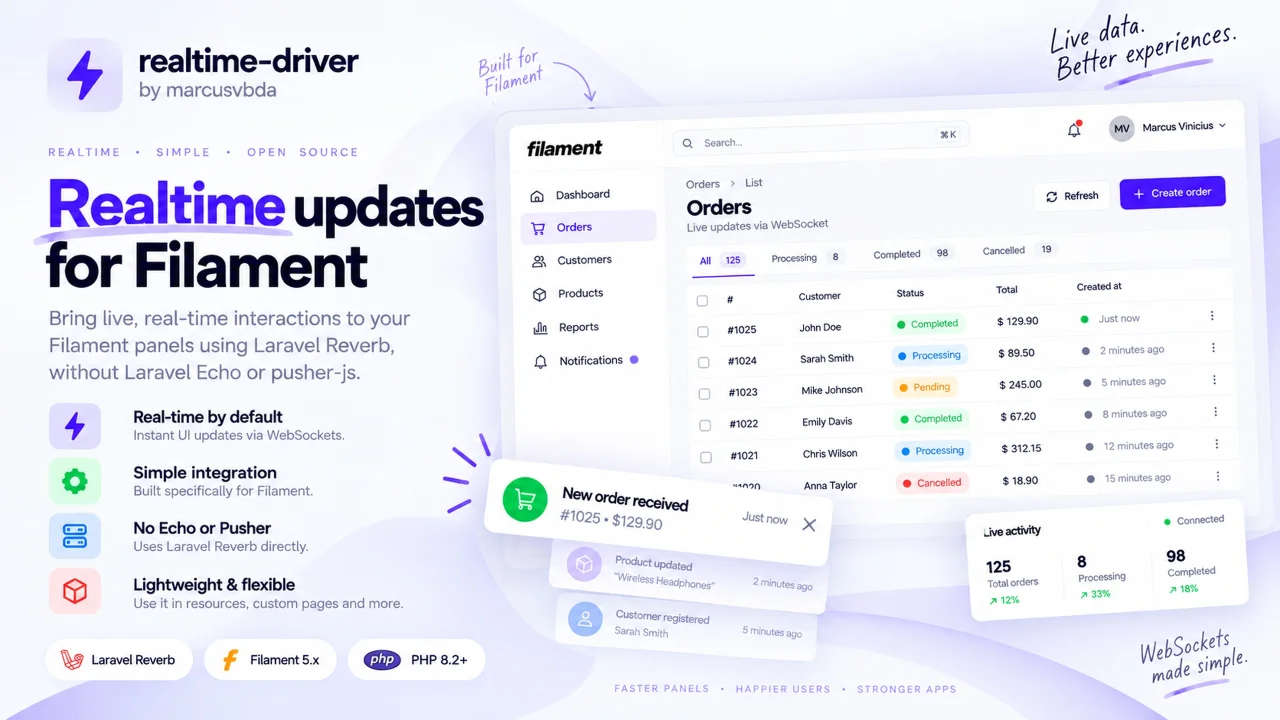
CommunityRealtime updates for Filament panels, backed by Laravel Reverb (or any Pusher-protocol-compatible broadcaster), without Laravel Echo or pusher-js on the frontend.
 Author:
Marcus V Bassalobre
Author:
Marcus V Bassalobre
Package health
BetaAutomated checks of this plugin's Composer package
15 checks
- Skipped: GitHub Actions pinned to SHA
- Skipped: GitLab CI includes pinned to SHA
- Passed: Open security advisories
- Passed: Dependabot PR responsiveness — No open Dependabot PRs.
- Skipped: Renovate MR responsiveness
- Skipped: Dependabot or Renovate configured
- Skipped: Dependency update cooldown configured
- Failed: Provides a security policy — View details on Plumb
- Passed: Abandoned or archived — No consulted source marks the package abandoned (packagist, github).
- Passed: Commit and release recency — Active: last commit 0 days ago; last release 0 days ago.
-
Passed:
composer.lock not committed by library
—
composer.lockis absent from the released dist archive. - Passed: Dist archive is lean
-
Passed:
Current Laravel version supported
—
Package dependencies resolve together with current Laravel
13.0. -
Passed:
Current PHP version supported
—
Constraint
^8.4.1supports current PHP8.5. - Skipped: Current Symfony version supported
filament/
namespace. Review the source and install at your own risk. Found
malware or an unresolved security issue the author won't
address?
Report it
.
Documentation
- Requirements
- Installation
- Configuration
- Quick start
- How it works
- Usage
- Generic broadcasting — RealtimeEvent
- Channel types and authorization
- Activating, configuring, segmenting — summary
- Known limitations
- License
Realtime updates for Filament panels, backed by Laravel Reverb (or any Pusher-protocol-compatible broadcaster), without Laravel Echo or pusher-js on the frontend.
It replaces wire:poll / database-notification polling with actual WebSocket pushes:
- One shared WebSocket connection per page, no matter how many components listen.
- No JS dependencies. The browser client speaks the Pusher wire protocol directly (~4 KB, inlined, no build step).
- A tiny
window.Echo-compatible shim, so Filament's own broadcasting-aware components (flash notifications, database notifications) work completely unmodified. - Fully opt-in. Nothing changes in a panel that doesn't call
->socket(). - Public, private and presence channels, with private-channel authorization handled automatically (browser-side via
/broadcasting/auth, backend-side via a local HMAC signature).
#Requirements
- Laravel 11+ (built and tested against Laravel 13)
- Filament 5+
- A running Reverb server (or another Pusher-protocol broadcaster) —
BROADCAST_CONNECTION=reverb
If you haven't set up broadcasting yet:
composer require laravel/reverb
php artisan reverb:install
This publishes config/reverb.php, adds REVERB_* / VITE_REVERB_* variables to .env, and sets BROADCAST_CONNECTION=reverb. Run the server locally with:
php artisan reverb:start
(or add it to your composer.json dev script via Laravel's DevCommands::artisan('reverb:start', 'reverb'), so composer dev starts it alongside everything else).
#Installation
Not published to Packagist yet — install as a local path package. In your app's root composer.json:
{
    "repositories": [
        { "type": "path", "url": "packages/filament-realtime-driver" }
    ],
    "require": {
        "recruiter-labs/filament-realtime-driver": "*"
    }
}
composer update recruiter-labs/filament-realtime-driver
The service provider is auto-discovered — nothing else to register.
Optionally publish the config file:
php artisan vendor:publish --tag=filament-realtime-driver-config
#Configuration
config/filament-realtime-driver.php:
| Key | Env var | Default | Purpose |
|---|---|---|---|
server |
FILAMENT_REALTIME_SERVER |
localhost:8080 |
host:port of the Reverb server the browser connects to |
channel |
FILAMENT_REALTIME_CHANNEL |
filament-realtime-driver |
Default channel the backend listener (connectAndListen()) auto-subscribes to |
key |
REVERB_APP_KEY |
— | Reverb app key, required in the WebSocket connection path |
secure |
FILAMENT_REALTIME_SECURE |
derived from REVERB_SCHEME |
Whether the browser connects over wss:// instead of ws:// |
key reuses your existing REVERB_APP_KEY by default — there is normally nothing to configure beyond what reverb:install already set up.
#Quick start
Register the plugin on a panel and call ->socket():
use Marcusvbda\FilamentRealtimeDriver\FilamentRealtimeDriverPlugin;

public function panel(Panel $panel): Panel
{
    return $panel
        // ...
        ->plugin(
            FilamentRealtimeDriverPlugin::make()->socket()
        );
}
->socket() alone doesn't change anything visible — it just makes the shared browser client available on that panel. You opt into individual features (tables, database notifications, or your own <x-filament-realtime-driver::listener> usage) separately, as shown below.
#How it works
->socket()injects one small inline<script>(via aBODY_ENDrender hook) that defineswindow.FilamentRealtimeDriver— a lazy, multiplexed WebSocket client keyed by"channel::event". It only opens a connection the first time something actually subscribes.- The same script defines a minimal
window.Echoshim (channel()/private()/join()/.listen()/.notification()/.socketId()), because Livewire itself callswindow.Echo.socketId()on every request oncewindow.Echoexists, and Filament's native notification components callwindow.Echo.private(...).listen(...). This lets those built-in Filament features work for free, without installing Laravel Echo. - Everything — the Blade component,
Table::socket(), and the database notifications bridge — subscribes through that samewindow.FilamentRealtimeDriver.subscribe(channel, event, callback)call, so a page with ten realtime widgets still opens exactly one socket.
#Usage
#1. Frontend — the <x-filament-realtime-driver::listener> component
Drop it anywhere in a Blade view (inside or outside a Filament panel — it works on any page, it doesn't require Livewire):
<x-filament-realtime-driver::listener channel="orders" event="OrderUpdated">
    <h1 x-text="event.id"></h1>
    <span x-text="event.status"></span>

    @script
    <script>
        console.log('order updated', event);
    </script>
    @endscript
</x-filament-realtime-driver::listener>
Props:
| Prop | Required | Description |
|---|---|---|
channel |
yes | Channel name. Prefix with private- or presence- for protected channels. |
event |
yes | Event name — matches whatever broadcastAs() returns on the PHP side. |
callback |
no | Raw JS, evaluated every time an event arrives, alongside updating the reactive event variable used above. |
Inside the slot, event is an Alpine-reactive object holding whatever broadcastWith() sent — bind to it with x-text, x-show, etc.
To just trigger a Livewire refresh instead of reading the payload, skip the slot and use callback:
<x-filament-realtime-driver::listener channel="orders" event="OrderUpdated" callback="$wire.$refresh()" />
#2. Filament Tables — Table::socket()
Adds a socket() method directly to Filament\Tables\Table (registered as a macro — Filament's Table is already Macroable, so this is a non-invasive extension, not a parallel implementation). Use it as an alternative to ->poll(...):
use Filament\Tables\Table;

public static function table(Table $table): Table
{
    return $table
        ->columns([
            // ...
        ])
        ->socket(
            channel: 'orders',
            event: 'OrderUpdated',
        );
}
Behaviour:
- No periodic request of any kind. The table subscribes once, over the shared socket.
- When (and only when) the exact
channel/eventpair is received, the table's Livewire component gets$wire.$refresh()'d — a normal Livewire round trip, not a client-side row patch. - Requires the panel's plugin to have
->socket()enabled; if it doesn't, the injected listener no-ops safely (checkswindow.FilamentRealtimeDriver &&before using it) instead of throwing.
Fire the matching event from wherever the record changes — typically a model event:
use Marcusvbda\FilamentRealtimeDriver\RealtimeEvent;

protected static function booted(): void
{
    static::saved(function (Order $order): void {
        RealtimeEvent::dispatch('orders', 'OrderUpdated', ['id' => $order->id]);
    });
}
Segmenting a channel per user (or tenant, or anything else): parametrize the channel name with whatever identifier should scope who receives the update. This project's JobsTable does it per acting user:
use Illuminate\Support\Facades\Auth;

->socket(
    channel: 'jobs_' . Auth::id(),
    event: 'JobUpdated',
)
// App\Models\Job::booted()
static::saved(function (Job $job): void {
    RealtimeEvent::dispatch('jobs_' . Auth::id(), 'JobUpdated', ['id' => $job->id]);
});
Be precise about what this achieves: the browser subscribes to jobs_{theViewer'sOwnId}, and the dispatch broadcasts to jobs_{theEditor'sId} — so with Auth::id() on both sides, a user only sees a live refresh for edits they themselves triggered (useful for "your own action confirmed" UX, e.g. across two open tabs). If the goal is instead "everyone looking at this list sees every change", scope the channel by something shared by all viewers instead — e.g. 'jobs_' . $job->company_id — and have every viewer's table subscribe to that same channel.
This is a public channel either way (no private- prefix): it only filters which browser tabs get the push, it is not an authorization boundary — anyone who knows or guesses the channel name can subscribe to it. See Channel types below if you need an actual access check.
#3. Backend — a persistent PHP listener
For server-side reactions to realtime events (independent of any browser), configure a callback when calling ->socket():
use Marcusvbda\FilamentRealtimeDriver\RealtimeConnection;

->plugin(
    FilamentRealtimeDriverPlugin::make()->socket(
        function (RealtimeConnection $listener) {
            $listener->watch('event.example', function ($params) {
                Log::info('Realtime event received', ['params' => $params]);
            });
        }
    )
)
Run it with the bundled Artisan command — this is a long-lived, blocking process, not something you call from an HTTP request:
php artisan filament-realtime-driver:listen
Wire it into composer dev the same way you would reverb:start or a queue worker (in AppServiceProvider::boot()):
if ($this->app->runningInConsole()) {
    DevCommands::artisan('filament-realtime-driver:listen', 'realtime');
}
If ->socket() is called with no callback (as in the quick-start example), the command connects, finds nothing to watch, and exits immediately — it's a no-op, not an error. Backend listening is entirely optional and independent of frontend usage.
#4. Database notifications
Replaces Filament's own database-notifications polling with a push, using the broadcast event Filament already ships (Filament\Notifications\Events\DatabaseNotificationsSent) — this package doesn't reimplement or duplicate the notifications UI at all.
->plugin(
    FilamentRealtimeDriverPlugin::make()
        ->socket()
        ->databaseNotifications()
)
Two things to know:
-
The panel itself must also enable database notifications — that's Filament's own toggle for the bell UI, unrelated to this package:
$panel->databaseNotifications();This plugin only changes how that UI gets its updates, not whether it exists.
-
Send notifications with
isEventDispatched: true, or nothing gets broadcast:use Filament\Notifications\Notification; Notification::make() ->title('Something happened') ->body('Details here') ->sendToDatabase($user, isEventDispatched: true);
What ->databaseNotifications() actually does:
- Calls
$panel->databaseNotificationsPolling(null), turning off Filament's default 30-second polling. - Injects a small bridge script that subscribes to the current user's private notification channel and, on
database-notifications.sent, firesLivewire.dispatch('databaseNotificationsSent')— a global Livewire event Filament'sDatabaseNotificationscomponent already listens for unconditionally.
That last point matters: Filament's own component only starts listening for realtime updates on its own once it has rendered at least one existing notification (a quirk in database-notifications.blade.php, not something this package can fix upstream). The bridge above works around it, so even a user's very first notification arrives live instead of needing a page reload.
The notifications table must exist (php artisan make:notifications-table && php artisan migrate if you haven't already), and on PostgreSQL, its data column must be json, not the framework's default text — Filament queries it with data->>'format', which Postgres's text type doesn't support.
#Generic broadcasting — RealtimeEvent
Instead of writing a dedicated Event class for every notification, dispatch this ready-made one directly with a channel, event name and payload:
use Marcusvbda\FilamentRealtimeDriver\RealtimeEvent;

broadcast(new RealtimeEvent('orders', 'OrderUpdated', ['id' => $order->id]));
// or
RealtimeEvent::dispatch('orders', 'OrderUpdated', ['id' => $order->id]);
It implements ShouldBroadcastNow (broadcasts immediately, no queue worker required). Write your own Event class instead if you need queued broadcasting, or richer payload logic than "here's an array".
#Channel types and authorization
This package talks the Pusher wire protocol directly (the same protocol Reverb speaks) instead of using Laravel Echo / pusher-js. It never installs or requires those packages — the shim in How it works exists purely so Filament's own code (which does expect a real window.Echo) keeps working.
- Public channels — any string not prefixed
private-/presence-. No authorization: anyone who knows the name can subscribe. Fine for non-sensitive updates (a table refresh signal, a generic "something changed" ping). - Private channels (
private-*) — require authorization on every subscribe:- Browser side: the client calls Laravel's standard
POST /broadcasting/authautomatically (sending the session cookie), exactly like Laravel Echo would. - Backend listener side (
RealtimeConnection, used byfilament-realtime-driver:listen): signs the subscription locally with your Reverb app key/secret (HMAC-SHA256) — no HTTP round-trip, since it already runs inside the Laravel app.
- Browser side: the client calls Laravel's standard
- Presence channels (
presence-*) — subscribe/authorize the same way as private channels. The member-list events (here/joining/leaving) are not implemented — nothing in this package or in Filament's own broadcasting-aware components needs them.
Either way, you still need routes/channels.php authorization rules for private/presence channels — this package doesn't add or replace that, it's plain Laravel broadcasting:
use Illuminate\Support\Facades\Broadcast;

// Required for Filament's own database notifications feature — publish it
// via `php artisan reverb:install` / `php artisan install:broadcasting`,
// or add it yourself if it's missing:
Broadcast::channel('App.Models.User.{id}', function ($user, $id) {
    return (int) $user->id === (int) $id;
});

// Your own private channels need the same treatment:
Broadcast::channel('orders.{id}', function ($user, $id) {
    return $user->companies->contains('id', Order::find($id)?->company_id);
});
Public channels (like the orders / jobs_{id} examples earlier in this README) need no entry in channels.php at all — Reverb accepts a subscription to any public channel name without asking Laravel.
#Activating, configuring, segmenting — summary
- Activate: call
->socket()onFilamentRealtimeDriverPlugin::make()in your panel provider. Nothing else in the package does anything until this is called. - Deactivate: remove the
->socket()call (or the whole->plugin(...)). Every feature — the shared client,Table::socket(), database notifications — is gated behind it and becomes fully inert. - Configure:
config/filament-realtime-driver.php(server, channel, key, secure) — see Configuration. - Toggle a single feature:
->databaseNotifications()is independent of->socket()— call it or don't, regardless of whether the socket itself is on. - Segment who receives what: parametrize channel names with a user/tenant/record identifier (see the
Table::socket()section above) — use a private channel with aroutes/channels.phprule if that segmentation needs to be enforced, not just filtered client-side.
#Known limitations
- No automatic reconnection/backoff if the WebSocket connection drops.
Table::socket()always does a full$wire.$refresh()— no client-side row patching.- Presence channel member events (
here/joining/leaving) are not implemented. - Filament's own
DatabaseNotificationscomponent has a first-load quirk (see Database notifications) that this package works around, but is worth knowing about if you build directly against Filament's Echo integration elsewhere.
#License
MIT.
Featured Plugins
A selection of plugins curated by the Filament team
Blueprint
Filament Blueprint is a premium Laravel Boost extension that helps AI agents produce accurate, detailed implementation plans and security reports for Filament apps.
 Filament
Advanced Tables (formerly Filter Sets)
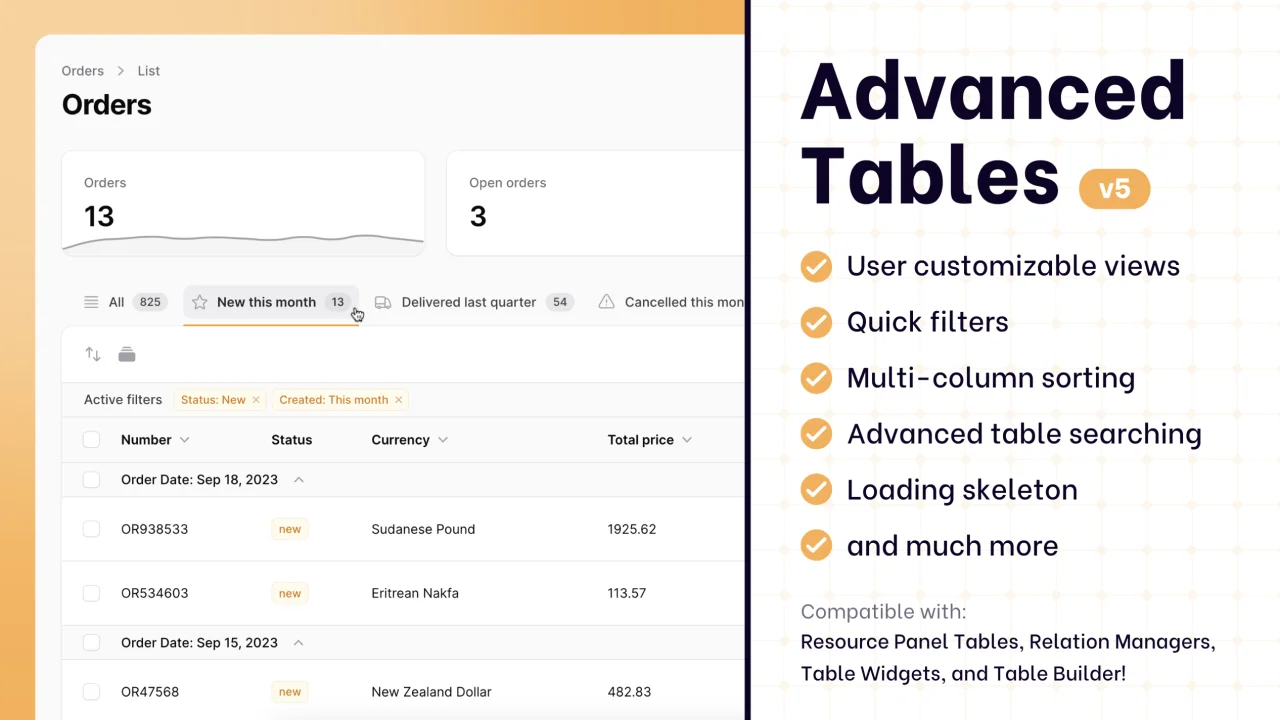
Supercharge your tables with powerful features like user-customizable views, quick filters, multi-column sorting, advanced table searching, convenient view management, and more. Compatible with Resource Panel Tables, Relation Managers, Table Widgets, and Table Builder!
 Kenneth Sese
Soft Theme
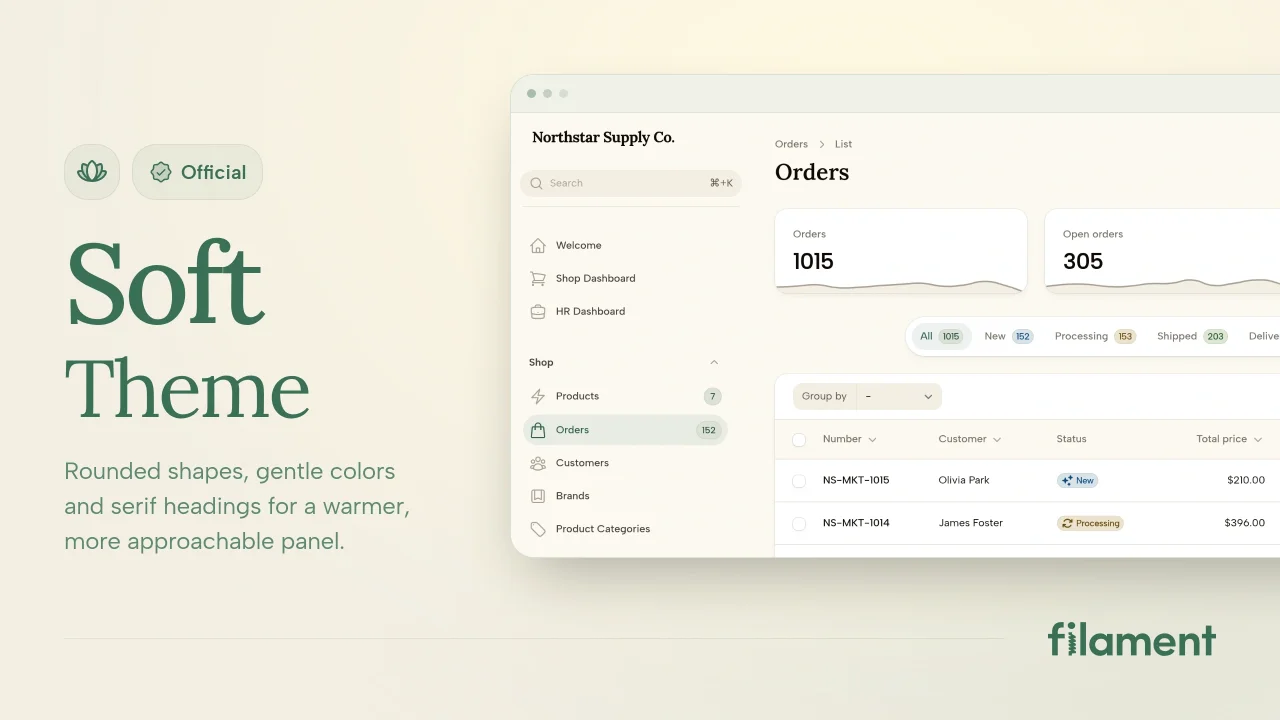
A theme that gives panels a warm, approachable look with rounded shapes, gentle colors, and serif headings.
Filament