FilaKit v5
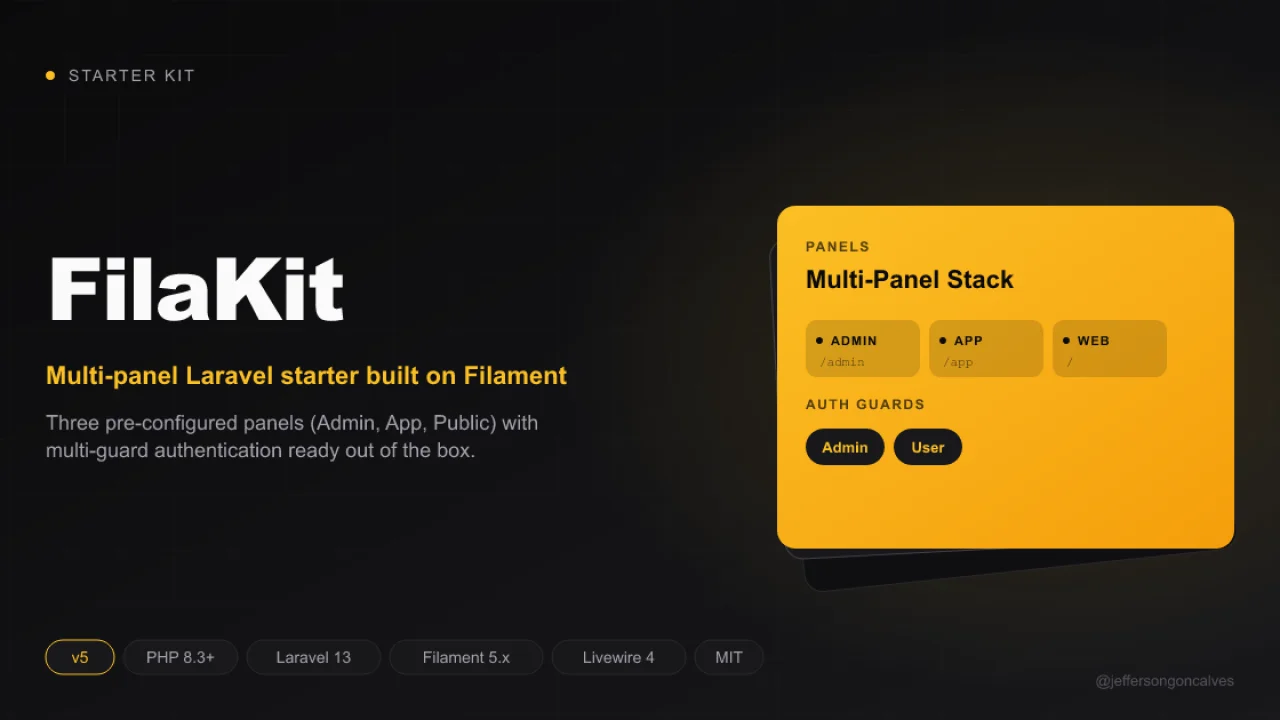
CommunityFilaKit is a robust starter kit, designed to accelerate the development of modern web applications with a ready-to-use multi-panel structure.
 Author:
Jefferson Gonçalves
Author:
Jefferson Gonçalves
Package health
BetaAutomated checks of this plugin's Composer package
15 checks
- Passed: GitHub Actions pinned to SHA
- Skipped: GitLab CI includes pinned to SHA
- Passed: Open security advisories
- Passed: Dependabot PR responsiveness — No open Dependabot PRs.
- Skipped: Renovate MR responsiveness
- Passed: Dependabot or Renovate configured
- Passed: Dependency update cooldown configured
- Passed: Provides a security policy
- Passed: Abandoned or archived — No consulted source marks the package abandoned (packagist, github).
- Passed: Commit and release recency — Active: last commit 0 days ago; last release 0 days ago.
- Skipped: composer.lock not committed by library
- Warning: Dist archive is lean
-
Passed:
Current Laravel version supported
—
Package dependencies resolve together with current Laravel
13.0. -
Passed:
Current PHP version supported
—
Constraint
^8.3supports current PHP8.5. - Skipped: Current Symfony version supported
filament/
namespace. Review the source and install at your own risk. Found
malware or an unresolved security issue the author won't
address?
Report it
.
Documentation
- About FilaKit
- Features
- System Requirements
- Installation
- Installation with Docker
- Authentication Structure
- Development
- Customization
- User Profile — joaopaulolndev/filament-edit-profile
- Impersonation — stechstudio/filament-impersonate
- Developer Logins — dutchcodingcompany/filament-developer-logins
- Resources
- License
- Credits

#About FilaKit
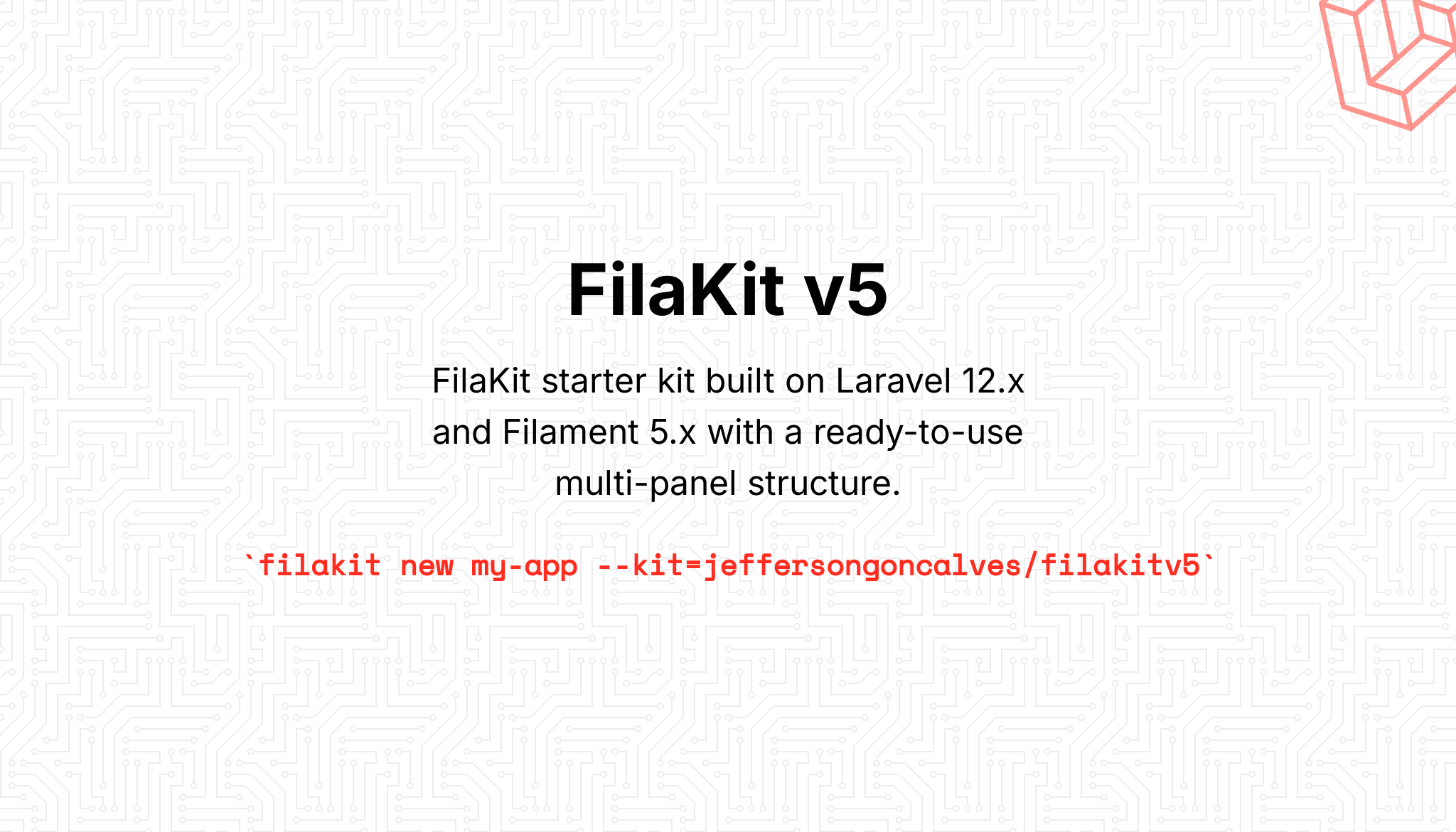
FilaKit is a robust starter kit built on Laravel 13.x and Filament 5.x, designed to accelerate the development of modern web applications with a ready-to-use multi-panel structure.
#Features
- Laravel 13.x - The latest version of the most elegant PHP framework
- Filament 5.x - Powerful and flexible admin framework
- Multi-Panel Structure - Includes three pre-configured panels:
- Admin Panel (
/admin) - For system administrators - App Panel (
/app) - For authenticated application users - Public Panel (frontend interface) - For visitors
- Admin Panel (
- Environment Configuration - Centralized configuration through the
config/filakit.phpfile
#System Requirements
- PHP 8.3 or higher
- Composer
- Node.js and PNPM
#Installation
Clone the repository
laravel new my-app --using=jeffersongoncalves/filakitv5 --database=mysql
#Using FilaKit CLI
Or use FilaKit CLI for a simplified setup:
filakit new my-app --kit=jeffersongoncalves/filakitv5
Install FilaKit CLI:
composer global require jeffersongoncalves/filakit-cli
#Easy Installation
FilaKit can be easily installed using the following command:
php install.php
This command automates the installation process by:
- Installing Composer dependencies
- Setting up the environment file
- Generating application key
- Setting up the database
- Running migrations
- Installing Node.js dependencies
- Building assets
- Configuring Herd (if used)
#Manual Installation
Install JavaScript dependencies
pnpm install
Install Composer dependencies
composer install
Set up environment
cp .env.example .env
php artisan key:generate
Configure your database in the .env file
Run migrations
php artisan migrate
Build frontend assets
pnpm run build
Run the server
php artisan serve
#Installation with Docker
Clone the repository
laravel new my-app --using=jeffersongoncalves/filakitv5 --database=mysql
Move into the project directory
cd my-app
Install Composer dependencies
composer install
Set up environment
cp .env.example .env
Configuring custom ports may be necessary if you have other services running on the same ports.
# Application Port (ex: 8080)
APP_PORT=8080

# MySQL Port (ex: 3306)
FORWARD_DB_PORT=3306

# Redis Port (ex: 6379)
FORWARD_REDIS_PORT=6379

# Mailpit Port (ex: 1025)
FORWARD_MAILPIT_PORT=1025
Start the Sail containers
./vendor/bin/sail up -d
You won’t need to run php artisan serve, as Laravel Sail automatically handles the development server within the container.
Attach to the application container
./vendor/bin/sail shell
Generate the application key
php artisan key:generate
Install JavaScript dependencies
pnpm install
#Authentication Structure
FilaKit comes pre-configured with a custom authentication system that supports different types of users:
Admin- For administrative panel accessUser- For application panel access
#Development
# Run the development server with logs, queues and asset compilation
composer dev

# Or run each component separately
php artisan serve
php artisan queue:listen --tries=1
pnpm run dev
#Customization
#Panel Configuration
Panels can be customized through their respective providers:
app/Providers/Filament/AdminPanelProvider.phpapp/Providers/Filament/AppPanelProvider.phpapp/Providers/Filament/PublicPanelProvider.php
Alternatively, these settings are also consolidated in the config/filakit.php file for easier management.
#Themes and Colors
Each panel can have its own color scheme, which can be easily modified in the corresponding Provider files or in the
filakit.php configuration file.
#Configuration File
The config/filakit.php file centralizes the configuration of the starter kit, including:
- Panel routes
- Middleware for each panel
- Branding options (logo, colors)
- Authentication guards
#User Profile — joaopaulolndev/filament-edit-profile
This project already comes with the Filament Edit Profile plugin integrated for the Admin and App panels. It adds a complete profile editing page with avatar, language, theme color, security (tokens, MFA), browser sessions, and email/password change.
- Routes (defaults in this project):
- Admin: /admin/my-profile
- App: /app/my-profile
- Navigation: by default, the page does not appear in the menu (shouldRegisterNavigation(false)). If you want to show it in the sidebar menu, change it to true in the panel provider.
Where to configure
-
Panel providers
- Admin: app/Providers/Filament/AdminPanelProvider.php
- App: app/Providers/Filament/AppPanelProvider.php In these files you can adjust:
- ->slug('my-profile') to change the URL (e.g., 'profile')
- ->setTitle('My Profile') and ->setNavigationLabel('My Profile')
- ->setNavigationGroup('Group Profile'), ->setIcon('heroicon-o-user'), ->setSort(10)
- ->shouldRegisterNavigation(true|false) to show/hide it in the menu
- Shown forms: ->shouldShowEmailForm(), ->shouldShowLocaleForm([...]), ->shouldShowThemeColorForm(), ->shouldShowSanctumTokens(), ->shouldShowMultiFactorAuthentication(), ->shouldShowBrowserSessionsForm(), ->shouldShowAvatarForm()
-
General settings: config/filament-edit-profile.php
- locales: language options available on the profile page
- locale_column: column used in your model for language/locale (default: locale)
- theme_color_column: column for theme color (default: theme_color)
- avatar_column: avatar column (default: avatar_url)
- disk: storage disk used for the avatar (default: public)
- visibility: file visibility (default: public)
Migrations and models
- The required columns are already included in this kit’s default migrations (users and admins): avatar_url, locale and theme_color, using the names defined in config/filament-edit-profile.php.
- The App\Models\User and App\Models\Admin models already read the avatar using the plugin configuration (getFilamentAvatarUrl).
Avatar storage
- Make sure the filesystem disk is configured and that the storage link exists: php artisan storage:link
- Adjust the disk and visibility in the config file according to your infrastructure.
Quick access
- Via direct URL: /admin/my-profile or /app/my-profile
- To make it visible in the sidebar navigation, set shouldRegisterNavigation(true) in the respective Provider.
Reference
- Plugin repository: https://github.com/joaopaulolndev/filament-edit-profile
#Impersonation — stechstudio/filament-impersonate
This project ships with stechstudio/filament-impersonate wired so administrators can impersonate application users from the Admin panel only.
How it is wired in this kit
- Admin → User direction only. The
App\Models\Adminmodel returnscanImpersonate(): trueandApp\Models\UserreturnscanImpersonate(): false, so only admins can trigger impersonation. - Action available on the Admin
UserResource:- Table row action in
app/Filament/Admin/Resources/Users/Tables/UsersTable.php - Header action on
app/Filament/Admin/Resources/Users/Pages/EditUser.phpandViewUser.php
- Table row action in
- Every action is configured with
->guard('web')->redirectTo('/app')so the impersonated user is logged into the App panel under thewebguard. - Global action defaults (color, icon-only button) are applied once in
app/Providers/AppServiceProvider.phpviaImpersonate::configureUsing(...).
Restricting who can be impersonated
- Add a
canBeImpersonated(): boolmethod onApp\Models\Userif you need to exclude specific records (e.g. block staff accounts). When the method is absent, every user is impersonable.
Leaving impersonation
- A banner is automatically rendered on Filament pages while impersonating. Click "Leave impersonation" to return to the Admin session.
- For non-Filament Blade layouts, add
<x-impersonate::banner/>right before</body>so the banner stays visible outside Filament.
Optional ENV configuration
FILAMENT_IMPERSONATE_REDIRECT— global fallback redirect (this kit overrides per action with/app).FILAMENT_IMPERSONATE_ALLOW_SOFT_DELETED— set totrueto allow impersonating soft-deleted users.FILAMENT_IMPERSONATE_BANNER_STYLE—dark(default),light, orauto.FILAMENT_IMPERSONATE_BANNER_POSITION—top(default) orbottom.
Reference
- Plugin repository: https://github.com/stechstudio/filament-impersonate
#Developer Logins — dutchcodingcompany/filament-developer-logins
Quick-login buttons are enabled on the Admin and App panels for local development. The list is built dynamically from the database, restricted to active records (status = true).
- Admin panel (
app/Providers/Filament/AdminPanelProvider.php): pulls fromApp\Models\Admin. - App panel (
app/Providers/Filament/AppPanelProvider.php): pulls fromApp\Models\User. - Both panels are gated by
app()->environment('local'), so the buttons never appear in staging/production.
To change the column shown on the buttons, edit the ->users(...) closure in each provider (for example, swap pluck('email', 'name') for pluck('email', 'email')).
Reference
- Plugin repository: https://github.com/DutchCodingCompany/filament-developer-logins
#Resources
FilaKit includes support for:
- User and admin management
- Multi-guard authentication system
- Tailwind CSS integration
- Database queue configuration
- Customizable panel routing and branding
#License
This project is licensed under the MIT License.
#Credits
Developed by Jefferson Gonçalves.
The author
I'm a Full Stack PHP Developer from Assis, SP, Brazil with over 18 years of hands-on experience building robust platforms, managing server infrastructures, and crafting scalable solutions for businesses of all sizes.
My passion lives in the open source world — I actively maintain 20+ Filament plugins and a growing collection of Laravel packages used by thousands of developers worldwide. I believe great software should be accessible to everyone.
From the same author
Scanner Guard
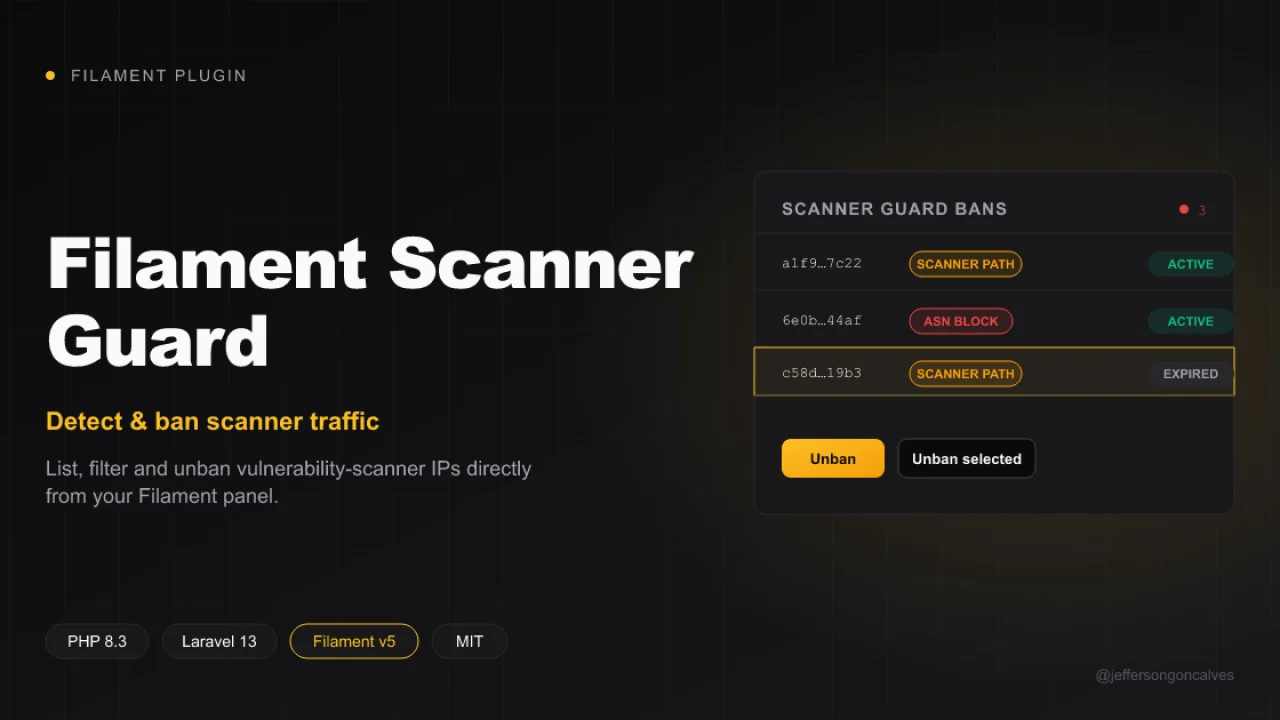
Filament UI for jeffersongoncalves/laravel-scanner-guard: list, filter and unban vulnerability-scanner IPs directly from your admin panel. This plugin ships a read-only Resource over the scanner_guard_bans table, an active/expired filter, and unban / bulk unban actions.
Author:
Jefferson Gonçalves
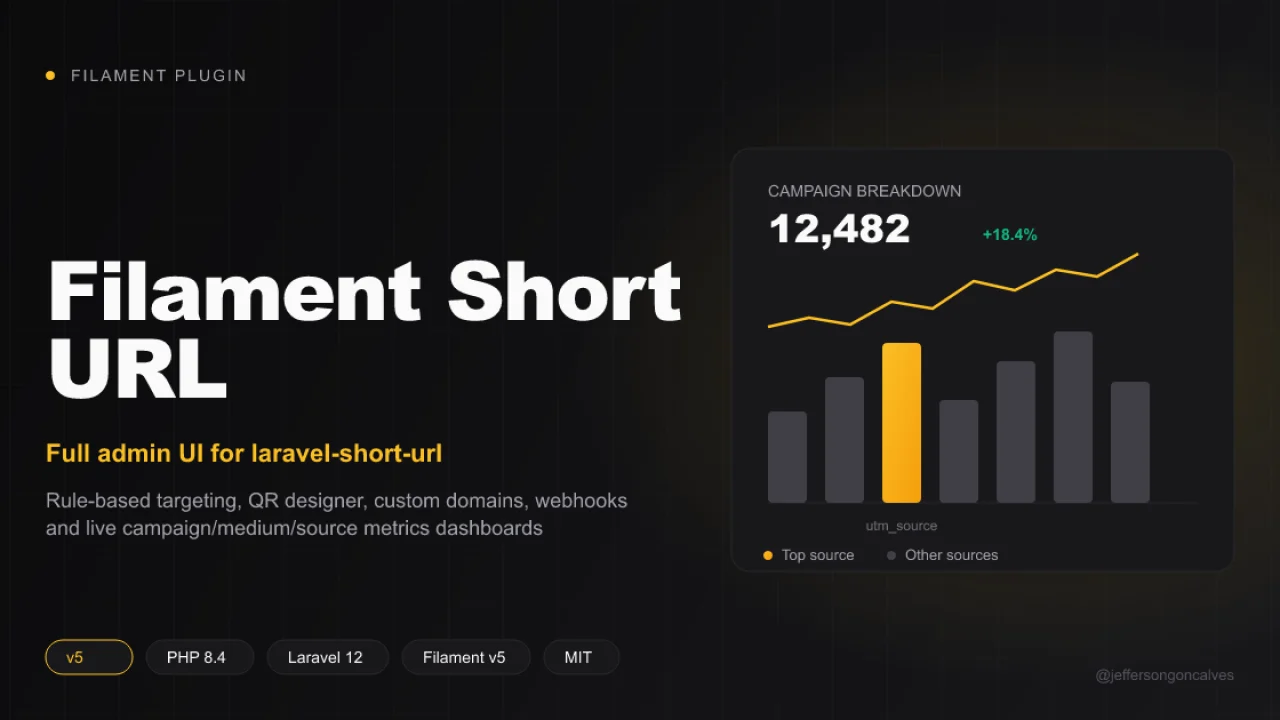
Short URL
A complete Filament v5 admin layer for jeffersongoncalves/laravel-short-url — the headless core package that owns the models, migrations, redirect pipeline, tracking and every business rule. This package duplicates none of that: it's the presentation layer (Resources, Pages and Filament components) built on top of the core's Facade and contracts.
Author:
Jefferson Gonçalves
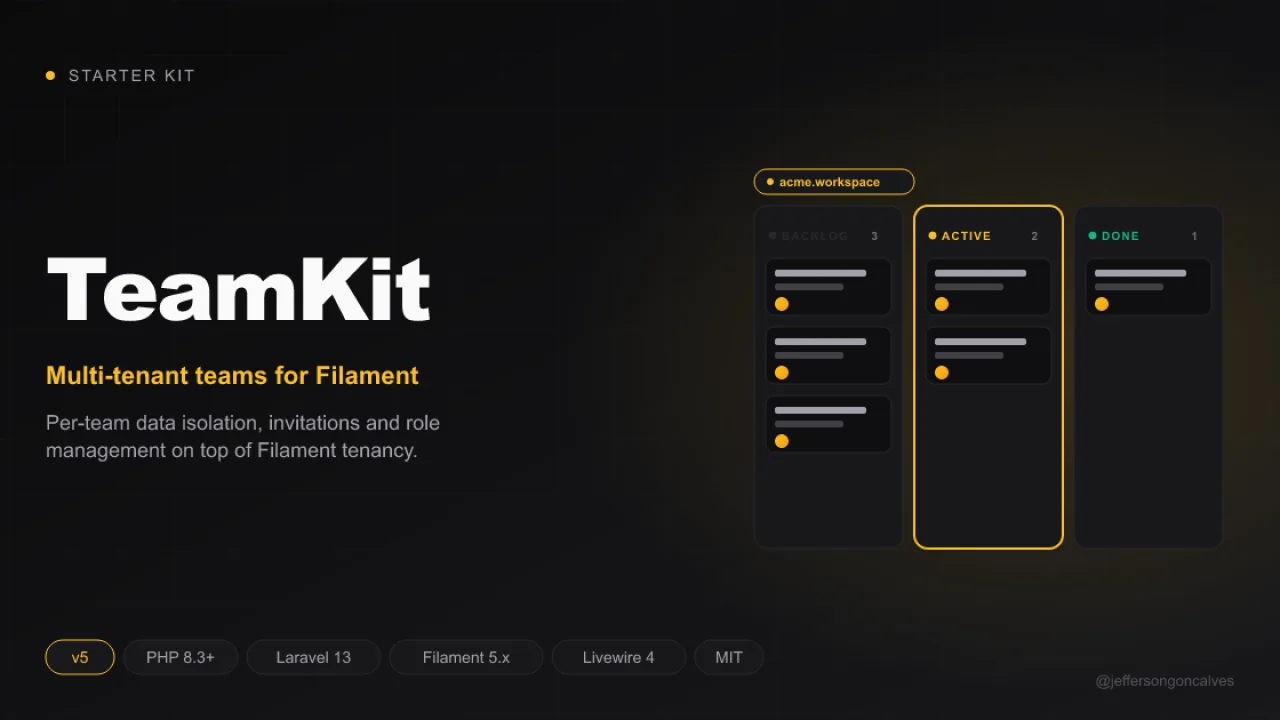
TeamKit v5
Teamkit is a robust starter kit, designed to accelerate the development of modern web applications with a ready-to-use multi-panel structure.
Author:
Jefferson Gonçalves
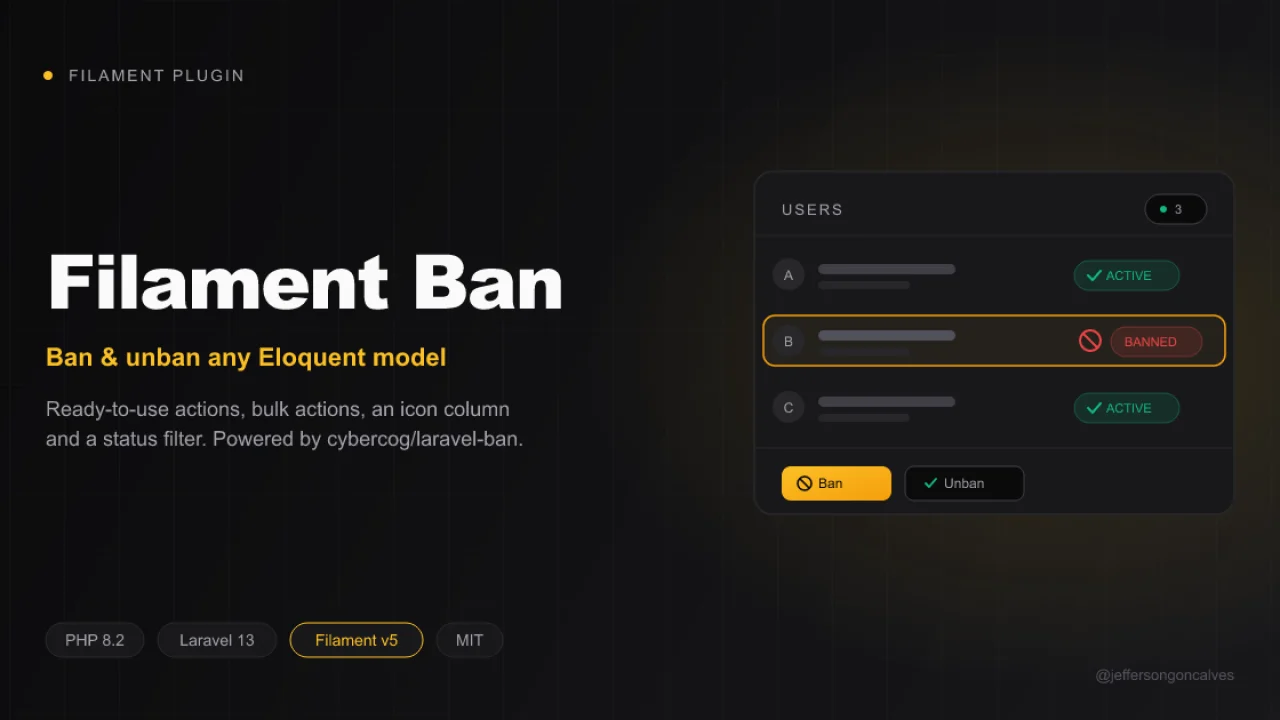
Ban
Ban and unban any Eloquent model directly from your Filament panel. This package wraps cybercog/laravel-ban and ships ready-to-use actions, bulk actions, an icon column and a status filter for your Filament resources and tables. Inspired by cybercog/laravel-nova-ban.
Author:
Jefferson Gonçalves
Featured Plugins
A selection of plugins curated by the Filament team
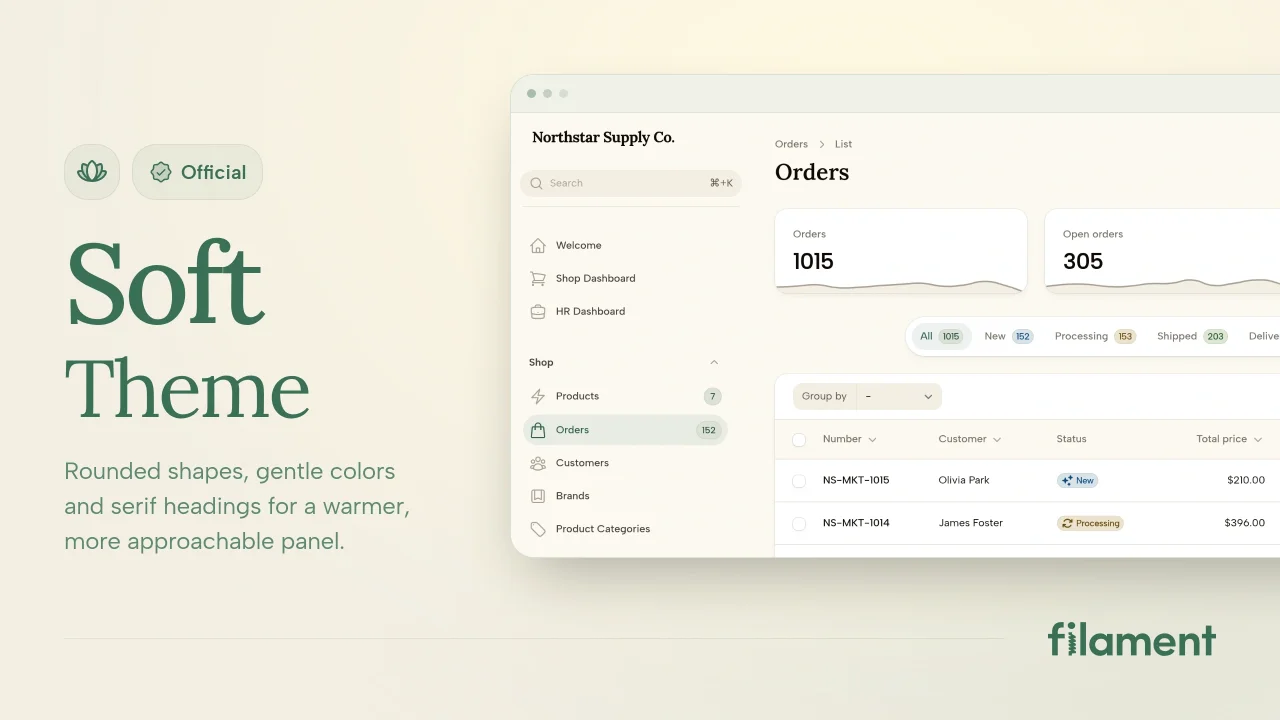
Soft Theme
A theme that gives panels a warm, approachable look with rounded shapes, gentle colors, and serif headings.
 Filament
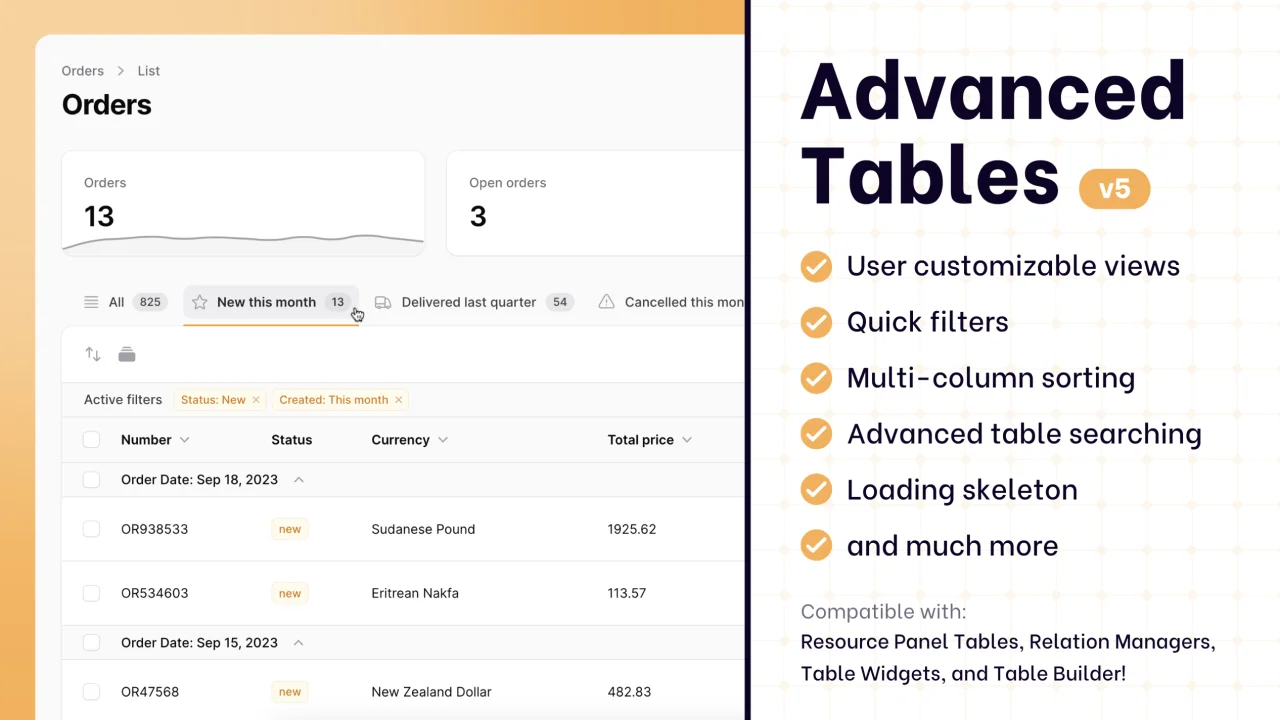
Advanced Tables (formerly Filter Sets)
Supercharge your tables with powerful features like user-customizable views, quick filters, multi-column sorting, advanced table searching, convenient view management, and more. Compatible with Resource Panel Tables, Relation Managers, Table Widgets, and Table Builder!
 Kenneth Sese
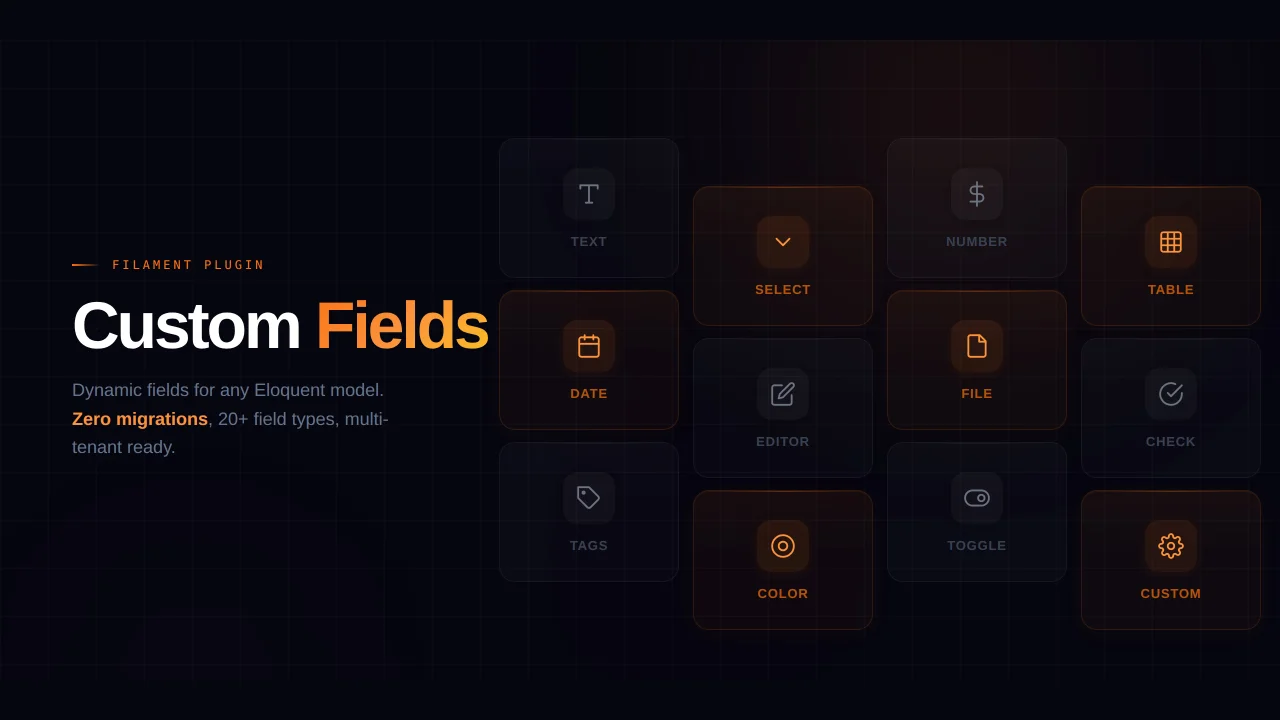
Custom Fields
Eliminate custom field migrations forever. Let your users create and manage form fields directly in Filament admin panels with 20+ built-in field types, validation, and zero database changes.
 Relaticle