
Exception Viewer
CommunityA Simple & Beautiful Exception Viewer plugin for your Filament Panels.
 Author:
Bezhan Salleh
Author:
Bezhan Salleh
Package health
BetaAutomated checks of this plugin's Composer package
15 checks
- Failed: GitHub Actions pinned to SHA — View details on Plumb
- Skipped: GitLab CI includes pinned to SHA
- Passed: Open security advisories
- Passed: Dependabot PR responsiveness — No open Dependabot PRs.
- Skipped: Renovate MR responsiveness
- Passed: Dependabot or Renovate configured
-
Failed:
Dependency update cooldown configured
—
No cooldown configured in
.github/dependabot.yml. View details on Plumb - Failed: Provides a security policy — View details on Plumb
- Passed: Abandoned or archived — No consulted source marks the package abandoned (packagist, github).
- Passed: Commit and release recency — Active: last commit 29 days ago; last release 29 days ago.
-
Passed:
composer.lock not committed by library
—
composer.lockis absent from the released dist archive. - Passed: Dist archive is lean
-
Passed:
Current Laravel version supported
—
Package dependencies resolve together with current Laravel
13.0. -
Passed:
Current PHP version supported
—
Constraint
^8.2|^8.3supports current PHP8.5. - Skipped: Current Symfony version supported
filament/
namespace. Review the source and install at your own risk. Found
malware or an unresolved security issue the author won't
address?
Report it
.
Documentation






A Simple & Beautiful Exception Viewer for FilamentPHP's Admin Panel
Version Compatibility:
- Filament 4.x & 5.x → use version 4.x
- Filament 3.x → use version 3.x
- Filament 2.x → use version 1.x
#Installation
- You can install the package via composer:
composer require bezhansalleh/filament-exceptions
- Publish and run the migration via:
php artisan exceptions:install
- Register the plugin for the Filament Panel
public function panel(Panel $panel): Panel
{
    return $panel
        ->plugins([
            \BezhanSalleh\FilamentExceptions\FilamentExceptionsPlugin::make()
        ]);
}
That's it! The package automatically registers itself with Laravel's exception handler and starts recording exceptions.
[!IMPORTANT] The plugin follows Filament's theming rules. So, to use the plugin create a custom theme if you haven't already, and add the following line to your
theme.cssfile:
@source '../../../../vendor/bezhansalleh/filament-exceptions/resources/views/**/*.blade.php';
Now build your theme using:
npm run build
#Recording Control
By default, exceptions are recorded automatically. You can control this behavior in your AppServiceProvider's boot() method:
#Stop/Start Recording
use BezhanSalleh\FilamentExceptions\FilamentExceptions;

public function boot(): void
{
    // Stop recording exceptions
    FilamentExceptions::stopRecording();

    // Resume recording
    FilamentExceptions::startRecording();

    // Check if recording is active
    FilamentExceptions::isRecording();
}
#Conditional Recording
Use recordUsing() to define custom logic for when exceptions should be recorded:
use BezhanSalleh\FilamentExceptions\FilamentExceptions;

public function boot(): void
{
    // Only record in production
    FilamentExceptions::recordUsing(fn () => app()->isProduction());

    // Skip specific exception types
    FilamentExceptions::recordUsing(function (Throwable $e) {
        return ! $e instanceof \Illuminate\Validation\ValidationException
            && ! $e instanceof \Illuminate\Auth\AuthenticationException;
    });

    // Combine multiple conditions
    FilamentExceptions::recordUsing(function (Throwable $e) {
        if (! app()->isProduction()) {
            return false;
        }

        // Skip 4xx HTTP exceptions
        if ($e instanceof \Symfony\Component\HttpKernel\Exception\HttpException
            && $e->getStatusCode() < 500) {
            return false;
        }

        return true;
    });
}
#Configuration Options
When registering the FilamentExceptions plugin, you can chain various methods to customize its behavior. Here are all available configuration options:
#Navigation
FilamentExceptionsPlugin::make()
    ->navigationBadge(bool | Closure $condition = true)
    ->navigationBadgeColor(string | array | Closure $color)
    ->navigationGroup(string | Closure | null $group)
    ->navigationParentItem(string | Closure | null $item)
    ->navigationIcon(string | Closure | null $icon)
    ->activeNavigationIcon(string | Closure | null $icon)
    ->navigationLabel(string | Closure | null $label)
    ->navigationSort(int | Closure | null $sort)
    ->registerNavigation(bool | Closure $shouldRegisterNavigation)
    ->subNavigationPosition(SubNavigationPosition | Closure $position)
#Labels and Search
FilamentExceptionsPlugin::make()
    ->modelLabel(string | Closure | null $label)
    ->pluralModelLabel(string | Closure | null $label)
    ->titleCaseModelLabel(bool | Closure $condition = true)
    ->globallySearchable(bool | Closure $condition = true)
#Mass Pruning Settings
FilamentExceptionsPlugin::make()
    ->modelPruneInterval(Carbon $interval)
Note This requires laravel scheduler to be setup and configured in order to work. You can see how to do that here Running The Scheduler
#Tenancy Configuration
FilamentExceptionsPlugin::make()
    ->scopeToTenant(bool | Closure $condition = true)
    ->tenantOwnershipRelationshipName(string | Closure | null $ownershipRelationshipName)
    ->tenantRelationshipName(string | Closure | null $relationshipName)
#General Configuration
FilamentExceptionsPlugin::make()
    ->cluster(string | Closure | null $cluster)
    ->slug(string | Closure | null $slug)
Example usage:
return $panel
    ->plugins([
        FilamentExceptionsPlugin::make()
            ->navigationLabel('Error Logs')
            ->navigationIcon('heroicon-o-bug-ant')
            ->navigationBadge()
            ->navigationGroup('System')
            ->modelPruneInterval(now()->subDays(7))
    ]);
#Custom Exception Model
- Extend the base model as follow:
<?php

namespace App\Models;

use BezhanSalleh\FilamentExceptions\Models\Exception as BaseException;

class MyCustomException extends BaseException
{
    ...
}
- Then, in a service provider's
boot()method for instanceAppServiceProvider:
use App\Models\MyCustomException;
use BezhanSalleh\FilamentExceptions\FilamentExceptions;
...
   public function boot()
   {
       FilamentExceptions::model(MyCustomException::class);
   }
...
#Translations
Publish the translations with
php artisan vendor:publish --tag=filament-exceptions-translations
#Testing
composer test
#Changelog
Please see CHANGELOG for more information on what has changed recently.
#Contributing
Please see CONTRIBUTING for details.
#Security Vulnerabilities
Please review our security policy on how to report security vulnerabilities.
#Credits
#License
The MIT License (MIT). Please see License File for more information.
The author
Bezhan Salleh is a full-stack developer with a strong focus on backend development and a passion for open-source. He’s the creator of Shield, Filament’s most starred plugin, and the author of other popular plugins, including Plugin Essentials and Google Analytics. His work focuses on delivering practical, powerful solutions with an emphasis on performance and developer experience.
From the same author

Google Analytics
Google Analytics integration for Filament Panels with a set of widgets to display your analytics data in a beautiful way.
Author:
Bezhan Salleh
Plugin Essentials
A collection of essential traits that streamline Filament plugin development by taking care of the boilerplate, so you can focus on shipping real features faster.
Author:
Bezhan Salleh

Shield
The easiest and most intuitive way to handle `Policies` and `Permissions for your Filament Panels' components.
Author:
Bezhan Salleh
Panel Switch
Switch between Filament panels with ease.
Author:
Bezhan Salleh
Featured Plugins
A selection of plugins curated by the Filament team
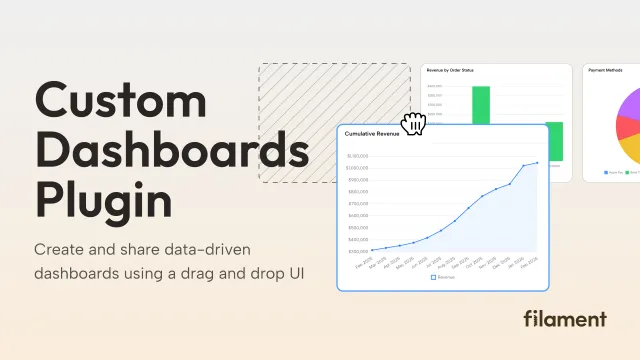
Custom Dashboards
Let your users build and share their own dashboards with a drag-and-drop interface. Define your data sources in PHP and let them do the rest.
 Filament
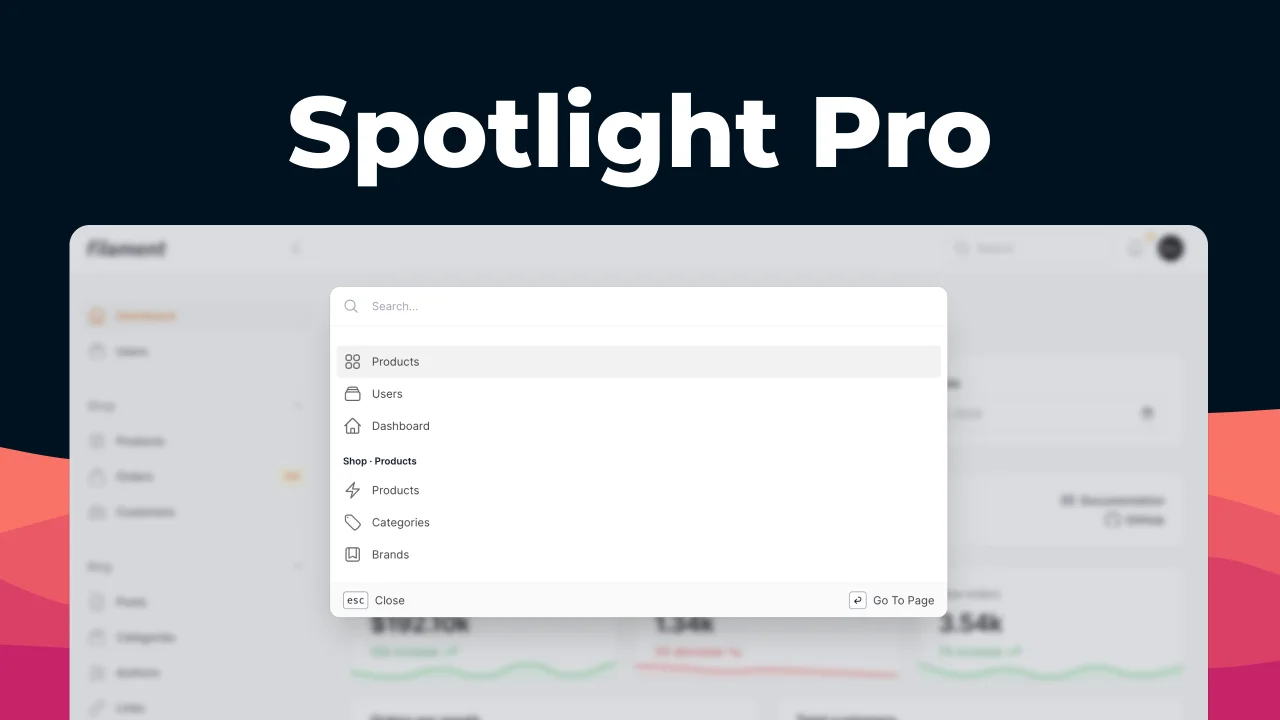
Spotlight Pro
Browse your Filament Panel with ease. Filament Spotlight Pro adds a Spotlight like Command Palette to your Filament Panel.
 Dennis Koch
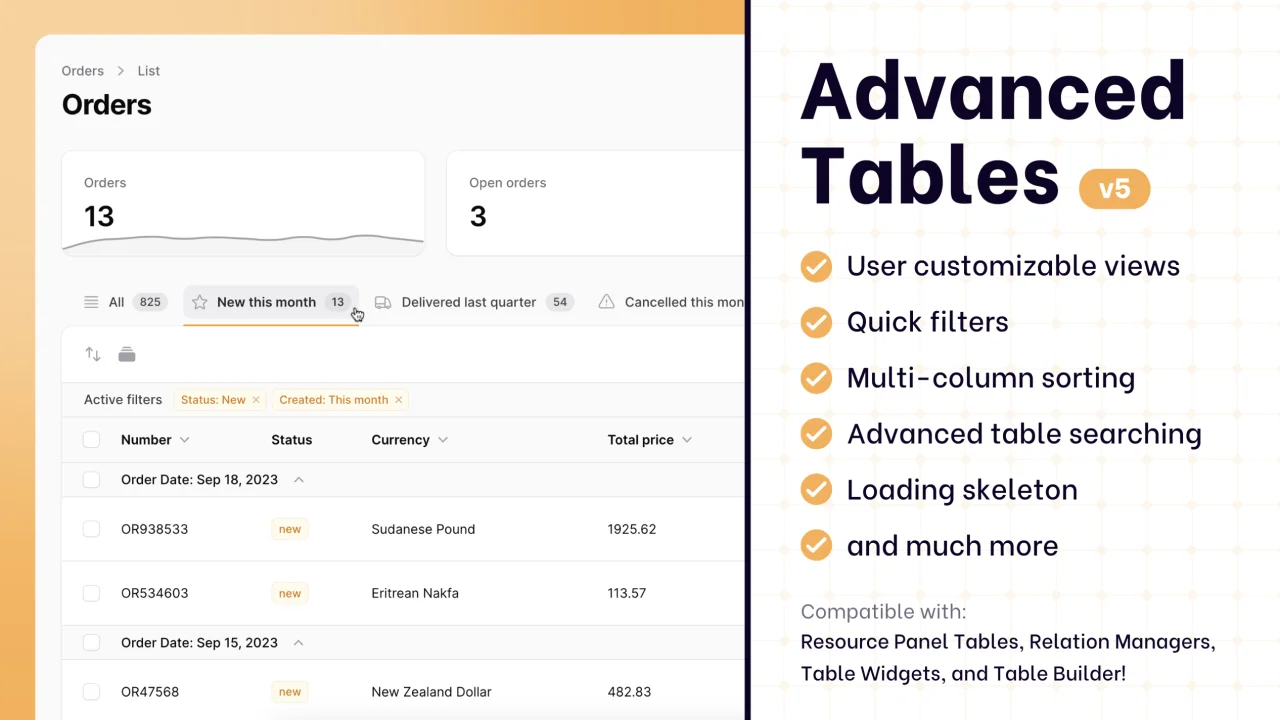
Advanced Tables (formerly Filter Sets)
Supercharge your tables with powerful features like user-customizable views, quick filters, multi-column sorting, advanced table searching, convenient view management, and more. Compatible with Resource Panel Tables, Relation Managers, Table Widgets, and Table Builder!
 Kenneth Sese