
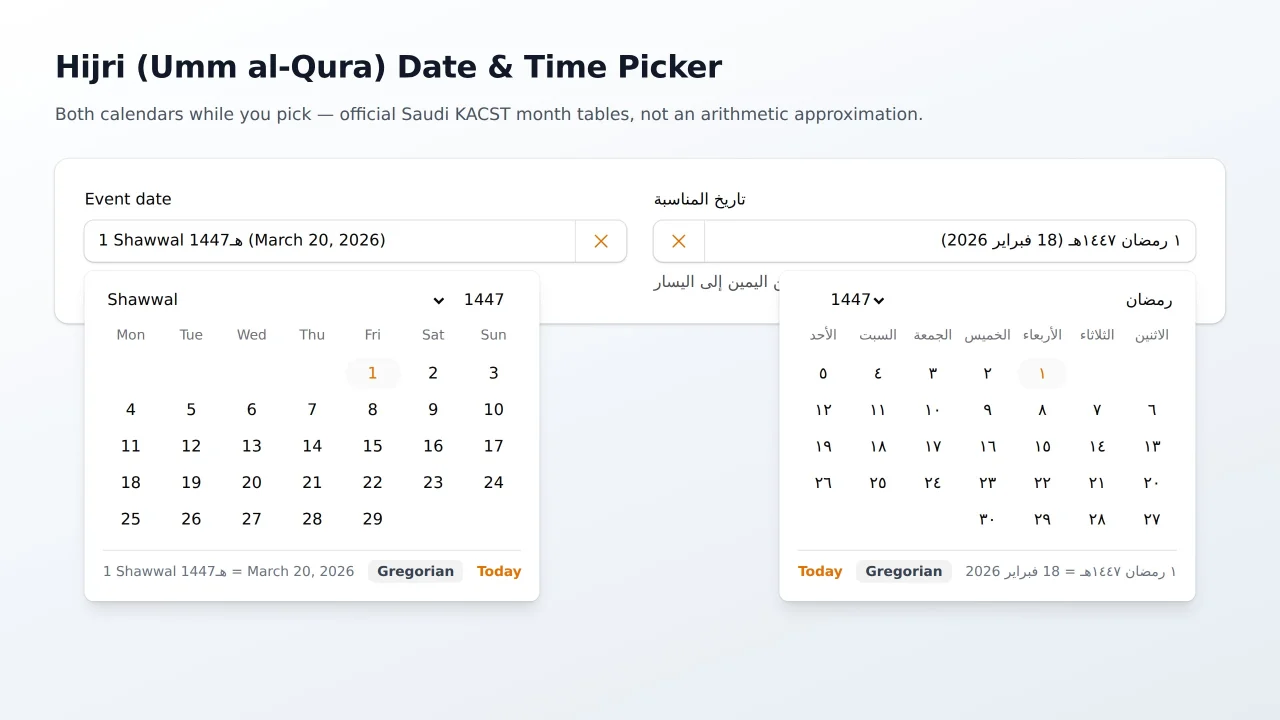
Ummulqura Hijri Date Picker by Asim Al-Twijry
CommunityA Hijri (Umm al-Qura) date & time picker for Filament that always shows the user both calendars while picking, and lets you choose independently which calendar the UI displays and which calendar the value is stored in.
 Author:
Asim Al-Twijry
Author:
Asim Al-Twijry
Package health
Automated checks of this plugin's Composer package
15 checks
- Skipped: GitHub Actions pinned to SHA
- Skipped: GitLab CI includes pinned to SHA
- Passed: Open security advisories
- Passed: Dependabot PR responsiveness — No open Dependabot PRs.
- Skipped: Renovate MR responsiveness
- Skipped: Dependabot or Renovate configured
- Skipped: Dependency update cooldown configured
- Failed: Provides a security policy — View details on Plumb
- Passed: Abandoned or archived — No consulted source marks the package abandoned (github).
- Passed: Commit and release recency — Active: last commit 3 days ago; no release date available.
-
Passed:
composer.lock not committed by library
—
composer.lockis absent from the released dist archive. - Passed: Dist archive is lean
- Skipped: Current Laravel version supported
-
Passed:
Current PHP version supported
—
Constraint
^8.2supports current PHP8.5. - Skipped: Current Symfony version supported
filament/
namespace. Review the source and install at your own risk. Found
malware or an unresolved security issue the author won't
address?
Report it
.
Documentation
- Features
- Matching national IDs and civil records
- Installation
- Usage
- Notes & caveats
- Testing
- Credits & license
A Hijri (Umm al-Qura) date & time picker for Filament that always shows the user both calendars while picking, and lets you choose independently which calendar the UI displays and which calendar the value is stored in.
Conversions use asimnet/ummulqura-calendar — exact month-start tables harvested from the official Saudi KACST Umm al-Qura service, not an arithmetic approximation.

#Features
- Real Hijri month grid — month lengths (29/30 days) come from the official tables, including years where Dhu al-Hijjah has 30 days.
- Two independent axes — display calendar (what the picker shows) and storage calendar (what goes into your database), in any combination.
- Equivalent date always visible — the display input shows the other calendar's date in parentheses, and the panel footer live-updates both calendars for the focused day, so the user always knows exactly which day they are picking.
- Runtime calendar switch — a button in the panel lets the user flip the grid between Hijri and Gregorian on the fly; the stored value never changes (it stays in the configured storage calendar). Disable with
->calendarToggle(false). - Time support — hours/minutes/seconds alongside the Hijri date, preserved in either storage calendar.
- Server-side authority — the selected value is re-validated on the server against the Umm al-Qura tables; nonexistent dates (e.g. 30 Safar) are rejected with a translatable message.
- Familiar API — extends Filament's own
DateTimePicker, sominDate(),maxDate(),disabledDates(),displayFormat(),closeOnDateSelection(),firstDayOfWeek()and friends all work. - RTL, dark mode, keyboard navigation, Arabic/English month names, and optional Eastern Arabic (Indic) numerals.
- Supported range: 1318-01-01 → 1500-12-30 AH (1900-04-30 → 2077-11-16 CE).
| Hijri grid, with the Gregorian day under the cursor | The same field, flipped to Gregorian mid-pick |
|---|---|
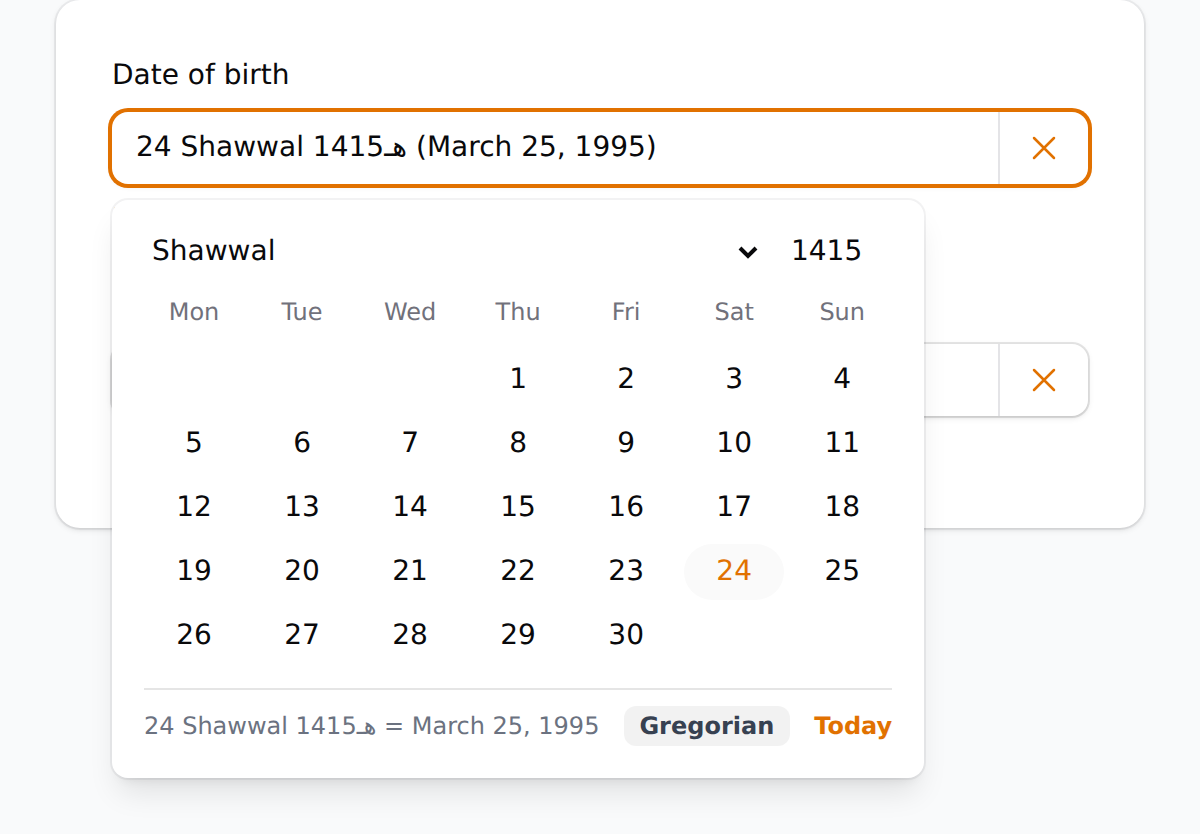 |
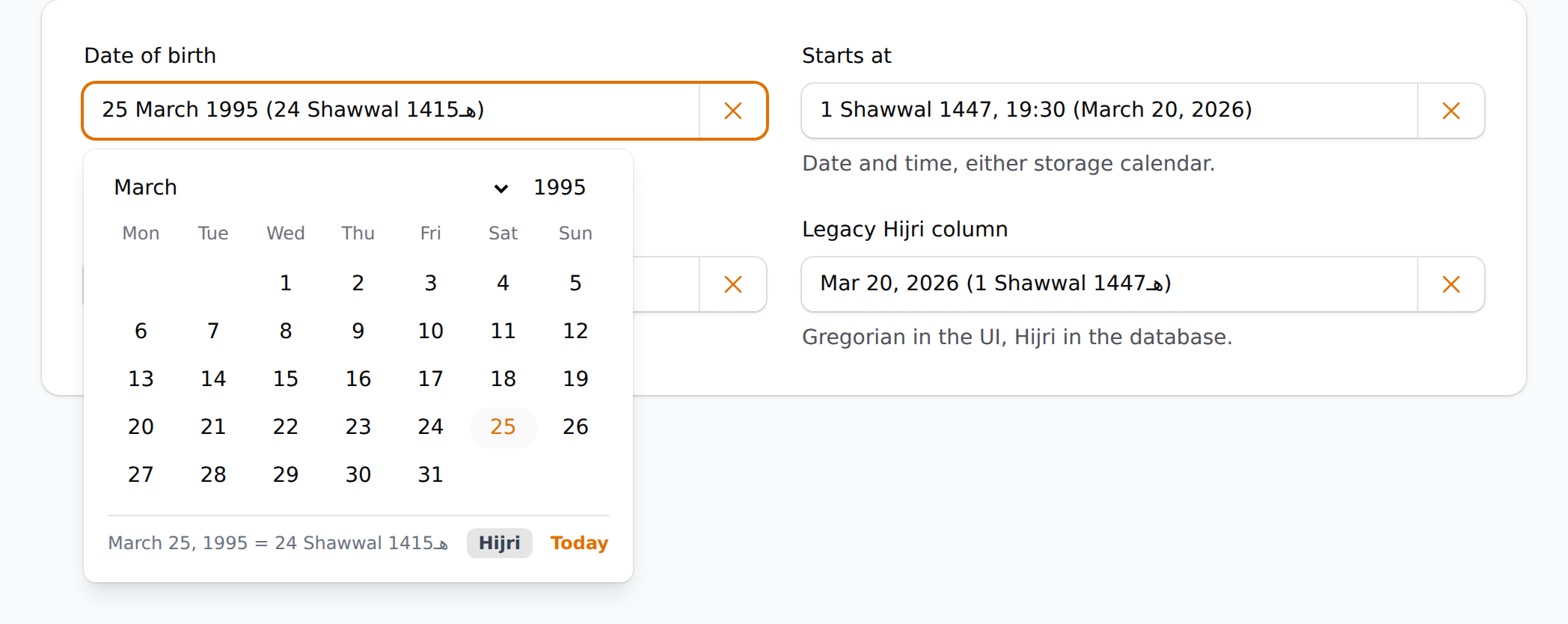 |
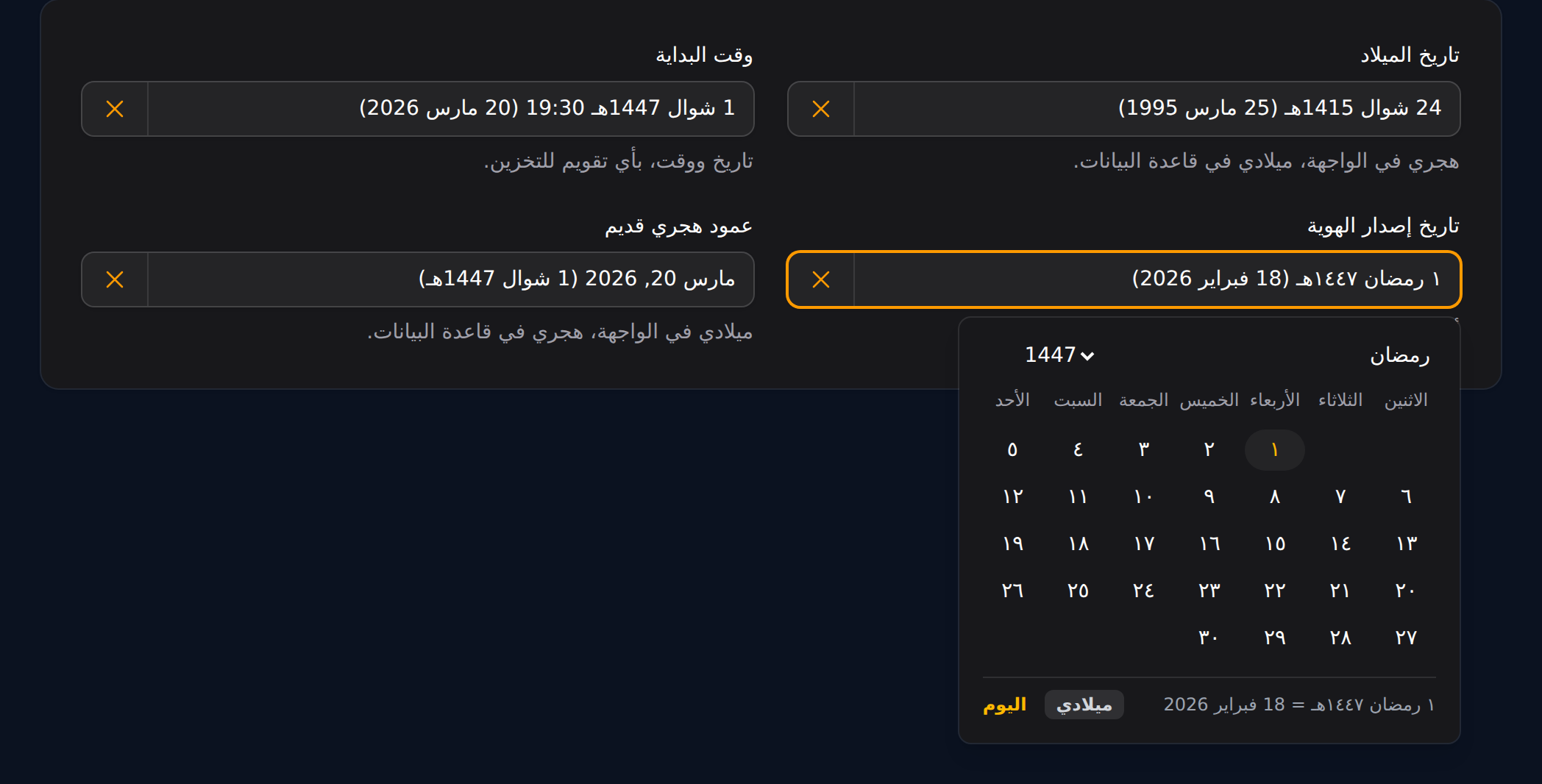
Arabic, RTL, dark mode, Eastern Arabic numerals — all four fields above are one form.
#Matching national IDs and civil records
Conversions follow the Umm al-Qura calendar as it was published at the time (Reckoning::AsPublished in the underlying library). This only affects dates before 1420 AH (April 1999): today's official KACST service applies the current criterion retroactively and can land a day off from what the almanac actually printed — and the printed value is what Saudi national IDs and Ahwal Madaniyya documents recorded. The picker uses the printed value, so a birth date round-trips against the ID.
From 1420 AH onward both readings are identical, so present-day and future dates are unaffected. For 1318–1355 AH (before 1937 CE), where the historical almanacs are not settled, the picker falls back to the official reconstruction.
#Installation
The plugin and its calendar engine are installed straight from GitHub. Add both repositories to Composer (Composer does not read repositories declared by a dependency, so the calendar engine needs its own entry), then require the plugin:
composer config repositories.ummulqura-calendar vcs https://github.com/AsimNet/ummulqura-calendar
composer config repositories.filament-ummulqura-date-picker vcs https://github.com/AsimNet/filament-ummulqura-date-picker
composer require asimnet/filament-ummulqura-date-picker
php artisan filament:assets
GitHub rate limits: Composer reads tags through the GitHub API. If installs get throttled (common in CI), add a GitHub token:
composer config --global github-oauth.github.com YOUR-GITHUB-TOKEN(no scopes needed for a public repository), or provide it viaCOMPOSER_AUTH='{"github-oauth":{"github.com":"YOUR-GITHUB-TOKEN"}}'.
#Usage
#Hijri in the UI, Gregorian in the database (default)
The user picks a Hijri date; your model receives a plain Gregorian Y-m-d (or Y-m-d H:i:s) value — no schema changes, works with date/datetime casts:
use AsimNet\FilamentUmmulqura\Forms\Components\HijriDatePicker;
use AsimNet\FilamentUmmulqura\Forms\Components\HijriDateTimePicker;

HijriDatePicker::make('birth_date')

HijriDateTimePicker::make('starts_at') // with time (and seconds by default)
#Gregorian in the UI, Hijri in the database
use AsimNet\FilamentUmmulqura\Enums\CalendarSystem;

HijriDatePicker::make('hijri_date')
    ->displayCalendar(CalendarSystem::Gregorian)
    ->storageCalendar(CalendarSystem::Hijri) // state: "1447-01-15"
Any combination of the two axes is valid — including Hijri display with Hijri storage for legacy Hijri columns. When the storage calendar is Hijri, filling the form with a DateTimeInterface/Carbon instance or an AsimNet\UmmulquraCalendar\HijriDate object converts automatically.
#Options
HijriDateTimePicker::make('starts_at')
    ->seconds(false)                      // hide seconds
    ->time(false)                         // date only (or use HijriDatePicker)
    ->indicDigits()                       // ٢٥ محرم ١٤٤٧هـ instead of 25 محرم 1447هـ
    ->equivalentDate(false)               // hide the other-calendar hint
    ->calendarToggle(false)               // hide the in-panel Hijri/Gregorian switch button
    ->displayFormat('j F Yهـ H:i')        // PHP date() tokens, applied to the display calendar
    ->minDate(now()->subYear())           // Gregorian bound (Carbon/string)
    ->maxHijriDate('1447-12-29')          // or bound it in Hijri directly
    ->minDate(new HijriDate(1445, 1, 1))  // HijriDate objects work everywhere
    ->disabledDates(['2025-07-01'])       // Gregorian, like the stock picker
    ->closeOnDateSelection()
    ->locale('ar')                        // month/weekday names (defaults to app locale)
displayFormat() supports the PHP tokens d j D l m n M F y Y H G h g i s A a — F/M and D/l resolve month and weekday names in the display calendar and locale.
#Storage formats
| Storage calendar | Date only | With time |
|---|---|---|
| Gregorian (default) | 2025-06-26 |
2025-06-26 14:30:00 |
| Hijri | 1447-01-01 |
1447-01-01 14:30:00 |
#Displaying stored Gregorian dates as Hijri in tables
Pass the same reckoning the picker uses (see Matching national IDs) so table cells render the identical Hijri day — otherwise pre-1420 AH dates can show a day off from the picker and the ID:
use AsimNet\FilamentUmmulqura\Support\Reckonings;
use AsimNet\UmmulquraCalendar\UmmAlQura;

TextColumn::make('birth_date')
    ->formatStateUsing(fn ($state) => UmmAlQura::format(
        $date = Carbon::parse($state),
        'j F Yهـ',
        Reckonings::forGregorian($date),
    ))
#Notes & caveats
- Conversion is civil-date based (midnight boundary). The religious Hijri day begins at sunset; if you show a date near midnight it follows the civil convention, like every Umm al-Qura conversion service.
- Dates outside the supported range fail validation with a translatable message instead of throwing.
- The JS calendar engine is generated from the PHP package's tables and is cross-verified against it — every month start, middle, and end in the supported range.
#Testing
composer test
#Credits & license
- Calendar data: KACST Umm al-Qura via asimnet/ummulqura-calendar.
- Component structure inspired by Filament's own
DateTimePicker.
MIT — see LICENSE.
Featured Plugins
A selection of plugins curated by the Filament team

Blueprint
Filament Blueprint is a premium Laravel Boost extension that helps AI agents produce accurate, detailed implementation plans and security reports for Filament apps.
 Filament
Custom Fields
Eliminate custom field migrations forever. Let your users create and manage form fields directly in Filament admin panels with 20+ built-in field types, validation, and zero database changes.
 Relaticle
Noir Theme
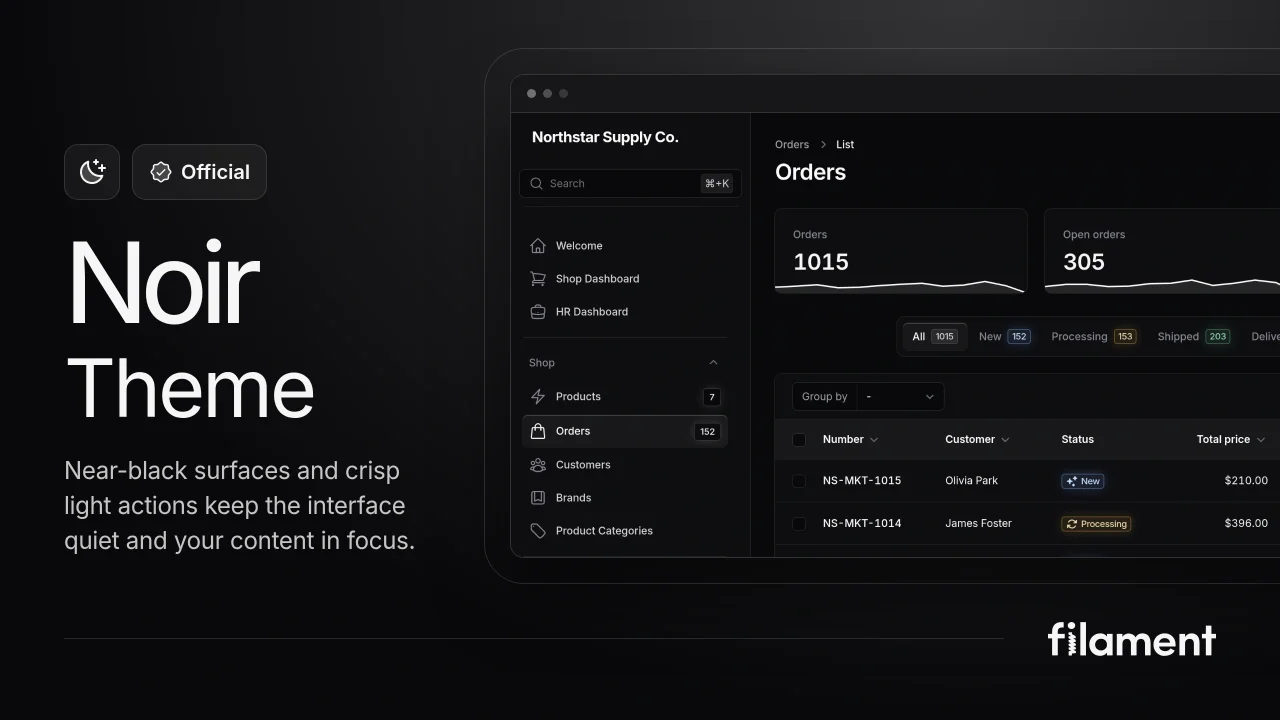
A theme that gives panels a focused, refined look with near-black surfaces, crisp actions, and restrained color.
Filament