Kanban Pro by asign
CommunitySwimlanes, WIP limits, transition rules, column totals, stale and overdue badges and several boards as tabs for the asignua Kanban board in Filament 5.
filament/
namespace. Review the source and install at your own risk. Found
malware or an unresolved security issue the author won't
address?
Report it
.
 Author:
asign
Author:
asign
Documentation
- Screenshots
- Purchase
- Requirements
- Installation
- Usage
- Workflow designer (Pro)
- Configuration
- Gotchas
- Translations
- AI agents
- Testing
- Changelog
- License
Documentation only. Filament Kanban Pro is a commercial plugin: this public repository holds its documentation, changelog and licence terms. The package itself is installed from the private Composer repository you get with a licence — buy one on Anystack. Questions: support@asign.in.ua.
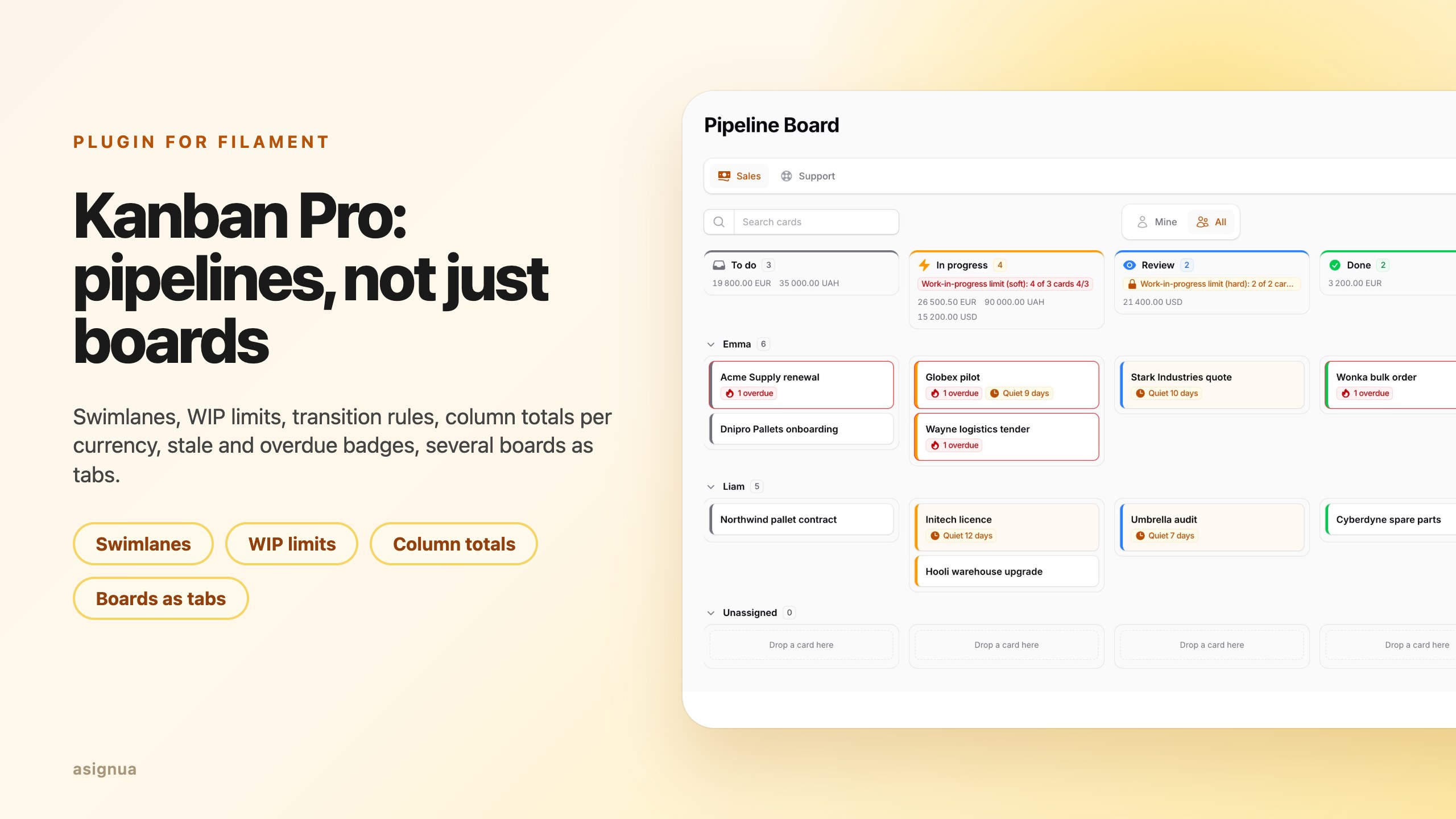
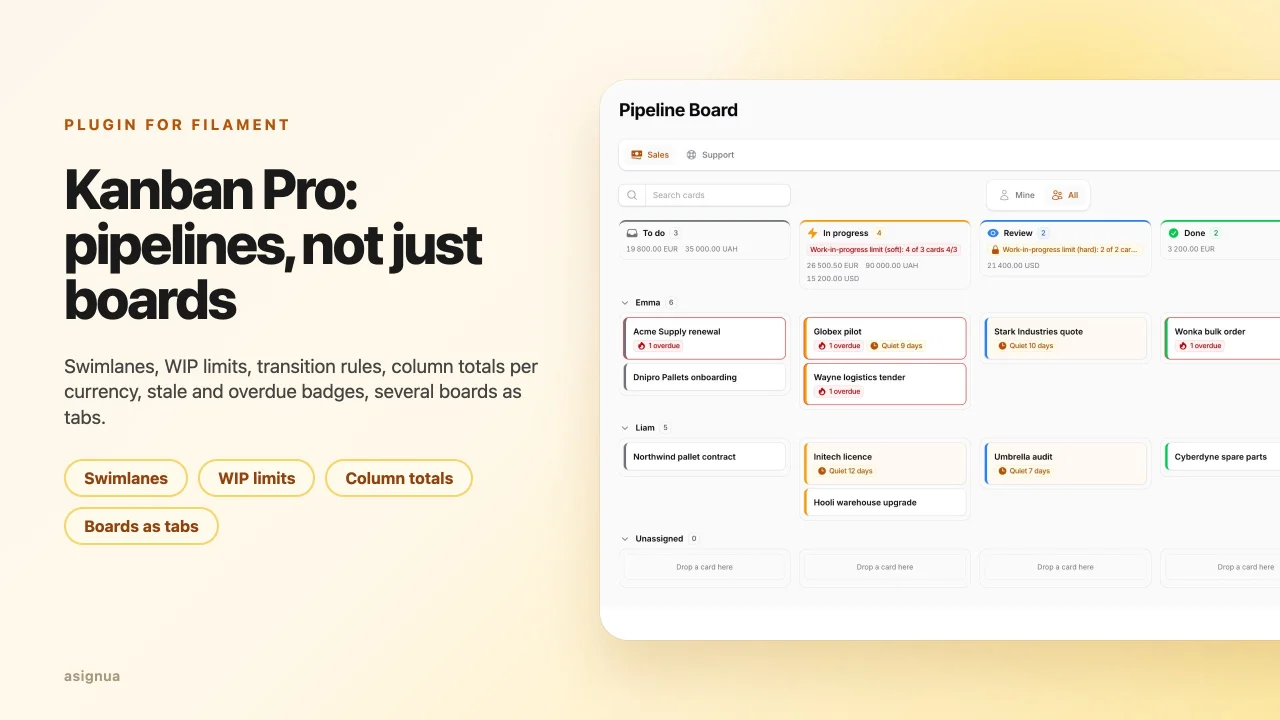
Kanban Pro turns the free filament-kanban board into a pipeline tool: swimlanes, WIP limits, transition rules, column totals per currency, stale and overdue badges, several boards as tabs, Mine / All scope toggles and Filament table filters on the board. It builds on the base package's documented extension points and never forks its views or its move pipeline, so the base package keeps receiving fixes on its own.
#Screenshots
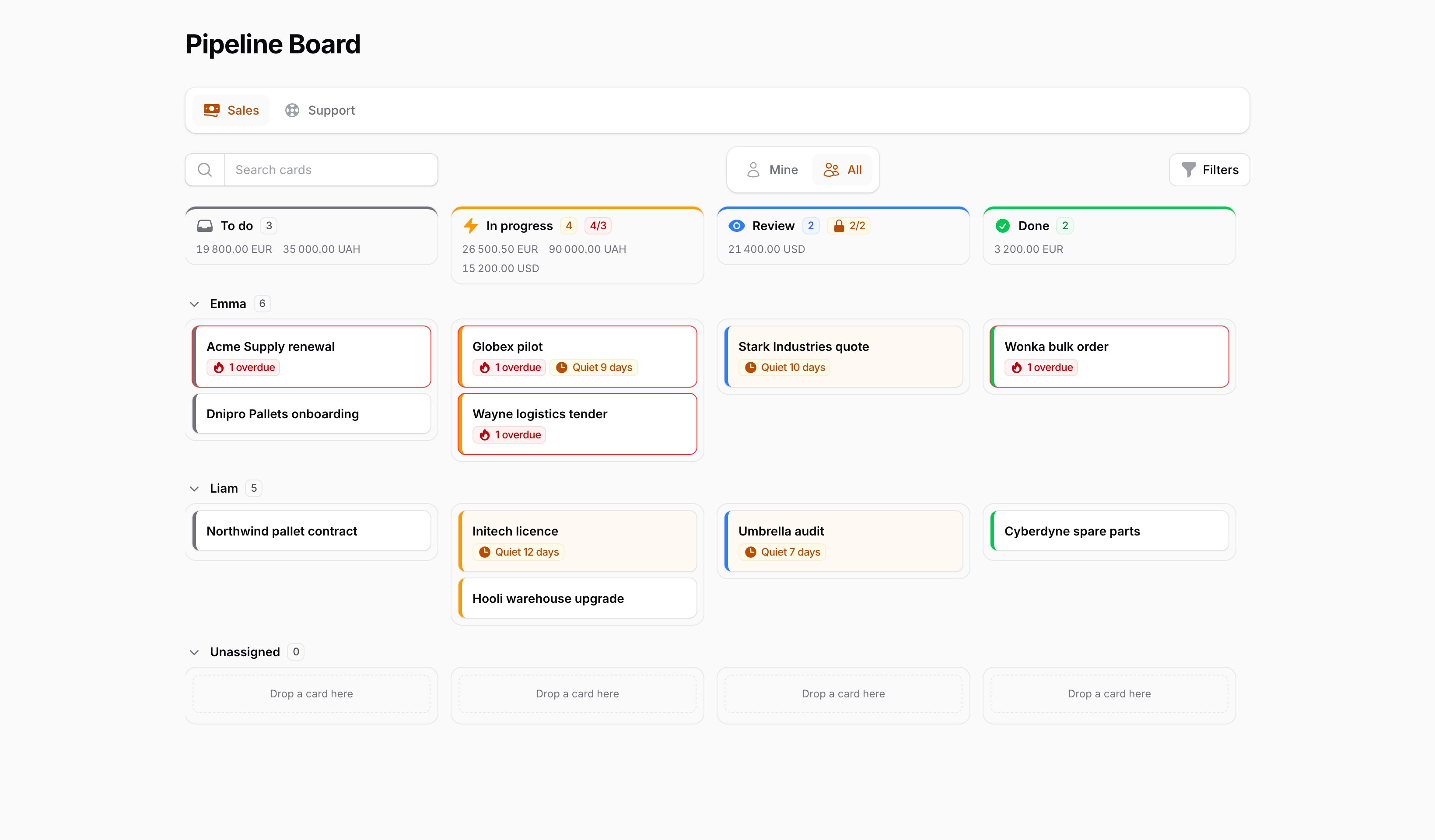
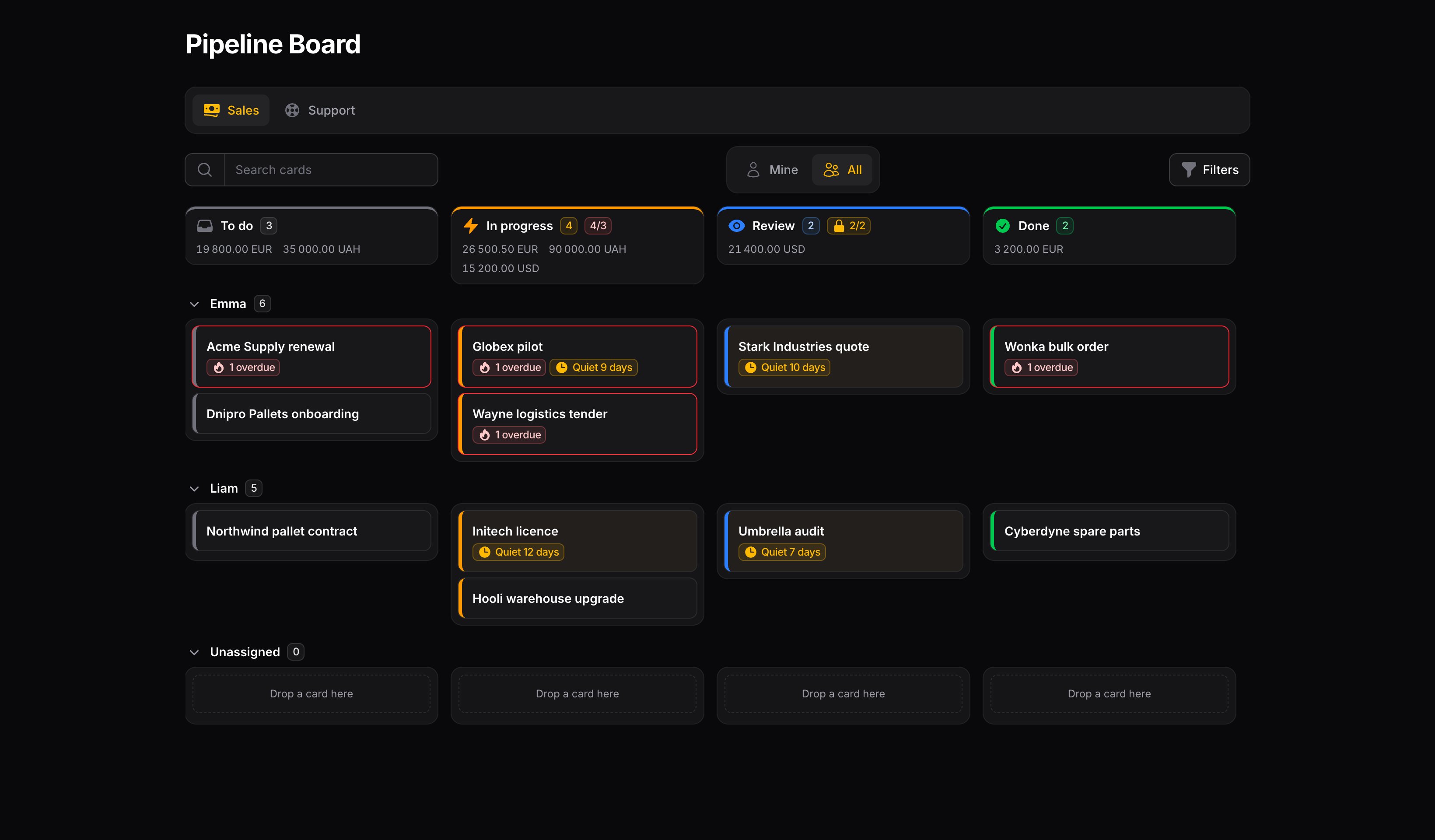
Swimlanes by owner, WIP limits (soft and hard), column totals per currency, stale and overdue badges, boards as tabs and a Mine / All toggle on one page:
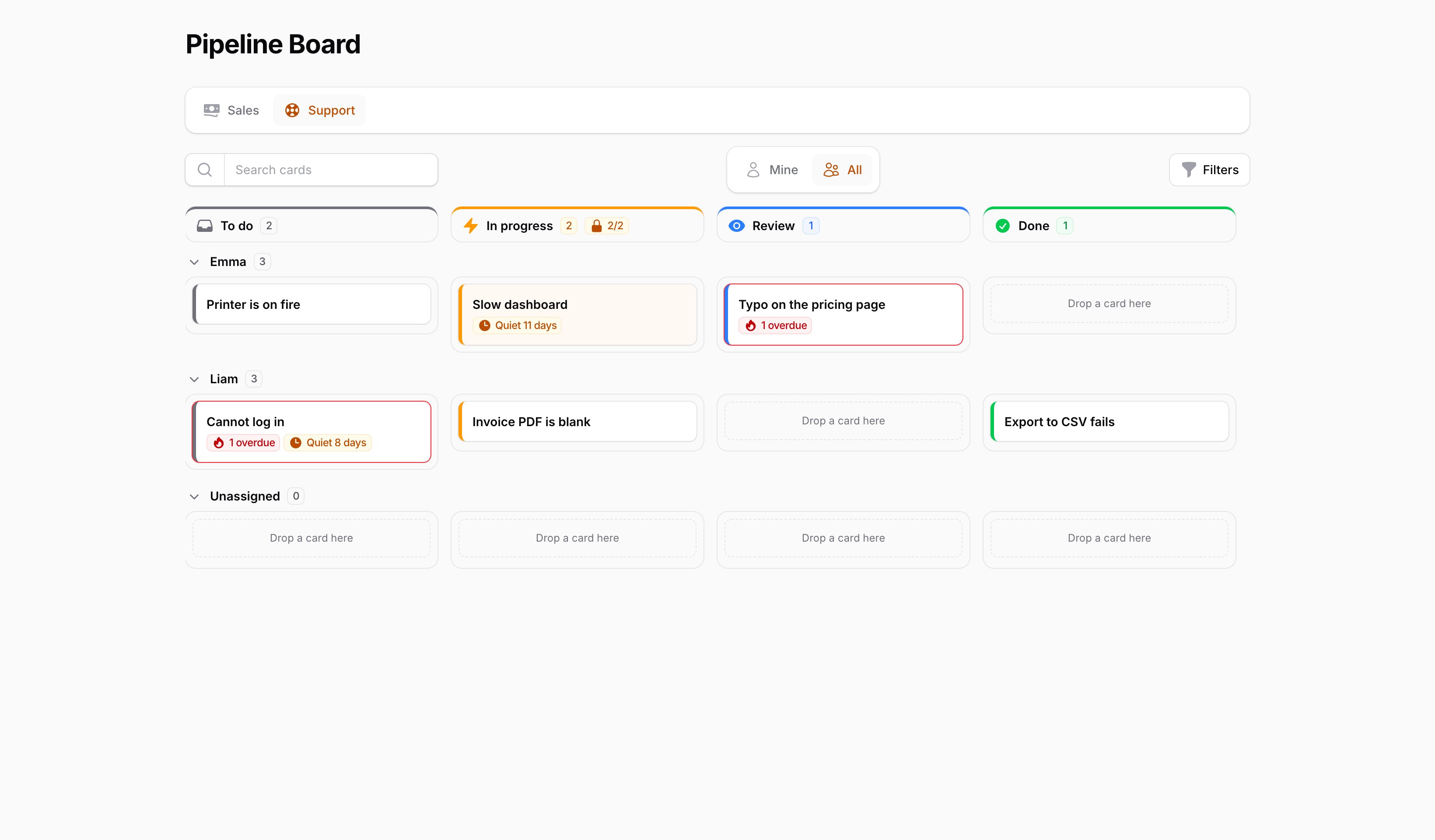
Several boards as tabs, each with its own scope and limits (here Support with a hard WIP limit on "In progress"):
Dark mode:
#Purchase
Filament Kanban Pro is a commercial plugin. Both tiers include one year of updates; after that the plugin keeps working on the last release you received, and you can renew for further updates.
| Tier | Projects | Activations | Price | Renewal |
|---|---|---|---|---|
| Single Project | 1 | up to 3 (production, staging, local) | €69 | €35 / year |
| Unlimited | any number, SaaS included | unlimited | €169 | €85 / year |
Refunds are available within 14 days of purchase.
Buy a licence on Anystack — after the purchase you receive a licence key and access to the private Composer repository. See LICENSE.md for the licence terms.
#Requirements
- PHP 8.3+
- Laravel 12 or 13
- Filament 5
asignua/filament-kanban^1.0 (installed automatically)
#Installation
-
Add the private repository (the same for every customer):
composer config repositories.filament-kanban-pro composer https://filament-kanban-pro.composer.sh -
Add your credentials. The username is the e-mail address you bought the licence with; the password is your licence key. A Single Project licence is bound to a fingerprint, so the password is the key followed by a colon and the fingerprint you activated — usually the production domain:
# Single Project
composer config --auth http-basic.filament-kanban-pro.composer.sh you@example.com "LICENCE-KEY:shop.example.com"

# Unlimited
composer config --auth http-basic.filament-kanban-pro.composer.sh you@example.com "LICENCE-KEY"
This writes
auth.jsonnext to yourcomposer.json— keep it out of git (addauth.jsonto.gitignore). On CI and servers pass the same JSON through theCOMPOSER_AUTHenvironment variable instead. A Single Project licence allows three activations (for example production, staging and local); manage them in your Anystack account. -
Require the package:
composer require asignua/filament-kanban-pro -
Register the plugin on your panel (optional - the assets and translations load without it):
use Asignua\FilamentKanbanPro\KanbanProPlugin;

$panel->plugin(KanbanProPlugin::make());
#Usage
Extend KanbanProBoard (or KanbanProResourcePage on a resource) instead of the base KanbanBoard and override the
hooks you need. All of them are protected and off by default. The base board's own properties and hooks
($model, $statusEnum, $recordSortAttribute, validateMove(), recordBadges()...) work exactly as before.
use Asignua\FilamentKanbanPro\Pages\KanbanProBoard;
use Asignua\FilamentKanbanPro\Support\{BoardDefinition, BoardScope, ColumnSummary, OverdueBadge, StaleBadge, Swimlanes, TransitionRules, WipLimit};
use Filament\Forms\Components\Textarea;
use Filament\Tables\Filters\SelectFilter;
use Illuminate\Database\Eloquent\Builder;

class DealsBoard extends KanbanProBoard
{
    protected static string $model = Deal::class;
    protected static string $statusEnum = DealStatus::class;
    protected static ?string $recordSortAttribute = 'position';

    protected function swimlanes(): Swimlanes
    {
        return Swimlanes::by('owner_id')->options(fn () => User::pluck('name', 'id')->all());
    }

    protected function wipLimits(): array
    {
        return ['doing' => 5, 'review' => WipLimit::hard(3)];
    }

    protected function transitionRules(): TransitionRules
    {
        return TransitionRules::make()
            ->allow('todo', ['doing'])
            ->allow('doing', ['todo', 'review'])
            ->allow('review', '*')
            ->ask('done', [Textarea::make('resolution')->required()]);
    }

    protected function columnSummary(): ColumnSummary
    {
        return ColumnSummary::sum('amount')->currency('currency');
    }

    protected function staleBadge(): StaleBadge
    {
        return StaleBadge::make()->sinceLatest('interactions', 'happened_at')->after(7)->exceptColumns(['done']);
    }

    protected function overdueBadge(): OverdueBadge
    {
        return OverdueBadge::relation('tasks', fn (Builder $q) => $q->whereNull('done_at')->where('due_at', '<', now()));
    }

    protected function boards(): array
    {
        return [
            BoardDefinition::make('sales')->label('Sales')->scope(fn (Builder $q) => $q->where('pipeline', 'sales')),
            BoardDefinition::make('support')->label('Support')->scope(fn (Builder $q) => $q->where('pipeline', 'support'))
                ->statuses(fn () => Stage::where('pipeline', 'support')->get()->map(fn ($s) => ['id' => (string) $s->id, 'title' => $s->name, 'value' => $s->id])->all())
                ->wipLimits(['3' => WipLimit::hard(2)]),
        ];
    }

    protected function scopes(): array
    {
        return [
            BoardScope::make('mine')->label('Mine')->icon('heroicon-o-user')->default()->query(fn (Builder $q) => $q->where('owner_id', auth()->id())),
            BoardScope::make('all')->label('All')->icon('heroicon-o-users')->visible(fn () => auth()->user()->isManager()),
        ];
    }

    protected function boardFilters(): array
    {
        return [SelectFilter::make('priority')->options(['low' => 'Low', 'high' => 'High'])];
    }
}
#Swimlanes
Swimlanes::by('owner_id') groups the visible cards by the attribute. Without options() the lanes are the distinct
values on the cards (title from relation('owner'), from a HasLabel enum, or from titleUsing()); with
options([value => title]) the lanes are fixed and empty lanes stay drawn as drop targets (showEmpty(false) hides them).
Cards with an empty attribute go to an "Unassigned" lane (unassigned('Nobody') renames it, unassigned(false) removes it
and forbids dropping into it). A drop into a lane is validated: a lane that is not on the board is refused with a
notification and nothing is written. Columns are not collapsible while lanes are on.
#WIP limits
['doing' => 5] is a soft limit: the header shows count/limit in warning colour at the limit and danger colour above it.
WipLimit::hard(3) also refuses a drop that would exceed it (and greys the column out while a card is dragged). The count
is the real number of cards in the column, so cards hidden by search or filters still count. A board of a tab brings its own
limits through BoardDefinition::wipLimits().
#Transition rules
allow(from, to) builds an allow-list; once there is one, anything not listed is refused ('*' is "any column" on either
side; a column nobody can leave simply has no entry). ask(to, fields) demands fields when entering a column - optionally
only from: one source column, or a closure fn (Model $record, string $from, string $to): array - and
askIfEmpty('doing', 'owner_id', Select::make('owner_id')...) asks only while the card's attribute is empty. The answers are
saved with the move by the base onTransitionConfirmed() (fill the record), so name fields after attributes or override it.
Your own validateMove() still runs first.
#Totals and badges
ColumnSummary::sum('amount')->currency('currency')->scale(2) prints one line per currency in the column header; cards
without an amount are skipped, cards without a currency are summed under no currency. The totals cover the cards the board
shows. StaleBadge reads the last activity from an attribute (since('last_activity_at')) or from the latest related row
(sinceLatest('interactions', 'happened_at'), one withMax for the board), falling back to created_at. OverdueBadge
reads a count attribute (OverdueBadge::attribute('overdue_tasks_count')) or counts a relation with your constraint
(OverdueBadge::relation(...), one withCount). Both take inColumns([...]) / exceptColumns([...]), and a badged card
gets the classes fi-kanban-card--stale / fi-kanban-card--overdue.
#Boards, scopes, filters
With two or more visible boards a tab row appears; the picked board is remembered in the session, an unknown or no longer
visible key falls back to the first board. A board's scope() closure is part of the board's own query (it defines which
cards belong to it), so reordering and WIP counts respect it. Scope toggles narrow the visible cards only, and are
remembered too.
Scopes are view filters, not an authorization boundary. They only narrow what is drawn; a crafted request can still move or edit a card hidden by the active scope if the policy allows it. Restrict access with a policy or
canMove(), or put the restriction intogetEloquentQuery()/BoardDefinition::scope().
boardFilters() takes any Filament table filter (SelectFilter, TernaryFilter, Filter::make()->schema(),
QueryBuilder...), applied live and remembered in the session.
#Workflow designer (Pro)
An opt-in module: steps, allowed transitions, reasons, required fields and automations are designed in the panel (a git-graph style diagram) instead of being hard-coded, and every change of a record's step goes through one engine that checks the rules, writes a journal row and runs the automations.
1. Enable and migrate. Set KANBAN_PRO_WORKFLOW=true (config key filament-kanban-pro.workflow.enabled) and run
php artisan migrate. The tables are not loaded while the flag is off. Register KanbanProPlugin::make() on the panel to
get the "Workflows" resource.
2. Add the step column to the table of the model that moves through a workflow:
php artisan kanban-pro:workflow-column "App\Models\Deal"   # --column=workflow_step_id by default
php artisan migrate
It writes a nullable foreign key to the steps table with restrictOnDelete(). The command refuses a class that is not
an Eloquent model or does not use HasWorkflow.
3. Use the trait, register the model and decide who may design:
use Asignua\FilamentKanbanPro\Workflow\Concerns\HasWorkflow;

class Deal extends Model
{
    use HasWorkflow;
}

Workflow::for(Deal::class);   // required: in a service provider's boot(); the designer offers only registered models

Gate::define('manageWorkflows', fn ($user) => $user->isAdmin());   // deny by default
// or: KanbanProPlugin::make()->authorizeWorkflowsUsing(fn (?Authenticatable $user) => ...)
// menu: KanbanProPlugin::make()->workflowNavigationGroup('Admin')->workflowNavigationLabel('Pipelines')->workflowNavigationSort(90)
4. Move records through the engine. The model guard throws WorkflowGuardViolation when the step column is written
directly:
use Asignua\FilamentKanbanPro\Workflow\Workflow;

Workflow::engine()->move($deal, $step, ['comment' => '...'], by: $user);   // throws TransitionRefused
Workflow::engine()->assign($deal, $step);            // the first placement of a record that has no step yet
Workflow::engine()->refusalFor($deal, $step);        // ?string reason, null = allowed
Workflow::engine()->allowedTargets($deal);           // steps the record may move to
Workflow::engine()->requirements($from, $to);        // comment / reason / fields demanded by the target

Workflow::withoutGuard(fn () => Deal::query()->update([...]));   // seeders, imports, migrations
HasWorkflow also gives the record thin wrappers: $deal->workflow() (the process it sits in), $deal->allowedSteps()
and $deal->moveTo($step, $data, $by).
A record with no step: create it empty, then assign(). Creating a record already in a step is not guarded (seeders,
imports), but writes no journal row; assign() is the documented entry that places a step-less record with the same
requirements, a journal row (from nothing) and on-enter actions as a move. It refuses a record that already has a step.
If a policy is registered for the model, a move needs an authenticated user allowed to update it. withoutGuard() only
lifts the model guard, it does not bypass that check. For the console, queue jobs and imports use the system mode:
Workflow::asSystem(fn () => Workflow::engine()->move($deal, $step, [], $user)); // $user is optional
Inside the callback the policy and canTransition are skipped, but the allowed transitions, the requirements and hard
WIP limits still apply; the journal row is written with is_system = true and user_id = $user (null if none — the logged-in user is
not borrowed).
A system placement is not a user decision. When a record that has no step yet is placed in system mode
(Workflow::asSystem(fn () => Workflow::engine()->assign($lead, $step)) — a website lead, an import), the entry
requirements of the step (comment / reason, also a required reason with no reason configured) and its hard WIP limit are
not applied: nobody is there to answer the modal, and refusing would lose the record itself (an owner tightening the
first step in the designer would silently break lead intake). A comment or reason passed in is still validated and
journalled. Soft limits are a board hint and never block. A system move of a record that already has a step keeps
every requirement and the hard limit.
The guard covers Eloquent updating only. A query-builder update(), saveQuietly() or withoutEvents() bypass it
(they fire no model event), so keep step writes on the engine.
5. Show it.
// A board: one tab per workflow of the model, one column per step, edges, WIP limits and the requirements modal.
class DealsBoard extends KanbanProBoard
{
    use InteractsWithWorkflow;   // Asignua\FilamentKanbanPro\Workflow\Board\InteractsWithWorkflow

    protected static string $model = Deal::class;
    protected static string $recordStatusAttribute = 'workflow_step_id';
}

// A table / infolist
MoveToStepAction::make();        // row action
MoveToStepBulkAction::make();    // bulk action
WorkflowStepEntry::make();       // read-only badge with a "Change step" action
6. Per-model hooks (all optional):
Workflow::for(Deal::class)
    ->canTransition(fn (Deal $deal, ?Step $from, Step $to, ?Authenticatable $by) => $deal->owner_id === $by?->id ?: 'Only the owner.')
    ->fields(fn (Deal $deal, Step $to) => [TextInput::make('amount')->required()])   // extra form fields in the modal
    ->rules(fn (Deal $deal, Step $to) => ['amount' => ['required', 'numeric']])
    ->afterTransition(fn (StepChange $change) => ...)                                // inside the move's transaction
    ->recipients(fn (Deal $deal) => [$deal->owner])                                   // the "responsible" of notification / mail
    ->title(fn (Deal $deal) => $deal->name)                                           // used in notifications and mail
    ->url(fn (Deal $deal) => DealResource::getUrl('view', ['record' => $deal]));
Keep personal data out of the journal. Every validated app field lands in the journal row (StepChange::$data)
for good. Fields that belong on the record only (tax numbers, addresses) go in journalExcept(): they are still
validated and handed to afterTransition through $change->submitted(), but the journal row never stores them.
Workflow::for(Deal::class)
    ->journalExcept(['tax_number', 'registration_address'])
    ->afterTransition(fn (StepChange $change) => $change->submitted());   // the full set; $change->data has no excluded keys
afterTransition runs inside the move's transaction: an exception rolls the move back. Put side effects (mail, HTTP,
dispatching jobs) in DB::afterCommit(fn () => ...), or use an automation, which runs on the queue after the commit.
canTransition returns true, or a string (the refusal reason); anything else refuses with a generic message.
Host step fields. Declare your own fields for the step slide-over (a SLA, a queue, a flag your code reads) with
stepFields(); they are stored in steps.settings (JSON) and read with Step::setting():
Workflow::for(Deal::class)->stepFields(fn () => [
    TextInput::make('sla_hours')->numeric(),
    Section::make('Routing')->schema([TextInput::make('queue')]),
]);

$step->setting('sla_hours', 24);   // key, default
Only keys that belong to the declared components are saved; anything else sent to WorkflowDesigner::createStep() /
updateStep() in settings is dropped.
Journal name snapshots. Every journal row (StepChange) also stores from_step_name and to_step_name, the step
labels at the time of the change (current locale, with the usual fallback). When a step is deleted its journal rows lose
from_step_id / to_step_id, but the names stay readable.
Automations are configured per step in the designer. Built in: notification (panel), mail and webhook. Write your
own by implementing Actions\StepAction (key(), label(), configSchema(), handle(StepChange $change, array $config))
and registering it, for example in a service provider:
Workflow::registerAction(SlackAction::class);
The queue is required. Automations run on the queue after the commit; without a running queue worker nothing is sent. A failed action does not undo the move.
Webhooks. https only, no redirects followed, the host is resolved once and pinned, and private, loopback and CGNAT
addresses are refused. The body is signed: X-Workflow-Signature is sha256= plus the HMAC SHA-256 of the raw body, keyed with the secret set on the automation. Only a connection
error, 5xx, 408 and 429 are retried. Config (filament-kanban-pro.workflow.webhooks): allow_http and allow_private
(both false; for local development only), timeout (10 s), tries (3).
Other config keys: table_prefix (kanban_, set before the first migrate), colors (the palette offered for steps),
locales (languages the designer offers for names; empty = the current locale).
#Limitations
- The journal uses
morphs(), so the primary keys of workflow models must be integers; ULID / UUID keys are not supported yet. rolerecipients for notification and mail are not implemented yet: pick users, the actor, or the record's responsible people (recipients()).- Deleting a step relocates all its records first, including those hidden by global scopes (soft deletes, tenants), and journals each as a system change; the target must be a step of the same kind (the designer offers only those), and the kind of a step that holds records cannot be changed. Hard WIP limits are enforced by the engine for every writer; soft limits are a board hint only.
#Configuration
The boards need no config; everything is declared on the board class. The only config is the opt-in workflow designer
(config/filament-kanban-pro.php, see above). Translations can be published with
php artisan vendor:publish --tag=filament-kanban-pro-translations. Registering KanbanProPlugin on the panel is optional.
#Gotchas
- The page must
implements HasTable.KanbanProBoardandKanbanProResourcePagealready do; if you put the traitInteractsWithKanbanProon your own page, add the interface,protected string $view = 'filament-kanban-pro::kanban-board'andprotected static string $toolbarView = 'filament-kanban-pro::kanban-toolbar'to the class itself (PHP does not let a trait redeclare a property the parent class already has). The page then also carries Filament's table plumbing, with no columns and no records of its own. - Drop targets in lane mode carry the lane:
data-status-id="column|lane". If you published or replaced the board views, keep that attribute, otherwise lane drops are read as plain column drops. - A hard WIP limit is checked just before the move, not locked. Two people dropping the last free slot at the same moment can both succeed; the next render shows the column as over its limit.
- Put the model's own scopes in
getEloquentQuery(), UI filters inmodifyRecordsQuery()- the base package finds a whole column through the first when it saves positions. ABoardDefinition::scope()counts as the first kind. - Aggregates need the relation:
sinceLatest('interactions', ...)/OverdueBadge::relation('tasks', ...)callwithMax/withCounton the board query, so the relation must exist on the model. A Lane title fromrelation()is eager loaded for you. - Lane ids are strings. An integer owner id
5is the lane'5';options()keys keep their original type when written. - The "forbidden column" painting and the early refusal of a drop are JavaScript conveniences. The server validates every
move with
validateMove()regardless.
#Translations
The interface ships in English, Ukrainian, German, Spanish, French, Italian, Dutch, Polish, Brazilian Portuguese and Turkish
under the filament-kanban-pro::filament-kanban-pro namespace. A test keeps every language in step with the English keys. Override a
string by publishing the translations (--tag=filament-kanban-pro-translations) and editing the copy in
lang/vendor/filament-kanban-pro.
#AI agents
The package ships Laravel Boost guidelines (resources/boost/guidelines/core.blade.php) so a
coding agent wires it up correctly.
#Testing
composer install
vendor/bin/phpunit
npm test            # the small drag-rule helpers in resources/dist/kanban-pro.js
vendor/bin/phpstan analyse --memory-limit=1G
vendor/bin/pint --test
composer.json has a development-only path repository for ../filament-kanban; remove it before tagging a release
(see the CHANGELOG).
#Changelog
See CHANGELOG.md.
#License
Filament Kanban Pro is commercial software. See LICENSE.md.
The author
asign is a small web-dev company from Lviv, Ukraine. We build business applications on Laravel and Filament — CRMs, automation systems for standard and non-standard business processes, booking and content management systems, including our own Filament-based CMS. We open-source the parts that prove useful beyond a single project
From the same author
Relation Manager Tabs
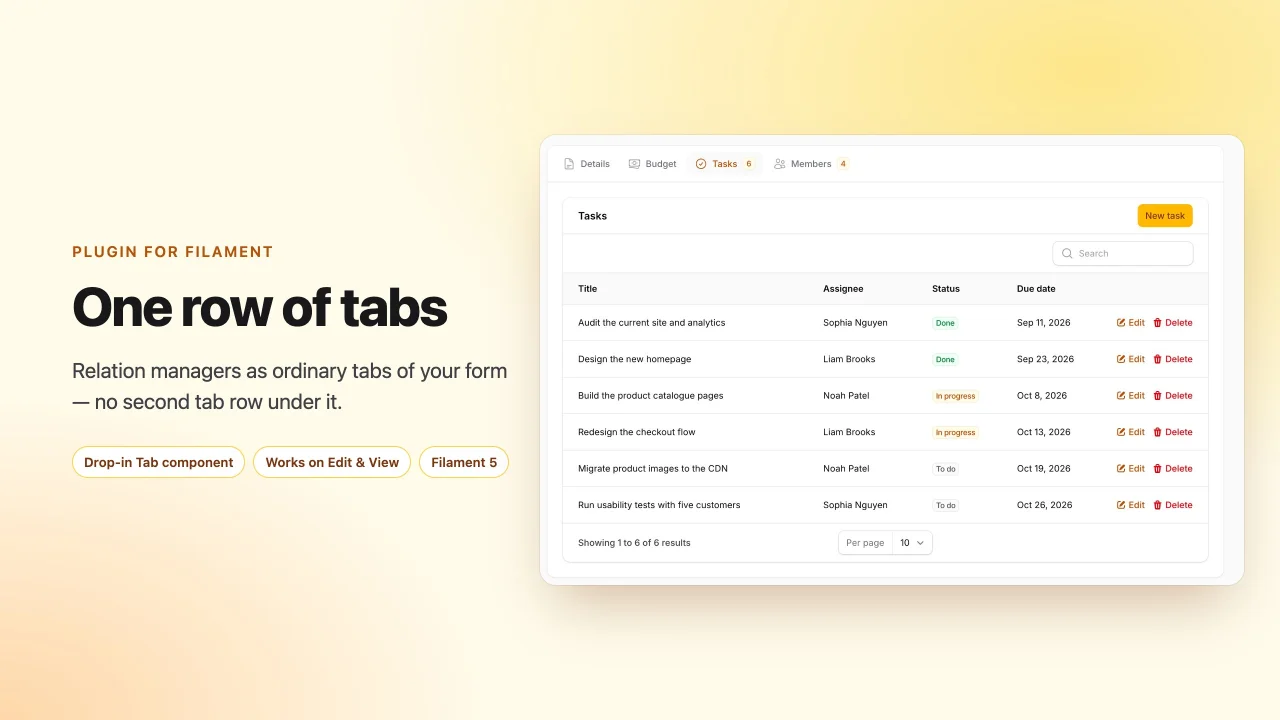
Render relation managers as ordinary tabs of the record form, so an edit or view page has exactly one row of tabs.
Author:
asign
SEO Files
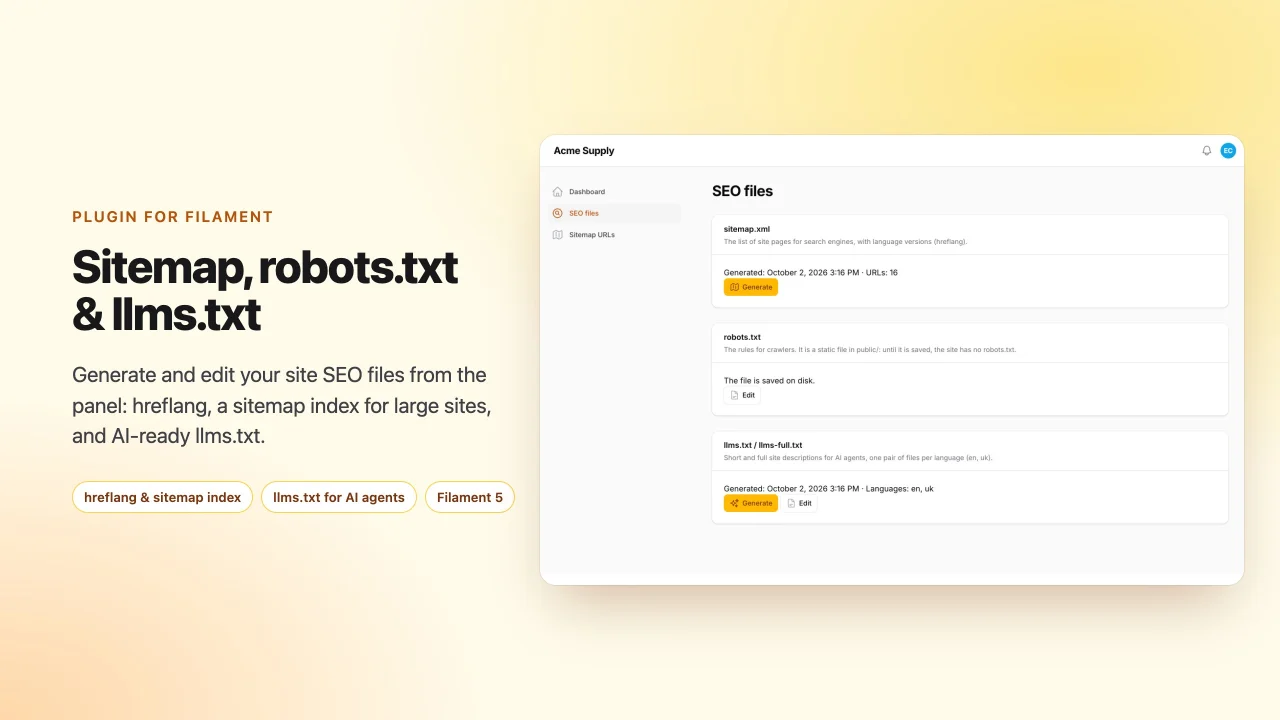
Generate and edit sitemap.xml with hreflang and a sitemap index for large sites, robots.txt and llms.txt / llms-full.txt from your Filament panel
Author:
asign
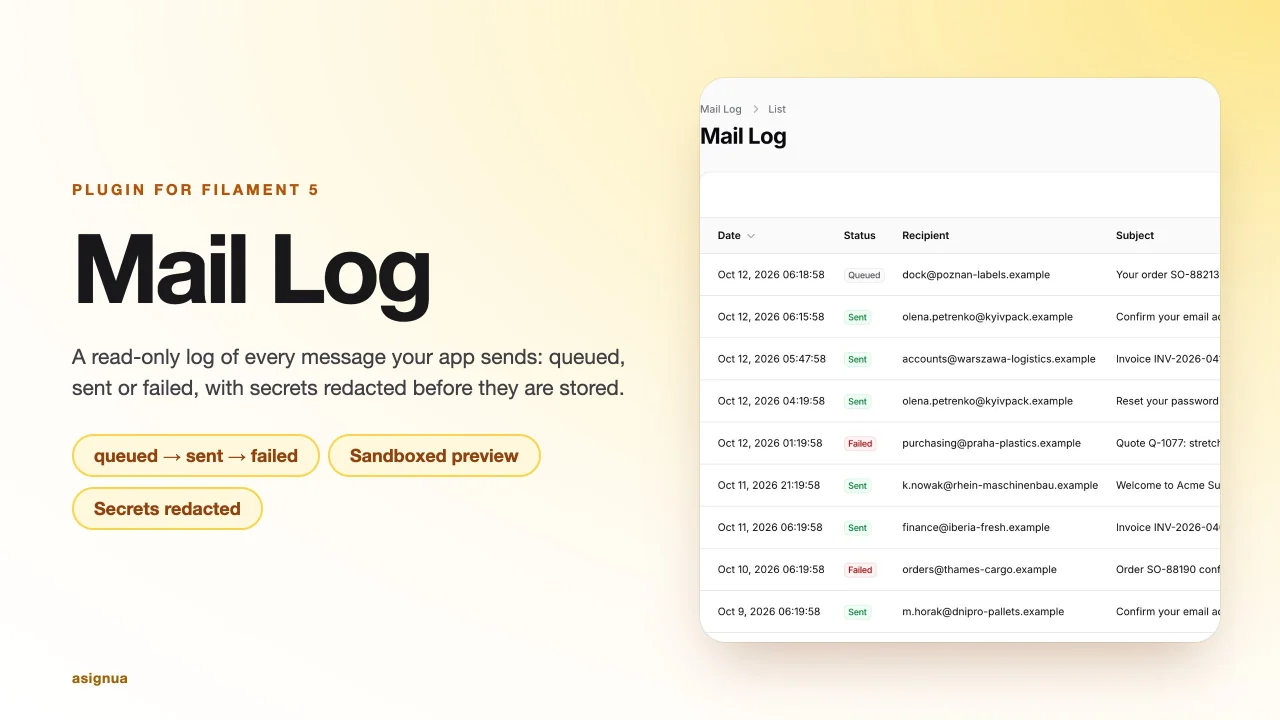
Mail Log
Log of every outgoing mail with queue status, a sandboxed preview and signed links, tokens and passwords redacted before storage.
Author:
asign
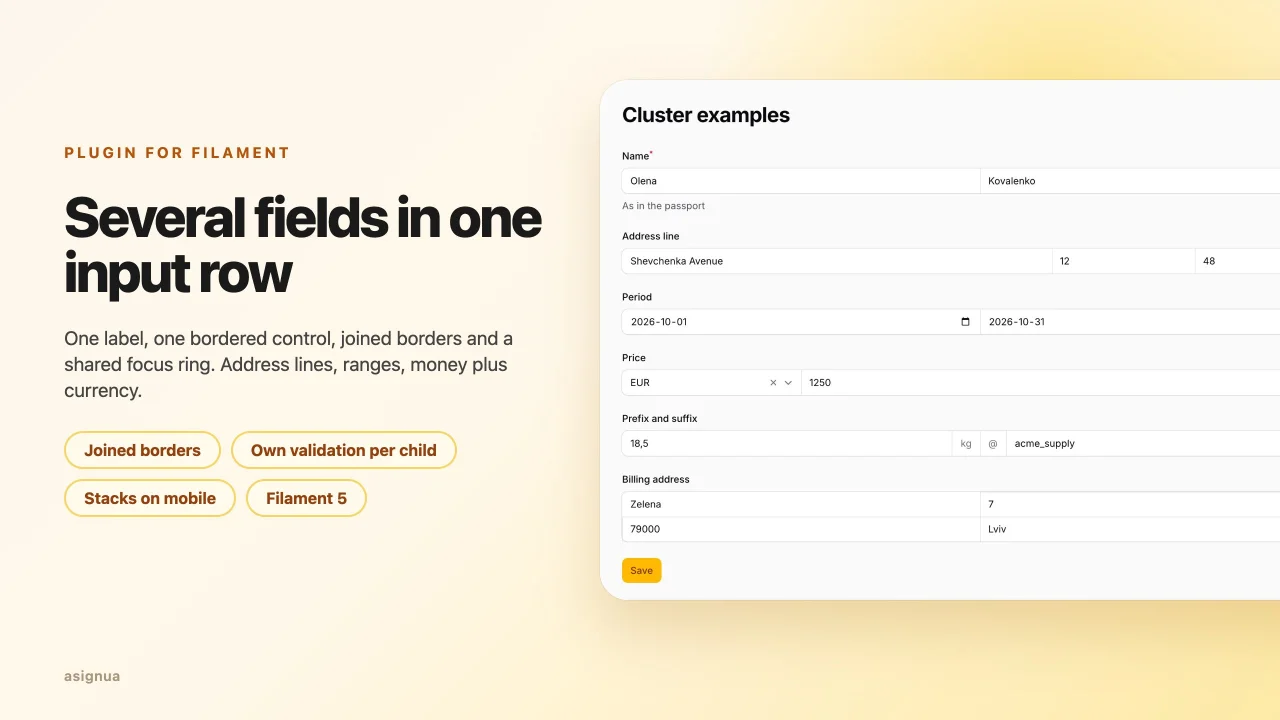
Clusters
Group several fields into one input row with a shared label, joined borders and one focus ring — the successor of guava/filament-clusters.
Author:
asign
Featured Plugins
A selection of plugins curated by the Filament team

Blueprint
Filament Blueprint is a premium Laravel Boost extension that helps AI agents produce accurate, detailed implementation plans and security reports for Filament apps.
 Filament
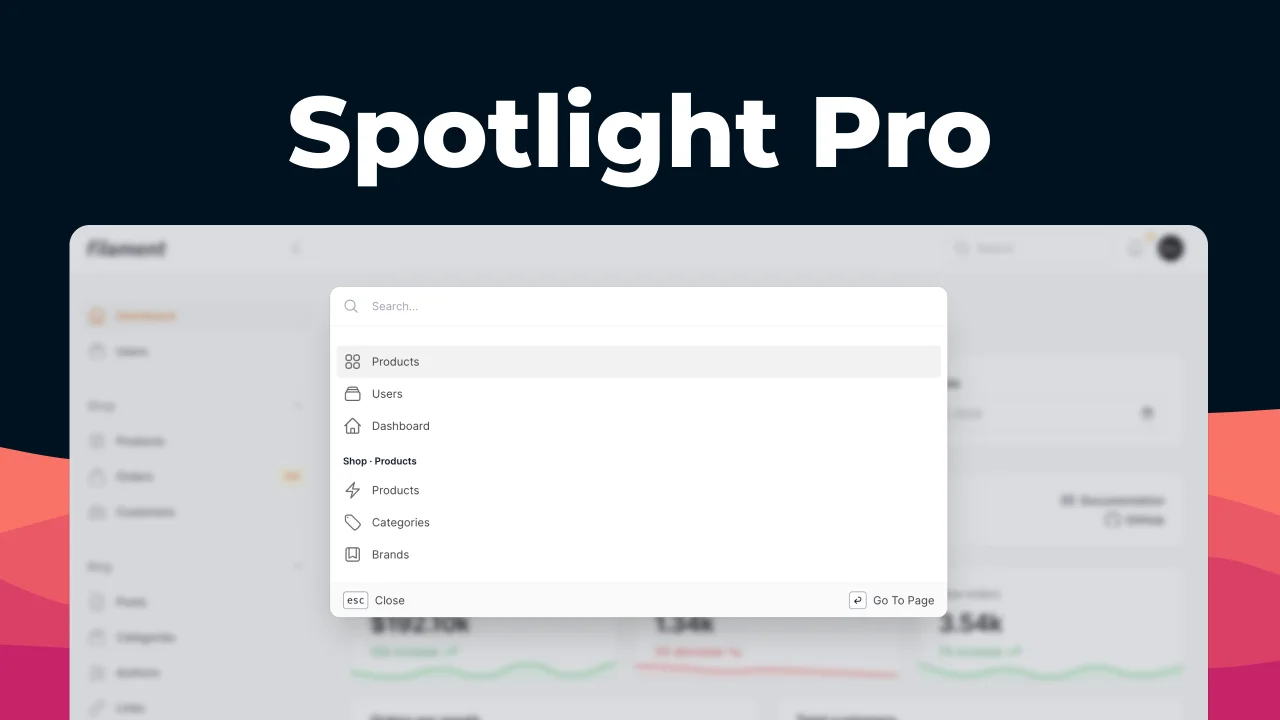
Spotlight Pro
Browse your Filament Panel with ease. Filament Spotlight Pro adds a Spotlight like Command Palette to your Filament Panel.
 Dennis Koch
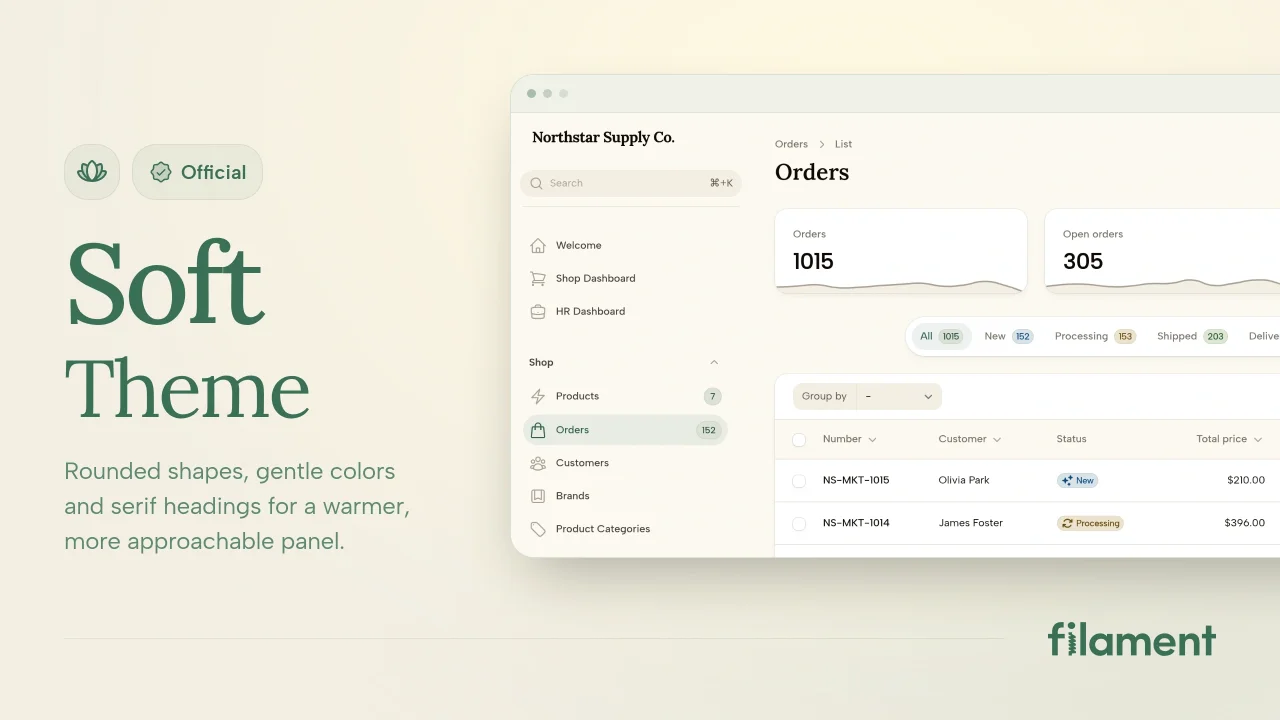
Soft Theme
A theme that gives panels a warm, approachable look with rounded shapes, gentle colors, and serif headings.
Filament