
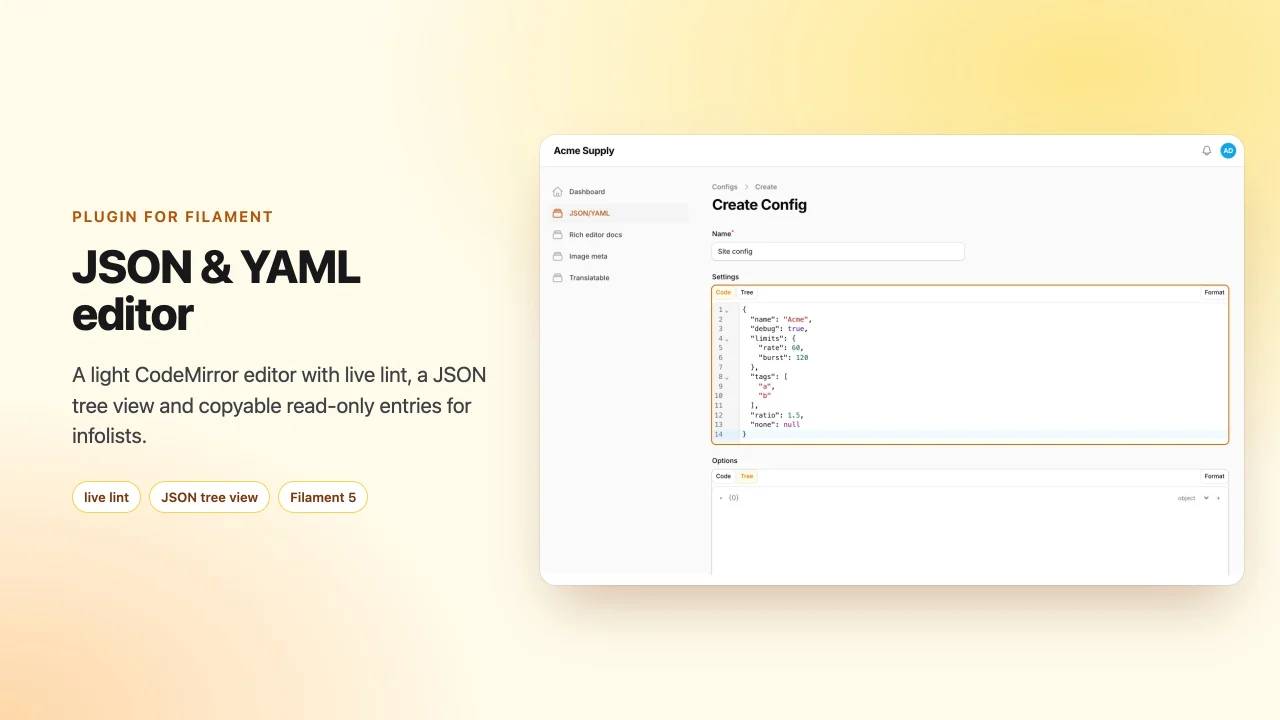
JSON & YAML Editor by asign
CommunityJSON and YAML editors with code and tree modes, live validation, JSON Schema rules and highlighted infolist entries.
 Author:
asign
Author:
asign
Package health
Automated checks of this plugin's Composer package
15 checks
- Passed: GitHub Actions pinned to SHA
- Skipped: GitLab CI includes pinned to SHA
- Passed: Open security advisories
- Passed: Dependabot PR responsiveness — No stale Dependabot PRs.
- Skipped: Renovate MR responsiveness
- Passed: Dependabot or Renovate configured
- Passed: Dependency update cooldown configured
- Passed: Provides a security policy
- Passed: Abandoned or archived — No consulted source marks the package abandoned (packagist, github).
- Passed: Commit and release recency — Active: last commit 0 days ago; last release 0 days ago.
-
Passed:
composer.lock not committed by library
—
composer.lockis absent from the released dist archive. - Passed: Dist archive is lean
-
Passed:
Current Laravel version supported
—
Package dependencies resolve together with current Laravel
13.0. -
Passed:
Current PHP version supported
—
Constraint
^8.3supports current PHP8.5. -
Passed:
Current Symfony version supported
—
Package dependencies resolve together with current Symfony
8.1.
filament/
namespace. Review the source and install at your own risk. Found
malware or an unresolved security issue the author won't
address?
Report it
.
Documentation
- Screenshots
- Requirements
- Installation
- Usage
- Configuration
- Gotchas
- Translations
- AI agents
- Testing
- Changelog
- License





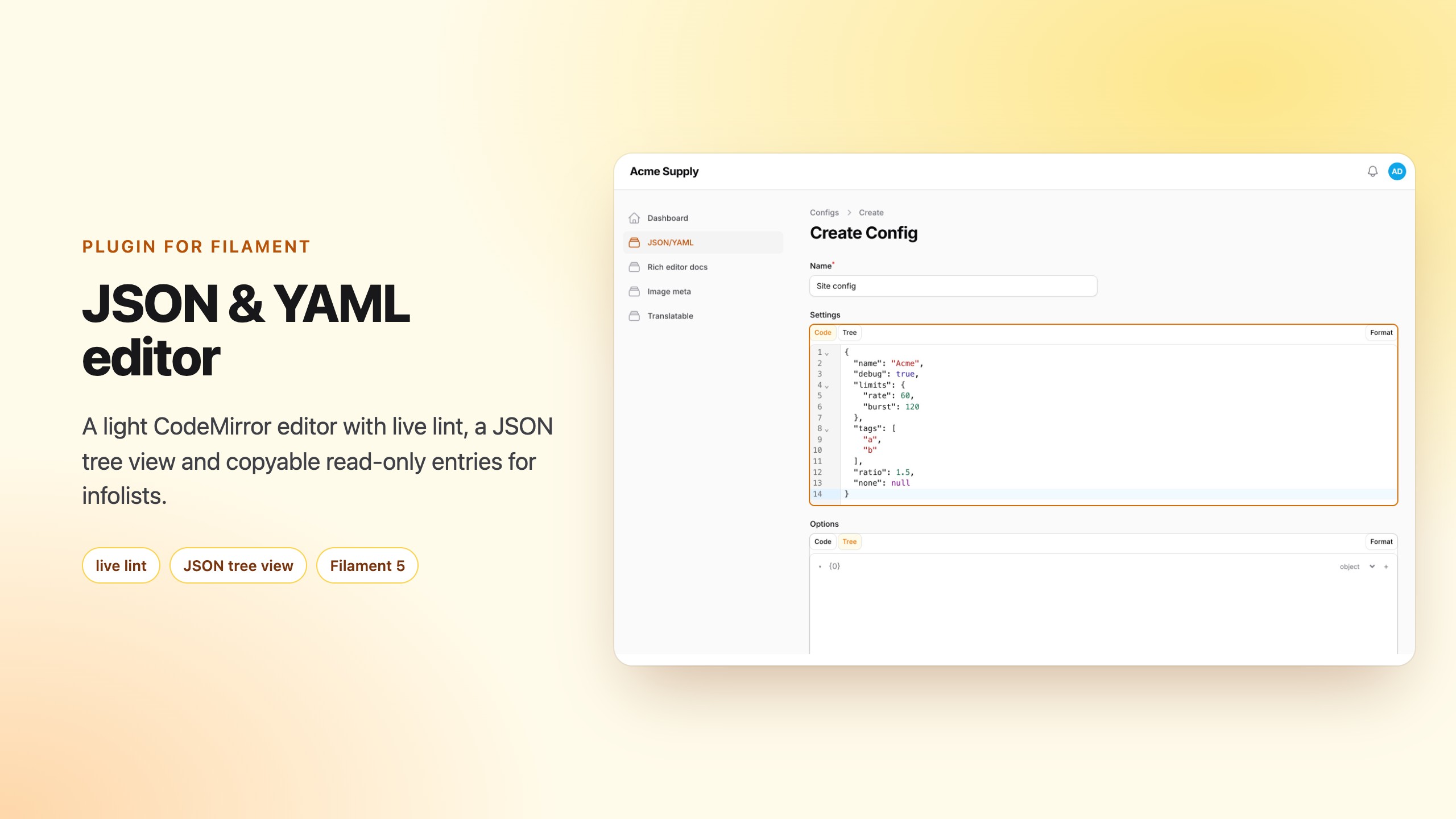
JSON and YAML editing for Filament 5: two form fields and two infolist entries.
Filament 5 ships a CodeEditor, but it is a plain text editor: no tree view, no validation, no schema, no formatting.
The popular Filament 3 plugin for this (invaders-xx/filament-jsoneditor)
has no Filament 4/5 release, and YAML editing has had nothing at all.
-
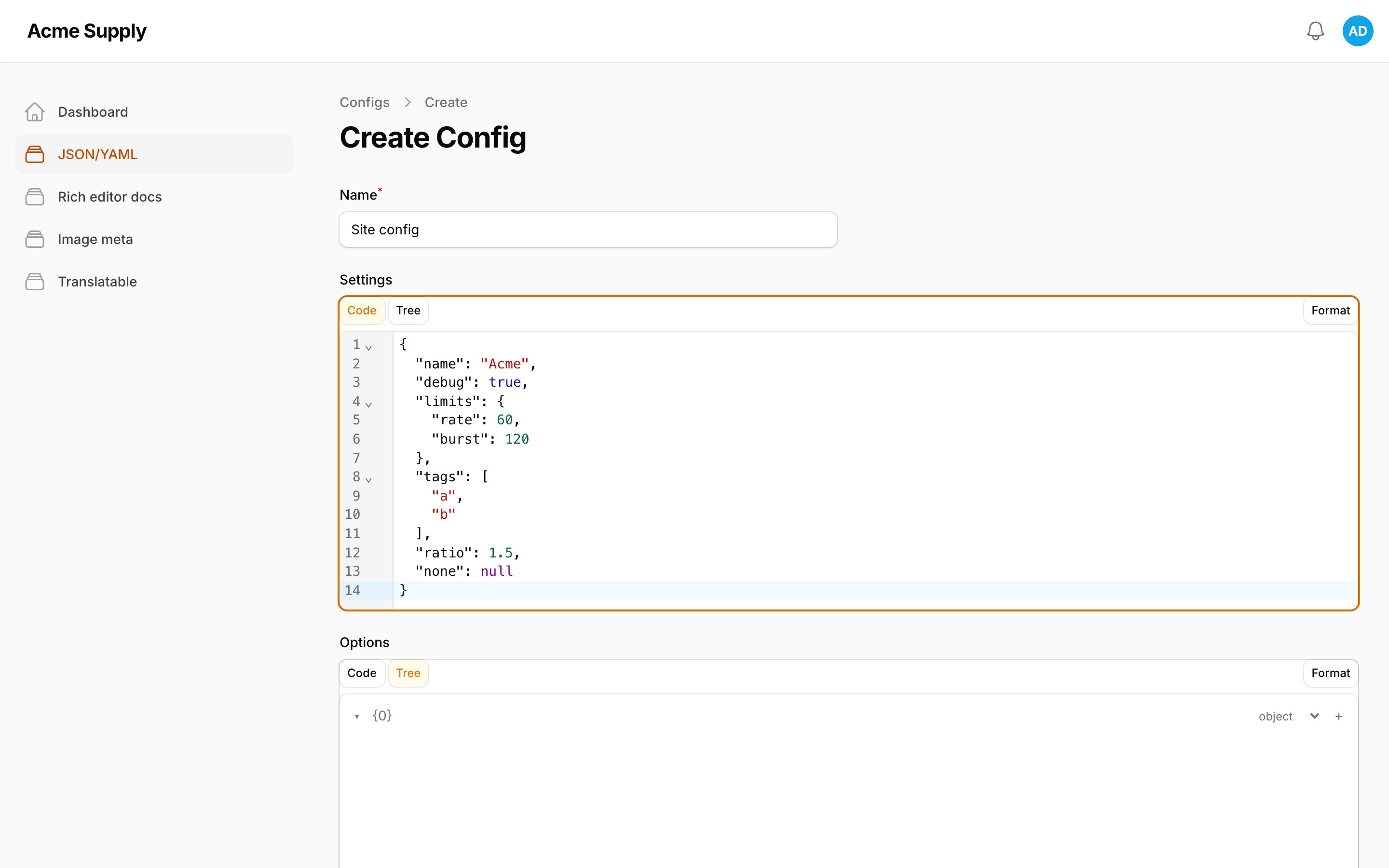
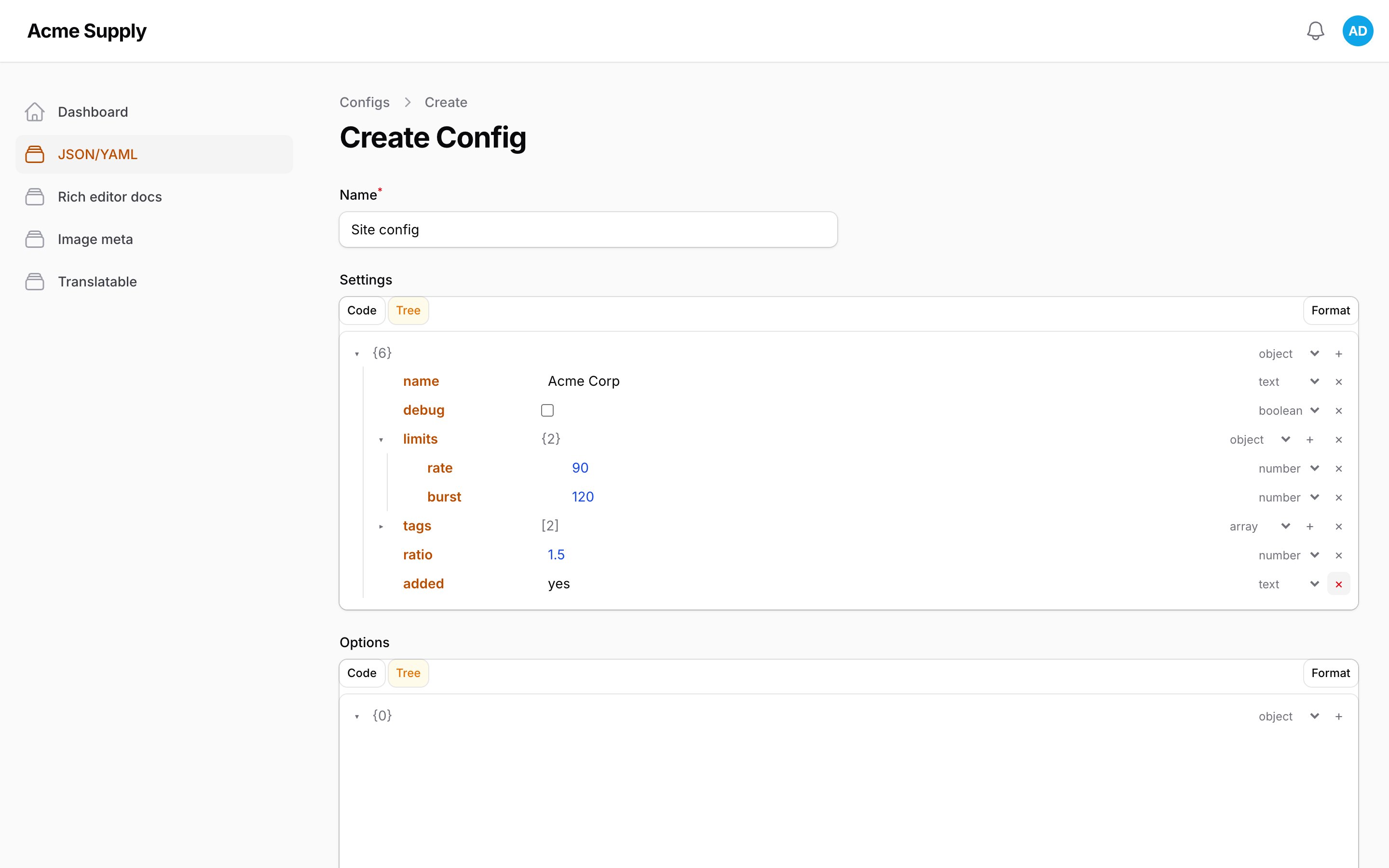
JsonEditor: a code view (highlighting, line numbers, folding) and a tree view (expand / collapse, edit values, rename keys, change types, add and remove), live validation with the error line, a Format button, optional JSON Schema. -
YamlEditor: the same code view with the YAML language and a livejs-yamllint that shows the error line. -
JsonEntry/YamlEntry: read-only highlighted, collapsible blocks with a copy button, for infolists. -
Server-side rules for all of it:
JsonRule,YamlRule(symfony/yaml) andJsonSchemaRule.
#Screenshots
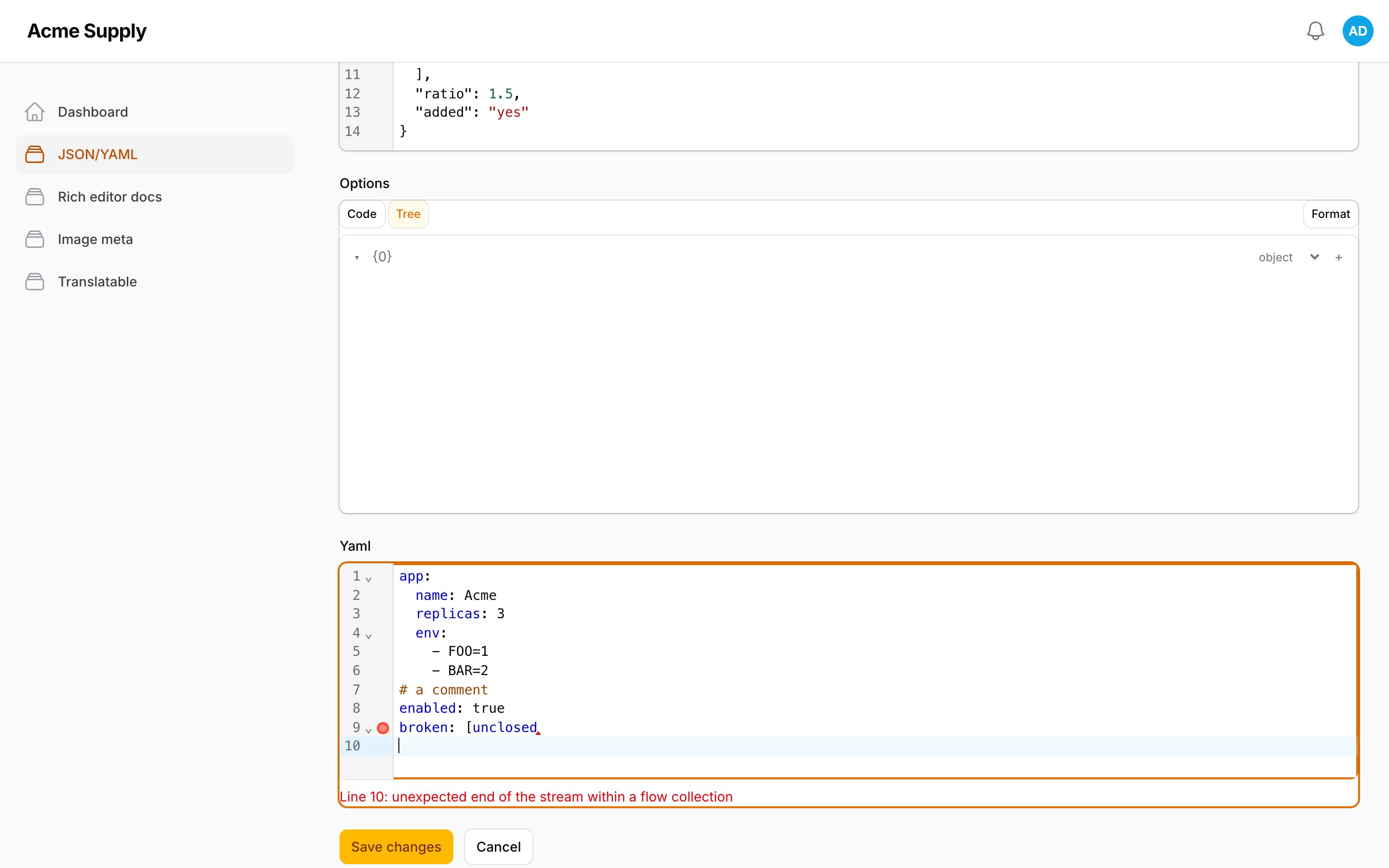
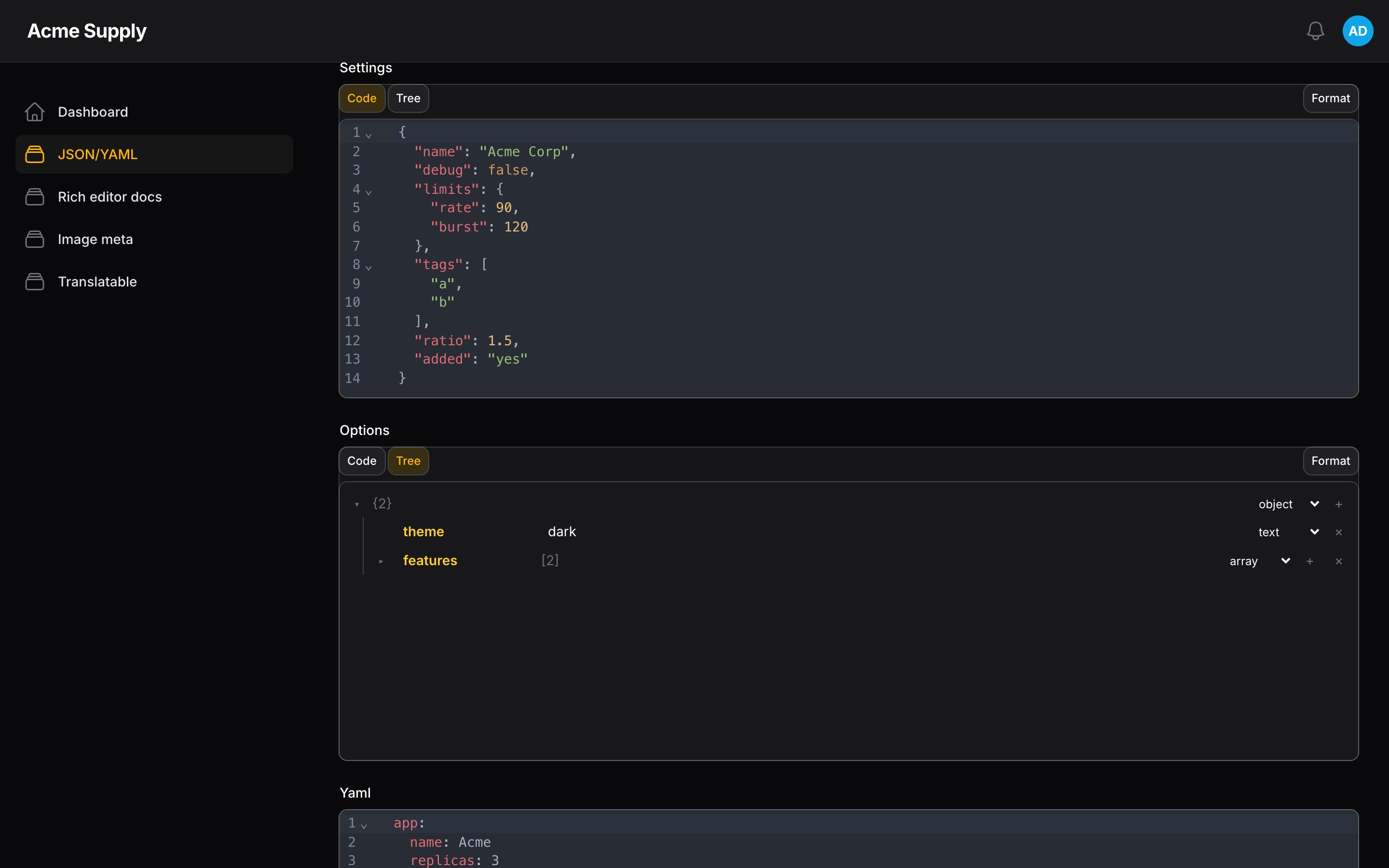
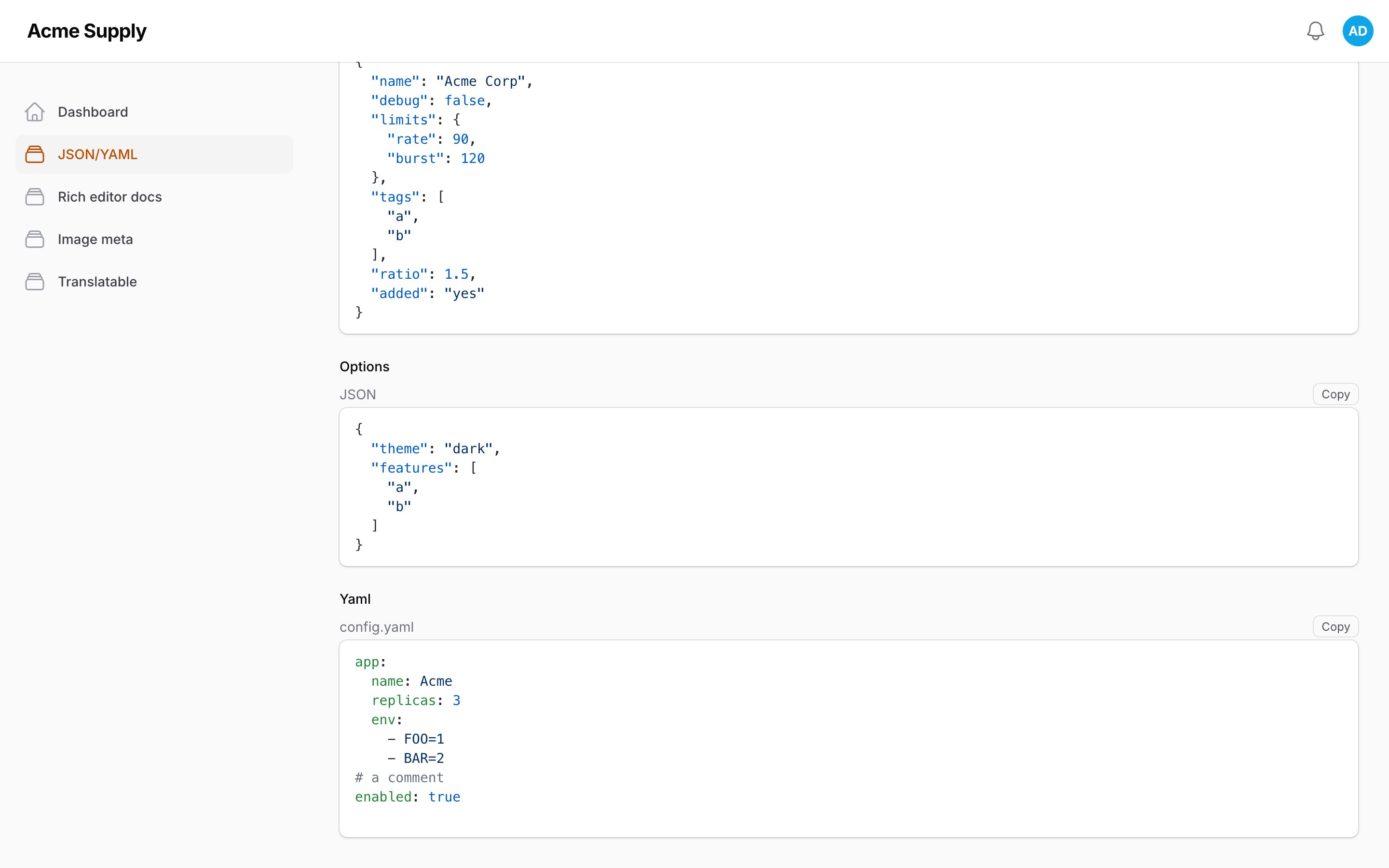
#Requirements
- PHP 8.3+
- Filament 5, Laravel 12 or 13
symfony/yamlandphiki/phiki(installed with the package)- Optional, for
JsonSchemaRule:opis/json-schema(preferred) orjustinrainbow/json-schema
#Installation
composer require asignua/filament-json-yaml-editor
php artisan filament:assets
Nothing to register on the panel. The editor bundle (CodeMirror 6, js-yaml, the tree view; about 475 kB minified,
160 kB gzipped, against ~985 kB for Filament's own code editor that bundles 13 languages) is an Alpine component loaded
on request: a page without an editor never downloads it. A 5 kB stylesheet is registered with Filament's assets.
#Usage
use Asignua\FilamentJsonYamlEditor\Enums\EditorMode;
use Asignua\FilamentJsonYamlEditor\Forms\JsonEditor;
use Asignua\FilamentJsonYamlEditor\Forms\YamlEditor;

JsonEditor::make('settings')
    ->asArray()                                   // the model gets an array (for `array` / `json` casts)
    ->modes([EditorMode::Code, EditorMode::Tree]) // default; one mode hides the switch
    ->defaultMode(EditorMode::Tree)
    ->format()                                    // the "Format" button (on by default)
    ->indent(4)                                   // Format / tree / array display
    ->height('28rem')                             // or ->height(400) for pixels
    ->schema($jsonSchema);                        // server-side JSON Schema

YamlEditor::make('config')
    ->asArray()     // parse to an array on save; array from the model is dumped for display
    ->inline(4)     // Yaml::dump(): the level where it switches to {a: 1} flow style (default 10)
    ->indent(2)
    ->schema($jsonSchema); // the parsed document is checked against a JSON Schema
State is text by default: what the user typed is what the model gets, comments and formatting included.
->asArray() hands the model a decoded array instead. An array (a Collection, an ArrayObject, an object) coming from
the model is always shown as text. Blank text is stored as null.
Without an explicit ->asArray() the field follows the model's cast: a column cast to array, json, object,
collection, AsArrayObject or AsCollection (and their encrypted variants) gets an array, because handing such a cast
the text would store a JSON string literal instead of an object. ->asArray(false) forces text (for a column without
such a cast, or one whose cast takes text). Outside a model (a
custom page, a nested ->statePath()) nothing is detected: pass ->asArray() yourself.
With ->asArray() an empty JSON object {} stays an object in both fields: it is stored as {} (an empty YAML map
a: {} too, while a: [] is stored as []), and when the form is reopened the text is built from the stored column,
not from the cast's arrays (which would turn it into []). This holds for the plain JSON casts; an encrypted cast
stores ciphertext, so its {} is shown (and saved back) as []. A non-empty object whose keys are 0..n
({"0": "x", "1": "y"}, or YAML 0: x) is a list to PHP and is stored as ["x", "y"]. YAML timestamps
stay strings (released: 2024-01-01 is stored as "2024-01-01", at: 2024-01-01T00:00:00Z as
"2024-01-01T00:00:00+00:00"), not unix integers.
Integers beyond PHP_INT_MAX change type with ->asArray(). PHP cannot hold them as numbers, so
{"id": 12345678901234567890} is stored as {"id": "12345678901234567890"}: the digits are kept, but from then on the
value is a string — the editor shows it quoted and a ->schema() with type: integer rejects it. If they must stay
numbers, keep the column as text: remove the array / json cast from the model attribute and leave ->asArray() off, so
the text is stored as typed. Do not combine ->asArray(false) with a column that keeps its array cast: the cast would
encode the text again and store a JSON string literal. Translatable attributes
(spatie/laravel-translatable) are never switched to an array automatically.
Both fields are ordinary Filament fields: ->required(), ->disabled() (read-only editor), ->live(), ->columnSpanFull(), ...
work as usual.
#Validation
The syntax rule is added automatically (->validateSyntax(false) turns it off; the in-browser lint stays). With
->asArray() the rule stays regardless: text that does not parse would otherwise be saved as null over the stored value. The rules are
also usable on their own:
use Asignua\FilamentJsonYamlEditor\Rules\JsonRule;
use Asignua\FilamentJsonYamlEditor\Rules\JsonSchemaRule;
use Asignua\FilamentJsonYamlEditor\Rules\YamlRule;

$request->validate([
    'a' => ['nullable', JsonRule::make()->containerOnly()], // object or array only
    'b' => ['nullable', new YamlRule],
    'c' => ['nullable', JsonSchemaRule::make($schema)],       // array, JSON string or decoded object
    'd' => ['nullable', JsonSchemaRule::make($schema)->yaml()->maxErrors(3)],
]);
JsonSchemaRule needs opis/json-schema or justinrainbow/json-schema; with neither installed it throws a
LogicException instead of silently passing. Syntax errors are JsonRule / YamlRule's job: the schema rule skips
text it cannot parse. Client-side schema validation is deliberately not bundled (an engine would double the bundle).
With justinrainbow/json-schema only $refs to the bundled draft meta-schemas resolve; remote and file:// references
are refused (reported as a validation error) so that a schema coming from data cannot make the server fetch URLs or read
files. opis/json-schema does not fetch unregistered URIs either.
#Infolist entries
use Asignua\FilamentJsonYamlEditor\Infolists\JsonEntry;
use Asignua\FilamentJsonYamlEditor\Infolists\YamlEntry;

JsonEntry::make('settings')->collapsed()->maxHeight('16rem');
YamlEntry::make('config')->inline(4)->summary('config.yaml')->collapsible(false);
The state may be an array, an object, a Collection or text. Highlighting is done on the server with Phiki exactly like
Filament's CodeEntry (light and dark themes, ->lightTheme() / ->darkTheme() / ->grammar() work), the block is a
native <details> element, and the copy button copies the text. ->copyable(false) removes it.
#Configuration
There is no config file. Everything is a fluent option on the field or entry; see the method list above and the translations section for the labels.
#Gotchas
- Tree view re-serialises on edit. Editing a value, a key or a type in the tree rewrites the document with
JSON.stringify: integer-like keys ("1","2") are re-ordered by JavaScript, and numbers beyond 2^53 lose precision. Expanding and collapsing nodes is not an edit and leaves the text alone; so does the code view. - YAML aliases are bounded. A document whose aliases expand past a budget (1M nodes plus 10 per byte of source) fails the syntax rule, so a "billion laughs" document cannot exhaust memory on save, schema validation or display.
- YAML comments. They survive while the state stays text.
->asArray()parses to an array, so comments are gone. - YAML is parsed with no object flags.
symfony/yamlnever instantiates PHP objects from!php/objecttags here. - JSON tree is JSON only.
YamlEditorhas no tree view. wire:ignore. The editor owns its DOM; a state change from the server ($set,fill) is pushed into it. An array set that way is shown as text (JSON pretty-printed, YAML dumped byjs-yaml).- Run
php artisan filament:assetsafter install and after every update; the bundle is served frompublic/js/asignua/.
#Translations
English, Ukrainian, German, Spanish, French, Italian, Dutch, Polish, Brazilian Portuguese and Turkish, namespace
json-yaml-editor::messages. Publish to override:
php artisan vendor:publish --tag=filament-json-yaml-editor-translations
#AI agents
The package ships Laravel Boost guidelines in resources/boost/guidelines/core.blade.php.
#Testing
composer test            # PHPUnit (Orchestra Testbench + workbench panel)
composer analyse         # PHPStan level 8
composer format          # Pint
npm ci && npm test       # node: pure JS logic, the tree view and a smoke test of the Alpine component (jsdom)
npm run build            # rebuild resources/dist/json-yaml-editor.js with esbuild (commit the result; CI fails when it differs)
#Changelog
See CHANGELOG.
#License
MIT. See LICENSE.
The author
asign is a small web-dev company from Lviv, Ukraine. We build business applications on Laravel and Filament — CRMs, automation systems for standard and non-standard business processes, booking and content management systems, including our own Filament-based CMS. We open-source the parts that prove useful beyond a single project
From the same author
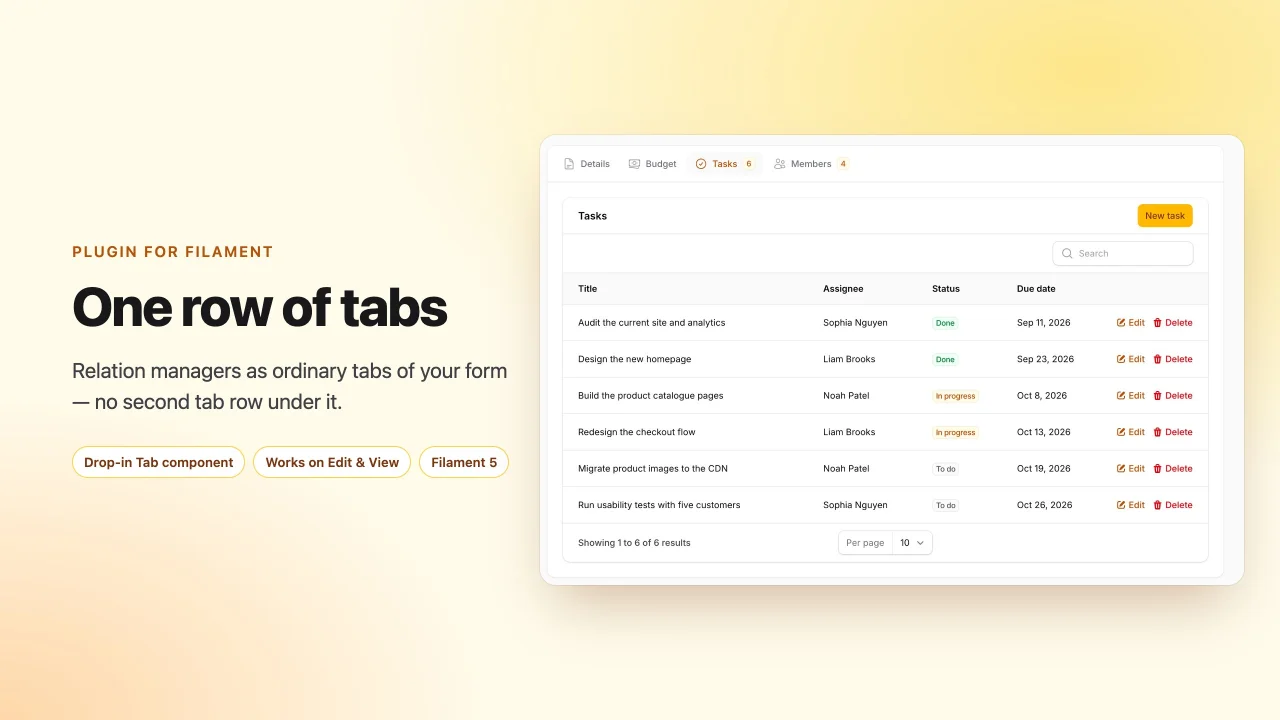
Relation Manager Tabs
Render relation managers as ordinary tabs of the record form, so an edit or view page has exactly one row of tabs.
Author:
asign
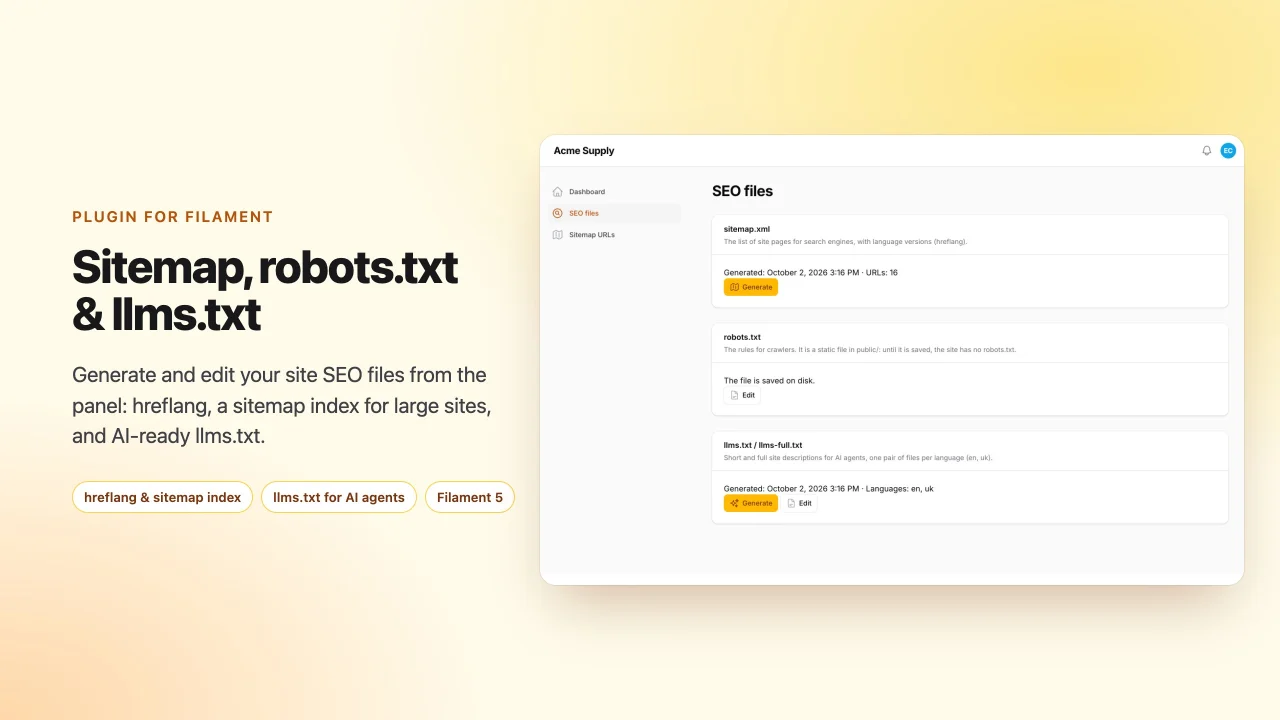
SEO Files
Generate and edit sitemap.xml with hreflang and a sitemap index for large sites, robots.txt and llms.txt / llms-full.txt from your Filament panel
Author:
asign
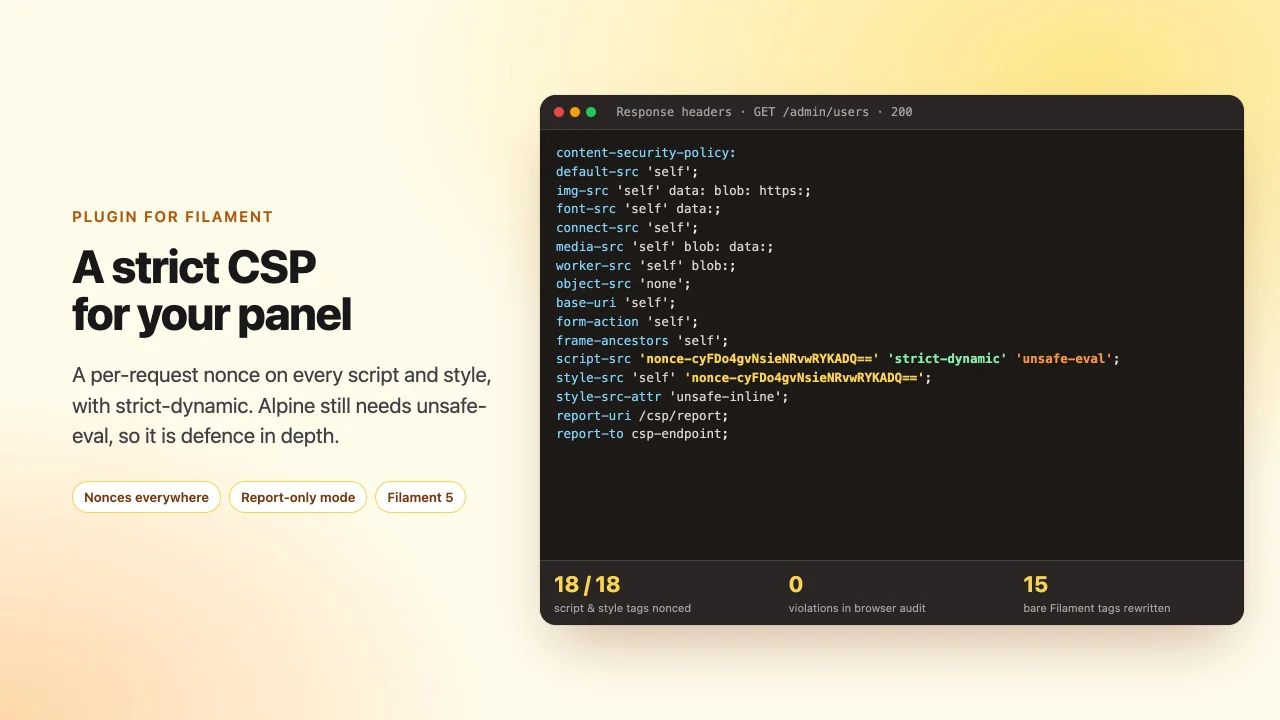
CSP Nonce
Per-request CSP nonce, a Content-Security-Policy header and violation reports for Filament panels.
Author:
asign
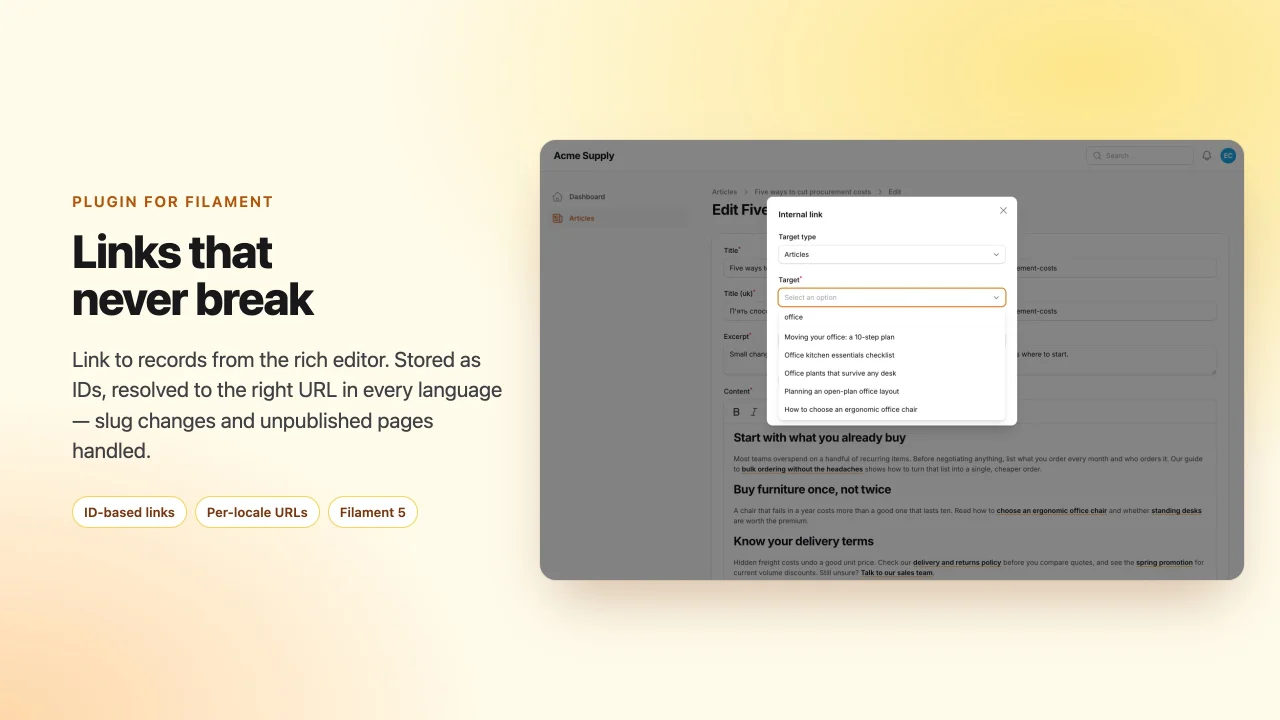
Rich Links
Internal links for the RichEditor: pick a record, store its ID instead of a URL, and resolve it to the current address in every language — slug changes and unpublished pages handled.
Author:
asign
Featured Plugins
A selection of plugins curated by the Filament team
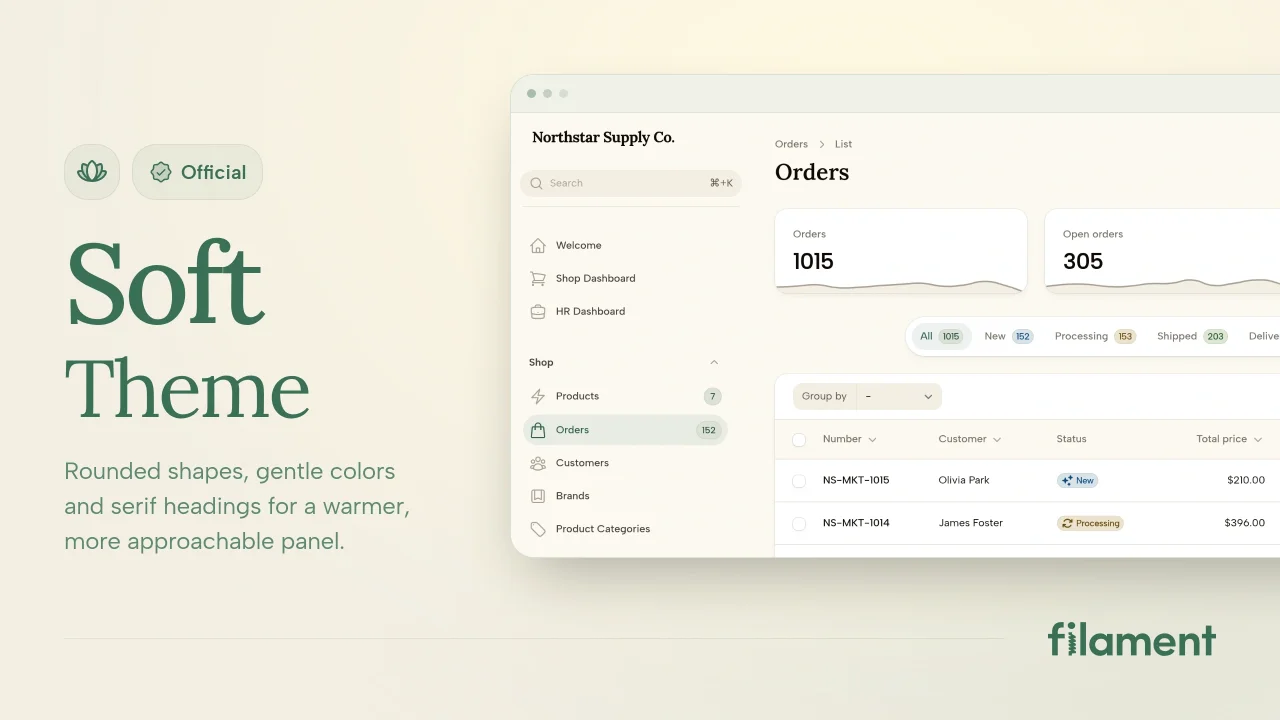
Soft Theme
A theme that gives panels a warm, approachable look with rounded shapes, gentle colors, and serif headings.
 Filament
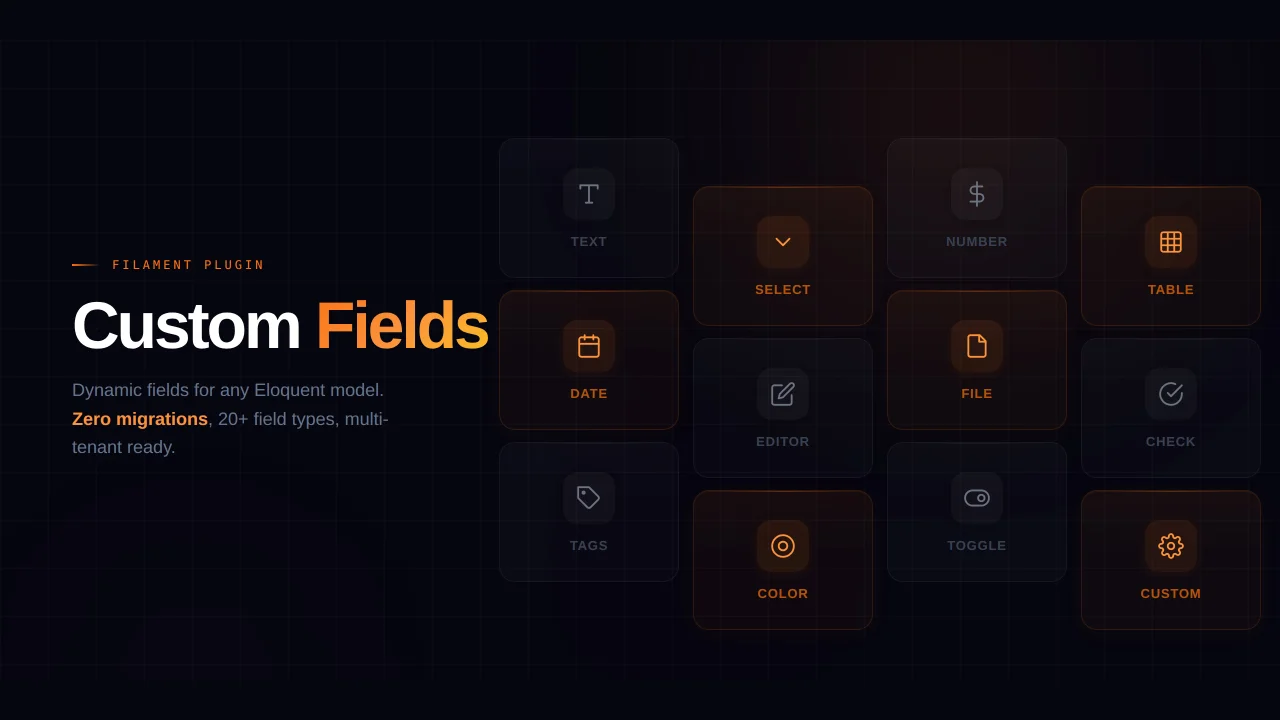
Custom Fields
Eliminate custom field migrations forever. Let your users create and manage form fields directly in Filament admin panels with 20+ built-in field types, validation, and zero database changes.
 Relaticle
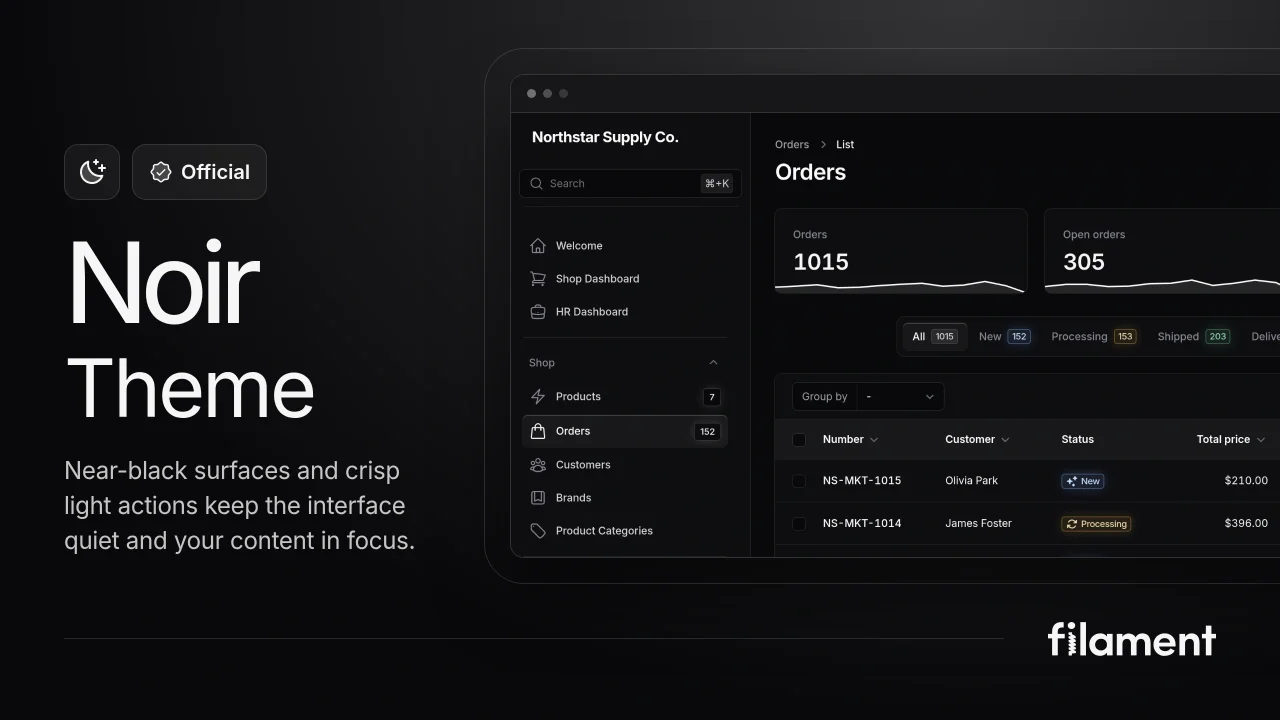
Noir Theme
A theme that gives panels a focused, refined look with near-black surfaces, crisp actions, and restrained color.
Filament