Auto Transliterate by Abdullah Shahneel
CommunityInline, as-you-type multi-script transliteration and translation for Filament form inputs. Type Latin script (Arabizi, Roman Urdu, Hinglish, …), press Space, and get Arabic, Urdu, Hindi, Persian, Cyrillic, or Greek script inline without leaving the field.
 Author:
Abdullah Shahneel
Package health
Automated checks of this plugin's Composer package
15 checks
- Passed: GitHub Actions pinned to SHA
- Skipped: GitLab CI includes pinned to SHA
- Passed: Open security advisories
- Passed: Dependabot PR responsiveness — No stale Dependabot PRs.
- Skipped: Renovate MR responsiveness
- Passed: Dependabot or Renovate configured
- Passed: Dependency update cooldown configured
- Passed: Provides a security policy
- Passed: Abandoned or archived — No consulted source marks the package abandoned (packagist, github).
- Passed: Commit and release recency — Active: last commit 0 days ago; last release 0 days ago.
-
Passed:
composer.lock not committed by library
—
composer.lockis absent from the released dist archive. - Passed: Dist archive is lean
-
Passed:
Current Laravel version supported
—
Package dependencies resolve together with current Laravel
13.0. -
Passed:
Current PHP version supported
—
Constraint
^8.2supports current PHP8.5. - Skipped: Current Symfony version supported
filament/
namespace. Review the source and install at your own risk. Found
malware or an unresolved security issue the author won't
address?
Report it
.
Documentation
- Why this exists
- How it differs from "translation" plugins
- Requirements
- Installation
- Usage
- Configuration
- HTTP API
- JavaScript API
- Security and privacy
- Upgrading to 0.3
- Troubleshooting
- Development
- Roadmap
- License



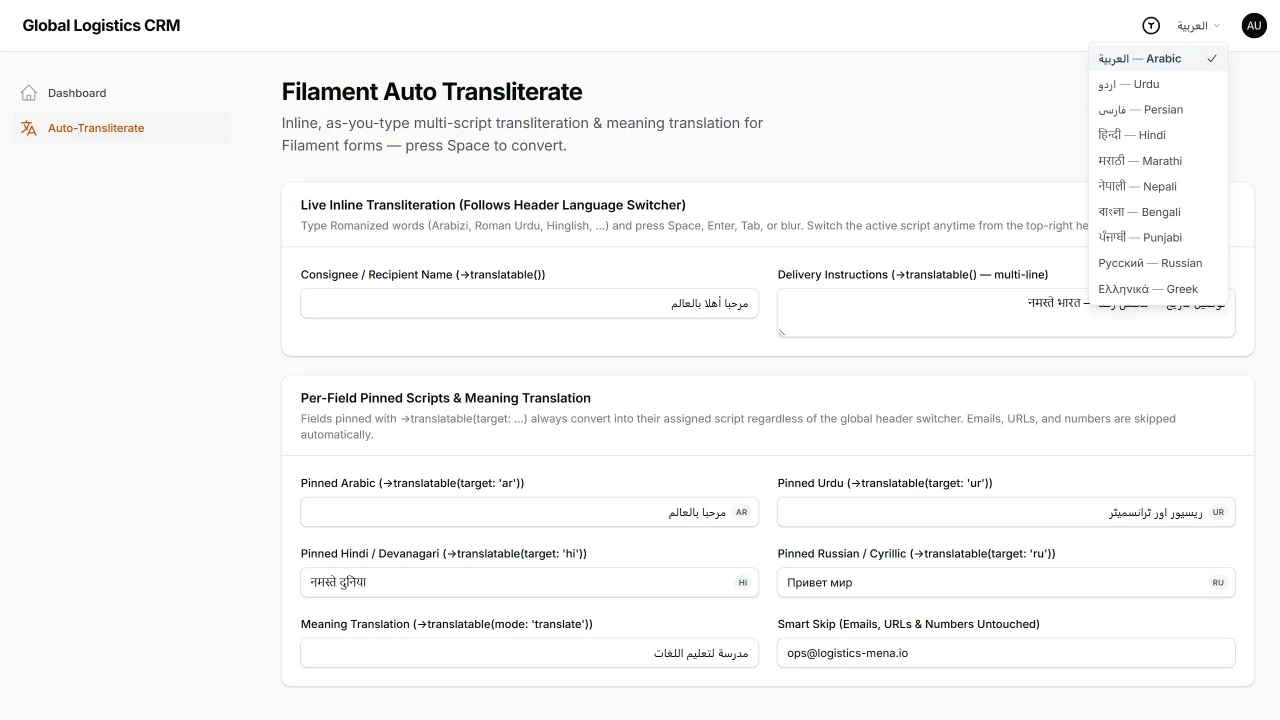
Inline, as-you-type transliteration and translation for Filament form inputs.
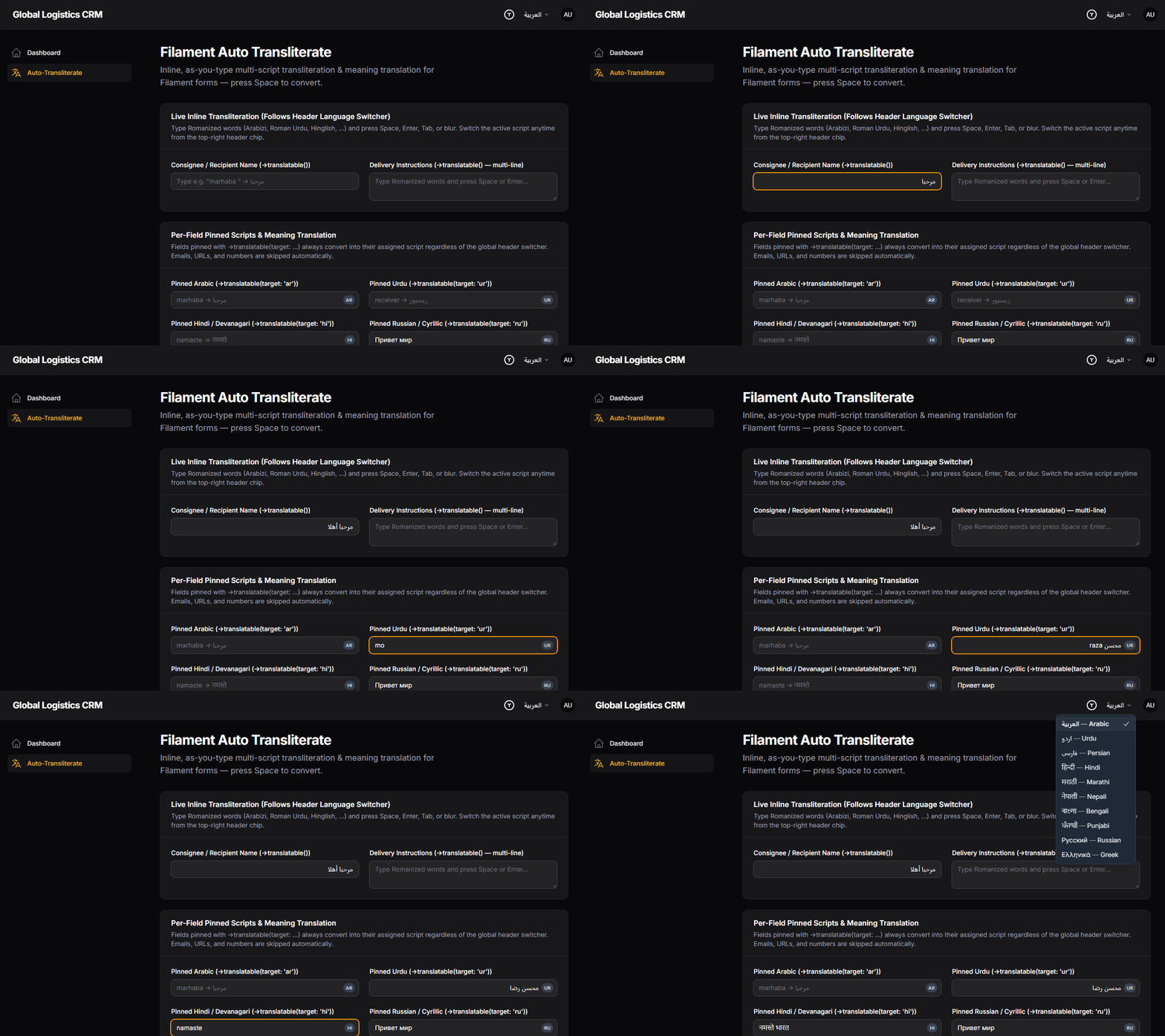
Type Romanized text (Arabizi, Roman Urdu, Hinglish, …), press space, and the word is rewritten in the target script — without leaving the field, opening a modal, or switching OS keyboards. Built for multilingual data-entry teams who think in Arabic, Urdu, Hindi, Persian, or other non-Latin scripts but type on a standard QWERTY keyboard. 10 target languages ship out of the box (ar by default), switchable from the panel header.
marhaba   ->  مرحبا         (transliterate: Arabic — default)
receiver  ->  ریسیور        (transliterate: Roman Urdu -> Urdu script)
namaste   ->  नमस्ते         (transliterate: Hinglish -> Hindi Devanagari)
receiver  ->  المستلم       (translate: by meaning — opt-in)
#Why this exists
The existing Filament translation plugins are action-based (click a button, fill a per-locale modal) or automate static labels. None of them convert what the user is typing, as they type it. This package fills that gap: it is a keyboard-style input helper, not a content-translation workflow.
#How it differs from "translation" plugins
It ships two distinct modes and keeps them strictly separate:
| Mode | What it does | On a miss |
|---|---|---|
transliterate (default) |
Writes the same sounds in the target script (Arabizi/Roman to Arabic/Urdu/…) | Leaves your text unchanged |
translate (opt-in) |
Converts by meaning (English to Arabic/Urdu/Hindi/…) | Leaves your text unchanged |
Transliterate mode never silently falls through to meaning-based translation. That separation is the whole point: a phonetic helper that quietly "translates" a word it didn't recognise is worse than one that leaves it alone.
#Requirements
| Dependency | Version |
|---|---|
| PHP | 8.2+ (CI: 8.2, 8.3, 8.4) |
| Laravel | 11.x, 12.x (CI-tested) |
| Filament | 3.2+, 4.x, or 5.x (CI-tested) |
#Installation
composer require iabduul7/filament-auto-transliterate

# Publishes the config + migrations and offers to run migrations.
php artisan filament-auto-transliterate:install

php artisan filament:assets
The migrations ship as publishable stubs, so use the install command above
(php artisan migrate alone won't create the cache table until the migrations are
published). To publish manually instead:
php artisan vendor:publish --tag="filament-auto-transliterate-migrations"
php artisan migrate
Add the plugin to a panel:
use Iabduul7\FilamentAutoTransliterate\FilamentAutoTransliteratePlugin;

public function panel(Panel $panel): Panel
{
    return $panel
        ->plugin(FilamentAutoTransliteratePlugin::make());
}
That registers the header on/off toggle (next to global search) and injects the assets. Nothing else to wire up.
#Plugin options
FilamentAutoTransliteratePlugin::make()
    ->showToggle(false)                               // hide the header on/off toggle
    ->languageSwitcher(false)                         // hide the language chip/dropdown
    ->injectCsrfMeta(false)                           // your layout already has <meta name="csrf-token">
    ->toggleRenderHook(PanelsRenderHook::TOPBAR_END)  // move the toggle
    ->scriptNonce(fn () => Vite::cspNonce());         // CSP nonce for the inline config script
| Option | Default | Purpose |
|---|---|---|
showToggle(bool) |
true |
Render the header on/off toggle. |
languageSwitcher(bool) |
true |
Show the language chip when more than one language is configured. |
injectCsrfMeta(bool) |
true |
Inject <meta name="csrf-token">. The overlay also falls back to the XSRF-TOKEN cookie. |
toggleRenderHook(string) |
PanelsRenderHook::GLOBAL_SEARCH_BEFORE |
Render hook for the toggle + chip. Move it for custom topbars, sidebar-only or simple-layout panels. |
scriptNonce(Closure|string|null) |
Vite::cspNonce() |
Nonce for the inline window.fatConfig script under a strict CSP. |
FilamentAutoTransliteratePlugin::authorizeUsing(?Closure) |
null |
Static host gate for every endpoint. Receives the Request; a falsy return yields a 403. Call it from a service provider's boot(). |
use Illuminate\Http\Request;

FilamentAutoTransliteratePlugin::authorizeUsing(
    fn (Request $request) => $request->user()?->can('use-transliteration')
);
#Usage
Mark any text field, textarea, etc. as translatable:
use Filament\Forms\Components\TextInput;

TextInput::make('receiver_name')
    ->translatable();                 // uses the default mode

TextInput::make('description')
    ->translatable(mode: 'translate'); // convert by meaning instead

TextInput::make('name_hi')
    ->translatable(target: 'hi');      // pinned to Hindi, ignores the header switcher
->autoTransliterate() is an identical alias, for hosts that already define their own translatable macro. Both throw a LogicException on components that aren't inputs (no extraInputAttributes()).
Turn the feature on with the header toggle. Focus a marked field, type a Roman word, press space — done. State persists per browser.
When a word is converted:
- Triggers: space, Enter in a textarea, Tab, and blur. Pasted text is left untouched.
- Skipped: emails, URLs, numbers, and text already in the target script.
- Safe to type with: IME/composition-aware, works with mobile keyboards, and native undo (Ctrl/Cmd+Z) still reverts a conversion.
#Switching languages
When more than one language is configured, a language chip appears next to the header toggle showing the active language's native name (e.g. العربية). Click it to switch (it is keyboard-accessible); the choice persists per browser. Fields pinned with ->translatable(target: ...) show a badge and always use their pinned language. Hide the chip with ->languageSwitcher(false) on the plugin.
10 languages ship enabled by default — Arabic, Urdu, Persian, Hindi, Marathi, Nepali, Bengali, Punjabi, Russian, and Greek. Trim or extend the list via the languages config key (each entry carries its label, native name, RTL flag, and Unicode script ranges used to detect already-converted text) — any other language Google Input Tools supports (Gujarati, Tamil, Telugu, Kannada, Malayalam, Sinhala, Amharic, Hebrew, …) is one config entry away.
#It learns from corrections
When a user fixes a word the package applied (e.g. it wrote مکن and they correct it to مکان), the correction is stored — authenticated, validated, and stamped with the correcting user's id — as a high-confidence cache entry that wins over provider output on every future request. The more the package is used, the better and faster it gets, at zero API cost. Disable with 'learn' => ['enabled' => false].
#Configuration
Publish the config to customise providers, modes, language, route, and limits:
php artisan vendor:publish --tag="filament-auto-transliterate-config"
#Configuration reference
Every key in config/filament-auto-transliterate.php:
| Key | Default | Env | Purpose |
|---|---|---|---|
enabled |
true |
FILAMENT_AUTO_TRANSLITERATE_ENABLED |
Master switch; when false ->translatable() is a no-op. |
mode |
transliterate |
FILAMENT_AUTO_TRANSLITERATE_MODE |
Global default mode (transliterate or translate). |
source_language |
en |
FILAMENT_AUTO_TRANSLITERATE_SOURCE |
Source language passed to providers. |
target_language |
ar |
FILAMENT_AUTO_TRANSLITERATE_TARGET |
Default target; users switch via the header chip, fields can pin their own. |
target_script_pattern |
null |
- | Global regex override for "already in target script" detection; null uses the per-language pattern. |
languages |
10 languages | - | Language registry: label, native name, RTL flag, Unicode script_ranges, optional itc override. |
route.prefix |
filament-auto-transliterate |
FILAMENT_AUTO_TRANSLITERATE_PREFIX |
URL prefix for the endpoints. |
route.guard |
null |
FILAMENT_AUTO_TRANSLITERATE_GUARD |
Auth guard; builds ['web', 'auth:<guard>']. null = default guard. |
route.middleware |
null |
- | null builds the default stack. An explicit array is used verbatim and guard is then ignored. |
route.throttle |
60,1 |
FILAMENT_AUTO_TRANSLITERATE_THROTTLE |
Per-user (fallback: IP) limit as max,minutes; empty = no limit. |
allowed_modes |
['transliterate', 'translate'] |
- | Modes the endpoints accept; anything else is a 422. Use ['transliterate'] to protect paid provider quota. |
ops_endpoints.enabled |
false |
FILAMENT_AUTO_TRANSLITERATE_OPS_ENABLED |
Enable /stats and /provider-status (404 otherwise). |
ops_endpoints.probe_providers |
false |
FILAMENT_AUTO_TRANSLITERATE_OPS_PROBE |
Let /provider-status make live calls to every provider (can hit paid APIs). |
api_timeout |
5 |
FILAMENT_AUTO_TRANSLITERATE_TIMEOUT |
Seconds per provider HTTP request (connect timeout is a fixed 3s). |
cache_enabled |
true |
- | Permanently cache successful conversions in the database. |
table_name |
translation_cache |
- | Cache table name; override before migrating if it clashes. |
cache_ttl_days |
null |
FILAMENT_AUTO_TRANSLITERATE_CACHE_TTL_DAYS |
Age after which filament-auto-transliterate:prune deletes provider rows (corrections are never pruned). null = keep forever. |
provider_map |
7 providers | - | Provider key => class. Add your own here. |
providers.transliterate |
['transliterate_dictionary', 'google_input_tools'] |
- | Ordered fallback chain for transliterate mode. |
providers.translate |
['dictionary', 'mymemory', 'libretranslate', 'microsoft', 'google'] |
- | Ordered fallback chain for translate mode. |
mymemory_email |
null |
MYMEMORY_EMAIL |
Raises the MyMemory free quota. |
libretranslate_url |
null |
LIBRETRANSLATE_URL |
LibreTranslate server URL. |
libretranslate_key |
null |
LIBRETRANSLATE_API_KEY |
LibreTranslate API key. |
microsoft_key |
null |
MICROSOFT_TRANSLATOR_KEY |
Azure Translator key. |
microsoft_endpoint |
null |
MICROSOFT_TRANSLATOR_ENDPOINT |
Azure Translator endpoint. |
microsoft_region |
null |
MICROSOFT_TRANSLATOR_REGION |
Azure region (e.g. westeurope), sent only when set; needed for regional / multi-service resources. |
google_api_key |
null |
GOOGLE_TRANSLATE_API_KEY |
Google Cloud Translation key. |
dictionary_path |
null |
FILAMENT_AUTO_TRANSLITERATE_DICTIONARY |
Translate-mode glossary JSON ({target} placeholder supported). |
dictionary_max_words |
3 |
- | Longest phrase (in words) the dictionaries attempt. |
transliterate_dictionary_path |
null |
FILAMENT_AUTO_TRANSLITERATE_TRANSLITERATE_DICTIONARY |
Transliterate-mode romanization JSON, checked before any network provider. |
suggestions_per_word |
4 |
FILAMENT_AUTO_TRANSLITERATE_SUGGESTIONS |
Candidates requested from Google Input Tools; the extras are returned as alternatives. |
provider_failure_threshold |
3 |
FILAMENT_AUTO_TRANSLITERATE_FAILURE_THRESHOLD |
Consecutive provider errors before the circuit breaker opens. |
provider_failure_cooldown |
120 |
FILAMENT_AUTO_TRANSLITERATE_FAILURE_COOLDOWN |
Seconds an open breaker skips the provider. |
min_text_length |
2 |
- | Shorter text is a server-side no-op ("Text too short"). |
max_text_length |
1000 |
- | Maximum text length per item (422 above). |
max_batch_size |
10 |
- | Maximum items per batch request. |
learn.enabled |
true |
FILAMENT_AUTO_TRANSLITERATE_LEARN_ENABLED |
Learn-from-correction loop; /learn 404s when off. |
learn.max_original_length |
200 |
FILAMENT_AUTO_TRANSLITERATE_LEARN_MAX_ORIGINAL |
Longest original a correction may carry. |
learn.throttle |
20,1 |
FILAMENT_AUTO_TRANSLITERATE_LEARN_THROTTLE |
Stricter extra limit for /learn (max,minutes; empty = off). |
learn.min_script_ratio |
1.0 |
- | Share of the correction's letters that must be in the target script. |
fallback_transliteration |
false |
FILAMENT_AUTO_TRANSLITERATE_FALLBACK |
Crude char-by-char fallback when every provider misses. Transliterate mode only, never cached. |
char_fallback_map |
Keyed ar + ur letter maps |
- | Keyed by language code (['ar' => [...], 'ur' => [...]]) or a flat map (applies to the default target_language only). A target without a map gets no fallback. |
log_requests |
false |
FILAMENT_AUTO_TRANSLITERATE_LOG |
Debug-log activity including typed text. Keep off in production. |
#Providers
Out of the box: Google Input Tools (transliteration), and MyMemory, LibreTranslate, Microsoft, Google plus local JSON dictionaries. Unconfigured providers (missing API keys) are skipped automatically. Every successful conversion is cached permanently in the database, so repeats are instant and free — and user corrections outrank everything. Add your own by implementing Contracts\TranslationProvider, registering it in provider_map, and adding its key to a mode's chain.
Free-service resilience is built in. A provider outcome is either a miss (it worked but has no answer: unknown word, no candidates, quota-warning text) or an error (transport failure, timeout, any non-2xx including 429, malformed payload). Only errors count towards the circuit breaker: a provider that errors provider_failure_threshold times in a row is skipped for provider_failure_cooldown seconds instead of eating a timeout per word. The client de-duplicates concurrent requests, remembers misses for the session, and backs off after 429 / auth / server errors.
#Local dictionaries
Two separate files, one per mode (so a meaning-glossary can never answer a phonetic query):
// translate mode: meanings
'dictionary_path' => resource_path('dictionaries/en-{target}.json'),

// transliterate mode: romanization → script, checked before any network provider
'transliterate_dictionary_path' => resource_path('dictionaries/roman-{target}.json'),
Both are { "source word": "target word" } JSON maps with a {target} placeholder to ship one file per language. A missing file is a miss, not an error. A dictionary only returns a hit when every word of a short phrase is known, so it never partially mangles input.
#Cache maintenance
Provider results can be pruned by age; user corrections never are:
php artisan filament-auto-transliterate:prune --days=90 # or set cache_ttl_days and omit --days
#HTTP API
Five routes under route.prefix (default filament-auto-transliterate), named filament-auto-transliterate.{translate,batch,learn,status,stats}. All are auth-gated (web + auth, or auth:<guard>), optionally gated again by authorizeUsing(), and rate-limited by the named limiter filament-auto-transliterate (route.throttle; /learn also gets filament-auto-transliterate-learn). They are JSON endpoints that use Laravel's CSRF protection.
| Method | Path | Purpose |
|---|---|---|
POST |
/translate |
Convert one text. |
POST |
/batch-translate |
Convert up to max_batch_size texts. |
POST |
/learn |
Store a user correction (404 when learn.enabled is false). |
GET |
/provider-status |
Provider health (404 unless ops_endpoints.enabled). |
GET |
/stats |
Cache statistics (404 unless ops_endpoints.enabled). |
POST /translate — body { "text": "receiver", "target_lang": "ur", "mode": "transliterate" } (target_lang and mode optional; target_lang must be a configured language code, mode must be in allowed_modes).
{ "success": true, "translated": "ریسیور", "source": "google_input_tools", "confidence": 0.9,
  "processing_time": 120.5, "original": null, "message": null, "alternatives": ["رسیور"] }
A no-op or miss is success: false with the original text and a message ("No translation needed", "Text too short", "No translation available"); the field is simply left unchanged.
POST /batch-translate — body { "texts": ["a", "b"], "target_lang": "ur", "mode": "transliterate" }.
{ "success": true, "results": { "0": { "...": "per-item result as above" } }, "total": 2, "successful": 1 }
Top-level success is true when at least one item succeeded.
POST /learn — body { "original": "makan", "corrected": "مکان", "target_lang": "ur", "mode": "transliterate" }. original must not already be in the target script (max learn.max_original_length), corrected must differ and be in the target script (learn.min_script_ratio). Returns { "success": true, "target_lang": "ur", "mode": "transliterate" }.
GET /provider-status — one entry per provider_map key:
{ "success": true, "probed": false, "timestamp": "...",
  "providers": { "mymemory": { "configured": true, "circuit_open": false } } }
With ops_endpoints.probe_providers on, each entry also has ok (bool) and error (null or "unavailable") from a live test call, and probed is true. Provider/exception text is never returned.
Errors
| Status | Meaning |
|---|---|
| 401 / 403 | Not authenticated, or authorizeUsing() returned falsy. |
| 404 | Disabled route (learn.enabled, ops_endpoints.enabled). |
| 419 | Missing/expired CSRF token. |
| 422 | { "success": false, "message": "Invalid input", "errors": {...} } — validation, unknown target_lang, or a mode outside allowed_modes. |
| 429 | Rate limit exceeded (route.throttle / learn.throttle). |
| 500 | { "success": false, "message": "...", "error": "Internal server error" }; the detail is shown only when app.debug is on, and the exception goes to report(). |
#JavaScript API
The overlay is a singleton at window.FilamentAutoTransliterate (re-evaluating the bundle on wire:navigate reuses it).
| Member | Purpose |
|---|---|
.isEnabled |
Whether conversion is currently on. |
.toggleEnabled(bool) |
Turn conversion on/off (same as the header toggle). |
.setTargetLang(code) / .getTargetLang() |
Set/read the active target language. |
.refresh() |
Re-scan the DOM for tagged inputs. |
Storage: localStorage keys fat_enabled ("true"/"false") and fat_target_lang.
window.fatConfig — injected at HEAD_END: { languages, defaultTarget, learnEnabled }.
Events — CustomEvents dispatched on window; the payload is in event.detail:
| Event | Detail |
|---|---|
fat:ready |
{} — instance constructed or refreshed. |
fat:applied |
{ input, original, applied, targetLang, mode } — a conversion was written into a field. |
fat:error |
{ input, status } — request failed; status is the HTTP status, or 0 for network error/timeout. |
fat:toggled |
{ enabled } |
fat:language-changed |
{ code } |
window.addEventListener('fat:applied', (e) => console.log(e.detail.original, '->', e.detail.applied));
Field attributes — set by the macro, read by the overlay:
| Attribute | Value |
|---|---|
data-fat-translatable |
"true" marks the input. |
data-fat-endpoint |
Relative translate route URL (fields without it are skipped). |
data-fat-learn-endpoint |
Relative learn route URL. |
data-fat-target |
Target language code. |
data-fat-mode |
transliterate or translate. |
data-fat-min-length / data-fat-max-length |
Text length bounds (integers). |
data-fat-timeout |
Client request timeout in ms (api_timeout + 3s, default 8000). |
data-fat-pinned |
Language code, present only on fields pinned via ->translatable(target: ...). |
There is intentionally no JSON attribute: Laravel's attribute bag does not HTML-escape values (it turns " into \"), which would truncate it. Inputs tagged by hand with a legacy data-fat-config JSON attribute (and no data-fat-endpoint) are still read.
Client error handling: 401/403/419 shows "Session expired" and pauses requests for 30s; 429 pauses for 15s; 5xx/network errors pause for 5s; 422 is remembered as a miss.
#Security and privacy
- Typed text leaves your server. It is sent to whichever providers you configure (Google, Microsoft, MyMemory, LibreTranslate, …). Use only providers you are comfortable sharing it with, or restrict the chains to the local dictionary providers.
- The endpoints are an auth-gated, throttled proxy to those APIs — keep them authenticated. Restrict
allowed_modesto['transliterate']if you don't want users spending translate-provider quota. - Nothing is logged unless
log_requestsis explicitly on; provider/exception text never reaches API responses. - Provider API keys stay in your server config and are never sent to the browser.
- Cached conversions and corrections live in your own database table.
Report vulnerabilities privately — see SECURITY.md.
#Upgrading to 0.3
-
Publish and run the new migration (adds
user_idand makes the cache lookup index UNIQUE; duplicates are collapsed, keeping corrections; it is a no-op on fresh installs):php artisan vendor:publish --tag="filament-auto-transliterate-migrations" php artisan migrateOnly the
add_user_id_and_unique_index_to_translation_cache_tablestub is new; skip re-publishing the create migration if you already have it. -
/provider-statusresponse shape changed (breaking): each provider is now{ configured, circuit_open }(plusok/errorwhen probing) and the response has a top-levelprobed. Update anything consuming the old shape. -
/statsand/provider-statusare off by default. Setops_endpoints.enabledto bring them back; live probing needsops_endpoints.probe_providers. -
route.middlewarenow defaults tonull(stack built fromroute.guard). A published config with an explicit array keeps working verbatim; to use the newguardoption, setmiddlewaretonull. Throttling now comes from the named limiter /route.throttle. -
allowed_modesis new (default: both modes). Requests with a mode outside it get a 422. -
Run
php artisan filament:assetsso the new JS/CSS is served, and re-publish the config if you want the new keys visible (all have defaults).
#Troubleshooting
| Symptom | Fix |
|---|---|
Table translation_cache doesn't exist |
Run php artisan filament-auto-transliterate:install (or publish the migrations, then migrate). migrate alone won't find the stubs. |
| Old behaviour / missing UI after upgrade | Stale assets: php artisan filament:assets, then hard-refresh. |
| 419 on every request | No CSRF token on the page. Keep injectCsrfMeta(true) (default), or ensure your layout has <meta name="csrf-token">. |
| 401/403, "Session expired" | The panel uses a non-default guard: set route.guard (or route.middleware) to match it. A 403 can also come from your authorizeUsing() callback. |
| Inline config script blocked | Strict CSP: provide a nonce with ->scriptNonce(...) (or Vite::useCspNonce()). |
| Toggle missing in the header | Custom topbar/layout: pick another hook with ->toggleRenderHook(...). |
/stats or /provider-status return 404 |
Enable ops_endpoints.enabled. |
#Development
composer install && npm install

composer test      # Pest (199 tests, in-memory SQLite, all HTTP faked)
composer lint      # Pint, check only
composer format    # Pint, apply fixes
composer analyse   # PHPStan / Larastan, level 5

npm run build      # rebuild resources/dist (committed; CI fails if stale)
The compiled JS/CSS ship in resources/dist. See CONTRIBUTING.md for the branch flow.
#Roadmap
Design documents for shipped and upcoming work live in docs/.
Learn-from-correction— shipped (see above).First-class support for additional target languages and scripts— shipped (10 languages + header switcher).- Client-side preload of the most common learned words (no network round-trip at all).
- Candidate picker UI for Google Input Tools alternatives (the API plumbing already returns them).
- A cache/glossary-management Filament resource.
#License
MIT. See LICENSE.md.
The author
Abdullah Shahneel is a full-stack Laravel and Filament developer who builds production ERP systems, multi-script localization tools, and booking API integrations. He enjoys extracting practical open-source packages that solve real-world workflow and data-entry challenges for the Laravel community.
Featured Plugins
A selection of plugins curated by the Filament team

Blueprint
Filament Blueprint is a premium Laravel Boost extension that helps AI agents produce accurate, detailed implementation plans and security reports for Filament apps.
 Filament
Advanced Tables (formerly Filter Sets)
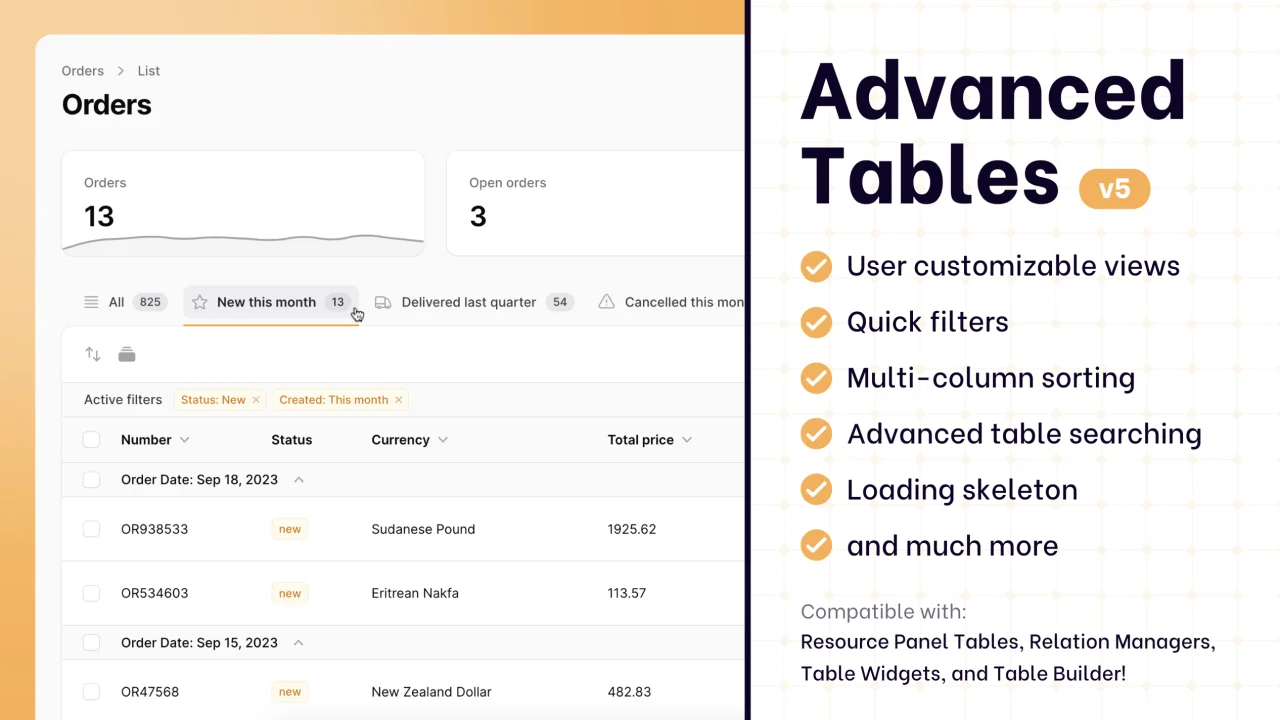
Supercharge your tables with powerful features like user-customizable views, quick filters, multi-column sorting, advanced table searching, convenient view management, and more. Compatible with Resource Panel Tables, Relation Managers, Table Widgets, and Table Builder!
 Kenneth Sese
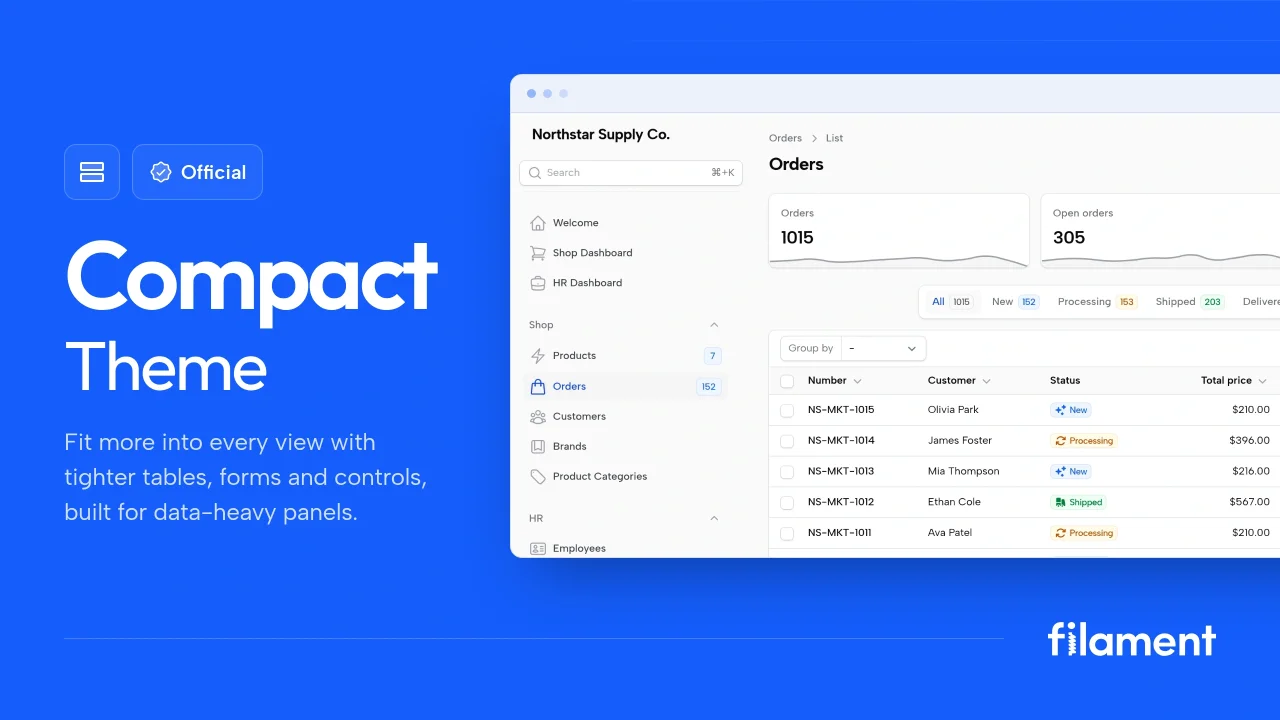
Compact Theme
A theme that makes data-heavy panels easier to scan by fitting more useful information on each screen.
Filament